During the opening of our new exhibit, “Rochester and the Revolution,” someone said he understood that Rochester had once been part of Marion. Some other museumgoers felt that many were unaware as to why the term Tri-Town is used. So, to straighten this out, Old Rochester (official name: Rochester – Town of New England) originally included a section of town known as “Seppacan” (today’s Marion; remember that the name Marion was from a Revolutionary War general), a section known as Mattapoisett, and until 1739, a large section of today’s Wareham. The term Tri-Town refers to the three towns that were Rochester until the mid-1800s.
This means when we talk about veterans of the Revolutionary War, we are including all those buried in cemeteries in Marion and Mattapoisett, because in 1775–1783, all these men were from Rochester and buried in Rochester.
One such veteran was John Pitcher. He was born in Scituate on January 11, 1736. Many of Rochester’s earliest settlers came from towns that had grown up as Plymouth Colony expanded. Scituate was one such town.
Pitcher’s father was Zeruiah Booth Pitcher. We don’t know when John Pitcher arrived in Rochester, but we know he married Elizabeth Sprague, became a surgeon and was the father of five children: three boys (one named Zeruiah) and two girls.
His first muster card is for “Pitcher, John-Rochester – Capt. Nathaniel Hammond’s (2d Rochester) Co.” They marched on April 20, 1775, at the alarm of April 19. The company marched to Marshfield, and the length of his service was four days. His next muster card has him as a “Surgeon, Col. Theophilus Cotton’s Regiment – return of field and staff officers dated camp at Roxbury October 7, 1775.”
He is also on the record as a surgeon in Col. Benjamin Howes’ Regiment, entering service August 5, 1778, and discharged on September 12, 1778. He was in service one month and nine days when his regiment marched to Rhode Island.
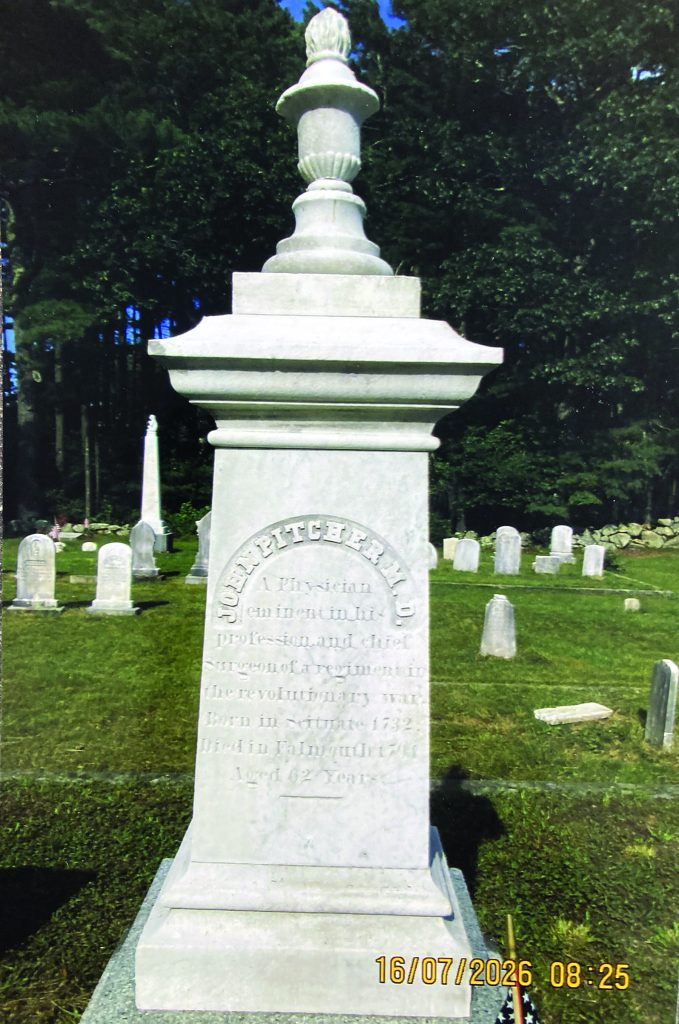
Dr. John Pitcher died in Falmouth on June 12, 1794. He is buried in the Evergreen Cemetery, which is in today’s Marion. He has an impressive tombstone. The inscription reads “A physician eminent in his profession and chief surgeon of a regiment in the Revolutionary War.”
By Connie Eshbach