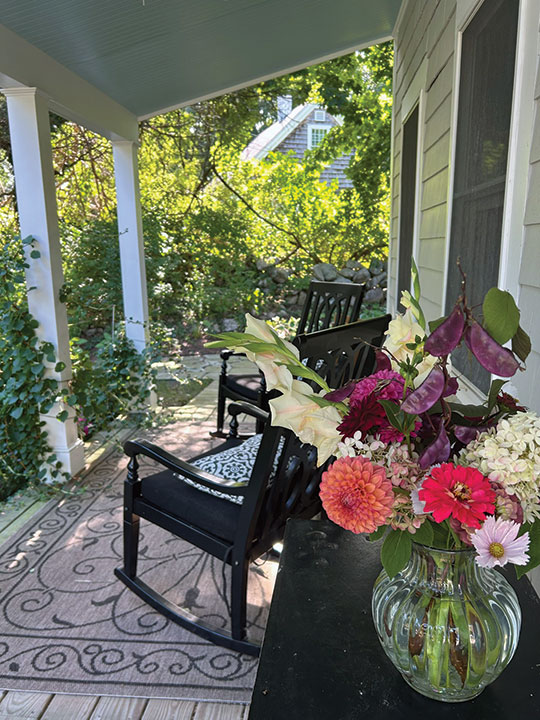
Flowers breed contentment. Spread them around.
Adorn your indoor habitat with cut flowers throughout the growing season. All you need is a handful of blooms, a vase and perhaps a little imagination.
For those who grew up with bouquet-makers, carrying on the tradition comes naturally. Even as a youngster, I remember the powerful impression of my great-grandmother’s simple arrangements — usually a mix of whatever happened to be in bloom — set against a freshly laundered linen tablecloth. I remember, too, my father’s choice roses, cut from the garden and displayed in a crystal bowl for my mother all summer long.
Beauty. Life. Love.
It is not unusual to find flowers in more than one place in our home: on the kitchen counter, gracing a bedside table, or brightening the living room mantel. They lend personality to a room, making it come alive in a subtle way — their heady fragrance and varied textures reaching out into the surrounding space.
I like to bring garden-picked flowers into my classroom as well, lending a cheerful note to the lessons of the day. A few stems can transform an ordinary space, reminding us that beauty need not be elaborate to make itself felt.
“The ephemeral nature of flowers, their acting immediacy, helps us to live in the present,” write Tricia Guild and Elspeth Thompson in Cut Flowers, a pictorial book celebrating the wonders of cut flowers close up. “Look at them now, see them this moment as the light falls on spiraling petals — tomorrow they’ll be different; indeed, tomorrow may be too late.”
Flowers are symbols of spontaneous joy, the authors note, and are often woven into the most significant moments of our lives — weddings, funerals, births and graduations. In literature and film, too, flowers can carry deeper meaning. Lara is associated with yellow daffodils in Doctor Zhivago, a bright light set against the cynicism and upheaval of the Russian Revolution. In Shakespeare’s Hamlet, Ophelia distributes flowers whose meanings reflect the corruption and sorrow of the court around her. Rosemary stands for remembrance, pansies for thoughts, and rue for sorrow and repentance. Violets symbolize faithfulness — and early death.
But I don’t think flowers need much analysis in our daily lives. They brighten a room, enhance the mood and lift the spirits. They are, quite simply, something to be enjoyed.
My friend Pam has an extraordinary eye for flowers. Her arrangements (see photo) are hard to describe because they never seem arranged at all. They have a looseness and exuberance that makes you look twice — an unexpected flower here, a graceful stem there, colors that somehow belong together even when you wouldn’t have thought to put them together yourself. Much of what she uses comes from her own cutting garden, where she plants not just for the garden but for the bouquets she imagines.
Right now, on my kitchen counter, are two stalks of white gladiolus that sprang up in the vegetable garden, as they do every year. They remind me of the homemade bouquets my great-grandmother, Babi, used to create. The choice of flowers is still good, and I never tire of foraging for blooms and bringing them into our home. It is such a simple stroke of joy.
A Few Basics for Homemade Arrangements
-Harvest flowers in the early morning or late in the day and place them immediately in a bucket of water.
-For a simple preservative, use a quart of water mixed with one teaspoon of sugar, one teaspoon of lemon juice and a couple of drops of bleach.
-To prepare flowers and greens, strip away the bottom leaves and recut the stems at a 45-degree angle for better water absorption. Do this while the stems are submerged in a tub of water to keep air from entering the cut. This is preferable to cutting them under running tap water.
-Use warm water, around 70–75 degrees, especially for tropical flowers such as roses.
-Use coolish water and avoid preservatives with bulb flowers such as iris, tulips, delphinium and freesia, which are more delicate and can be damaged by preservatives.
-For woody stems such as hydrangeas, cherry blossoms and lilac, gently smash the ends with a hammer to open them up for better water intake. Recut the stems every few days.
As he was dying, the poet John Keats wrote to a friend: “I muse with the greatest affection on every flower I have known from my infancy — the shapes and colors are as new to me as if I had just created them with a superhuman fancy. It is because they are connected with the most thoughtless and happiest moments of our lives.”
So go ahead. Go out and pick a bunch of flowers now.
It’s a memory in the making.
“When the heart is open, you will change just like a flower slowly opening.” — Van Morrison
The Seaside Gardener
By Laura McLean