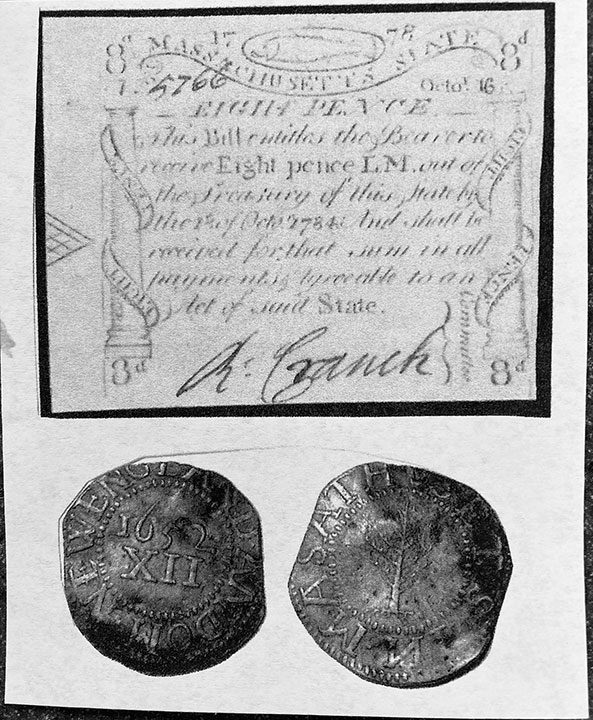
There is something we share today with Rochester residents in the 1600s and 1700s: inflation and its negative impact on everyday life. Money in the American colonies was complicated. There were three main forms of currency in use: “specie,” which were coins, most often Spanish dollars; paper notes printed by a variety of entities; and barter, which, while not an actual form of currency, was frequently used.
In 1652, the Massachusetts Colonial government authorized John Hull to make coinage. His pine tree shilling is shown in the picture. However, this was the exception to the rule, as few coins were minted in the colonies, as Great Britain restricted colonial coinage.
In 1690, the Province of Massachusetts was again creating money. This was the “first authorized paper money by any government in the Western world.” They did so to pay off debt incurred during one of the French and Indians War. Other colonies followed Massachusetts’ lead. The paper money they issued could be used to pay taxes and to pay off other public debt. Soon the Parliament of Great Britain began to pass currency acts in 1751, 1763 and 1764 to regulate colonial paper money. These currencies could only be used in the states that issued them. You couldn’t pay off a debt in New York with Massachusetts bills.
In 1749, Massachusetts Colony’s currency began to be regulated. At this point, there had been two kinds of paper money with different values. However, by 1750, all debts were to be paid in coined silver. This was under a law that made a “shilling a sixth part of a Spanish dollar or 16 and 2/3rds cents,” which meant that the colonial pound (not the English pound) equaled $3,331/3 pounds in silver.
Most hard money (coins) came into New England through trade with the Caribbean or the occasional pirate coming ashore to refit his ship or to buy some grog. When Britain created an embargo on colonial trade and closed the port of Boston, the source of Spanish dollars (pieces of eight) dried up.
Even before the Revolution, money was scarce in New England. In 1720, the provincial government granted 50,000 pounds to be loaned to towns. Rochester’s share was 365 pounds, which was only bestowed through a lottery. Once the war with England began, each colony became an independent state and once again began distributing its own paper money. The newly formed Continental Congress also issued “continental currency.” In addition, English money still circulated, much of which was counterfeit.
At one time in Rochester, a transaction might include “New Emission money,” Old Emission money, hard money, or “Continental Currency.” To illustrate this complicated state of affairs, one Rochester town meeting voted “one hundred dollars as bounty for the soldiers, made an appropriation of 671 pounds in Bills of ye new Emission for army beef and an assessment of 1860 Continental Dollars upon the town to pay the constables.”
Resolutions were constantly being made in reference to the money situation, but all the different paper monies, as well as the war, caused rampant inflation. A phrase began to circulate, “not worth a continental,” to show dislike of this currency. In May 1779, some resolves were passed in an effort “to appreciate the Currency.” Their importance was emphasized by an accompanying “malediction” stating that anyone who violated the resolves “shall be Deemed Infamous and held up as an Enemy to ye Independence, freedom and happiness of his Country by publishing his name in ye newspapers.”
Rochester kept trying through committees and conventions to “stipulate prices of Labour & Sundry articles sold in town.” In 1781 (even after the new State Constitution was passed), town meeting was protesting “duties laid on Rum, wine etcetera.” The money problems had made it hard to raise soldiers to fill the ranks, and after the War ended, soldiers were not getting paid.
On December 30, 1782, the town meeting voted “to petition the Great & General Court to receive in all paper money of both Emissions now in Town’s hands and give the Town credit for the same.” The difficulty of creating a stable currency for the new nation was complicated by the lack of a national treasury and the arguments between the new states and the new government. Rochester continued to send requests and demands to the General Court and the new legislature.
By Connie Eshbach