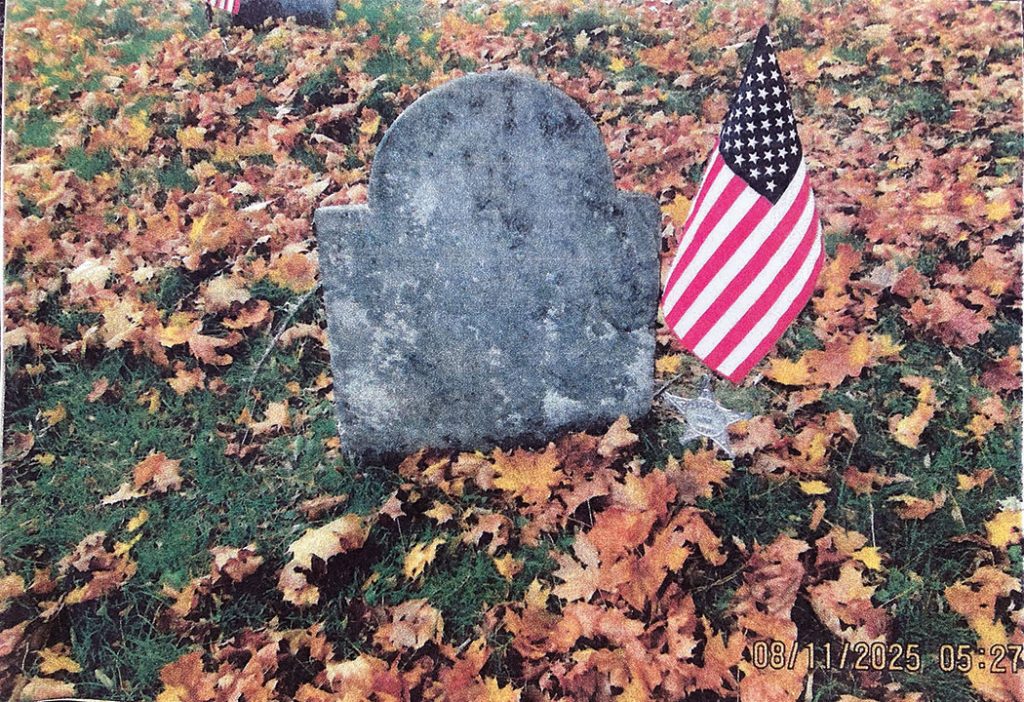
Along with researching and setting up the exhibit, “Rochester and the Revolution,” supported in part by the Rochester Cultural Council, a local agency, supported by the Massachusetts Cultural Council, a state agency, the Historical Society has been working with the Rochester Historical Commission to find the graves of more than 400 Rochester men who served during the Revolutionary War. This effort is supported in part by both the Marion and Mattapoisett Cultural Councils. There is definitely an overlap between these two endeavors, with many of those whose tombstones we have located also included in the exhibit.
One of these is Lieutenant-Colonel Ebenezer White. White had definite Rochester bona fides. The son of John and Mercy White, he was a direct descendant of Samuel White who arrived on the Mayflower, moved to Marshfield and was one of Rochester’s original Proprietors. His father, John White, in 1704, owned lands a mile or so east of Rochester Center.
Ebenezer White was a prosperous man who had fought with the militia in the French and Indian Wars. In 1769, prior to the Revolution, he was elected to be the town’s representative to the General Court. He was re-elected to this post 19 times. For the first 14 years, he was elected unanimously. This was a “difficult Revolutionary period” for the town, and he was entrusted with many important duties.
As the momentum towards war increased, Ebenezer White was put in charge of a militia regiment and was soon given the rank of Lieutenant-Colonel. By 1780, he was in charge of the 4th Plymouth County Regiment. Many Rochester soldiers’ muster cards show them serving in his regiment.
After years of representing Rochester on the General Court, in 1780, Lt.-Col. White became Rochester’s first representative under the new state constitution. After the war ended and peace was declared, Lt.-Col. White’s job became even more important, and he received many directives from the town.
In May of 1785, he was told to use his “Influence that a large Impost be laid on all Goods imported in British Bottoms.” In 1786, he was again instructed to use his influence “that there be a Bank of paper money Emitted by the General Court.”
Later that same year, a committee of three men appointed by the town was given the job of communicating with other towns “in order to Devise & Adopt” legal ways to find a “redress from grievances.” They gave White extensive instructions that covered up to six pages of closely written precepts to bring to the new state government.
Some of these concerned the most important principles of government. They included concerns over the redemption of currency, the right of Congress to set taxes on the state, the Constitutional power of the General Court to “place checks on Congress” and more.
With all these important items given to him to deal with, it is apparent that he was a highly respected citizen of Rochester. One can’t help wondering if he didn’t occasionally think that leading his militia troops had been an easier duty.
Ebenezer White lived to be 80 years old. He died in 1804 and is buried in the Rochester Center Cemetery.
By Connie Eshbach