This article was originally intended for August, but other events got in the way. Now, to protest the Stamp Act in 1765, Boston’s Sons of Liberty hanged effigies of the stamp collectors from the branches of an elm tree they dubbed the Liberty Tree. From that time on, they rallied and held meetings under the tree. A version of the Liberty Tree, the Liberty Pole, became a common site in towns throughout Massachusetts. In the current exhibit at the Museum, a tabletop-sized replica of the 45-foot one stands near the original meetinghouse.
The first Liberty Tree was an American elm. Beginning in colonial times, elm trees were planted along the streets and commons of New England. Their leafy branches were the most common in the colony and later throughout America until the 1930s. Dutch Elm Disease entered the country on European logs. Spreading through the United States, it killed 50% of the country’s elm trees.
The Elm Research Institute, a nonprofit, was established to do the research needed to develop disease-resistant elm trees. They succeeded and created the American Liberty Elm. This is the only American elm that has been street-proven and comes with a lifetime warranty against the disease, with only 1% loss.
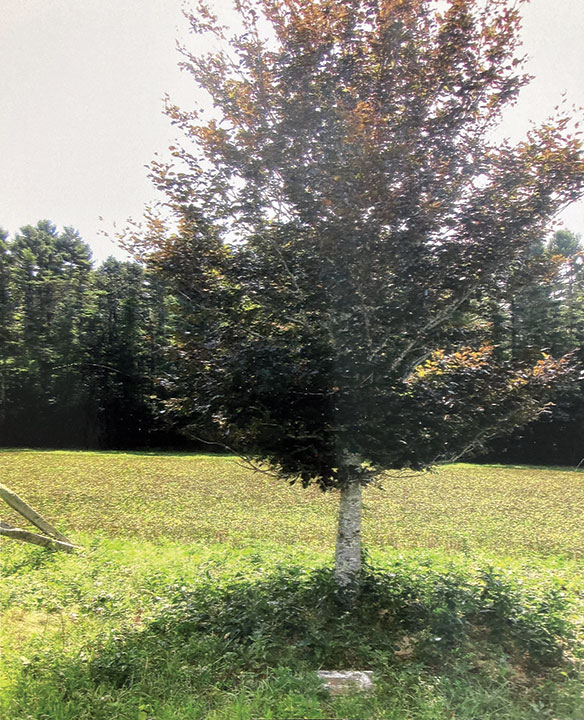
After Boy Scout Ian Burns took on planting American Liberty Elm Tree seeds as his Eagle Scout project, it became a community service project for Scouts everywhere. In May of 2008, an American Liberty Tree (pictured here) was donated to the Joseph H. Plumb Library by the Boy Scouts of Rochester Troop 31 and the Greenways Committee. On August 14, 2008, the tree was dedicated on National Liberty Tree Day.
By Connie Eshbach