President Abraham Lincoln proclaimed that Thanksgiving would be celebrated on the last Thursday in November in 1863. Because Thanksgiving wasn’t celebrated as a national holiday until then, there is of course, nothing much mentioned about the holiday in early memoirs.
In colonial Rochester, the “days of thanksgiving” were spent in church thanking God for things like rain to end a drought or the end of a spreading epidemic. There is no mention of feasting or the gathering together of families as we see later in history. Any feasting which we associate with Plymouth was a feast to celebrate a good harvest and there is no mention of that happening in town.
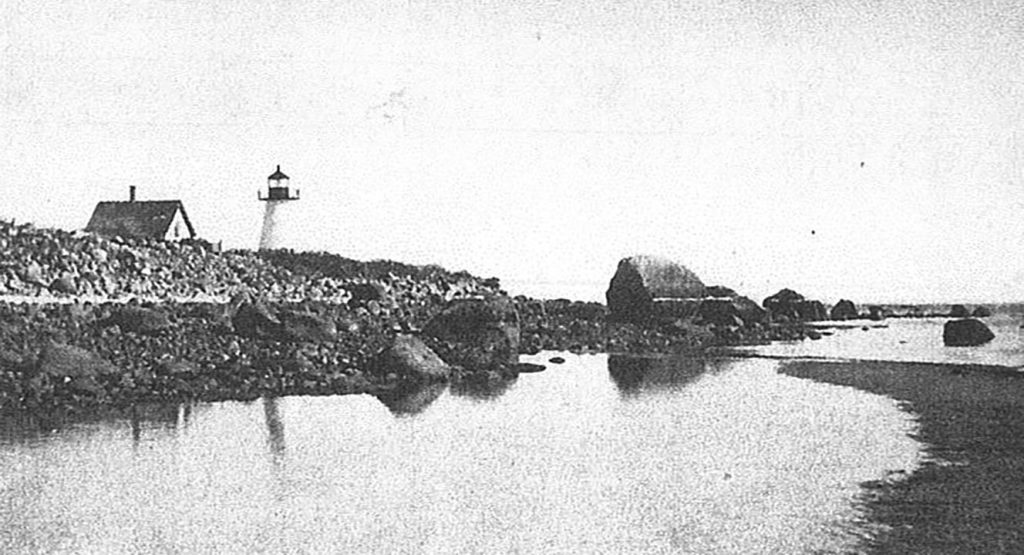
The biggest feast mentioned in “Mattapoisett and Old Rochester”(a history of this area) is in the recounting of a feast written about in Captain Benjamin Church’s book, Entertaining History of King Philip’s War. This feast was held in 1676 between Capt. Church and Awashonks, “the squaw sachem of the Indians of Little Compton.” They met on a shore with a broad view of the bay. With the effects of time on the shoreline, it is hard to pinpoint the exact place, but it’s believed to be near today’s Ned’s Point, as shown in an old picture.
Awashonks invited Capt. Church to a “supper.” Platters of bass, eels, flatfish and shellfish were placed on a table with no bread or salt. The “feast” was followed by ceremonial dances performed by her braves as a way to declare that they would fight on the side of the English in the continuing battles of King Philip’s War. So, I guess feasts can be held for all kinds of reasons. Happy Thanksgiving and enjoy your holiday and feasting.
By Connie Eshbach