The Rochester Historical Society in collaboration with the Rochester Historical Commission are continuing with their project to make as many of our Revolutionary soldiers and sailors more than just names on a list. Any help with this would be greatly appreciated.
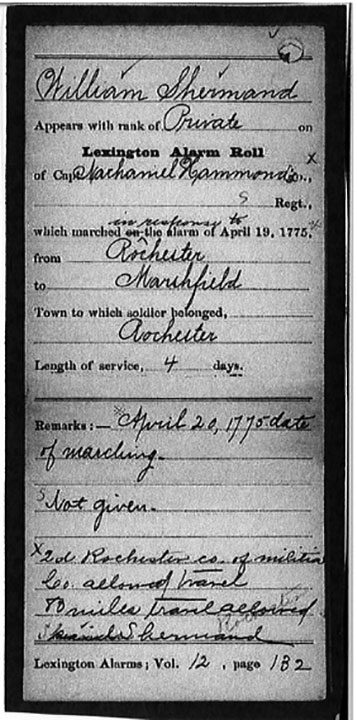
While the muster cards and pension records tell the story of their service in the fight for independence from England, there are additional resources to further flesh out their lives. Shown here is a muster card for William Shermand (sic) which is really that of William Sherman about whom I have previously written.
As regular readers know, I enjoy receiving responses to my articles. I was excited to hear from Cornelia Dougall. William Sherman, born in 1726 and dying in 1800, was her 5th great grand uncle. Through her ancestry searches, she had more information about him outside of his militia duties.
His family (and hers) became Rochester residents in 1715 when John B. Sherman and Sarah Baker Sherman settled in Rochester on 80 acres granted to his father in 1697. Shermans can still be found on Snipatuit Rd. today.
William married Abigail Handy in Sandwich on June 4, 1752. The couple had 14 children. At the time of his service, William was 49 yrs. old. His oldest child was 21 and his youngest was 1 yr. old.
For context it is interesting to note that the average life expectancy of a male in 1775 ranged from around 36 years to 53.5 years. However, a man who reached 60 yrs. was more apt to live into his 70’s. The colonists actually had a longer average life expectancy than the average English working man.
William responded to the Marshfield Alarm on April 19,1775, marching with his militia company under Capt. Nathaniel Hammond on April 20,1775. Marshfield was home to many loyalists (pro England) and after hearing of the colonists’ success at the battles of Concord and Lexington and the retreat of the British forces, they entreated then Commander in Boston, Gen. Thomas Gage, to send troops to protect them.
On hearing of British troops being dispatched to Marshfield, the militias were called out. When the militia companies from across the south coast arrived, they were 2000 strong. The 100 British soldiers who had been sent there quickly departed. The militia men then returned to their homes.
William Sherman’s muster card shows “80 miles of travel allowed” and 4 days of service. This was the only card that I found for him. Maybe the 80 mile walk for a false alarm discouraged him from future service.
If anyone in our area knows that they have an ancestor who was a Revolutionary War soldier or sailor and doesn’t really want to research the military but has already done ancestor research, I would really appreciate it if you would share your findings with me. I can be reached at 617 750 2818 or eshbach2@aol.com. Also, reach out if you are interested in researching the veterans listed in the back of the book, “Mattapoisett and Old Rochester” that you can find at Plumb Library or on the town website under the Historical Commission.
By Connie Eshbach