Rochester’s early settlers led lives that we would find difficult. No running up to Friend’s Market at Plumb Corner to get a forgotten supper item or to Wareham Crossing for a new shirt. Pretty much anything you ate or wore had to be grown by you or a neighbor willing to barter.
One crop grown in Rochester in those early days was flax. The cultivated flax plant, scientifically named “Linum usitatissiman” by Carl Linneaus in his book “Species Plantarum” (no doubt a big seller) in 1753, has been grown and used since the 5th millennium B.C. The word, flax, is used to denote both the plant and its spun fiber. The cultivation of it was introduced to North America by the colonists settling there. Flax likes certain growing areas, one of which is in the soil just above the water line of a cranberry bog.
This plant is quite interesting as well as being essential in the 1800’s. It has a fairly short growing season and is harvested soon after flowering and forming seed capsules. This is usually in early summer. The plant which reaches 3 ft. is pulled completely out of the soil.
The flax plant is full of edible seeds but was grown primarily for its long fibers which after much preparation could be spun into thread (yarn) and then woven into linen cloth, an important colonial commodity. Linen was absorbent, washable and durable, so it was perfect for everything from underclothes to men’s shirts.
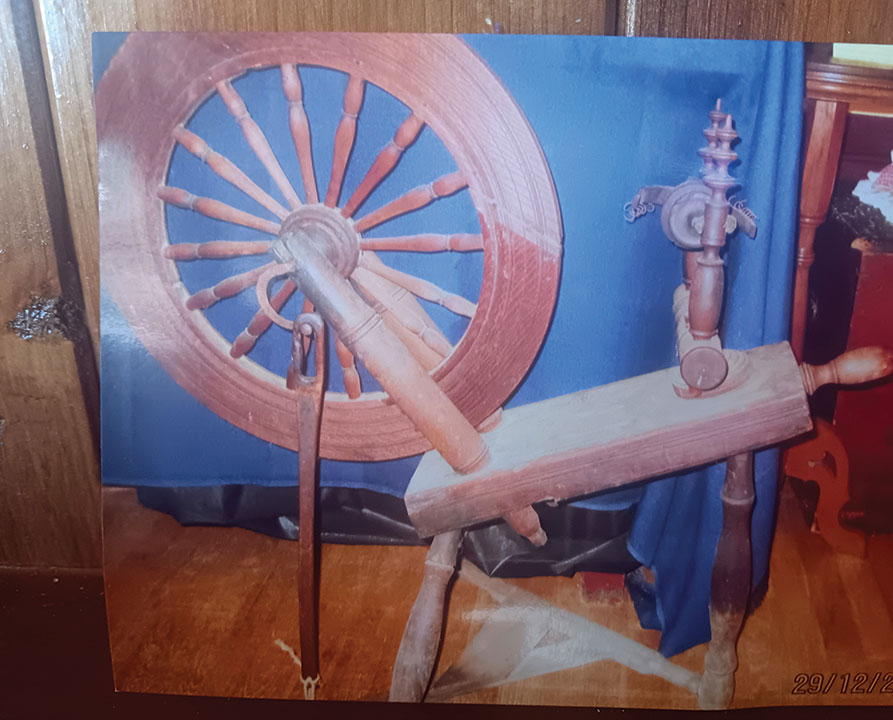
The harvesting is the easiest part of getting flax thread. Once the plant is pulled from the garden there are several steps to get the flax to the flax wheel pictured here with its distaff and recently donated to the museum by Pam and Orrin Robinson.
After drying the plants by laying them out in the sun, they need to be “retted”. Retting is the process of breaking down the pectins that bind the fibers. The most common way to do this was “pond retting”. Placed in a shallow part of a pond the water would basically rot the plant, loosen the unwanted fibers and as a by-product release a “prodigious odor.”
L.C. Humphrey, in his papers, says that in Rochester, the flax would be taken to Mary’s Pond for this process to take place. Its clear bottom made it an ideal location and there are/were old stones on the south side that shows where the flax was placed.
Once softened, it had to be again dried in the sun until it was “bone dry.” The flax was then beaten against a board with a blunt wooden knife. A contraption called a “flax break” was used. Next a “scutching knife” was used to “scutch” or break out the woody stems.
The next tool was a “hetchel”. This tool came in sizes from large to small and looked somewhat like the wool comb in our exhibit. These were used to remove the remaining woody stems and short fibers, gradually refining the fibers. As the combing process continued, discarded fibers were saved to be fire starters or to be made into rope and even socks.
When the fibers were smooth and start to look like hair (source of term, flaxen haired), they were finally ready to be spun into the thread used to weave linen cloth. The distaff on the wheel held the flax and spinners would wet their hand to ensure smooth not fuzzy yarn.
Obviously, it was linen’s durability that made it worth all the work entailed in making it. Colonials had few pieces of clothing and wore them for many years.
By Connie Eshbach