I hope that some of you out there are researching our Rochester Revolutionary War soldiers. With all the cold weather, it’s an excuse to stay in where it’s warm. Remember all the information that you need to get started is on the Rochester Town Website under the Historical Commission.
Following up on names from the list of Revolutionary soldiers and sailors can sometimes be confusing. One sunny fall day, I decided to start my search at the Rochester Center Cemetery where flags placed by Dave Watling pointed me in the right direction. Unfortunately, many of the tombstones are difficult to impossible to read, but I persevered and came up with some that matched listed names.
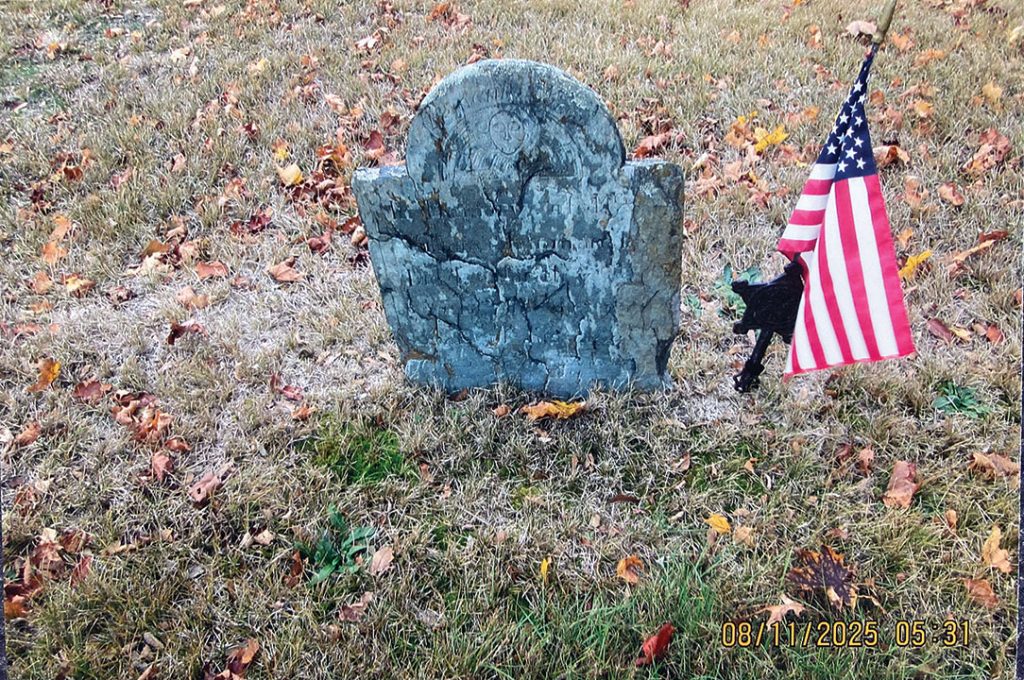
One gravestone that I found and photographed was that of William Sherman. This matched a name on the list of soldiers and sailors, as well as, on a list of those buried in the Center Cemetery. William was born January 11, 1726, and died March 3, 1800, at the age of 74. He was one of the 7 children of Martin and Cynthia Sherman.
However, I hit a snag when I looked him up in the Revolutionary War muster cards. There was no record of him serving. Not to be deterred, I went to the Plumb Library and looked for him in the volumes containing information on who served. There I found not William Sherman but William Shermand. I rechecked the list, but that surname was not there. According to his muster card, he was from Rochester and a Private in the 2nd Rochester Company under Capt. Nathaniel Hammond. He along with his company marched on April 20,1775 in response to the alarm of April 19,1775 (the Battle of Lexington and Concord). They were sent to Marshfield and served 4 days and walked a total of 80 miles. This is the only record of service.
This leaves me with a conundrum. Is this the William Sherman whose tombstone is pictured here or someone else? I’ve searched records for the area and have not found the surname “Shermand”.
One possible explanation is that the “D” might be his middle initial and was added to the name. Remember that spelling was erratic at the time and handwriting sometimes difficult to read. The name on the muster card seems to have an added “d”, but no clue as to who wrote it.
I’m going with the muster card belonging to William Sherman (my spellcheck is adamant that Sherman doesn’t end with a “d”. Certainly, if anyone is familiar with that surname, please, let me know, but until then I’m going to connect the card to the soldier buried here in town.
By Connie Eshbach