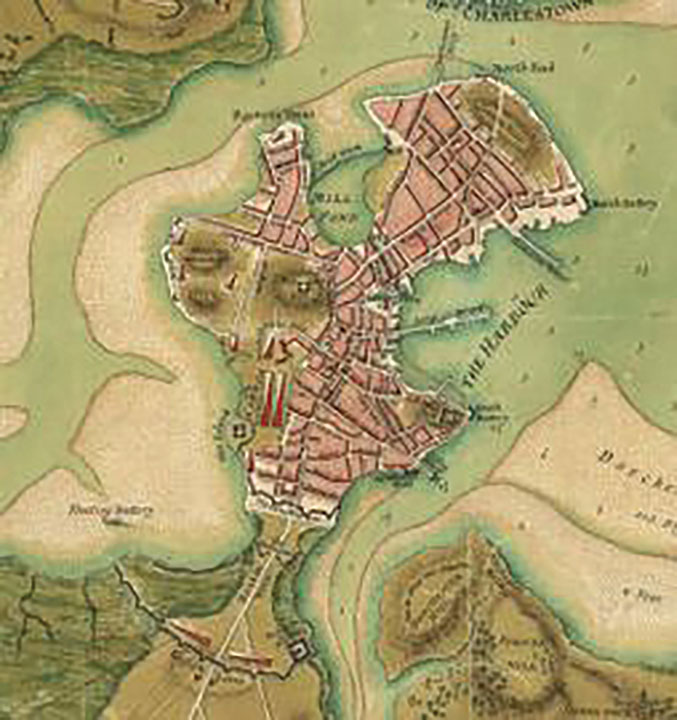
This week in Revolutionary War history, let’s check up on what was going on 250 years ago in and around the colonial Province of Massachusetts Bay. Last week, at long last, the Continental Army began the “hot” phase of the Siege of Boston as artillery atop Dorchester Heights, brought east by Colonel Henry Knox from Ticonderoga, began to rain down metal on the Shawmut Peninsula that Boston occupies. Around 6,000 men occupy the top of the highlands with many hundreds of others guarding the neck heading towards the city. The British had tried for a push towards Dorchester, with much of the approaching seas frozen, but have been unable to get close, nor can their cannons in the city shoot American positions. Boston is surrounded at all sides as casualties mount and options dwindle for the British.
On March 8, 1776, Boston has been shelled by American artillery for the past three day. At this time too, many British ships were in range of the guns atop Dorchester Heights, leading to immense anxiety to the defenders. The Boston Selectmen wrote to General George Washington, saying, “As his Excellency General Howe is determined to leave the town with the troops under his command, a number of the respectable inhabitants being very anxious for its preservation and safety, have applied to General Robertson for this purpose, who at their request has communicated the same to his Excellency General Howe, who has assured him that he has no intention of destroying the town unless the troops under his command are molested during their embarkation.” Is that it then; Howe pledges to leave the city?
That same day, the four Selectmen, Samuel Austin, Thomas Marshall, Timothy Newell, and John Scolley left the city and crossed the neck with white flag in hand. They affirm that Howe intends to leave the city but has threatened to destroy it should he not be allowed to leave the city with his roughly 11,000 men, soldiers and loyalists citizens, in peace.
The next day, General Washington finally sends an update to President John Hancock in
Philadelphia after nearly a week of no writings. He gives a timeline of events so far, saying, “When the enemy first discovered our works in the morning, they seemed to be in great confusion, and from their movements to have intended an attack,” though mentions their good fortune had made it impossible.
However, that night, a counter-attacks begins. This time, a successful one. The British open fire from across the city towards Dorchester, targeting Nook’s Hill, the nearest hill towards Boston. Lieutenant Isaac Bangs from Harwich on Cape Cod would write in his journal, “Heavy fire from the shipping in the harbor from several of the wharves & from several batteries; such a firing, before was never before heard in New England they killed 4 men with one ball.” This devastating attack shattered the seeming invincibility of the Continental Army’s Position, but it did nothing to halt the siege. Bangs would add, “the next morning we picked up 700 balls that they had fired upon us.”
On March 12, Boston Selectmen Timothy Newell would write in his journal aptly named “A Journal Kept During the Time that Boston was Shut Up in 1775 – 6,” “The Inhabitants are greatly distressed thro-fear the Town would be set on fire by the Soldiers.”
That would prove to be the final push though, as General Howe would issue a proclamation to those in the city the next day, confirming a British withdrawal from the city was eminent. It would be published in the Pennsylvania Evening Post a month later, allowing us to read it today, “As linen and woolen goods are articles much wanted by the rebels, and would aid and assist them in their rebellion, the Commander in Chief expects that all good subjects will use their utmost endeavors to have all such articles conveyed from this place. Any who have not opportunity to convey their goods under their own care, may deliver them on board the Minerva, at Hubbard’s wharf, to Crean Brush, Esq; marked with their names, who will give a certificate of the delivery, and will oblige himself to return them to the owners, all unavoidable accidents excepted. If, after this notice, any person secrets or keeps in his possession such articles, he will be treated as a favorer of rebels.” Thereby confirming the Americans would soon have command over the city, and its stockpile.
As the 11,000 evacuees got organized, ships amassed in the harbor all while shelling continued. American privateers, staying near the coast, harassed the British frigates and even managed to capture some supply ships. Abigail Adams, wife of the future president, would herself count around 170 ships in the harbor as she watched on with other spectators from afar.
On March 13, Washington again write to Hancock, mentioning the eminent capture of the city and the British departure, saying, “I mentioned the intelligence I had received respecting the embarkation of the troops from Boston & fully expected before this, that the town would have been entirely evacuated – Although I have been deceived and was rather premature in the opinion I had then formed, I have little reason to doubt but the event will take place in a very short time.” The British await favorable winds for the departure, and it has been stormy with sporadic hail the last weeks.
He tells Hancock he expects the retreating troops to either go north towards Halifax or south. Either way, he fears a retaliatory strike on Boston is next. They await the full retreat as the winds rage and the sea outside the harbor swells.
This Week in Revolutionary War History
By Sam Bishop