When we envision a company of militia fighting in the Revolution, I think we usually picture the well-known three white marchers with the flag, the drum and the bugle. However, the Revolutionary War was also fought by men of color and Native Americans. Early in the war, the Native American tribes chose sides, with most going with the British, but the Oneida and Tuscarora sided with the colonists. The Mohawks from the Sturbridge area were one group that also joined them. In our area by the time of the Revolution, few Native Americans were left, but there are records of some in local militias.
There were also local men of color fighting on the side of the colonies even though, ironically, they would not benefit from the words of the Declaration of Independence for at least another century. Some of these were formally enslaved men who had managed to buy their freedom. Many who served were used primarily to build fortifications as the African American minutemen did in Boston, but when needed, they provided military support.
The Pilgrim Society has detailed lists of many soldiers from Plymouth County who served in the Revolution. The lists include both Black and Native American soldiers. Two Black soldiers, William Blye and Peter Haskell, are listed as from Rochester. Their muster cards are in the current exhibit. Blye was in Nathaniel Hammond’s Company and Col. Sprout’s Regiment. Peter Haskell was in Samuel Briggs’s Company and, like many from surrounding towns, in Rochester’s Lt. Col. White’s Regiment. A muster card has Haskell later reporting to the 12th division of the Continental Army in Springfield, Massachusetts.
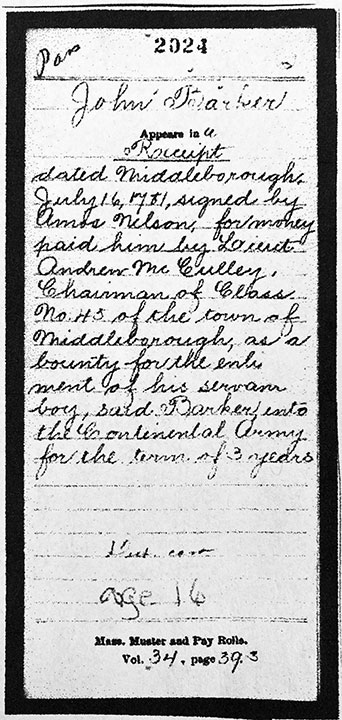
Also in Lt. Col. White’s regiment are four Native Americans. Peleg Stewart, age 16, John Capy, age 17, and John Barker, age 29, all enlisted from Rochester. In the same regiment, there is a second John Barker, age 16, from Middleborough. His muster card is interesting, as it details how Amos Nelson received money from the Continental Army as a bounty for enlisting his Native American servant boy in the army for a period of three years, beginning July 16, 1781. The older John Barker from Rochester received a bounty paid by the town of Rochester to serve in the Continental Army for three years, beginning in May of 1781.
An example of the difficulty researching soldiers from the American Revolution is Josiah Soul, a Native American, age 22, who enlisted from Plymouth, but who also “enlisted under the name John Methrick’s from Rochester.” The second enlistment was in Lt. Leonard’s Company and Col. Theophilus Cotton’s Regiment. I wonder if he collected more than one bounty.
By Connie Eshbach