Monthly Travel Talk at the ETL

Come join us on Tuesday, March 10 at 6:30 pm for a tour of three undiscovered gems of Germany and Austria: Münster and Marburg in Germany, and Ladis, Austria. Christine Watt, a German native, grew up in the Münsterland, an area of Water Castles and stately farmsteads in the Northwest of Germany. Her husband, Stephen, has traveled extensively in Germany, including a year-abroad at the University of Marburg in central Germany. Marburg has played host to many famous German visitors, including Martin Luther and the Brothers Grimm, and its narrow streets, lined with half-timber houses, offer a glimpse into what Germany may have looked like several hundred years ago. Over the past ten years, Tine and Stephen have regularly visited the Oberinntal in the Alps of Austria. This is an area of not only breath-taking scenery, but also centuries-old traditions that still play a dominant role in the daily lives of local residents. We invite you to marvel at their natural beauty of these three areas of Germany and Austria, and learn more about their culture and history.

Committee Cuts Back Capital Improvement

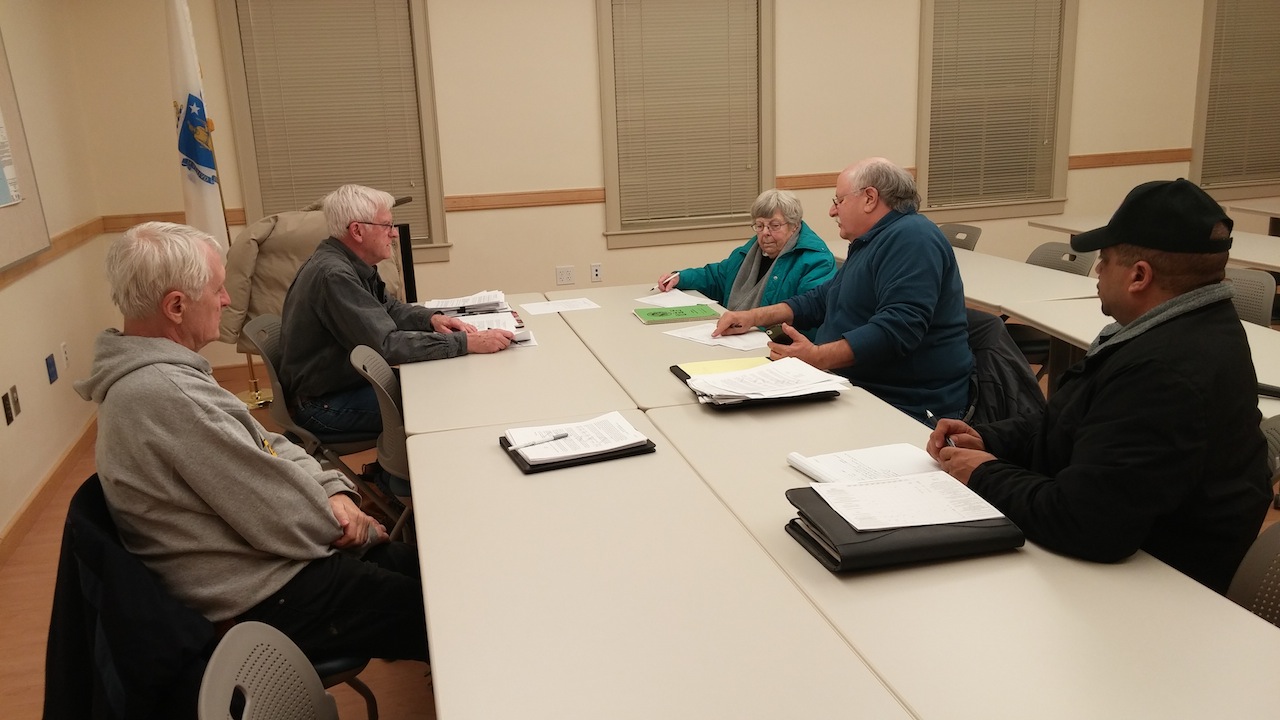
Thursday evening the Marion Capital Improvement Planning Committee met to discuss revisions to the fiscal year 2016 report ahead of the March 3 Board of Selectmen meeting. The report details the plans of the CIPC for the next 10 years.

A major change to the report from the last meeting was the removal of three projects from the FY16 plan to compensate for the adjustments requested by the EPA for renewing the license, or National Pollution Discharge Elimination System (NPDES) permit, for the Town’s wastewater treatment plant.

The projects removed include $150,000 for the design and engineering of a new Department of Public Works building; $4.77 million for Phase 1B construction of Village Area CIP improvements; and $270,000 for Phase 2 designs, totaling $5.19 million worth of projects put on hold.

Casey Barros expressed that he was happy to see the changes made to the proposed projects list.

Allocated for permit negotiations and lagoon analysis is a $450,000 placeholder amount to present to the selectmen.

“It’s a placeholder for engineering services for what we need to do to respond to the EPA,” said CIPC Chairman Norman Hills.

According to the report, the resultant financial impact of the changes is unknown. During the February 5 meeting of the Marion Board of Selectmen, engineers determined that costs could exceed $20 million.

One of the major changes the EPA requests is the elimination of unlined lagoon use, as well as the prohibition of letting biosolids degrade naturally in the lagoons. This requires the elimination of three unlined lagoons off Benson Brook Road, which were built in the 1970s to store excess wastewater and treat biosolids. This would require the Town to export the sludge, line the lagoons, and expand filtration amongst other costs.

Other changes to the report include adding a detailed description of Item 2 listed in the proposed projects road repair for sections of Point Road and Front Street. Those repairs include grind, overlay and crack seal.

The cost of this project will be $273,000 and is funded by Chapter 90, a MassDOT program that entitles municipalities to reimbursement for certain projects.

The CIPC report suggests the funding of 20 FY16 capital projects, down from the originally suggested 23, totaling $2,162,065. The report also provides information detailing where the funding would come from for each project.

The changes were accepted unanimously by the committee following a brief discussion about more changes to grammar, capitalization, and spelling suggested by Barros.

The next meeting of the Marion Capital Improvement Planning Committee is scheduled for March 5 at 7:00 pm in the Marion Police Station conference room.

By Andrew Roiter

MRcapimp_022615

Academic Achievements

Kiernan M. Reynolds, son of Dr. and Mrs. Jason Reynolds of Marion, was named to the Dean’s List for the fall 2014 semester at the University of Massachusetts Amherst. Kiernan is a junior majoring in Political Science.

Megan Psyhojos, a member of the class of 2016 from Marion, has been named to the fall 2014 Dean’s List at Loyola University Maryland. In order to qualify for the Dean’s List at Loyola, a student must have a GPA of at least 3.5 with a minimum of 15 credits.

Abigail Adams of Mattapoisett and Laura Morse of Mattapoisett were named to the Merrimack College Dean’s List for fall 2014. To be eligible for the Dean’s List, a student must achieve a 3.25 GPA out of a 4.0 grading system.

Fire Fighters Clam Boil

The Marion Fire Fighters Association will hold its annual Winter Clam Boil on Saturday, March 28 at the Marion VFW Pavilion on Route 6. The Veterans will run a cash bar and there will be raffle prizes and a 50/50 raffle. Doors will open at 5:00 pm with dinner service beginning at 6:00 pm. Tickets are $27 each and can be bought by contacting Brooks Wilson at 508-728-0840 or brookswilson24@gmail.com. Buy your tickets today as tickets will not be available at the door. We thank you for supporting your local fire fighters.

Mattapoisett Friends Make ‘Amigos’ in Cuba

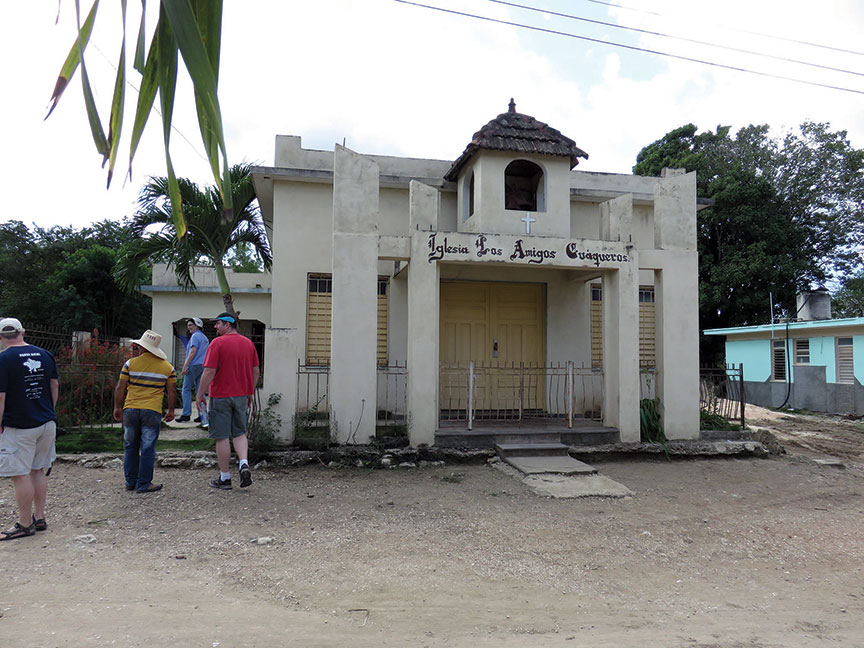
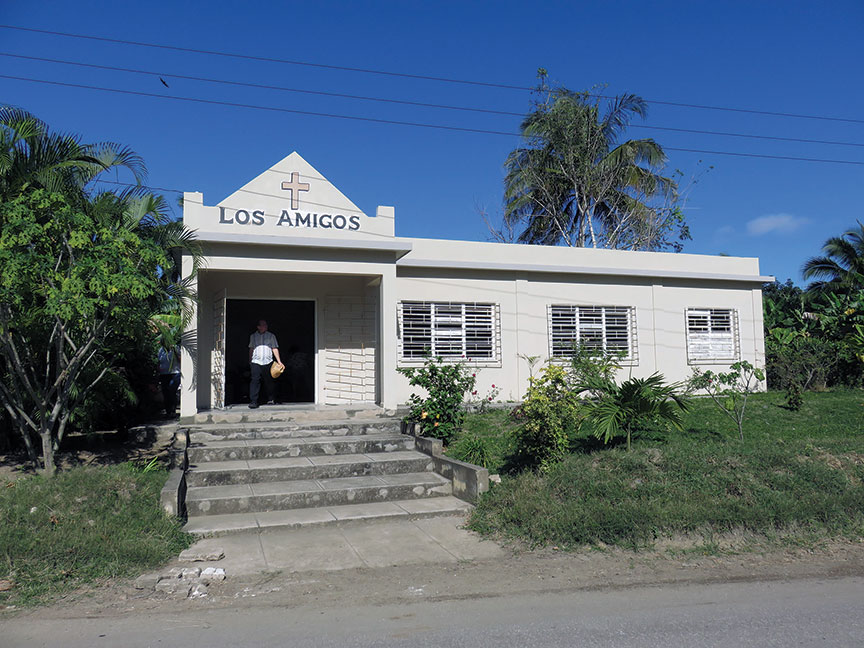
The bridge between the Mattapoisett Friends Meeting and their Cuban Quaker counterparts has been strengthened by a first-time visit to Cuba by Deena Kinsky, the delegate for the Mattapoisett Friends, along with six other Quakers from other parts of the United States.

The Mattapoisett Friends have hosted Cuban delegates in the past as part of the program Puente de Amigos, which means Bridge of Friends, that serves to form sister meetings with the Cuban Amigos under the umbrella of the New England Yearly Meeting. The Puente de Amigos Committee was formed in 1991 to promote a spiritual relationship between Friends of both countries that is based on equality and mutual respect.

Last summer, one of the Cuban ‘Cuaqueros,’ the Spanish word for Quakers, visited the Mattapoisett Friends Meetinghouse and suggested the Mattapoisett Friends consider adopting a sister meetinghouse in Cuba, which Kinsky said interested her fellow Friends. Soon after, Mattapoisett Friends made the connection with the meetinghouse in El Retrete, a small town in the province of Holguin, and the sister relationship began.

“And then the opportunity came for me to go there, so I got to meet them in person,” said Kinsky. “It sort of kicks off the relationship.”

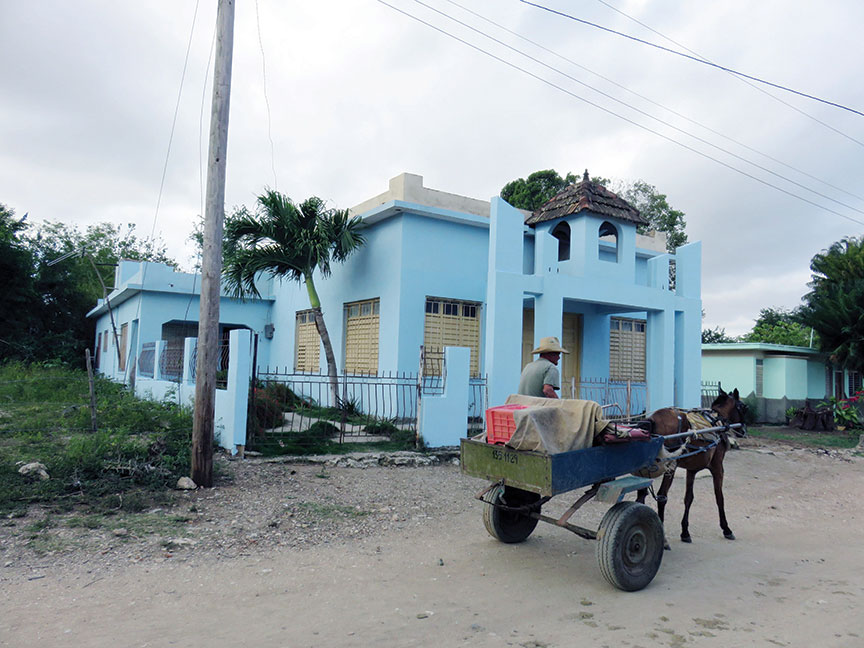
Kinsky and the other six Friends were there in Cuba on what Kinsky called a “work visit.” In preparation for the trip, the Friends gathered the supplies they needed to help paint a meetinghouse in a village called Bocas as a sign of friendship and to also help with construction of the building.

The children of the Mattapoisett Friends Meetinghouse put together a photo album of pictures of the Mattapoisett meetinghouse and Friends for Kinsky to give to the Amigos as a gift, with the intention of continuing written communication between the children of both countries.

The Friends arrived on January 23 at the airport in Holguin, a small city on Cuba’s eastern shore in the province of Holguin, where an old ’57 Chevy took them to their first destination, the Quaker Meetinghouse in Holguin. From there, the group traveled to Gibara, a smaller town outside Holguin, where they visited the Amigos there and stayed in the dormitory of the Quaker Peace Institute. Kinsky also took a side trip to visit the Mattapoisett Friends’ sister meetinghouse in El Retrete before settling into another village for the work visit.

“Then we went to the village of Bocas,” said Kinsky. “We painted the ‘church.’ It’s a beautiful shade of blue now!” said Kinsky, showing the before and after photos. “They’re renovating the building. We did grunt work so the skilled labor workers could use their skills.”

The most significant part of the cultural and spiritual exchange was for both Friends and Amigos to share with each other their differences and celebrate their similarities – to come to a new understanding of what it means to be a Quaker.

“Their faith is really important to them and they meet several times a week,” said Kinsky. “They’re not very impressed with us over here.” She laughed. “We meet once a week and when the weather is nice, we might meet twice a week.”

One fundamental difference between the Bocas Amigos and the Mattapoisett Friends is that, while the Mattapoisett Meetinghouse is more non-denominational, the Bocas Meetinghouse is based more on Christianity. And while the Mattapoisett Quaker meetings are generally silent, the Cuban Cuaqueros engage in more singing and music, and preaching with the presence of a pastor.

“They have pastors, more like an evangelical church, so they have a different style there. They all told us, ‘Oh, we couldn’t sit for that long … Cubans like to make noise,’“ Kinsky said. “That was the biggest difference, but it was interesting to experience the differences.”

Throughout her stay in Cuba, as she observed those differences between the Amigos Meetinghouse and the Mattapoisett Friends Meetinghouse, Kinsky said she started asking herself, “What actually makes us all Quakers?”

One of the principles of the Mattapoisett Quakers, as well as other Friends Meetings in the United States, is simplicity. Kinsky said she noted there is more of an ornate characteristic to the Bocas Amigos, who dress up more for their meetings and sometimes wear more jewelry.

Kinsky asked others what makes them all Quakers, aside from the shared ‘peace testimony’ of pacifism, non-violence, and opposition to war.

“And really, everybody had a different answer,” said Kinsky. “The conclusion I came to was that it is a shared history.” At one point in history, Quakerism diverged into different groups that varied in a number of ways. “But we have respect,” she said. “They do things differently than we do.”

Kinsky returned home on February 3 and unfortunately, because of persistent snowstorms, has not yet been able to share her experience with the Mattapoisett Friends. But she knows that she is going to tell them about how welcome the Amigos of Bocas made her feel, the fun she had working together with them on the meetinghouse, and that the Amigos are grateful to know that people over here care about them.

“Even though our governments don’t see eye to eye,” said Kinksy, “it’s nice to know that we can still be amigos…”

By Jean Perry

CUBA_0068 CUBA_0209 CUBA_0242 CUBA_0354

Board Content with Zoning Bylaw Progress

Just one night after discussing its limited commercial zoning bylaw amendment with selectmen, the Rochester Planning Board on February 24 made some finishing touches to the language and now looks toward presenting it to residents living in or near the affected zones.

Based on issues brought up the night before, the board reviewed some notes sent by Town Counsel Blair Bailey meant to clarify certain sections of the bylaw – mainly points brought up by Planning Board member Ben Bailey about objective language subject to interpretation.

Language in one section of the bylaw mandating a 20 percent green or recreational space of the “disturbed” area of the development was tightened to include explicit examples of such spaces, like pedestrian walks, decks, paths, plazas, and gardens, among other things.

Bailey’s concern over the term “harmonious” led to a bit more discussion on the matter, but the term will stay put in the bylaw, regardless. Bailey wondered how one would decide what was harmonious.

“Isn’t it like pornography?” Planning Board member Susan Teal asked Bailey. “You’d know it when you see it.”

Planning Board Chairman Arnold Johnson added that this section of the bylaw serves more as a parameter for development and less as design restrictions. Bailey conceded.

“I understand that you can’t write a bylaw that protects the neighbors that doesn’t have subjective language,” said Bailey, adding that he stood mostly for property owners’ rights and fewer restrictions placed upon them. “But what I would do to this, nobody would vote for.”

The board decided to send the changes made to Bylaw Subcommittee Chairman Richard Cutler to review instead of calling another meeting of the subcommittee.

Johnson asked the board to make suggestions on a date for a Saturday public forum for residents living in or near the limited commercial zones affected by the bylaw amendment, and determined that March 28 at 9:00 am would be best.

“I would like to see a dry run of the presentation for the board no later than our second meeting in March,” said Johnson, who would prefer to answer all of the concerned residents’ questions at the forum rather than explain it on Town Meeting floor.

The next meeting of the Rochester Planning Board is scheduled for March 10 at 7:00 pm at the Rochester Town Hall.

By Jean Perry

ROplan_022615

Blood Drive at Tabor Academy

In October 2013, two days before she turned one, Pippa Larsen, child of a faculty member at Tabor Academy, was unexpectedly diagnosed with acute lymphoblastic leukemia (A.L.L.). She immediately began a two-year chemotherapy treatment at Boston Children’s Hospital and the Dana Farber Cancer Institute. Her treatment involved many blood and platelet transfusions, more than the family can count! It is now the wish of Pippa’s family to give back in the form of a blood drive to benefit those receiving cancer treatments at the Dana Farber. Ginger Larsen says, “There is no gift more valuable than donating this gift of life for both children and adults in need.”

The Kraft Family Blood Donor Center provides blood for Dana Farber (including The Jimmy Fund) and Brigham and Women’s Hospital in Boston. Please join the Tabor community and the Larsen Family on Monday, March 2 at Tabor Academy for a blood drive to benefit The Kraft Family Blood Donor Center. Many families from the Southcoast of Massachusetts (and all around New England) make the trip to Dana Farber for their cancer care, so the impact of your gift may even be felt locally!

The blood drive will be held March 2 in the Blood Mobile parked in the Fish Center for Health and Athletics Parking Lot at Tabor Academy at 256 Front Street, Marion. To make a blood donation, either stop by the Blood Mobile on March 2 or call 508-291-8375 to make an appointment for a specific time between 9:30 am and 3:30 pm. (A photo ID is required to donate blood and you must be at least 17 years of age and weigh at least 110 pounds.)

On the day of the drive, photo ID required, drink extra water the day before and of donation, and eat before donating.

Marion Snow Budget in the Red

This snowy and icy February has drained the Town’s snow and ice removal budget, prompting the Marion Board of Selectmen on February 20 to vote to allow deficit spending to cover the expenses from the last storm and any further storms to come.

The snow and ice removal budget was set at $50,000 and is now $19,475 in the red, which Town Administrator Paul Dawson told selectmen does not include the payroll from the February 14 snowstorm.

Selectman Jody Dickerson commented that, instead of the roughly $70,000 the Town has spent so far, he was surprised to hear the total was not yet more like $100,000 spent.

“We may be by the time we’re done,” said Dawson, “but we are not there yet.”

Dawson said snow and ice removal from Winter Storm Juno, which blasted the area with roughly 20 inches of snow and blizzard conditions on February 7, might be eligible for reimbursement from FEMA and MEMA due to the calling of a state of emergency during that storm.

“So we are marching forward with that assumption,” Dawson said. The February 14 storm did not reach the threshold for a state of emergency in the Tri-Town region, so the Town does not expect any reimbursement from that storm.

Also during the Friday special meeting of the selectmen, the board voted to award the contract for construction of the new Great Hill water tank to DN Tanks of Westfield, MA, the lower of the two bids the Town received for the project.

The bid was for a total of $1,352,200, which is lower than the Town Meeting approved maximum of $1.5 million.

The next meeting of the Marion Board of Selectmen is scheduled for March 3 at 7:00 pm at the Marion Town House.

By Jean Perry

MRsel_022615

Model United Nations

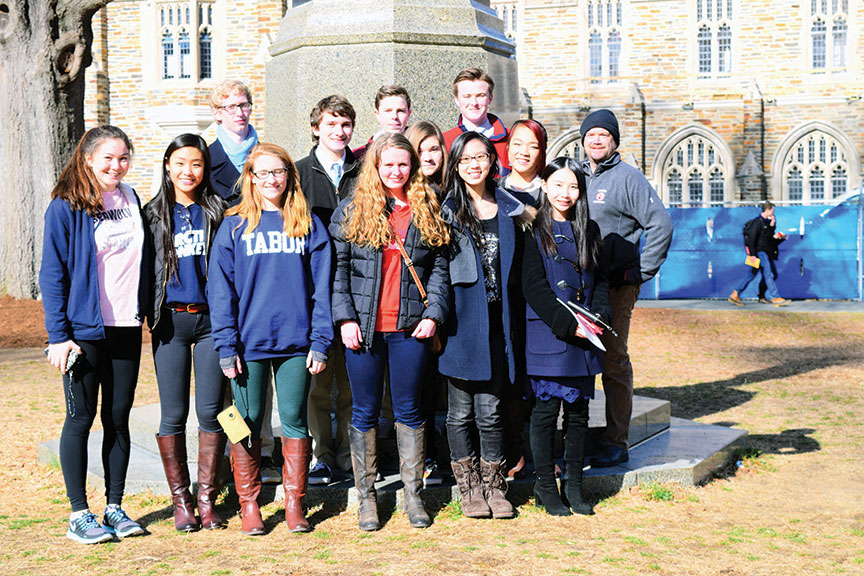
On Thursday, February 18, twelve Tabor Academy students headed to Durham, North Carolina to participate in the Duke University Model United Nations Conference.

These students have spent their winter together in the Model United Nations (MUN) group and have been preparing for this conference for a while. The students who attended the conference with Faculty Supervisor Gary Sousa are seniors Samantha Chan, Ned Mitchell, Gwen McCain, and Jenna Weyant, juniors Kyle Rood, Ellen Park, Evelyn Xue, Vienna Zhu, and Stephanie Zou, sophomores Camden Baer and Max Gonye, and freshman Grace Douvos.

In committee, the students – or delegates – represent a country, read speeches, debate, and write resolutions for their designated international issue. It also allows students to debate and collaborate with other students from all around the nation.

“The best part of the trip was definitely the experience of meeting new people, speaking in front of them, and working with them,” said Baer. “The social dynamic of having to work with people you didn’t know and getting to know people from around the nation was amazing.”

Pairs of the 12 students each researched and participated in debates about different issues. For example, Chan and Weyant were a part of the World Health Organization and discussed water sanitation, immunizations, and antibiotic resistance.

Zhu and Xue were a part of a historical committee, which focused on the French Revolution and resolutions to food crisis and social injustice.

In committee, the discussion is detailed and intensive. Weyant reflected on that.

“Research is definitely a big part of preparing, but confidence is paramount,” said Weyant.

According to Baer, his biggest challenge was “speaking in the beginning of the conference.”

Although some of the Tabor delegates were experienced with Model United Nations, this was the first trip for many.

Weyant has primarily played basketball, but did MUN for the first time this year.

“Ever since I came to Tabor, I wanted to try something completely out of my comfort zone, so I quit basketball and did MUN,” Weyant said, adding that this was a good decision because she feels more aware of the world than she was before. “MUN has really helped me expand my horizons.”

Baer said that Model United Nations has always intrigued him.

“I do MUN because I find global politics very interesting, and the aspect of going somewhere, playing a role, and fighting for what the country you represent believes in intrigues me.” Baer called this “an experience like no other,” and felt that he personally gained a lot from the conference.

“The progress I made from the first day to the final day was extraordinary,” said Baer. “…From public speaking to writing resolutions.”

Tabor’s Model United Nations program is a medium through which students can further broaden their global awareness while learning important skills through writing, debating, and collaborating with peers.

By Julia O’Rourke

TABOR_022615

Likely Cause Found in 40B Housing Fire

Investigators have not yet officially named the source of the fire that destroyed two apartments and damaged two others at Marion Village Estates off Front Street the night of February 19, but Fire Chief Thomas Joyce said Tuesday, February 24 that a propane construction heater in use was likely the cause.

“It appears to be unintentional and accidental,” said Joyce. “It all sort of proved non-suspicious in the end.”

Joyce said Deputy Chief Joseph Dayton, leading the investigation, is still handling paperwork for the case, but inspection of the scene leads to the conclusion that a propane heater that was used that evening to dry fresh plasterwork somehow tipped over, igniting the floor and burning downward.

“Based on where it started and how it burned,” said Joyce, “that’s where the heat source was.”

Firefighters who arrived at the scene at about 6:30 pm observed that some housing units appeared to have been entered by force, rousing suspicion of a possible arson. However, workers at the development who first spotted the fire said they initially busted into the units in their attempt to put out the fire as emergency response was en route.

Initial 911 calls reported a fire and billowing smoke coming from one of the complexes at the affordable housing development still under construction behind BrewFish.

The first police officer that arrived at the scene sounded a second alarm and mutual aid was called from the Mattapoisett, Rochester, and Wareham Fire Departments.

At about 7:00 pm, command on the scene called for the evacuation of all firefighting personal from the building for safety reasons, and a third alarm was sounded at 7:20 pm, requesting aid from Plymouth County Fire.

Weather conditions were windy with frigid cold wind chill temperatures.

There were no injuries reported and the housing units were unoccupied.

Manager of Marion Village Estates Ken Steen could not be reached for comment.

By Jean Perry