Someone who will remain nameless once suggested that there wasn’t enough Rochester history for all the articles I have written and maybe I was submitting them more than once. It was a joke, but I realized that unless you went to the museum and looked through all the file cabinets and books and boxes, you would have no idea of how much history and how many human- interest stories are stored there. I do occasionally revisit a topic when a new angle or new information comes to light.
However, there is one story I revisit every year (though always with a new article), and that is the story of the East Rochester Congregational Church’s (our museum) organ. While the organ appears to be a pipe organ, the pipes are merely decorative. As we had pointed out in our 2024 exhibit, there was a time when if you wanted music in your home, you either had to make it yourself or invite musicians to your home.
During the 1800’s to the early 1900’s, it became popular, for people who could afford it, to have an organ in their home. Very wealthy people like Henry Flagler, one of the tycoons in the same era as Fairhaven’s Henry Huddleston Rogers, had music rooms. Flagler’s was ballroom-sized with a soaring ceiling and a huge pipe organ that had once graced a European cathedral.
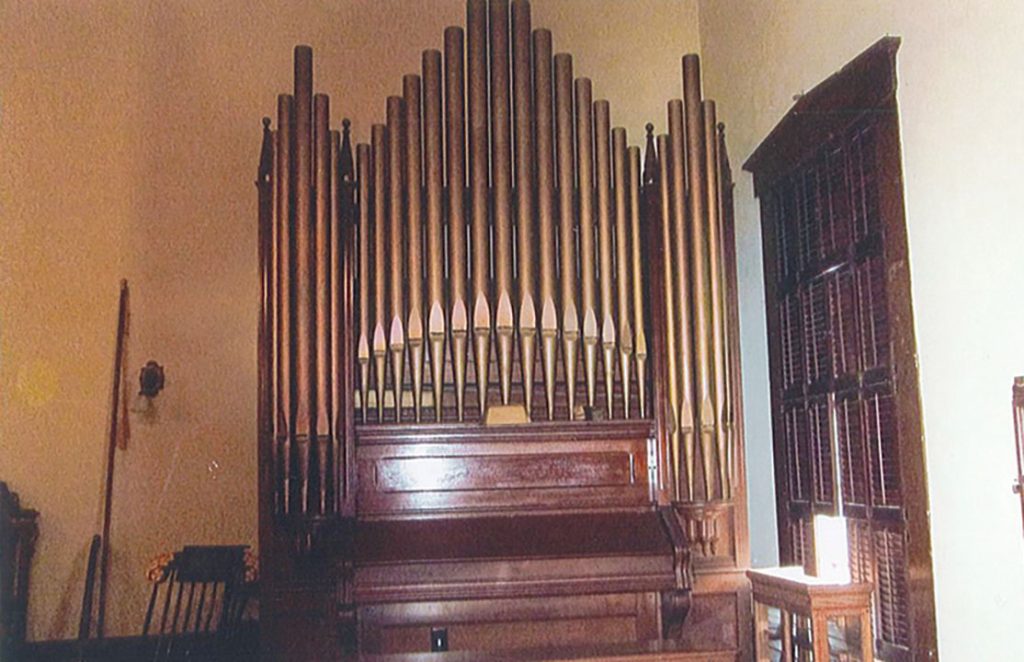
Other less wealthy people of means needed a smaller style organ for their music rooms. This brings us to the Vocalion organ. The organ (pictured here) here in our museum was once in the home on the Hathaway Estate in Wareham and was donated to the East Rochester Church by a Mrs. Stone in 1932.
Now, to the organ itself. As I said, at first glance, it looks like a pipe organ, but is an American Reed Organ built in 1895 by Mason & Risch, formally, the Hamilton Vocalion Organ Mfg. Co. of Worcester, MA. The decorative pipes are a hand-painted wooden facade. The stenciled nameboard says, ” Vocalion”. To quote Joe Sloane, an antique organ expert, ” Vocalion was the name given to a unique keyboard musical instrument conceived and marketed by its inventor to exemplify the pinnacle of reed organ building in the late 19th century.
Reed organs produce music through suction, but Vocalions are different from other reed organs. It makes music using pressure in a way that mimics the human throat. Going with that analogy, the organ has a number of “throats” that range in size giving it a much greater capacity than that of the human lung. When played, air passes from a wind chest (on a par with the human lung) through the “throats” making the reeds vibrate. Therefore, the mechanical action of the organ is designed to play its vibrating brass reeds rather than pipes.
In ads for Vocalion organs, it’s stated that they had everything found in a pipe organ and could produce tones as beautiful as the finest pipe organs. The Vocalion however, was less expensive and would fit more easily into a large, but not palatial home or church.
Vocalion organs have become rare. Many older churches have either taken them apart and put them in storage or sold them. We feel very fortunate to have ours as part of our museum. Like anything over 100 yrs. old, it has its issues, but it still produces some special music. We have been told that it actually needs to be played more, so if there’s any person or group interested in playing our organ, you can get in touch with us at 617-750-2818.
By Connie Eshbach