When I started writing about Rochester history, I titled the articles from the “Files of the Rochester Historical Society” because one of the important things that we do within our museum is to collect and preserve pictures and all kinds of paper (ephemera and archival material) that are important to the understanding of Rochester as a town and also of its place in Massachusetts history. History after all is just a story of a time, a place, an event, a community or an individual.
In addition to all that “ephemera” that is filed away, we also have many items donated by individuals who didn’t want to send their historic items to the landfill. Among these items is one of the earliest treadle sewing machines, a rare vocalion organ, a newly acquired flax wheel and the bench from Bettencourt’s front porch where workers from the Hartley Sawmill would sit to eat their lunches and occasionally, carve their names or initials into the wood.
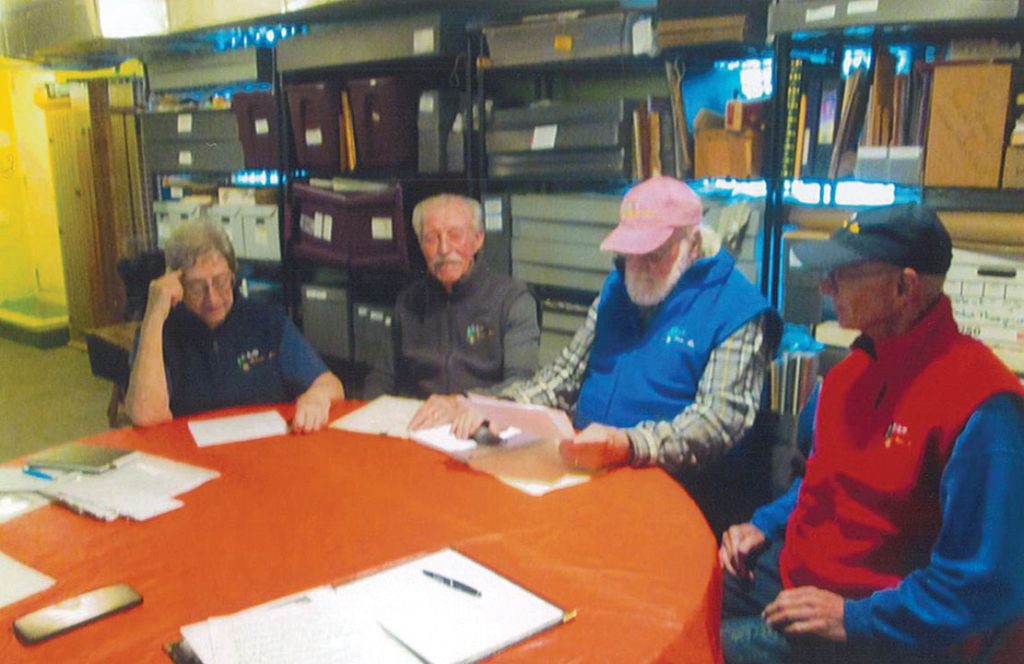
If historical societies aren’t careful, they can simply become repositories of dry papers and dusty stuff. This can be particularly true of small, underfunded ones similar to ours. However, the Board of the Rochester Historical Society, pictured here at a meeting (with some incidentally wearing our newest Rochester item, a fleece vest with our embroidered logo which will be for sale at the library’s Dec. 13th sale) believe that history is a living thing that should be shared with its community. It shows us where we’ve been, so we know how we’ve gotten to where we are today.
To bring Rochester history alive, we plan monthly programs and yearly exhibits (with the help of those who donate or loans their historic items). All of this takes work and planning from moving heavy cranberry sorters and awkward agricultural spreaders to creating programs that we hope people will find interesting.
For a small, member-supported museum reliant on donations and Cultural Council grants, we definitely punch above our weight class (I think that’s a boxing term). A few years ago, when our exhibit centered on maps, it was listed on an international website for museums focused on maps. More recently, a local educator praised our exhibit on how people of Rochester entertained themselves for over 300 yrs. as one of the best social history exhibits he’d seen.
We know an exhibit is a success when the people visiting identify with it. As people left this year’s exhibit of “The Tools and Industries That Made Rochester” there were comments that the exhibit “really took them back” or reminisces about working with some of the tools. I know I have a much greater appreciation of the 19th and early 20th century workers who hefted the heavy iron and wooden tools on display.
Hopefully, our upcoming 2026 exhibit, “Rochester and the Revolution” will live up to its predecessors. We’ll be opening sometime late spring/early summer and would appreciate any Revolutionary or colonial memorabilia that could be loaned to the museum.
By Connie Eshbach