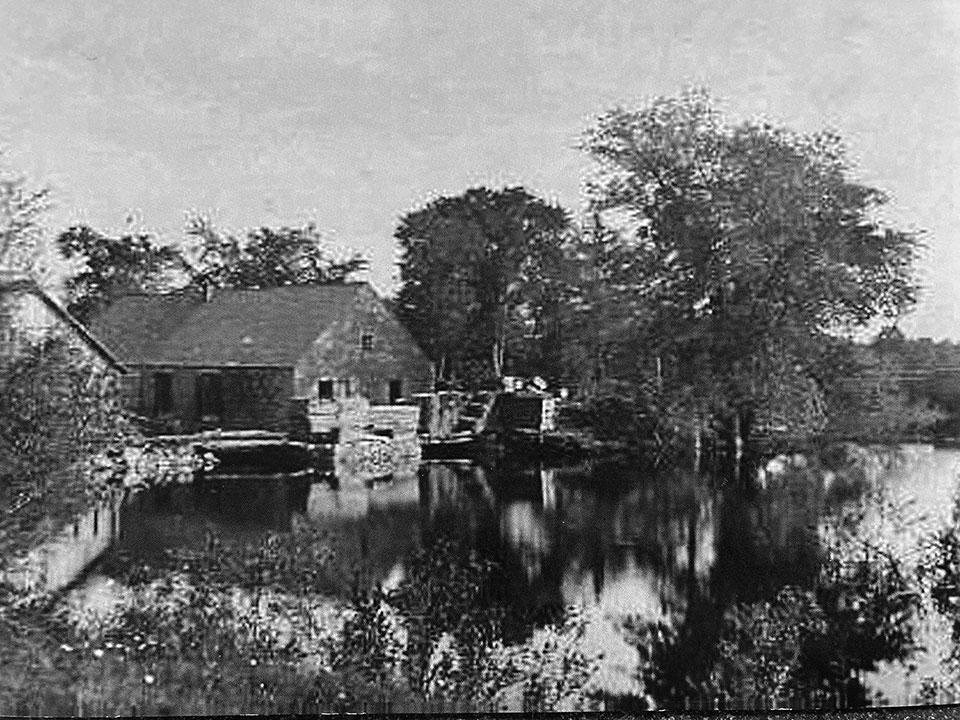
A couple of weeks ago, I mentioned the Hartley Sawmill which was a successful business for many years and finally closed in 1964. The actual site of that mill now marked only by rocks and a water course has an extensive history all its own. The area around it is historically referred to as the “Winslow Mill Area”, because in 1725, Maj. Edward Winslow developed the site as an iron forge.
It was a “bloomery ” forge where local bog iron was recovered from the water and then smelted to make iron bars for the nail works in Tremont. It’s believed that the bloomery forge shut down at some point after the Revolutionary War. Many of this type of forge were shutting down around this time, because the supply of bog iron was being depleted. However, the waterpower privilege was too valuable to be abandoned.
Elisha Ruggles turned the site into a grist mill in 1823 and over the next 65 years the site had many owners, among them; the David Peckhams, both Sr. and Jr., Hiram Waldron, Josiah Pierce, William T. Bryant and Charles and Eudora West. Many of these owners lived in close proximity of the mill.
Looking at the maps that we have for sale at the museum, the1856 map has the site as a grist mill. By the 1879 map, it is still listed as a grist mill, but box board and shingle mill have been added.
In 1888 (as mentioned previously), James Hartley purchased the property and from then on it was operated by him and then, his offspring. No doubt when he purchased the mill, it was powered by at least one waterwheel. As time passed, upgrades were made.
First, a 25 horsepower Acushnet Iron Foundry-built turbine type water wheel was installed to provide more power. By the early 1900’s, a steam engine and boiler were installed. In the late 1920’s, James Hartley, Jr., the 4th child and 3rd son, along with Malachai White replaced the horizontal wheel with a vertical-shaft-drive turbine. These upgrades in power were typical of how small sawmill owners improved their businesses
The boom years for the Hartley Sawmill were from the 1920’s to the 1950’s. In those years, the mill produced cordwood, house and boat lumber and boxboards and shingles. One of the Hartley Sawmill shingle machines is in George Church’s Museum on Mattapoisett Rd. The output of the mill was hauled by oxen and horse-drawn wagons to harbors like Marion and New Bedford to be loaded onto schooners.
After the mill closed down, the vacant and decaying mill buildings were removed or burned by the Rochester Fore Dept. However, the office building was left standing. Recently, Rick Miranda, the current keeper of the Hartley Sawmill Trust, has renovated the building which was the office of Hannah Ellen Hartley who both ran the hardware store and kept the records of all the mill transactions. One of her ledgers is part of the current exhibit at the Rochester Historical Society Museum. Anyone interested in viewing the exhibit; “The Tools and Industries That Made Rochester”, can set up time for a visit by calling Connie at 617-750-2818 or Sue at 508-295-8908.
By Connie Eshbach