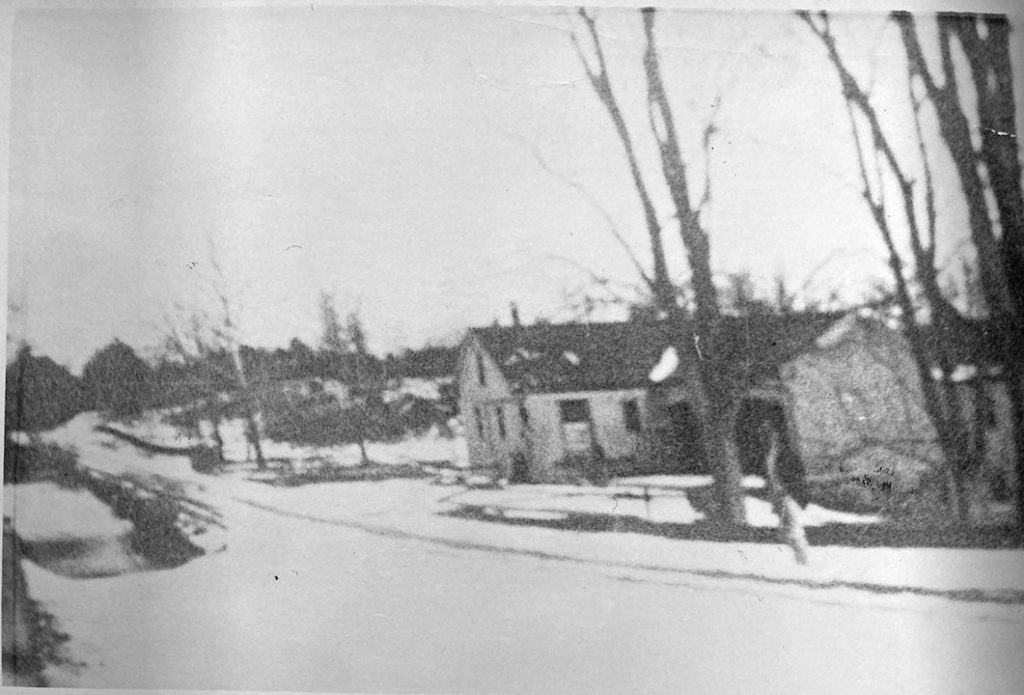
As this very cold and somewhat snowy spell of weather is due to alleviate, with temperatures expected in the 40’s soon, I was thinking about snow removal back in the day. Of course, for quite a long time, most area roads were dirt or gravel rather than paved, so dealing with snow was different and less imperative since many just switched over to horse drawn sleighs like in “Jingle Bells.”
The 1871-72 “Report of the Selectman of Rochester on the Financial Affairs of the Town (today’s town report) has a short list of men hired to clear snow. The ten men were paid various sums with George Alley ($19.70), Consider Smith ($21.55) and Charles H. Haskins ($12.20) being paid the most. The others were paid anywhere from $3.60-$ 7.60 with the total expenditure of $88.94. In 1893-94, even less money was spent with $32.55 split among 3 men: Richard W. Clark, J. G. B. Sherman and Ira D. Fuller.
By 1906, the reports showed an actual snow account although the money spent was only $57.85 and 32 men were paid out of that sum. Three years later, the snow budget was increased to $464.18. This coincides with mentions of stone roads.
In the 1920’s, the town was still paying for teams (horses) that were clearing snow. My favorite reference is Mrs. Annie Hartley paid $138.63 for gravel, lumber, team and auto in 1918. I’m sure Great Grandma’s sons were the ones doing the work.
Looking through the 1942 Record of the Town Officers of Rochester, MA (no, I haven’t looked through all of them) snow plowing payments are broken up by who did it and their hourly rate. There is also money paid for the welding of snowplow points and for snow fences. The Taking Down and Putting Up of snow fences cost the town $ 182.62. In addition, there were costs associated with the purchasing of fences at $.10 per foot for 130 feet, posts, as well as the transport of materials by truck and train.
In his papers, L.C. Humphrey mentions winter snow. He says that in colonial times and for many years later, roads ran along fields that were fenced with hedgerows growing along them. This, in effect, created walls that kept much of the snowfall off the roads. As roads were paved, these were removed and snow piled up on the roads. That was when the town started investing in snow fences.
Humphrey also recalled pre-plow storms when large rollers pulled by horses and oxen would press down the snow wide enough for two sleds or sleighs. The rolled paths were always double wide and had turnouts. With increased automobile ownership and paved roads, “motor driven” snowplows became the standard.
After a series of mild years, it will be interesting to see how 2025-2026 will measure up. Certainly, it will be significantly more than 19444’s $792.68.
By Connie Eshbach