Marion’s Town Meeting

Fellow Marion birdwatchers:

            Please attend Marion’s Town Meeting on November 5 at 6:45 pm and vote YES on Articles 5, 6, 7 and 8. This will preserve an approximately 42-acre forest block for bird and animal habitat, which, as you are aware, is crucial to keeping our bird friends around. One of the most special times of the year for me is that morning in February when I go for a walk at dawn and hear the first bird song of the year. Please join me in supporting the preservation of this land as space where both the birds and residents can enjoy the natural beauty of Marion.

            You must attend in order to vote.

Amanda Chace, Member of the Marion Open Space Acquisition Commission

The views expressed in the “Letters to the Editor” column are not necessarily those of The Wanderer, its staff or advertisers. The Wanderer will gladly accept any and all correspondence relating to timely and pertinent issues in the great Marion, Mattapoisett and Rochester area, provided they include the author’s name, address and phone number for verification. We cannot publish anonymous, unsigned or unconfirmed submissions. The Wanderer reserves the right to edit, condense and otherwise alter submissions for purposes of clarity and/or spacing considerations. The Wanderer may choose to not run letters that thank businesses, and The Wanderer has the right to edit letters to omit business names. The Wanderer also reserves the right to deny publication of any submitted correspondence.
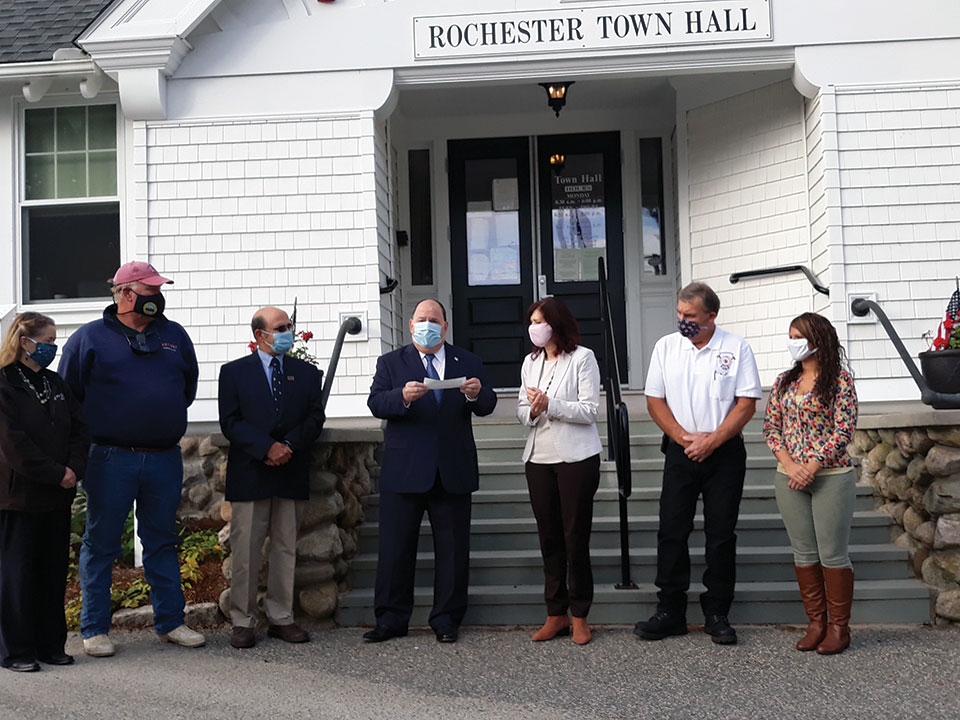
Rochester Receives Initial CARES Act Check

            Plymouth County Treasurer Thomas O’Brien’s first delivery of $33,602.20 in Coronavirus Aid, Relief, and Economic Security (CARES) Act funds will have many applications in the Town of Rochester, not the least of which are the services that the town provides for its senior citizens. The Senior Center is closed, but the activities of the Rochester Council on Aging are running.

            “We have socialization, we distribute food, but this equipment really helped us to get people in the door,” said COA Director Cheryl Randall of the personal protective equipment (PPE) and sanitization products for the center. “(Fire Chief Scott Weigel) got a fogger for us so whenever we have, not a huge group but more people than usual, we always fog. For example, we had early voting this week and it was quite active, which is great, so we fog every night in addition to the cleaning that’s done…. We sanitize the building and our vans.… It’s been really crucial to have these supplies.”

            COA programming is just one area where the rubber meets the road in the application of CARES Act funding. Behind the scenes of the coronavirus pandemic, town administrators have been working creatively as well as diligently to identify needs, find solutions, plan implementation, and scrape up the funds to achieve them.

            The CARES Act reimburses non-budgeted expenditures that have resulted from COVID-19, and the check of $33,602.20 hand delivered by O’Brien to Rochester Town Administrator Suzanne Szyndlar on October 23 outside Town Hall represents only a drop in the bucket. Rochester is eligible for approximately $700,000 in COVID-related reimbursements, and the list of needs is as long as it is diverse.

            Szyndlar says the application under current preparation will include expenditures related to the adaptation of town buildings and schools, such as Old Rochester Regional High School, ORR Junior High, Rochester Memorial School, and Old Colony Regional Vocational Technical High School.

            The far-reaching effects of the pandemic require meticulous recordkeeping, but so far town officials have been thrilled with the comprehensive service provided by Plymouth County in the administration of CARES Act funds. “It’s a good thing we’re under the Plymouth County (administration), they’ve treated us very well,” said Szyndlar.

            The amount received on October 23 was relatively small in the grand scheme, but the effects have already been felt at the Senior Center. While the facility is not operating at full capacity, Randall and the COA are working with town officials to ensure seniors can maximize access as allowed under state orders.

            “People come in [and] if they don’t have a mask, we give them a mask. Some people – the elders – they need a fresh mask. They don’t get out a lot, but if they come to see us, we give them a mask or two and encourage them to wear it wherever they go,” said Randall. “We do a lot of delivery because people stay in, and we deliver food at least two or three times a month.”

            The COA partners with Boston Food Bank, Coastline, and PACE. “We pick it up in New Bedford, we bring it to the center, people come and get it, and if they can’t, we deliver it,” said Randall of the touchless delivery practice. “We’ve been active. The phones have been busy because people are alone at home, so it’s good to be in touch with everyone. But this equipment [is] a godsend to get people in the door.”

By Mick Colageo

Selectmen Request Financials for ORCTV and ORR

            The October 22 Tri-Town Selectmen’s meeting delved into the contractual language, or lack thereof, of the agreement the Towns of Rochester, Marion, and Mattapoisett have with ORCTV, as well as the agreement between the Old Rochester Regional School District and the three towns.

            First up was the ORCTV contract now motoring along on an agreement that was penned in 2011, according to meeting moderator and Marion Town Administrator Jay McGrail. Marion was the host town for the meeting.

            McGrail said that the agreement has been on his to-do list since the first day of his employment over a year and a half ago. Now with proposed edits to the contract in hand, the selectmen sought to add text that would provide clearer and more concise verbiage.

            Specific areas of the agreement the selectmen found most in need of improvement involve timely deliveries of financial audit reports, more regularly scheduled agreement reviews, and insurance policies that would protect Old Rochester Regional High School. ORCTV operations are run out of space located inside the school.

            ORCTV Director of Operations Robert Chiarito and ORCTV Board of Directors Chairman Chris Charyk agreed that, in the event that the contractual agreement wanes (as is currently the situation), a letter of agreement should stand in to keep the cable operation on a steady course until the invested parties produce a new contract.

            Regarding financial audits, Chiarito said that he has had to “chase down” invoices from the member communities in order to make franchise payments and that he had not seen agreements between the towns and their two cable providers, Comcast and Verizon. But he did assure the towns that audits had been conducted, except one due back in April that has been postponed due to COVID-19.

            Mattapoisett Selectman Jordan Collyer said that he wanted to add language to the agreement that would require ORCTV to include equipment and asset management as part of the annual audit. Charyk concurred it was a reasonable request.

            Of the local membership, Chiarito said that it fluctuates between a mere 50 to as many as 200 members. He said a board of directors was chosen from the membership by the membership to keep governance as non-political as possible.

            McGrail wondered if the selectmen had a say in the selection of the board of directors.

            “We are the shareholders,” said Marion Selectman John Waterman. “We have no say in the board of directors.”

            Collyer commented that since ORCTV is a certified 501(c)(3) organization, it is incumbent upon them to remain non-political. Chiarito said that board members serve a two-year term and could be reinstated for up to six years. While Waterman acknowledged that the board’s roster should not be chosen by the selectmen, he asked if the directors should be reviewed by the selectmen. Rochester Selectman Woody Hartley said town government should not be involved with the selection of the directors.

            Marion Selectman Norm Hills requested a performance review, given that the last one was years ago and that such a review should be done by a third party. Collyer agreed, saying it should be completed in the next 12 months and would help to establish a baseline for future improvements.

            With edits in hand, McGrail will now update the agreement and distribute it to the three Boards of Selectmen and ORCTV for a final draft.

            The Tri-town team then turned its attention to the matter of the ORR School District agreement. Newly appointed Assistant Superintendent of Finance and Operations Howard “Howie” Barber said there were two areas that need attention when discussing the district-wide agreement: 1. the three-year assessment, and 2. the five-year stabilization fund.

            Under the jurisdiction of the Massachusetts Department of Elementary and Secondary Education (DESE), any regional agreement would require DESE vetting, which Barber said was currently underway.

            “Our intent is to move forward and, within the next two school committee meetings, complete our review and then turn it over to the towns for spring town meetings,” said Barber.

            Marion School Committee member Heather Burke said, “We know we have complied with all the state laws, but [DESE has] come back with some pretty bizarre things.” She said that DESE has the final word on all school district agreements and that those agreements were with the individual towns, not the Boards of Selectmen.

            As the agreement stands now, Waterman stated, “I’m not comfortable saying I agree with it. I’d like a legal review – am I being unreasonable to ask for that?”

            Burke replied, “I see no reason why not,” adding that it would protect the towns and the schools.

            Collyer suggested using KP Law, PC because they have experts on this topic, further adding that he wants to see an independent audit of the district’s financial records.

            Barber told him that the Department of Revenue audited the district, but Collyer stated that a history of non-responsiveness to requests for audits had “left a bad taste” in Mattapoisett’s mouth. Collyer wants language added to the agreement that mandates the submittal of certified audits to the boards of the three towns “to look out for the interests of the three towns,” he said.

            Collyer went on to say that he has confidence in Barber in his role as the district’s new business and operations leader. Barber acknowledged the importance of providing audits. Burke was unsure if DESE would allow language mandating that the district provide audits directly to the selectmen. She said she would follow up on that point. ORR School Committee member Tina Rood said the selectmen are welcome to attend the district budget meetings.

            Before the meeting ended, Collyer asked his fellow selectmen how their towns were coping in terms of local receipts and revenue in the wake of COVID-19. McGrail said that Marion was a little behind projections, but that the first quarter had been “OK.”

            Mattapoisett Town Administrator Mike Lorenco said, “We are behind.” Waterman said that sewer and water receipts were trending up in Marion, which Lorenco agreed is also the case in Mattapoisett. But Lorenco also cautioned, “Motor vehicle excise tax sparks some concern for us.”

            Collyer and Rochester Town Administrator Suzanne Szyndlar said their towns had just recently been placed in the ‘red’ zone due to a spike in confirmed COVID-19 cases by the Massachusetts Department of Public Health. Collyer noted that an updated plan was being developed for Mattapoisett possibly returning to earlier restrictions and asked the group what their plans were.

            Szyndlar said, “We went red today.” The challenge as she sees it for protecting town employees was that “every (municipal) building is different.” She said that at Town Hall it is difficult to manage the flow and movement of people entering the building and that a new intercom system would be installed to help control access to the interior of the building. Szyndlar also said that Rochester would be using CARES Act funding for an upgraded telecommunications system that would allow some town employees to work from home utilizing a town department telephone number. McGrail said that Marion is moving in that direction as well. Marion is presently an island in the gray ‘no color designation’ zone, surrounded by abutting towns in the red.

Tri-Town Selectmen’s Meeting

By Marilou Newell

Rochester Senior Center

The Rochester Senior Center would like to let everyone know that on Thursday, October 22 the Massachusetts Department of Public Health designated Rochester as a COVID-19 ‘high risk’ community. This designation is based on a calculation that includes a 14-day average of new COVID-19 cases and the population size. With this new ‘red’ designation, the Senior Center plans to make a few adjustments to ensure the safety of seniors attending activities.

            The Rochester Senior Center will hold one activity at a time to ensure that all COVID-19 protocols can be followed properly. Activities will be limited to the maximum capacity described for ‘red’ communities in Phase 3, Step 1 of the Reopening Massachusetts plan. The plan is posted on the mass.gov website.

            Please stay home if you have been in contact with someone who has tested positive for COVID-19 or has symptoms of an infectious illness (like a cold), if you are not feeling well, have cold-like symptoms, have recently traveled outside Massachusetts, or have attended a large gathering (like a wedding, funeral or birthday party). Face coverings must be worn over your mouth and nose while at the Rochester Senior Center. A social distance of at least 6 feet should be maintained when interacting with people who are not members of your household.

            Activities held at the Rochester Senior Center will be held outdoors whenever possible. Please plan ahead and dress accordingly. An outdoor propane heater was purchased to extend our outdoor season.

            On November 7 at noon, a Franks & Beans drive-thru supper will be held for Rochester veterans. This is a free event for veterans and their families. Please call to make a reservation.

            The Greater Boston Food Bank distribution is scheduled for Thursday, November 12 from noon to 2:00 pm. Food items should be picked up curbside at the Council on Aging by the program participant. Please call ahead if you need to make other arrangements or if you need your food items to be dropped off by a COA volunteer. If you would like to sign up for this program, please call the Senior Center.

            The Senior Center Board meeting will be held on Wednesday, November 18 at 9:00 am. The Friends of the Rochester Senior Center meeting will follow at 10:30 am. These meetings will take place in person and online. For the online link, please call the Senior Center.

            The Rochester Senior Center is an invaluable community resource for many of our local seniors. Every attempt will be made to continue providing this resource safely, with the help of our program participants. By wearing a face covering and practicing social distancing, we are working together to keep our friends and companions safe.

Mattapoisett Election Information

The polls will be open for the Presidential/State Election at Old Hammondtown School, 20 Shaw Street, from 7:00 am until 8:00 pm on Tuesday, November 3. There will be many protocols in place to keep everyone as safe as possible. Please wear a cloth face covering and observe social distancing. Please be patient, as wait times may be longer than usual because of precautions required to be in place at polling locations.

            If you still have an absentee or early ballot to return, please use the new secure ballot drop box located on the grass to the left of the front doors to Town Hall. If possible, please do not wait until the last minute to return your ballot. If you have any questions, feel free to call the Town Clerk’s Office at 508-758-4100 x 2.

Marion Open Space

To the Editor;

            Attention dog lovers, nature walkers, bird watchers and outdoor enthusiasts: There are open space articles on the Marion Fall Special Town Meeting warrant that need your voice. We all enjoy the beautiful woods around town, and a YES vote on articles 5, 6, 7 and 8 will preserve about 42 acres for more woodsy walks!

            Please attend Town Meeting on November 5 – your YES vote matters.

Casey Gunschel, Member of the Marion Open Space Acquisition Commission

The views expressed in the “Letters to the Editor” column are not necessarily those of The Wanderer, its staff or advertisers. The Wanderer will gladly accept any and all correspondence relating to timely and pertinent issues in the great Marion, Mattapoisett and Rochester area, provided they include the author’s name, address and phone number for verification. We cannot publish anonymous, unsigned or unconfirmed submissions. The Wanderer reserves the right to edit, condense and otherwise alter submissions for purposes of clarity and/or spacing considerations. The Wanderer may choose to not run letters that thank businesses, and The Wanderer has the right to edit letters to omit business names. The Wanderer also reserves the right to deny publication of any submitted correspondence.

DPW Facility Designs to Be Budget Driven

            The Marion Board of Selectmen spent the majority of its day on Monday in three separate interviews of engineers bidding to design a proposed Department of Public Works operations facility off Benson Brook Road.

            The three firms were distinct in size proportionate to local versus regional. The in-town bidder, Saltonstall Architects, Inc., interviewed at noon, followed at 1:30 pm by Boston-based CBI Consulting LLC, followed at 3:00 pm by New York-based DiGiorgio Associates, LLC.

            Because two of Marion’s three selectmen, Chairperson Randy Parker and Vice Chairperson John Waterman, wished to participate in the interview, the 11:30 am meeting was conducted as a public meeting and recorded by ORCTV at Police headquarters. Attending from the DPW was Director David Willett, Office Manager Becky Tilden, and Engineering Manager Meghan Davis. Town Administrator Jay McGrail presided over the interviews.

            Willett greeted each of the applicants for the job with a summary of parameters including three major components: the storage, parking, wash down of equipment, the fact this is essentially a “budget-controlled job,” and the location, which will be either behind or in front of the town’s wastewater treatment plant on Benson Brook Road.

            Likewise, Waterman took the opportunity to introduce the gravity of the financial concerns, lest it be considered rhetoric. He summarized ongoing challenges with water and sewer rates, an estimated $9.5 million in debt to upgrade the Wastewater Treatment Plant and a caution that a design that can pass on Town Meeting floor is imperative. Waterman asked each applicant to consider ways to drive down the $3 million price tag, and to think creatively in terms of a project that can be completed in phases and over time. “If we can get it done for $2 million over several years, I would be ecstatic. A durable salt shed at $500,000 boggles my mind; $1 million for site improvement, that boggles my mind,” he said.

            Acknowledging that the construction engineers are the ones who know, Waterman asked if it makes sense to go with a prefabricated structure like those marketed by Morton. “I’m convinced this is something we need to do in phases. We’re not going to have the money to get this done in one step,” he said.

            Longtime Marion architect Will Saltonstall, accompanied in his interview by engineering partner Wayne Mattson, arrived fully cognizant of the town’s challenges, as is guaranteed by his position as chairperson of Marion’s Planning Board.

            After introducing his company as a 40-year-old firm started by his father, Bill Saltonstall, Will Saltonstall emphasized the advantages of his all-local team including Mattson, engineer Bob Field of Mattapoisett, and Peter Bradley, president of Hingham-based PM&C – experts in cost estimation and project management. While Saltonstall is primarily known for residential work, these past 15 years his firm has been designing industrial projects.

            Mattson, the owner of Griffith and Vary, Inc. since 2005, brings the vital public sector experience to the Saltonstall team. A licensed mechanical engineer, Mattson did design work for Durfee High School, the Greater New Bedford Vocational Technical High School’s diesel program (including 10-wheel dump trucks, payload excavators, and tractor vehicles), and the Plymouth DPW.

            “We want the owner, Marion, to use us as a resource. If you have ideas you want to bounce off of us, consider us a resource to think out loud. We want to make sure you have full knowledge,” said Mattson. “I’ll be the face of Griffin and Vary; I’ll be the person in charge. I’ll be sitting next to Will.”

            Saltonstall, who would be the face of the operation with graphic artist TJ Wilbur assisting, discussed a three-dimensional rendering software so that the townspeople “can know what it looks like.

            “Our strength as professionals is navigating the scene. We also understand that part of our role is to be the heavy,” said Saltonstall, alluding to the difference between want and need.

            Further details were discussed before a lunch break prepared the minds to interact with CBI, a Socotec company represented by principals Wayne Lawson and Steven Watchorn.

            Watchorn asked about the existing DPW, and Parker explained that while the town has short-term plans to save the best piece of the building for marine storage, that site will have nothing to do with the new DPW site. Logistical discussion ensued around a phasing-in of fueling facilities and a salt shed.

            Lawson, a structural engineer, said CBI has a 34-person staff, its own field engineers, uses Code Red as a building-code consultant, and PM&C as cost estimator. Michael Teller would be the principal in charge of the Marion DPW project. CBI, according to Lawson, has completed over 45 DPW projects; 65 percent of the company’s projects are for the public sector.

            “We’re often going up against the new school or the new police station. Just understanding that is necessary to having a successful project,” said Watchorn. “We want to understand both the objective and subjective requirements.”

            McGrail told the CBI representatives, “We need help deciding which site is the best.”

            The present DPW facility uses 1.5 acres of the existing 2-acre site. Parker said he prefers the site behind the wastewater treatment plant and that Willett prefers out front for the DPW, but all three applicants agreed that both sites are more than large enough. And Willett described them as relatively flat.

            Geotechnical analysis of the sites is “absolutely step one,” according to Lawson. Beyond eliminating underground complications and avoiding wetlands infringement, logistics such as three-phase power, water, and sewer will all be considered.

            “The DPW is really a lightweight department and does not perform complex services,” said Willett, limiting basic needs to a pre-fabrication type of building with a mezzanine, an office and men’s and ladies’ rooms to accommodate a two-person administrative staff. “The rest of the operations run out of the Wastewater Treatment Plant.”

            Willett told CBI he only needs access to a common area to meet with personnel and distribute assignments. “There won’t be any training in there; we have other facilities,” he said.

            A daily challenge is washing down vehicles to keep them from rotting out.

            “Just overlaying these two sites with the existing site, we can come up with something here,” said Watchorn, who walked the town employees through pages of projects completed for other towns in Massachusetts.

            CBI said it can have a design proposal ready for March.

            Engineers Brian Novelline, senior vice president, and Edward DiSalvio represented DiGiorgio Associates, Inc., a LiRo Group company with headquarters in New York City, a 35-year-old Boston branch with 50 professional staffers, and the resources of 900 staff spread about 16 offices.

            The company boasts over 30 DPW facilities designed in Massachusetts alone. “It’s not build it and move on, we really want to build that relationship with the town,” said Novelline, who emphasized “one-stop shopping” that “eliminates the need for subcontracting (and) eliminates finger pointing.”

            Novelline said no junior representatives will be assigned to visit Marion’s job site.

            Like the prior two bidders, DiGiorgio said it has extensive experience in Chapter 149 and 149A projects. Under DiGiorgio, all architecture and engineering (with the exception of civil engineering) is done in-house.

            DiSalvio told Marion officials that Solar Mass, a state-administered, incentive-based payment or bill-credit program can be of assistance, and DiGiorgio staff can help the town apply for the program. He said the company engaged Revere in the program, which is based on how much energy is used and how much sold back to the grid. DiSalvio also mentioned net-zero energy rebates.

            DiGiorgio presented many examples of projects of varying size and style in a booklet with maps of Marion’s proposed sites. It also included a variety of fueling stations and salt storage sheds. “There are some I wouldn’t recommend in this neck of the woods … they just wouldn’t last as long in the New England environment,” said DiSalvio.

            Novelline said that DiGiorgio can assist in construction management if Marion decides to do some of the construction itself as a cost-cutting measure. DiGiorgio is in regular partnership with a general-contracting sister company.

            DiSalvio said DiGiorgio goes directly to manufacturers to achieve detailed cost estimates. “We’re getting real prevailing-wage rates for our projects,” he said. Novelline said that results in “hard bid numbers. You don’t have to get more money at Town Meeting. It’s a hard-bid estimation that you get from us.”

            DiGiorgio’s representatives ran out of presentation time without leaving any for a proper question-and-answer segment, but the interview was conversational, and questions were asked and comments made throughout. Novelline offered to follow up with a Zoom meeting.

            McGrail told the selectmen he will meet with Willett to discuss the bids and report back to them with a decision.

Marion Board of Selectmen

By Mick Colageo

What Everyone Needs to Know about Open Meeting Law

            While it may be true that public meetings can be a bit dry at times, their importance in the operation of cities and towns throughout the country cannot be overstated. Local government is the backbone of our democratic society. But how these meetings function and are handled at town halls and meeting centers throughout the Commonwealth requires rules that may sometimes confound boards and commissions, most of which are populated by volunteers.

            At the request of the Marion Board of Selectmen, Carolyn Murray of the law firm KP Law gave a nearly 90-minute presentation delving into the most salient aspects of the Open Meeting Law.

            Murray began by saying that everything one needs to know on this topic can be found in Massachusetts General Law Chapter 38 sections 18-25. She said the point of public meetings is to remove “the element of secrecy surrounding deliberations and discussions by public bodies.” She said that for purposes of this presentation a “public body” was any appointed or elected board or committee.

            Murray established what a “quorum” means and how that quorum of the public body is to conduct the business of the town. She drove home the point that individuals who are members of a public body should never gather to discuss a piece of business before them for deliberation outside the public meeting format.

            Even the appearance of secrecy should be avoided, she cautioned. As an example, Murray used a site visit where a quorum of a public body may be assembled. Individuals might ask questions, but she said that offering an opinion or talking amongst themselves should be avoided.

            During public meeting, Murray said that members of the public body should not continue discussing a point deliberated on during the open meeting. “Any communication, where it could be seen that you are weighing-in on a matter that has come before the board should be refrained from.” Opinions may be considered deliberations, she noted, including electronic transmissions (i.e. email, messaging via social media, or text).

            Murray spent considerable time informing the group on proper meeting conduct both inside an open meeting or if the public body attends another board’s meeting. “If a board member speaks at another board’s meeting, that person should make it clear they are not speaking for the body. She also warned against the mistake of responding to email by “reply all,” saying, “Assume that email may be forwarded to unintended recipients; it could end-up in the local newspaper or on a blog.” To make things easier, she said simply, “Refrain from making comments and don’t ask for anyone’s opinion, ideas, feelings or beliefs.… Remember applicants have the right to due process.”

            Murray’s presentation covered public or open meeting postings and what a good agenda should include. Beside the necessity of having the public notice of an open meeting posted 48 hours prior to the date of the meeting, the associated agenda “should contain enough detail to inform the public.”

            The exception to the 48-hour notice would be emergency meetings. “You can’t plan for an emergency,” Murray began, noting such events as natural disasters or public health and safety matters, “such as COVID-19.” But she said the emergency meeting should be posted as soon as possible and, if possible, should also include the next regular meeting details “in case ratification of what was decided during the emergency meeting is necessary.”

            Meeting minutes were briefly discussed with Murray saying such minutes need not be a transcript of the meeting but instead a detailed summary of discussions and any motions and voting that took place. “Minutes are public records and should be completed within 30 days of the meeting date.”

            With COVID-19 marginalizing face-to-face public meetings, Murray talked about the accessibility required of remote platform meetings such as Zoom. Common sense such as making sure everyone’s phone or computer microphone is muted to avoid crosstalk is important. Roll calls for voting during such open meetings ensure accurate voting on deliberated matters. And, she said, “Members of the public board must be clearly audible to all.”

            Other matters Murray reminded the attendees of were when and how executive session meetings may take place, minutes for such meetings, and when these minutes may be released to the public. She also touched on how a public body should handle any complaints received with respect to breaches of the Open Meeting Law.

            An Open Meeting Law complaint must be lodged with the public body within 30 days of the alleged violation; the public body must respond and forward the complaint to the Attorney General’s Office within 14 days of receiving it and should include remedial actions taken if any, and a complaint may be filed with the Attorney General’s office after 30 days from the date the complaint was filed with the public body.

            A second session of this annual Open Meeting Law review was scheduled to be held on October 28.

By Marilou Newell

Randall Lane Solar Array Begins ConCom Hearings

            On an evening when their agenda was packed with continued hearings, new hearings, and a large handful of other matters, the Mattapoisett Conservation Commission opened the Notice of Intent hearing for a mega-sized solar array planned by Randall Lane, LLC. On October 26, the commissioners saw for the first time the scope of the 7.5-megawatt project planned by SunRaise Investments and engineered by Beals and Thomas. Both the Conservation Commission and the vested parties agreed on one thing: This project would take a number of meetings to complete.

            Much as he had when the site plan review was opened with the Planning Board one week earlier, Beals and Thomas representative Eric Las gave an overview of the project touching on the size of site, stormwater management systems, and roadway conditions. The current access to the site is a private unpaved lane that traverses two culverts. Las stated that steel plates would protect the culverts from trucks used for the construction of the array and commented that the area had been heavily logged without damage to the culverts.

            After sharing an outline of the project that will skirt Route 195 to the north of the site and private properties to the south, east, and west – including properties in Fairhaven – Las pointed out the wetland features for the commissioners.

            Las said that there are large areas of jurisdictional acres that include, but are not limited to, the Mattapoisett River Valley, perennial streams, and bordering vegetable wetlands. He confirmed that the Massachusetts Department of Environmental Protection had made comments to the plans (those comments were not disclosed at this meeting). He also said that the project must meet guidelines set out by the Massachusetts Wildlife Natural Heritage & Endangered Species Program and the Massachusetts Environmental Policy Act.

            Representing abutters Chris and Veronica Brockwell, whose Cedar Rock farm meets the borders of the proposed solar site, was Bill Madden of G.A.F. Engineering and Attorney Jim Marsh. Madden had submitted for the commission’s consideration a letter noting several areas he believed needed clarification and investigation.

            Of specific interest to Madden was the mapping used to establish wetlands and other site features, saying the map submitted did not “sync with reality.” Madden also wanted more details with respect to the decommissioning statement and noted that the battery storage units planned at the entrance of the site weighed 90,000 pounds. He also believed that the planned single electrical underground conduit would not be sufficient and that additional conduits under the roadway would eventually be added. “The Notice of Intent doesn’t seem to have everything that is in their proposal,” said Marsh.

            Chairman Mike King said that all questions and concerns would be answered in due course and thanked the Brockwells’ representatives for their comments.

            Las said that his office had received notification from the Mattapoisett River Valley Water District, which found no deficits in the plan as submitted.

            Both the commission and the project representatives agreed that peer-review consultant(s) would be needed. King said he would reach out to Planning Board Chairman Tom Tucker to ascertain that board’s focus for peer consultancy to avoid overlapping tasks.

            The project was continued until November 9.

            In other business, David Davignon of Schneider, Davignon and Leone represented several clients in cases, including both newly opened and continued filings.

            A Request for Determination of Applicability filed by Thomas Pilleri of 26 Centre Street for landscape improvements received a negative determination, as did a filing by Andrew Bishins, 20 Winnatuxet, to repair an existing wooden walkway. Also represented by Davignon was John O’Reilly, 6 Pearl Street, whose RDA received approval with a negative determination of applicability.

            Davignon remained front and center with a Notice of Intent filing by Antassawamock Club for repairs to a stormwater outfall pipe that received conditions, and a Request to Amend an NOI filing by James Craig for property off Aucoot Road for invasive species removal was granted.

            Michael Bachstein, 124 Acushnet Road, represented by Rick Ricco of Field Engineering, received a negative determination of applicability for the construction of an in-ground pool.

            Representing Laura Hartnett, 6 Ocean View Avenue, was John Cacanaro with an RDA for modifications to an existing home subject to coastal zone flowage. The filing received a negative determination.

            The next meeting of the Mattapoisett Conservation Commission is scheduled for November 9 at 6:30 pm.

Mattapoisett Conservation Commission

By Marilou Newell

Mattapoisett Library STEAM Projects To Go: Paper Dragons

STEAM Projects To Go brings a new project this November! STEAM Projects To Go are created for busy teens, grades 6 to 12, who still want to engage with library programming and their community. This month’s project will explore aeronautics— the study of flight. The project will be to create a paper dragon in the form of a glider. Further, it will inspire teens to take it one step further with a list of extension projects.

            Each STEAM Project To Go includes: supplies needed for the project, instructions, information about the theme, a library book related to the theme, and ideas for more projects. If you are interested in getting a STEAM to go project, register at the library’s website (mattapoisettlibrary.org) on the calendar or by calling the library. You can register at any time between now and the end of November. Once you have registered, you will be contacted to arrange pickup (library card required). If there are no spots left, please register for the waiting list.

            Please contact Michelle Skaar at mskaar@sailsinc.org or call the library for more information. All programs are free and open to the public.