The Hoff Project

Dear Editor,

            I would like to encourage residents of Marion to support the Hoff project and come, if possible, to the Fall Town Meeting at ORRHS on November 5 at 6:45 pm. You may have seen concerns about the value of this land to the town, particularly the financial impacts. First, if we are looking at saving our town from the impact of large tax burdens, it’s important to see the scale of this property. One estimate is that all this land will amount to a dollar extra in yearly taxes for a house valued at $500,000. With all articles, we would gain over 43 acres and protect key benefits of already preserved land that is integral to our town’s character. In addition, the impact on services from the likely three houses that could have been crammed into the upland portions are likely to cost more than the additional tax revenue they produce. The land deal relies on donation of conservation restrictions by private landowners and contributions from a nonprofit; it does not raise any new revenue to pay for this deal.

            I hope that we will see ourselves as community members of Marion and not just taxpayers. Marion is a place we hold in common and need to protect for a common future. Hoff is one of the parcels that helps make Marion unique. It is currently covered in healthy hardwood forest and wetlands. The woods protect sections of two streams. These streams rely on this area for recharge and runoff control. It is recognized as part of an important landscape to protect listed species. We will also be investing in the future ability of the town to adapt to changes in where habitats might be in town, and where storms can be buffered. We should value it for all of these contributions.

            In addition, the Hoff Reservation is an important piece of a larger valuable feature of our town. The stretch of over 700 acres of protected forest and wetlands from Route 6 to the interstate highway is unique. Organizations like the Sippican Lands Trust and the Buzzards Bay Coalition, along with the state and town, have worked cooperatively to protect parcels that link together to protect much of the largest undeveloped area of Marion. The state recognizes the unique, unfragmented area for its opportunities to sustain many valuable natural communities and species in its BioMap2 project and in mapping endangered species habitat. This means protection for the endangered species and also protection of the many players in the complex community of life that makes the area stable and productive.

            The unfragmented “Aucoot Woods” also represents a chance for Marion residents to experience an everyday connection to the natural environment. As a society, we are becoming more aware of the benefits to good health – both long-term physical and mental health – when we can connect in a meaningful way to natural features in our lives. Studies show that people who have at least 20 minutes in a natural area have a much better health status. Thanks to all the work dozens of people over the years have done protecting land that we can visit frequently. Our kids can grow up still able to muck around in the woods and chase frogs in protected parcels where the spring choruses are nearly deafening. You can find cellar holes of old pump houses and hunting cabins, see migrating flocks of ducks, clouds of black birds, and find tracks of many critters. You can also get out often to where the noise fades, walking near the edge of actual silence where your attention isn’t pulled by a lawnmower or an angry radio. We need some of these areas without development cutting into them.

            You can support the preservation of this property by donating to the Hoff property on the Sippican Lands Trust page. Also, please talk with your Marion friends and neighbors and encourage their safe attendance and support of articles 5 through 8 at the town meeting on Nov 5 at 6:45 pm.

Alan Harris, Marion

The views expressed in the “Letters to the Editor” column are not necessarily those of The Wanderer, its staff or advertisers. The Wanderer will gladly accept any and all correspondence relating to timely and pertinent issues in the great Marion, Mattapoisett and Rochester area, provided they include the author’s name, address and phone number for verification. We cannot publish anonymous, unsigned or unconfirmed submissions. The Wanderer reserves the right to edit, condense and otherwise alter submissions for purposes of clarity and/or spacing considerations. The Wanderer may choose to not run letters that thank businesses, and The Wanderer has the right to edit letters to omit business names. The Wanderer also reserves the right to deny publication of any submitted correspondence.


Alisa Susan (Haimowitz) Pate

Alisa Susan (Haimowitz) Pate, 58, of Rochester, MA, daughter of the late Harold B. Haimowitz and Eileen Panitz Haimowitz, passed away on October 8, 2020.

            Alisa was born in Miami Beach, FL on June 23, 1962. She was raised in Jacksonville, Florida where she attended Wolfson Senior High School, and then served in the US Army Reserves as a paratrooper, attached to a Special Forces Intelligence Unit.

            Alisa moved to south Florida in 1989 and worked as the National Marketing Director for MJ Peters & Associates. She then became a Marketing Consultant for MJ and other firms. While in Massachusetts she met Gianno doing Voice-Over commercials and the rest became history. Alisa moved to Massachusetts in 1998 to live with her life partner of 22 years. She received her Insurance License, represented The Hartford, worked for New York Life and then decided to open her own agency “Your Agent For Life” with Gianno.

            Alisa was also a lifelong Democrat, political activist and a proud member of the Rochester Democratic Party.

            Alisa is survived by her three sibling, Jeffrey (Lisa), Russell (Kristin), and Marci Talisman, nieces, nephews and the love of her life, Gianno T. Lettieri, III.

Michele E. (Leger) Taylor

Michele E. (Leger) Taylor, 69, of Fairhaven died October 29, 2020 at St. Luke’s Hospital.

            She was the wife of Barry E. Scott.

            Born in Acushnet, daughter of the late Raymond J. and Germaine C. (Bussiere) Leger, she was raised in New Bedford before moving to Fairhaven in 1993.

            She was employed by Isotronics and Olin Aegis for many years.

            Michele’s favorite thing in life was spending quality time with her family. She was a loving and gentle soul who loved to laugh and found humor in most situations. She loved the beautiful colors of fall and watching the birds at her feeders. The cardinals were special- she felt that they were her angels. She had a love of animals, especially her bunny Charlie, and was an avid New England Patriots fan.

            Michele is survived by her husband; a son, Ronald Taylor and his wife Karin of Dartmouth; a daughter, Sheri Braga and her husband John of Assonet; a brother, Raymond Leger and wife Paula of New Bedford; 2 sisters, Marie Kelley and spouse Biff, and Denise Cabral and spouse Fred, both of New Bedford; 5 grandchildren, Samantha, Corey, Abigail, Matthew and Jennifer; 8 great-grandchildren; 3 Godchildren; and many nieces and nephews.

            She was the sister of the late Paul Leger and Daniel Leger.

            Her private arrangements are with the Saunders-Dwyer Home for Funerals, 50 County Rd. (Rt. 6) in Mattapoisett. In lieu of flowers, donations can be made in her memory to the Dartmouth Humane Society & Shelter Southcoast, 31 Ventura Dr, Dartmouth, MA 02747.

For online obituary and guestbook, visit www.saundersdwyer.com.

In-Law Apartment Will Wait on Special Permit

            One of three cases scheduled to be heard at the October 22 meeting of the Marion Zoning Board of Appeals was discussed, but without resolution. Case No. 780 filed by Katrina Trull, 12 Emil’s Way, requests a Special Permit under Section 230-8.6 for an in-law apartment.

            Trull was accompanied on Zoom by her mother, Sandy, and husband, Michael, who helped her explain the 15.5-foot by 22-foot addition off of an existing house previously permitted as an addition but now needing ZBA approval to add an outside door so it can be accessed independently from the main house.

            Katrina Trull explained that the addition, in progress to the point of a poured foundation, was considered small enough to connect to the existing septic system.

            Building Commissioner Scott Shippey explained to ZBA Chairperson Christina Frangos and the applicant that the prior permit was issued by him, but that the Marion Building Department is not responsible for supplying the details of prior approvals to the ZBA for its deliberations. Katrina Trull said those documents, including the plot plan, were sent to Anne Marie Tobia, the administrative assistant for the ZBA.

            Shippey said the application for the addition itself stated two needs of egress and one entrance through the main house. He said he was concerned, however, that the inside door connecting to the house might be blocked. “I wouldn’t let that go through without approval from the board,” he said. The Trulls removed the door instead, and in doing so removed one means of egress.

            According to Shippey, they started the permit process because they had contractors scheduled to work. “Everybody knows contractors are so busy right now and it’s hard to get them scheduled and in on time,” he said, summarizing that the Trulls have the permit for their addition through the Building Department. Now they seek approval for the in-law apartment.

            Frangos asked to see a floor plan of the entire house. ZBA member Cynthia Callow also sought clarification for where the apartment actually is relative to the house.

            Frangos said the ZBA does not have enough information and recommended the applicant look at the bylaws to make sure all requirements are met. She noted the requirement of an affidavit to the ZBA stating that the property owner will occupy one of the two dwellings. Frangos also read an October 21 correspondence from the Planning Board stating from its October 19 meeting that the application was incomplete, so the board did not have enough information to make a recommendation.

            Shippey told Frangos the ZBA can continue the hearing contingent upon the receipt of the requested documents over the next week. Abutters James and Martha Soden of 24 Emil’s Way said they have no issues at all with the Trulls’ plan. The ZBA voted to continue the hearing to Thursday, December 10, at 7:00 pm.

            Both of the other scheduled cases were wiped from the October 22 slate before the fact.

            In an October 20 letter to the ZBA, Heron Cove developer Ken Steen requested a continuance for the 40B project (Case No. 755) to the first available meeting date in December, so the ZBA voted to continue the public hearing for Heron Cove to December 10 at 6:30 pm.

            Diana Cress of 114 Point Road (Case No. 774) has withdrawn the application filed on October 14.

            The ZBA will not meet in November. The next meeting of the Marion ZBA is scheduled for December 10 at 6:30 pm.

Marion Zoning Board of Appeals

By Mick Colageo

Baby Steps Can Begin a Life-Changing Climb

            My dad had a pretty set routine throughout my childhood. He would come home after a hard day’s work, fix himself a dry martini, proceed to the den with a newspaper tucked under his arm, turn on the television to the local news, and resign to his familiar spot on the sofa.

            He’d snap the newspaper open into proper reading position and, as soon as his eyes scanned the first few words, his head would slowly tilt back as he drifted into a state of unconsciousness.

            Though he was never formally diagnosed with narcolepsy, he sure could turn from alert and communicative to out cold on a dime. He wouldn’t wake up when you called his name if a smoke alarm went off or if a car backfired, but if you changed the channel he would suddenly spring up and yell, “What are you doing?!”

            Through trial and error my sister and I eventually figured out how to breach his keen auditory tripwire. We would ever so gradually lower the volume in imperceptible increments, change the channel, and then reverse the process, gradually raising the volume to its original level. It was the perfect victimless crime, other than my dad being slightly less informed on a subliminal level.

            Incremental change is good, and so is incremental progress. Most of us don’t do very well with about-face, abrupt change. Old habits die hard and are often our default mode when trying to do too much too soon. Evolution is a gradual process with a distant finish line.

            I’ve trained a lot of people over the years and fondly recall my fair share of success stories, but in truth it wasn’t all beer and skittles with positive results. And although there wasn’t one specific recipe for failure, there was a particular category of client that usually didn’t end very well: the spouse buying workout sessions for their partner as a gift.

            There are plenty of important reasons to exercise, but this was almost always about cosmetic exercise goals for their mate. Reducing the risk factors for cardiovascular disease never entered the conversation; it was invariably about frumpy aesthetics as husbands and wives demeaned each other in front of me during our initial meeting. Nothing says ‘I love you’ like “I find you less physically attractive.”

            Even I know that cosmetic surgery coupons, self-improvement webinar links, and unsolicited workouts do not put you in good standing with your significant other.

            My prospective customers were not motivated. They felt ambushed, and there’s nothing like trying to work with a resistant audience. Change has to come from within; you can lead a husband to dumbbells, but you can’t make him lift. Certain people need to be eased into healthy lifestyle changes, not have it rammed down their throats.

            I’ve always felt that having my athletes buy into my program is an important piece of the success puzzle. When they understand why you’re having them do a certain drill it motivates their work effort in such a way that goes beyond a general desire to improve.

            ‘Slow and steady’ is a tough sell in our culture of instant gratification. With weight loss in particular, people who are on the right path to success plateau at some point, become frustrated, and quit. Improvement is never linear over the long-term; it should be looked at over the course of a year, not at how much more weight was lost in Week 3 compared to Week 5.

            Meaningful progress on a graph might look something like a staircase plot – a period of steep improvement, a subsequent stage of settling, then another surge, followed by the unwanted slowdown, and so on. From start to finish the growth is dramatic, though you may get discouraged in some moments along the way.

            I’ve never been much of a Lance Armstrong fan, even when he was a media darling, but a few of his sound bites have stuck with me. And to be fair, a sociopathic cheat can still offer up some profound wisdom.

            When he was a shell of himself, having literally and figuratively gotten back on the bicycle, he started out pedaling around the neighborhood on his automobile-priced bike getting crushed by the local 8-year-olds on their modest little bikes. He then told himself, “Next week you have to keep up with the 8-year-olds.” Once he caught the 8-year-olds, his ego took another hit as the soccer moms flew by him and it was on to the next goal of being able to hang with the soccer moms. He eventually got back into pre-cancer shape by setting these small goals and adjusting accordingly as he moved forward.

            I love this account of his recovery on so many different levels. A world-class athlete being outperformed by little snotty kids is quite humbling, but he worked with it rather than giving in to shame. He used an advisable progression to regain his pre-illness status.

            Change needs to be finessed, not forced.

            To paraphrase Mark Twain, “Habit is not to be flung out the window, but coaxed downstairs one step at a time.” The reverse must also hold some water: that improvement is a one-step-at-a-time ascending journey, not an elevator ride to your destination.

            Slow and steady may win the race, but it also delivers success if you have the patience and determination.

            — Certified strength and conditioning coach Norman Meltzer, the owner/operator of MW Strength and Conditioning in New Bedford, was known during his competitive weightlifting career as “the Muscleless Wonder” for his lean, mean physique lacking in the traditional bulk associated with strength training. Meltzer’s experience and knowledge has helped pro, college, and high school athletes and teams, and even regular people improve their strength and performance.

Schvitz’n with Norm

By Norm Meltzer

Sippican Historical Society

Marion (Old Rochester) is one of the oldest towns in the United States, and the Sippican Historical Society maintains an extensive collection of documentation on its historic buildings. In 1998, the Sippican Historical Society commissioned an architectural survey of Marion’s historic homes and buildings. Over 100 were cataloged and photographed. SHS will feature one building a week so that the residents of Marion can understand more about its unique historical architecture.

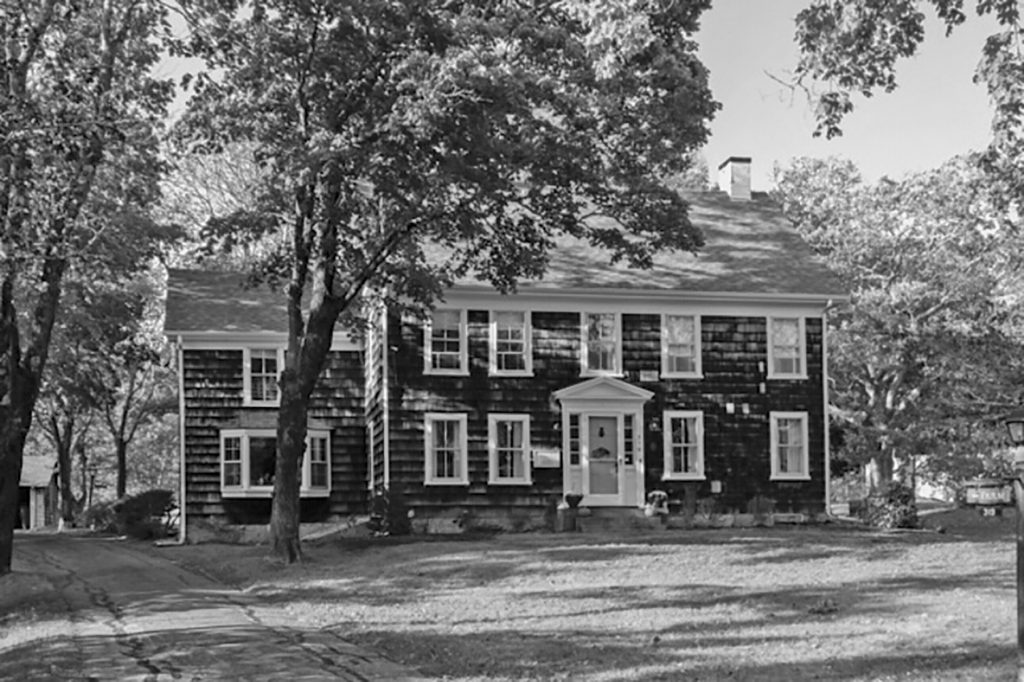
            The original house at 319 Wareham Street was a one-story saltbox built in 1775. A second story was added in the mid-1800s. Nathaniel Briggs of Rochester deeded the property to Joshua Dean of Wareham in the mid-1800s, who then gave the property to his daughter, Betsey, wife of Peleg Washburn. Their son, Horatio, was the next owner, followed by his son, Charles. The home next passed to Charles’s son, Ralph, and then to his son, Warren, and his wife, Ann. Warren and Ann’s son, Warren Washburn Jr., is the current owner and the sixth generation of Washburns to own this home.

Marion MA 2020

Community Center Will Soon Heat Up

            Marion Town Planner Gil Hilario told Monday night’s October 26 Energy Management Committee meeting that he has received official notice from the state giving Marion the approval to spend from the Green Communities grant.

            “We will start completing the projects very soon,” said Hilario. “They’re all small projects, except for the Community Center.”

            The Community Center will get heat pumps in all three of its rooms and will be tackled first. “Really, it’s a win-win because the grant is paying for 95 percent of the project cost,” said Hilario. “If you remember, heat pumps [were] a big question. It wasn’t part of our original proposal, and the work the committee did helped get heat pumps into that building.”

            The EMC’s desire for a net-zero Department of Public Works building is something that it accepts will not be on the table as the project seeks to get off the ground. But that does not rule out revisiting the matter.

            “I sensed that they weren’t ready to go to Town Meeting with that building,” said committee member Bill Saltonstall. Hilario heard from a selectman that it might be too expensive to tackle now, but maybe at the next one or two town meetings it can be addressed.

            Committee Chairman Christian Ingerslev said he sent a letter to Town Administrator Jay McGrail requesting he apply for a net-zero grant next year, and added the suggestion that ground-source heating be considered for some of the new DPW building.

            The EMC wants to see heat-recovery ventilation systems to increase the flow of fresh air in municipal buildings around town. “The Town House has no fresh air. I’d love to see them get some fresh air,” said Saltonstall, alluding to its old steam heating system. Saltonstall hopes Marion can get reimbursed for the expense by Coronavirus Aid, Relief, and Economic Security (CARES) Act funding.

            Ingerslev pointed out that the Town House uses substantially more energy than the Taber Library. Saltonstall pointed to the Town House’s lack of insulation. “They’ve done a wonderful job of sprucing up the outside of the building,” he said, noting that little heating units do not come with fresh air in the base models. “But these heat-recovery units will help a lot.”

            Taber Library, he said, was insulated in the early 1980s, but insulating the Town House would likely be too expensive with the removal of asbestos. Saltonstall suggested such an effort not be tackled until the town installs new electrical and plumbing systems.

            Now that the town is renting rather than owning at Atlantis Drive, Saltonstall said Marion might get 15 percent savings this year on energy use. “They know we’re waiting,” he said of the state. “Other than that, we’ve reported on projects we expect to be doing, i.e. a solar array on the site of the proposed Department of Public Works construction.

            The EMC has a 4:15 pm appointment during the Tuesday, November 3 meeting of the Board of Selectmen at the Marion Music Hall to officially request two vehicle charging stations. The charging station at Atlantis Drive was taken down after the sale of the building and is in storage.

            On October 6, Marion Police ordered a Ford Interceptor, a new hybrid police cruiser. “It’s great to get the first hybrid cruiser. We could pretty much replenish the whole fleet if they like the hybrid,” said Saltonstall.

            Rob Fisher has not heard back from the Massachusetts Department of Motor Vehicles in his effort to acquire the vehicle identification numbers that would help the EMC determine how many hybrid vehicles there are in town. This information is critical as the town considers adding electric charging stations.

            Hilario said that Eversource agreed to do a walk-through of the Wastewater Treatment Plant, and some rebates and incentive plans might become available.

            Along with the DPW project, the proposed Harbormaster building has drawn a lot of attention – not all of it positive.

            Saltonstall said that the building will add substantial energy use if built as proposed in a recent public meeting. He believes the current Harbormaster’s office would probably accommodate three people right now.

            “Great view, no one’s forcing us to throw these facilities away,” he said. “If these were on the list for some remedial work, I think the building would serve the Harbormaster for a long time. I’m personally opposed to a new building. Maybe most of the money is going to come from mooring fees. I’ve written a letter to the selectmen on this.”

            Saltonstall acknowledged issues with rusting railings and outdated insulation. “The town needs to have some toilet rooms that are open to the public. They’re serviceable,” he said. Ingerslev said few realize they are available to the public.

            Committee member Tom Fisher suggested the town target Green Community Program funds for Harbormaster renovations.

            Hilario noted that one of the reasons for the size of the structure as recently proposed is that the Seaport Grant funding brings the condition that space be made available to the public with an educational component.

            Towns now have additional incentive for solar installations that have battery systems as part of their overall energy. In such a scenario, Eversource would be connected and, during peak-load periods, would draw from the private batteries. The cost is $225 per kilowatt during summer months and $50 per kilowatt in winter months. Fisher said, “It has a tremendous payback,” though there are not yet state incentives. The federal government allows a 25 percent tax credit on purchases. Saltonstall said batteries are part of the solar project proposed for the landfill.

            The next and last 2020 meeting of the Marion Energy Management Committee is scheduled for Monday, November 16.

Marion Energy Management Committee

By Mick Colageo

School Buses Muddy Waters for Cranberry Highway Project

            The Rochester Planning Board addressed upcoming changes to the proposed development on Cranberry Highway in its meeting held on October 27. Phil Cordeiro, the project’s representative, came before the Planning Board once again after the project’s public hearing was continued numerous times.

            Despite the increasing number of delays stalling the project, Cordeiro explained that his business with the Rochester Planning Board should be coming to an end soon. Cordeiro provided a new plan sent to Field Engineering, the board’s peer-review engineer, to dispel concerns about the septic systems on the site. According to Cordeiro, the updated plans address all of the concerns put forth by Field Engineering, and Cordeiro is awaiting an official response to the new plans in order allow the project to move forward.

            With the septic system apparently resolved, Cordeiro mentioned a new problem on the site that he felt was important for the Planning Board to provide insight into. The Greater Attleboro Taunton Regional Transit Authority Bus Stop that is planned on the ring road leading into the site could raise problems. Cordeiro provided data to the Planning Board relating to the frequency of stops and potential traffic caused by the buses. Traffic consultants working with Cordeiro reported that GATRA buses will make four stops per day at the proposed stop. In addition, they informed Cordeiro that the buses will only make a stop at the location if someone flags down the bus. With that, the consultants advised Cordeiro that it was unlikely that the GATRA bus stop would cause any significant hinderance to the flow of traffic.

            The main difficulty with the bus stop at the site came when Cordeiro informed the Planning Board that discussions had begun surrounding the inclusion of a school bus stops at the GATRA location. After speaking with the bussing authorities, Cordeiro told board members that a shared bus stop between GATRA and Rochester schools is desired because school buses are directed to avoid private roadways wherever possible. The desire to avoid private roads moved discussions toward a shared bus stop rather than an alternate proposal of a specific school bus stop within the residential development.

            Combining the two bus stops into one location would raise problems. According to Rochester Planning Board Chairman Arnold Johnson, parents would likely line the ring road with their cars as they wait to drop off and pick up their children. Further, Vice Chairman Gary Florindo pointed out that a school bus requires all traffic to come to a halt in order to guarantee the safety of the children boarding the bus. These factors would undoubtedly cause large delays on the road where the stop is located and impede the traffic patterns of the development. Board members agreed that the combination of the two bus stops would not only cause traffic delays, but it could also present a safety risk for school children.

            Cordeiro echoed the sentiment of the Planning Board and explained his hope that the school bus stop could be moved into the residential area. Johnson told Cordeiro to add a location for the new bus stop into his plans for the board’s review. He also explained that he would speak with the Rochester schools in order to explain the importance of moving the bus stop, despite the new location being on a private road. With that, the Planning Board voted to continue the public hearing on the matter until its next scheduled meeting to allow Cordeiro time to find a new location for the bus stop.

            The Planning Board moved to a project which has already received an order of conditions to proceed: the Old Middleboro Road Solar Project. In their previous meeting, the Planning Board threatened action against the development as a result of a lack of required bonds and the developers working off of a plan set that was not approved by the board.

            Following that meeting, the Planning Board filed a Cease and Desist order against the developers and brought the project to a halt. Johnson explained that, on the day after the order was filed, the Planning Board received the required bonds. In addition, Field Engineering was able to review the new plans that included changes required by the Rochester Conservation Commission. According to Field Engineering, the changes in the plans did not constitute significant modifications to the development.

            Satisfied that their requirements had been met, the Planning Board voted to lift the Cease and Desist order on the project and allow work on the site to resume.

            The next Rochester Planning Board meeting is set to take place on Tuesday, November 10 at 7:00 pm at the Rochester Middle School, with remote access provided via Zoom.

Rochester Planning Board

By Matthew Donato

From the Files of the Rochester Historical Society

For people living in the 1600s and 1700s, the idea of encounters with all manner of spirits was accepted by pretty much everyone. Abraham Holmes, a well-regarded lawyer in Rochester, writes in his memoirs that, “Doubtless most of the stories which are told about witches and apparitions are ideal only and exist only in the imagination, but there is no argument against the existence of those beings”. He goes on to mention many instances of either himself or other respected community members who saw strange apparitions that vanished into thin air or who suffered some ill brought on by spectral beings.

            He tells of one old woman believed to have cause broken bones and dislocated joints to neighbors who refused to help her in some way. These misfortunes, he concludes, “could not be accounted for on any principal than witchcraft.” Bethiah Church, who ran the family tavern in Rochester, liked to entertain with wondrous tales of witchcraft, in which she believed. Another tale that appeared in a compilation of folktales, “The Narrow Land” told of a witch, Deb Burden, who lived in Rochester, and was said to have put a curse on the daughter of Thankful Haskell. The girl fell ill after sweeping under Burden’s chair and recovered after her father whipped Miss Burden when he came upon her in his garden. The big problem with this story is that there is no record of any Deb Burden or Deborah Borden ever living in Rochester at that time.

            However, even with all these stories of witches, devils, and spectral apparitions, the citizens of Rochester did not take part in the “witch hysteria” that occurred in other towns in Massachusetts. Indeed, Southeastern Massachusetts has few tales of witchcraft. Given that, it’s interesting to note that Rochester does have two locations tied to the supernatural. The best known is Witch Rock at the corner of New Bedford and Vaughan Hill Roads.

            This large rock contains many cracks and crevices, and one legend claims that on nights when the moon is bright, witches peer out from these ancient openings. The explanation most often given for the rock’s name is that sometime after the first settlers arrived, a meeting was arranged with the area Native Americans. It was to take place at the rock on a moonlit night. As they approached, they saw witches flying out of the cracks and fled the area in terror.

            Another rock off of New Bedford Road also claims a connection to an evil spirit. In a pine grove in the woods near a cedar swamp is Devil’s Rock. It gains its name from what appear to be footprints that go all the way to the top of the large rock and, of course, the explanation for the embedded marks is that the Devil left them there.

            Happy Halloween and be careful out there.

By Connie Eshbach

Marion Veteran’s Day Observance

The Town of Marion will honor veterans of all wars for their patriotism and willingness to serve in the military and sacrifice for our country at the Veterans Day Observance on Wednesday, November 11 at 11:00 am at Old Landing Memorial on Front Street. This short program will be followed by a lunch to go for Veterans offered by members of the Benjamin D. Cushing Community Center. For planning purposes for the lunch, veterans must call 508-748-3570