Sippican Historical Society

Marion (Old Rochester) is one of the oldest towns in the United States, and the Sippican Historical Society maintains an extensive collection of documentation on its historic buildings. In 1998, the Sippican Historical Society commissioned an architectural survey of Marion’s historic homes and buildings. Over 100 were cataloged and photographed. SHS will feature one building a week so that the residents of Marion can understand more about its unique historical architecture.

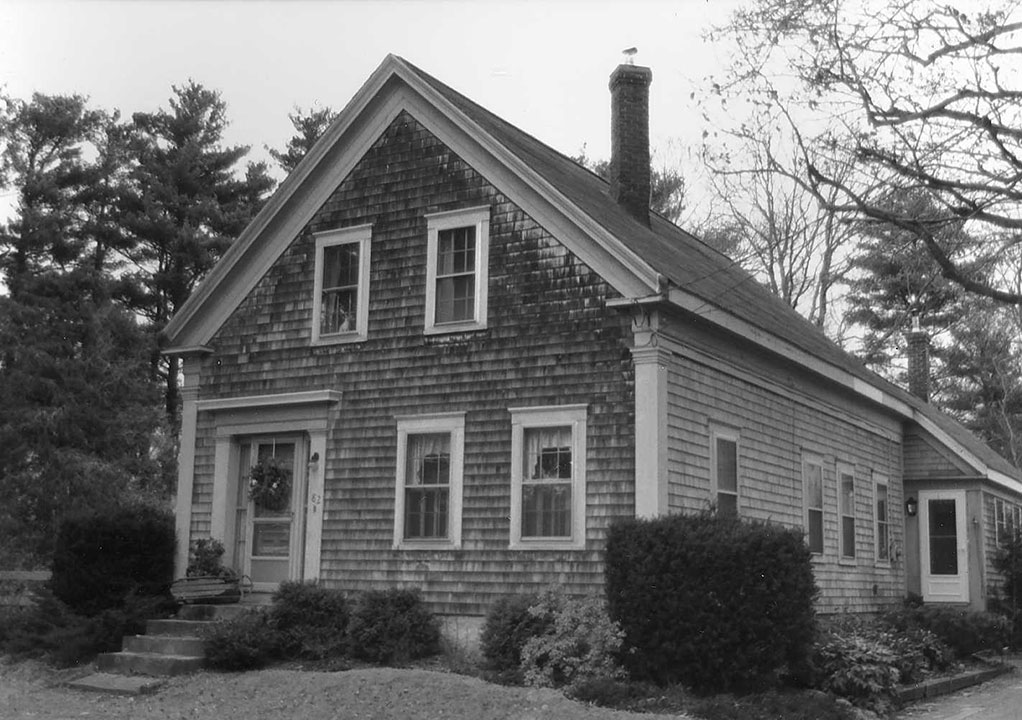
            The Greek Revival home at 82 County Road is located in North Marion. Its characteristic Greek Revival features include the gable-end facade, corner pilasters and wide entablature beneath the roof, and the original heavy entablature and sidelights in the entrance bay. Built between 1840 and 1855, this house provides a glimpse of a prosperous, mid-19th century miller’s homestead during a period characterized by the decline in the shipbuilding and whaling industries. It was owned in 1855 by Ezra S. Parlow who operated a mill on the pond across the street from this house. During the mid-1880s, Parlow served as treasurer of Marion’s Pythagorean Lodge, which was organized in 1861. The 1879 Marion map lists this home as owned by Nathan D. Parlow, who operated Nathan Parlow and Sons Grist Mill. In 1903, it was owned by Freeman F. Gurney, who resided at 202 Spring Street and operated a grocery store across from the depot.
“Tick Talk”: Preventing Tick Bites

Please join the Mattapoisett Land Trust and Blake Dinius, Plymouth County Extension Educator and accomplished entomologist, for a “Tick Talk” to learn about preventing tick bites. Blake will teach about tick biology, critical information for preventing bites and disease and will clear up any common misinformation about these bugs. Knowledge and awareness of ticks are crucial for us all to stay safe and healthy year-round!

            The talk will be held at the Mattapoisett Public Library’s community meeting room on Friday July 8 from 3:30 – 4:30 pm. There will be a presentation, plenty of educational materials distributed and ample time to ask questions and talk to Blake at the end of his talk.

            The “Tick Talk” is free and open for people of all ages, including residents of other towns. Start your summer off armed with information to keep you, your family and your pets tick-free. Contact manager@mattlandtrust.org with any questions about the event.

Brown Steps Down, Anticipates State Septic Regulations

The 2020 septic regulation spearheaded by Marion Board of Health chairperson Dot Brown that requires any new construction in town upgrade to include denitrification technology hit a snag during the board’s May 26 meeting when members Dr. Ed Hoffer and Vice Chairperson Dr. John Howard voted against Brown to grant an applicant a variance allowing a house expansion while retaining an existing Title 5 septic system.

            Brown resigned her position on the board effective June 14 and issued the following statement: “The Board of Health accomplished a lot while I was a member through some very
difficult times. One of my key objectives was to improve Marion’s open water quality. The Board of Health and the town made some good steps, but further progress depends on the full support of Marion’s town government and citizens, and that just isn’t there yet. I found it best to withdraw my efforts until the state imposes their regulations. I throw my full support behind those people continuing the work to keep our town beautiful, healthy and clean.”

            Howard announced Brown’s resignation in opening the board’s June 16 meeting: “On behalf of Dr. Hoffer and Lori (Desmarais, Public Health director/nurse) and Maureen (Murphy, administrative assistant) and myself, we would like to thank her very much for her time and effort, both to this board and also to the Town of Marion.”

            With that, Howard made a motion that he serve as chairman and Hoffer as vice-chairman and temporary clerk until the Select Board can appoint a new member to serve out the remaining year of Brown’s term scheduled to expire in May 2023.

            It has been a tumultuous 2022 for the Marion Board of Health. On the heels of massive volunteer efforts to vaccinate residents against COVID-19, the board’s other business turned volatile when several local businessmen expressed vehement opposition to a proposal for dumpster regulations that they insisted should not apply to them, considering the proposal emanated from complaints at two residential complexes and would leverage what local businesses consider unreasonable hardships on their operations.

            In response, Hoffer recommended a board member meet with local businessmen to hear their concerns in person and outside the limitations of a public meeting. He suggested the town go back to the drawing board and more accurately direct any further attempt at dumpster regulations toward the residential properties where the complaints were made.

            Soon thereafter, the town was without a health agent after the resignation of Ana Wimmer, who had been working for Marion on a part-time basis.

            Freshly reorganized to sink its teeth into the June 16 public meeting, Howard, the new chairman, and Hoffer, the new vice chairman, heard from recently retired Town of Wareham Health Director Robert Ethier, now assisting the towns of Marion and Wareham on a part-time basis.

Ethier reported on June 16 to the Marion Board of Health on problematic home inspections. He suggested town officials discuss the tougher situations with state authorities to ensure proper next steps.

            “I know the code very well and I know the law, but I just don’t want to go into another town … and just stir up a hornet’s nest. I want to do it right, and I want to help the people that are working with this,” said Ethier, telling the board he has been addressing six housing issues, among them a family with children living in a home with a mold problem created by water seeping in through a crack in the house’s foundation.

            A house on Pitcher Street, said Ethier, is dealing with a worsening problem of animals, rodents and insects invading the home through holes. He said neighbors told him they won’t let their children out at night because of the animals in the neighborhood as a result of the problem at that house.

            Ethier also reported an ongoing hoarding situation; Desmarais said the board was awaiting response to a letter sent to the owner of the property. Multiple citations were also made on a Front Street residence, and updates were given on several other properties.

            Howard thanked Ethier for his report.

            After a public hearing, the board voted to approve a septic-related variance requested at 162 Point Road. Representative Rick Charon described the residence as a seven-bedroom, waterfront home with work planned inside the 100-foot buffer zone to coastal bank.

            Desmarais reported 1,322 total Covid cases in Marion. As of June 16, there had been 17 documented cases for the month of June. Most are determined by home testing, Desmarais said.

            The board did not announce the date of its next public meeting upon adjournment.

Marion Board of Health

By Mick Colageo

What the Gravestones Said

On June 15, the Rochester Historical Society hosted retired educator and founding member of the Friends of the Middleborough Cemeteries Jeff Stevens, who has become something of a local expert on the topic of early American gravestone iconography. His talk was aptly titled The Story of Stones.

            Stevens started his talk at the very beginning when the colonists arrived. He said that we will never know where all the bodies are buried but that without a doubt they are buried everywhere in unmarked graves. He said that gravestones did not come into common use until the late 1600s. Before that time, simple wooden posts were placed at gravesites, many unmarked while others may have displayed the deceased’s name and date of death. Organic materials left to the ravages of Mother Nature didn’t last very long, he explained.

            Once formal grave markings came into use, slate was used. Stevens explained that the settlers were primarily Calvinists, whose beliefs were expressed by living a pious life. Stevens said Calvinists objected to religious art or iconography and whose members were referred to as “a good man” and women as “a good wife.” In spite of their austere clothing, homes and places of worship, Stevens said they “went wild” when carving headstones.

            The earliest symbols found on slate gravestones are skulls, bones or setting suns. Stevens said that while the early stone carvers did not leave behind instruction manuals on how to carve or even what to carve, the uniformity of imagery throughout New England speaks to a shared standard.

            As the decades went by and as religious beliefs evolved, gravestone images also changed. Replacing the simple and rather frightening carvings of skulls with hollowed eye sockets, mouth-openings that appeared to be screaming out and nearly absent noses, were more lifelike facial images. The carvers gave the skulls lips, eyes, noses and even hair, Stevens reported. Later still, the skulls were no longer featured but instead replaced by cherubs and angels. Death became a less horrifically represented event in human existence with the passage to the afterlife, if not hailed, at least far less darkly represented.

            Stevens noted that as people became more exposed to other cultures around the globe starting in the early 1800s, the art of Greece, Italy and even Egypt was incorporated into gravestone imagery. Urns, vines, weeping willows and rising suns, he believes depicting the resurrection, started to appear. He said that by the 1850s, there was far less iconography to be found on gravestones. He also said that the stones themselves changed from slate to marble and granite. At this point, Stevens suggested, “The stones stopped talking to us.”

            The position of bodies in graveyards was also discussed. Steven described how bodies were placed in graves so that when the “great awakening” came, the whole body would sit up before rising to heaven, facing east toward the holy lands.

            In concluding his presentation, Stevens offered the following titles for those interested in conducting further research into the gravestones of southeastern Massachusetts: “Early New England Gravestone Rubbing” by Edmund Vincent Gillon, Jr.; “The Masks of Orthodoxy – Folk Gravestones in Plymouth County” by Peter Benes; “Gravestones of Early New England and the Men Who Made Them” by Harriette Merrifield Forbes” and “Old Cemeteries of Southeastern Massachusetts” by Charles M. Thatcher.

            Rounding out the presentation was Rochester Historical Society member Kathy Phinney, who shared best practices for cleaning gravestones. “First and foremost, get permission,” Phinney said. Cemetery rules and regulations, along with familial ties to gravestones, need to be taken into consideration before cleaning should take place.

            But the biggest cautionary statement Phinney made was, “Do not use household products.” She explained that many chemicals in cleaning products are far too harsh for stone, which is porous. She suggested a product called D2 Biological Solution and further cautioned not be scrub the stones’ surfaces.

A quick look at the internet on this subject also suggests taking into consideration local temperatures to ensure that water does not seep into the stone and freeze, causing cracking to occur.

By Marilou Newell

Summer Activities at the MNHM

Coastal Explorations with the Marion Natural History Museum – During the Marion Natural History Museum’s Coastal Exploration summer program, we have fun exploring a variety of habitats in Marion. We take a close look at Barrier Beaches, Vernal Pools, Salt Marshes and tide pools. We learn about the types of Terns on Bird Island, the salamanders and tadpoles in vernal pools and net fish along our coastline. This is a half-day program, 9-12, and we meet at a variety of locations in Marion.

            We have a few slots remaining in our July 11-15 session and our August 1–5 session. Please go to the Marion Natural History Museum’s website, www.marionmuseum.org, to enroll in these and/or our other upcoming summer programs.

            Wild Care – Living with my Wild Neighbors! July 13, 2–3 pm – “Help! A bird struck my window… “There’s a baby squirrel at my doorstep… Now what?”  Wild Care, Inc. is a nonprofit wildlife hospital located in Eastham that is dedicated to the rescue and release of injured and orphaned wildlife on Cape Cod. Wild Care operates a Wildlife Helpline and rehabilitates over 1,800 animals per year; everything from Bald Eagles to Deer Mice. Wild Care’s Executive Director, Stephanie Ellis will cover “what to do” when you find baby animals in distress, who to call in MA and will provide tips for living with our wild neighbors. Join Stephanie for this fun and informative talk! Free program.

            Keep checking the Marion Natural History Museum’s website for other upcoming programs this summer.

Academic Achievements

Anne Le Gassick of Mattapoisett, Class of 2024 and Danielle Nutter of Mattapoisett, Class of 2024 were named to the College of the Holy Cross’ Dean’s List for outstanding academic achievement during the Spring semester of the 2021-22 academic year.

            Chase Guard of Marion has been named to the Plymouth State University President’s List for the Spring 2022 semester. To be named to the President’s List, a student must achieve a grade point average of 3.7 or better for the Spring 2022 semester and must have attempted at least 12 credit hours during the semester. Guard is a Business Administration major at Plymouth State.

            Congratulations to James Dwyer of Mattapoisett who graduated with a Bachelor of Science in Business Administration, Leadership and Innovation Management from Bryant University on May 21, 2022.

            Holden King of Rochester and Julia Winsper of Rochester have made the Dean’s List at Wentworth Institute of Technology for the Spring 2022 semester.

            Sarah Sirois of Mattapoisett, has been named to the MassBay Community College Dean’s List. Sarah Sirois, who studies Nursing, achieved this outstanding academic honor for the Spring 2022 semester.

            Sophie Lynch, daughter of Rachel and Stephen Lynch of Marion has earned Dean’s List honors at Providence College for the Spring 2022 semester.

Proposed Land Swap Continued

The June 16 meeting of the Mattapoisett Zoning Board of Appeals found the members continuing a land-swap application filed as a request for a Variance but advertised as a Special Permit. But that minor kerfuffle was not the primary reason the application was continued until July 21.

            Representing himself and his request for a land-swap variance was

Terrance Granahan, 0 Dupont Drive. Granahan said that he and an abutting neighbor wished to swap a small section of land that he believed would ultimately make the newly created lot capable of passing a percolation test for installation of a septic system. He said he had been before the Planning Board and had received its approval for the swap and movement of lot lines.

            A third party was not so keen on the idea.

            Coming before the board representing his client, Jessie Mendes, was David Davignon of Schneider, Davignon & Leone, Inc.

            Davignon alerted the board to multiple ramifications of Granahan’s land-swap plan. He said that if the board issued the variance, his client’s lot would be rendered unbuildable because the location of Granahan’s septic system would not allow 100 feet of separation to freshwater supplies. Davignon said that his client could not reconfigure his lot-development plans due to the placement of other wells on other abutting lots in the tightly packed neighborhood.

            Davignon also said that if the variance was granted, Granahan’s buildable, non-conforming lot would lose its grandfathered status because lot lines would be changed, meaning the newly created lot would have to meet current lot sizes, an impossibility for the undersized lot. That point surprised Granahan, who said he had not understood the impact his request would have on neighboring lots and his own.

            The case was continued at the request of the board to allow for further research by Granahan.

            Receiving a Special Permit on this night was Melissa Davies, 6 Bay View Avenue, for the construction of a deck encroaching on setbacks. Also receiving a Special Permit to construct a new home on an existing foundation was Joseph Paolini, 13 Shore Drive.

            The next meeting of the Mattapoisett Zoning Board of Appeals is planned for Thursday, July 21, at 6:00 pm if there are cases to be heard.

Mattapoisett Zoning Board of Appeals

By Marilou Newell

Museum Dives into Local Base

            The Mattapoisett Museum fits a lot about local history in its small, former-church space on Church Street. On June 15, the museum expanded that education with a detailed Zoom presentation on the early roots of American baseball.

            Historian and “The Folklorist” television show host John Horrigan revealed that the Northeast and New England had a lot of influence on what baseball is today.

            Baseball evolved from a variety of bat-and-ball games played in England prior to the mid-18th century. However, the modern rules for baseball as we know them were developed in the 1840s in New York by the Knickerbocker and Gotham clubs, made up, according to Horrigan, “of merchants, brokers and salesmen whom were at liberty after 3 pm.”

            In 1857, baseball enthusiast Edward G. Saltzman (and former second baseman for the Gothams) brought the game to New England when he moved to Boston from New York. In Dedham in 1858, he established what were known as the (short-lived) Massachusetts rules for the game and the first New England ball club, the MA Association of Baseball Players and its “Tri-Town Mountain Team.”

            With no opposing teams geographically available, the Tri-Town Mountains played against each other. That is, until the first baseball game played in New England happened in 1958 against a Portland, Maine, baseball club on the Boston Common.

            The popularity of the New York rules outgrew the slightly different Massachusetts rules, and by September of 1859, there were 16 baseball clubs in Massachusetts using the former, more popular baseball rules.

            In 1867, the Lowell Boston Baseball Club formed. The Harvard Club, baseball’s first collegiate team, formed and played the first collegiate baseball game ever versus Yale in 1868. On January 20, 1871, the Boston Red Stockings formed and won their league championships in 1872, ’73, ’74 and ’75.

            In 1876, the National League formed to oppose the American league to which the Boston team belonged. The Red Stockings won the first “National Association of Baseball” Championship in 1877 and again in 1878.

            Among New England’s first baseball parks, the South End (Boston) grounds at Walpole Street and Columbus Avenue opened in 1888; it was the game’s first double-decker stadium. Then the Huntington Avenue Grounds were built nearby at the former circus grounds where Northeastern University’s Nickerson Field now stands. It later became known as Boston Braves Field (part of the Braves Field bleacher construction is still evident at Nickerson.) The South End Grounds, which were twice reconstructed, were demolished by a fire in May 1894.

            The first World Series started on May 5, 1904, between what was then the Boston Americans and the Pittsburgh Pirates. The first four games were in Boston at the Huntington Avenue Grounds with Cy Young himself pitching for Boston. The next four games were played in Allegheny, Pennsylvania, at the Pirates’ home park, and the last game that won Boston the championship was played back in Boston.

            From 1907-1919, the Boston team’s name evolved from the Americans to the Doves to the Rustlers to the Braves to the Red Sox. The infamous Black Sox scandal in which the Chicago White Sox conspired to fix the World Series was planned on September 1919 at what is now the Buckminster Hotel in Kenmore Square, Boston.

            Toward the end of his presentation, Horrigan corrected the record on Babe Ruth’s sale to the New York Yankees in January of 1920. He said his research reveals that “My Lady Friends” (debuting in December 1919) not “No, No Nanette” as is widely believed, was the Broadway play that the Red Sox owner funded by trading Ruth to New York.

            For a link to this presentation and information on any of the museum’s other programs, visit mattapoisettmuseum.org.

By Michael J. DeCicco

Marion Garden Group News

Did you ever wonder who is responsible for planting and maintaining all of the cheerful window boxes and urns around Marion?  In addition to those boxes, new planters have popped up along busy intersections and transformed dusty corners into oases of beauty and color.  Volunteers of the Marion Garden Group are the ones dedicated to caring for the beautification projects of Marion. Non-members are welcome to volunteer as Planter Angels too! For information, check the website: www.mariongardengroup.org

            At the Annual Meeting of the Marion Garden Group held recently, outgoing president, Liz Hatch, thanked all those who have supported MGG’s many activities.  The new Board of Directors include: Suzy Taylor, president; Sarah Mitchell, vice-president; Phyllis Partridge, treasurer; Lindy Williamson, secretary; Sylva Strand, programs; Kathleen Egger, membership; Wendy Bidstrup, publicity and Liz Hatch, past president.

            In addition to the window boxes and plantings, MGG supports community activities and made contributions to Council on Aging, Elizabeth Taber Library, EmpowerORR, Marion Art Center, Sippican Lands Trust and the Tree Committee.

            Membership dues and donations, plus special events and fundraisers make it all possible. Various committees work year round in preparation for the Annual Holiday Boutique and Wreath Sale.  There is a Plant Sale in the spring, a Semi-annual Garden Tour in the summer and various programs open to the public with MGG partnering with other nonprofits like Art in Bloom at the MAC and a lecture at the Music Hall with Sippican Historical Society.

            For more information about the Marion Garden Group, go to the website or speak with any of the workers in pink safety vests or green aprons carrying watering cans, clippers and bug spray.

St. Philip’s 138th Summer Season Begins

St. Philip’s Episcopal Church, by the Town Beach in Mattapoisett, will begin its summer season with visiting clergy on June 26 through September 4. Services will be held at 8 and 10 am using the 1928 Book of Common Prayer. All are welcome!

            Schedule:

June 26: The Rev. Jay James, Retired Rector, St. Timothy’s Church, Raleigh, NC.

July 3: The Rev. Philip C. Jacobs III, Retired Rector, Trinity Church, Canton, MA

July 10: The Rev. Robert Malm, Interim St. Peter’s on the Canal, Buzzards Bay, MA

July 17: The Rev. Benjamin Straley, Rector, St. Stephen’s Church, Providence, RI

July 31: The Rev. Benjamin Straley

August 7: The Rev. Marc Eames, Priest-in-Charge, St. John’s Church, Vernon, CT

August 14: The Rev. Marc Eames

August 21: The Rev. Eric Fialho, Rector, St. Gabriel’s Church, Marion, MA

August 28: The Rev. Jeffrey Paull Cave, Retired, Diocese of Atlanta, GA

September 4: The Rev. Jeffrey Paull Cave