Hockey Unlimited Wraps Up Season

At the end of the season at Tabor Academy, Hockey Unlimited presented three special recognition awards.

Max Ohrenberger of Rochester received the Most Improved Player award. Tim Dyer, Managing Director & Head Coach of Hockey Unlimited, stated while presenting the award, “Max has shown that hard work and dedication can pay handsome dividends.” Dyer went on to say “Max’s skating and related hockey skills have improved almost every session he’s been with us. We are pleased to have him on our roster.”

The Hutchinson Family Sportsmanship Award was presented to Sophie Schiappa of Wareham. This award is named after the longtime Southeastern Massachusetts hockey family for “outstanding contributions to the program relative to sportsmanship and preserving the true spirit and ‘love of the game’ of hockey.” Coach Jim Hutchinson, Jr. stated “I am very pleased to see Sophie recognized by Hockey Unlimited in this way. The sportsmanship, fellowship and friendly spirit she brings to our organization clearly contributes to the culture we like to see in our young people – both on and off the ice.” Jim Hutchinson, Sr. the patriarch of the Hutchinson family, was on hand to present the award to Sophie … whose father, Skip, and sister, Norah, are also very involved with the program.

Also, the Comeback Player of the Year award was presented to Alicia Wohlgemuth of Halifax. Coach Patrick Hutchinson (and Hockey Unlimited Hall of Famer) noted … “I’ve had the opportunity to work closely with Alicia the past few years, and it was impressive to see her bounce back so strongly this season after a nasty knee injury shortened her time on the ice with us last year.”


Ellen Christian Keogh

Ellen Christian Keogh, 73, of Marion passed away on Tuesday, March 6 of a cardiac event in Coral Bay, St. John, USVI.

Ellen was born in Falmouth, MA in 1945. She married her husband, Joseph Patrick Keogh, in 1974 and moved to Marion, MA in 1979 where they raised two boys, Sean and Timothy.

Ellen graduated from Mass General School of Nursing and taught nursing at Children’s Hospital in Boston. She went on to get her Masters Degree in Nursing at University of Colorado in Denver. She joined UMass Dartmouth’s College of Nursing faculty in 1975, teaching a course on nursing care of children and provided clinical supervision in pediatrics at St. Luke’s. She served as department chair before being appointed director of the University’s Academic Advising Center. She was awarded the Yvonne Sandstone Award for her commitment to the success and retention of first year students.

In her retirement, Ellen continued to support the community, volunteering at the SMILE program, the Memory Cafe, Marion Visiting Nurses Association and Marion’s Council on Aging. She also served as unofficial health care proxy for her family and many friends.

In her free time, Ellen also kept busy, traveling and sailing with her husband and playing tennis with friends. She had recently taken up pickleball – a game she boldly declared to be “the sport of the future.” She enjoyed gardening both at home and in her children’s yards. In her quieter moments, Ellen loved watching the hummingbirds in her garden, reading her book club books, and texting with her granddaughter.

Ellen is survived by her husband, Joseph; her children, Sean and Tim; her grandchildren, Cecelia, Martin, and Olive; her brother, John Christian; her beloved cousins; and the countless friends that she considered family.

Services will be held at St. Gabriel’s Church in Marion, MA at 2:00 pm on Friday, March 16th. Light refreshments will be served in the parish hall following. In lieu of flowers, it was Ellen’s wish that donations be sent to the Woods Hole Library.


Library Project Approval is in the Books

On March 5 with a light agenda, the Marion Planning Board dispensed with two hearings, giving the green light to the Taber Library Improvement Project and approving a residential pier off Delano Road.

Library Trustee Bob Raymond, accompanied by Board of Trustees President Jay Pateakos, began the presentation of the pre-submission conference Site Plan Review of the Elizabeth Taber Library Improvement Project with a brief history of its genesis.

Over a year ago, a donor approached the library trustees offering to fund building accessibility improvements, specifically the installation of a ramp, benches, and new automatic door operators. The trustees worked with the donor, Ms. Peggy Repass, on the design for the library, which is loosely based on the public library courtyard in Camden, Maine.

The design of the stone benches in particular captured the imagination of Planning Board member Will Saltonstall. After Raymond let on that the titles of decorative stone books that would form the supports for the benches had yet to be selected, Saltonstall suggested, “Donate money, you get to name a book!”

Repass resides in Florida in the winter, returning to Marion in June, giving hope that the project could be completed by then.

Planning Board Chairman Eileen Marum suggested tying-in the Taber Library improvements with the Town House project, “…coming together as one campus.” Raymond agreed, pointing out that the sidewalks were designed to intersect with the Town House pathways.

With few comments on design details, next up was procedure. Saltonstall questioned whether a minor Site Plan Review was applicable to this project, asking the applicants if Building Commissioner Scott Shippey had suggested they come before the board. Project architect Erica Patten of T2 Architects in Marion acknowledged that, due to the fact that the project was publically owned, they wanted to make sure all the bases were covered.

Planning Board Vice Chairman Stephen Kokkins observed that there were no drainage issues and no traffic concerns, affirming Saltonstall’s question of applicability of a Site Plan Review. Board member Norm Hills referred to the bylaws stating that the project was not a building or a structure or a change of use, and the access structure was less than 500 square feet in area.

Board member Andrew Daniel, who is a vocal supporter of creating accessibility and ADA compliance, first stated “You won’t find a bigger supporter than me,” but he was cautious, citing a concern that it might appear that the board was letting the project move forward because it was a Town project. Hills responded that the board was following the letter of the bylaws, which seemed to satisfy Daniel.

After a brief discussion in which the board was assured of the reuse of the beautiful pink granite steps on site, the board voted unanimously that there was no need for a Site Plan Review.

Architect Patten was heard saying after the vote, “That will certainly help getting it done by summer!”

Engineer David Davignon of N. Douglas Schneider and Associates, Inc. came before the board briefly to tie up loose ends from the previous public hearing for the Special Permit for a pier as an accessory use for Carolyn G. Martin at 282 Delano Road. Davignon provided the board with a new project narrative that corrected a previous reference to the old bylaws. In addition, Davignon informed the board that the public hearing for the project had been closed by the Conservation Commission last week, and the project received a verbal vote of approval. He is awaiting the paperwork, which he will provide the board upon his receipt. Kokkins confirmed that the plan before the board was identical to the plan they had seen at the previous meeting. The board approved the pier, with standard pier language that had been reviewed by town counsel.

In other business, discussion turned to old business, and the issue of the marijuana moratorium was raised.

“The town passed the moratorium – now comes the hard part,” said Hills.

Marum declared that the Board of Health had already developed bylaws which were before town counsel, which Daniels questioned – “They’ve already written one (sic)?” Marum clarified that the board had a template.

Kokkins asked about the timeline leading up to December 31, and Hills reminded the board that the Town was waiting for the state regulations, which were due March 15.

Board member Chris Collings wondered aloud about the Town’s economic opportunity in licensing the marijuana establishments, saying, “This could be worth a few dollars – it’s a cash-rich business.”

Collings later stated, “[This] prospective business has to have a security plan; local police need resources to review this. Could this be a ten thousand dollar license? Could it be renewable? [The police] need to review [the security plan] each year? My comment is to get as much out of this as we can.”

Marum interrupted Collings’ musings with a terse, “We are the Planning Board. We are not in the business of selling marijuana.”

Daniel weighed in, saying that he agreed with Collings in that “the Town should benefit.” Collings added, “At least make sure we cover our costs.”

The licensing fees are set by the state, however, and so far, stated in the draft state regulations, the percentage the town receives would be defined within a tentative Host Community Agreement. Marum pointed out that the so-called community impact fee could be as much as 3% of gross sales, but the Town would need to provide documentation to justify that amount. Marum reiterated, “There are a few things that need to be ironed out.”

The next meeting of the Marion Planning Board is scheduled for March 19 at 7:00 pm at the Marion Town House.

Marion Planning Board

By Sarah French Storer


Old and New Collide at Town House Forum

Call it the largest turnout for the Marion Board of Selectmen in years. Hundreds gathered at Sippican School on Thursday for the first glimpse of a proposed plan to construct a town administrative office building on the grounds of the Benjamin D. Cushing Community/Senior Center – a project with a price tag of about $1.8 million less than renovating the historic Town House. But the debate amongst residents and town committee members went deeper than expensive versus less expensive; the more divisive aspect of the issue turned out to be modern versus history.

Tasked with conducting a feasibility study to build a town administrative office rather than renovate the Town House, the Town House Building Committee Subcommittee – with the $35,000 approved by Town Meeting – delivered its results on March 1, proposing an 8,500 square-foot, $5.1 million “21st Century building” touted as the “less risk,” less expensive, “straightforward building design” alternative to renovating the Town House.

Designed by LLB Architects, the one-story building would be placed adjacent to the community center and sit right along Route 6 with its own 34 parking spaces near the entrance. The right side, wooden horizontal shiplap exterior wing would align with the community center at a slant towards Route 6; the main entrance and stone exterior left side wing would align parallel with the road.

Just inside the main entrance would be the 30+ person meeting room and across it the town administrator’s office and selectmen’s secretary. Most frequented offices such as the Building and Planning Departments, Town Clerk’s Office, and the health and public nurse’s office occupy the right wing and are also accessible via two side entrances – one by the community center and one to the left alongside the new parking lot.

“We hope that its simple construction – not pretentious,” said co-chair of the subcommittee Rob Lane, “hopefully says ‘welcome’ and this is the house for all citizens of Marion.”

Alan Minard, co-chair of the subcommittee and Chairman of the Finance Committee, emphasized that new construction is less risky than a renovation, in both time and cost. Furthermore, the existing Town House could be sold to a condominium developer and solve a growing need for smaller-scale living in town, while adding enough of a tax base to support $1 million in debt, Minard said, adding that Marion ranks 7th in highest debt per capita out of the 351 Massachusetts municipalities.

“I think we need to be very careful about acquiring new debt,” said Minard. He called this design a “reasonable building,” as he concluded his presentation.

Breaking it down, the hard costs (building materials, interior finishes and fixtures) would total $4,122,160; soft costs (interior furnishings, equipment, computers) amounted to $985,400 for a total of roughly $5.1 million.

Re-introducing the Town House Building Committee’s nearly $8 million project to renovate the Town House was that committee’s chairman, Bob Raymond.

Community Preservation funds totaling just over $1 million would reduce the borrowing amount to $6.9 million, said Raymond, which would amount to an average ($400,000 home) tax burden of $136.91 for a 20-year loan or $104.14 over a loan period of 30 years.

The 11,255 square-foot (8,295 sq. ft. functional, 2,960 sq. ft. basement storage) plan includes demolishing the inefficient annex addition built in 1890, while completely gutting the interior of the original 1876 structure “down to the beams and studs” – a move that would reduce much of the common risks of renovations, said Raymond. “There’s a lot less unknowns.”

Erica Patten of T2 Architecture gave an overview of the renovation plan, which includes a new, “less dysfunctional” interior layout, handicap accessibility (wider entries, elevator to all four floors), expanded parking, and efficiency upgrades to utility systems.

On the first floor is the 24-person meeting room with double doors, along with the most frequently visited offices (town clerk, tax collector) and harbormaster and Assessor’s Office. On the second floor are conservation, planning, building, public health/nurse, and accounting. The third floor, mostly admin, houses the town administrator, selectmen’s office, and finance.

Breaking down the costs: hard costs account for $6.5 million and soft costs total $1.4 million. In addition to the $1 million is CPC funding, the tax burden, said Raymond, would be further reduced when school debt retires in 2026. But any further delay in a decision, Raymond emphasized, would cost the town an additional $400,000 for every year of inaction.

In preparation for debate, Raymond laid out the pros and cons of adopting the Town House renovation plan, such as the “white elephant building” problem like the one Fairhaven now faces with two unoccupied historical schools (one under contract with physical progress still two years away) that no one wants to buy and the town still must maintain and fund. Not to mention, he said, relocating the town hall would change the character of the village.

“This historic building has the character and preeminence appropriate for the center of town,” said Raymond. “Removing the seat of government from a pedestrian-centered village to an automobile-centered site will change the entire character of our town.”

Furthermore, he said, adding residential units at the town house building would increase the demand on town services.

“This is a special building, and it needs special treatment. When you walk through the front door of this building,” he said, you wouldn’t see the old, tired, inefficient town house you see now. “It’s gonna be wonderful.”

Raymond referred to a prior town-wide mailing that resulted in 900 responses, 55% of which supported a Town House renovation.

Public response was equally divided – passionate on one side, pragmatic on the other.

Resident Joe Zora called the Marion Town House “home” and lamented, “for God’s sake,” regarding the notion of transforming it into another condominium in the village of Marion.

“Then we can end up calling this ‘condo village,’” said Zora. “Pretty soon we won’t have a village anymore. My God, please don’t do this.…”

A $1.8 million difference in cost didn’t concern resident Ron Wisener when it came to honoring Elizabeth Taber and preserving the Town House. “Elizabeth Taber was responsible in large part for the character of Marion.… I agree with Mr. Zora about our heritage and our legacy.”

Resident Lee Vulgaris said, as a former Finance Committee member, he is aware of the impact on taxes as well as the fact that the Town should have implemented better long-term planning. “The decision comes down to intrinsic and intangible value; not so much the money,” said Vulgaris. “I like the beauty of the Town House,” he stated, adding that he also liked the new construction plan design. “But I have to say that I don’t think … we should just weigh it just on money.”

Bill Washburn rose to speak but first had to pause, saying, “This is tough for me.”

“Mr. Zora hit it on the head,” said Washburn with emotion. “Families that have been here a long time have a lot of history with that building, and it seems a shame that we just let it go.” Washburn continued, “Once it’s gone, it’s gone.”

Planning Board member Andrew Daniel said he understands the emotional ties to the building, which he hasn’t yet formed as a resident of fewer years. He said he likes the current location of the Town House, “But we’re kind of kicking the can down the road,” with building costs increasing every year. “We don’t know where we are with our sewage and what that’s going to be… We have other needs. We need a highway barn; we’ve got equipment sitting out in the rain.”

Something has to be done, Daniel said, “But the overall cost of living in this town is really starting to scare me.” Daniel wondered if tearing the Town House down and rebuilding one in its likeness would prove more economical in the scope of all the “red flags” Marion now faces.

Other residents’ comments pointed out, for example, that perhaps the $1 million in CPC funds would be better spent on the library, and that village-style pedestrian infrastructure is still not in place to encourage that aspect of the Master Plan when it came down to moving the town offices outside the village and across Route 6.

“I personally would not like to see it on Route 6,” said former selectman Jon Henry. “It’s more than just getting to it that bothers me.” He said the Route 6 site would be better suited for a future new fire station when the need arises.

Energy Management Committee member Bill Saltonstall said that while he was out in the village with consultants from California surveying the LED light transition, one of them said, “This is a beautiful town. This is really special,” Saltonstall spoke. “And I think we’ve just got to fight to keep these things here and keep the village thriving here now.”

“The Town House, like it or not,” said resident Peter McCormick, “is the centerpiece of the Town of Marion, and to turn that over to outside developers and lose control of that centerpiece to me would be a huge error – and once made is irretrievable.”

Retired Sippican School teacher Diane Cook said one of the highlights of teaching at Sippican has been leading third-graders on a walking tour of Marion’s historic center. “I’m not looking for taxes to go up, but I think we will find it – the money,” said Cook. “I think this is a very important project. I think we should preserve this building and we’ll find the money.”

Linda Goodwin recalled how she preserved her historical home, and said, “It’s too bad that I’m not willing to kick a building like that to the curb. I feel that it’s part of the town and … shame on us for not taking care of it.”

A few further comments were in favor of the new design, with one resident referring to the Town House as “a dilapidated building,” and another stressing, “A building’s function is more important than how you look at it.”

Resident Kathy Reed briefly commented that she does not yet know which option she prefers, but added that while she was looking for a small-scale residence in Marion she could not find one. “I looked for a condo … for a year and a half and was unable to find one,” Reed said.

“The option that we presented was fully [calculated] yesterday at noon,” said Minard. “A lot of Marion taxpayers are not here. They are the folks that need to have some exposure to this so when they go to the ballot box … they understand what they’re doing.”

Minard asked the selectmen to take the matter under advisement long enough to “give it a chance to percolate in the community.”

Selectman Jody Dickerson stated at the start of the forum that the Board of Selectmen would consider the options and consider them both while preparing articles for the Annual Town Meeting in May.

By Jean Perry

March Book Sale at Mattapoisett Public Library

The Friends of the Mattapoisett Library will be holding their Second Saturday Monthly Book Sale on March 10 from 10:00 am until 1:00 pm, downstairs at the library, 7 Barstow Street. Stop in to browse our great selection and buy a “Bag of Books” for $15.

The Friends wish to thank the many donors who keep the library supplied with quality book donations. Book sale proceeds enable the Friends to sponsor many of the special programs offered at the library and to make special purchases of books, museum passes, equipment, etc. Book donations are accepted at the library circulation desk during regular library hours.

The Friends of the Library is a 501(c)(3) nonprofit group of volunteers created to support the library. The Friends always seek adult volunteers to help with setup and during the sale, as well as help with various library events through the year. To become a member of the Friends of the Mattapoisett Library, inquire at the book sale or look for our membership forms located at the library circulation desk.

Honor the Flag

To the Editor:

I have noticed many flags this week and weeks past being flown in a worn or ripped state. The U.S. Flag Code states that “the flag, when it is in such condition that it is no longer a fitting emblem for display, should be destroyed in a dignified way, preferably by burning.” Each year on Veterans Day, the Boys Scouts have a flag burning ceremony. They collect flags all year long and have a box outside of the Mattapoisett Library to place the worn flag. Please take a moment to look at your flag and replace if worn. If flying the flag is important to you, show it the respect it deserves.

Thank you,

Lisa Hill, Mattapoisett


The views expressed in the “Letters to the Editor” column are not necessarily those of The Wanderer, its staff or advertisers. The Wanderer will gladly accept any and all correspondence relating to timely and pertinent issues in the great Marion, Mattapoisett and Rochester area, provided they include the author’s name, address and phone number for verification. We cannot publish anonymous, unsigned or unconfirmed submissions. The Wanderer reserves the right to edit, condense and otherwise alter submissions for purposes of clarity and/or spacing considerations. The Wanderer may choose to not run letters that thank businesses, and The Wanderer has the right to edit letters to omit business names. The Wanderer also reserves the right to deny publication of any submitted correspondence.

CPR Class

Learn how to save life. Restaurant crews, retail workers, school teachers and staff, spouses, parents, babysitters, everyone should get trained. Most people who experience cardiac arrest or choking at home, work, or in a public location need immediate help from someone on the scene. Be ready. Sign up for the Heartsaver CPR AED and Choke Save class on Monday, April 2 from 6:00 to 9:00 pm. Cost is $35 or $45 if you want a card. Located at COA entrance at Center School, 17 Barstow Street, Mattapoisett. Register by calling 508-758-4110 or by e-mailing to: coadirector@mattapoiset.net.

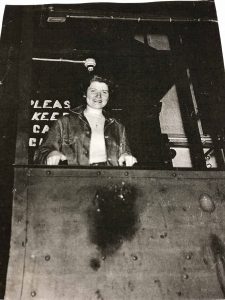
Eunice C. (Mullen) ‘Rosie the Riveter’ Manduca

Eunice C. (Mullen) ‘Rosie the Riveter’ Manduca: January 22, 1924 – March 4, 2018. The following is an excerpt from a piece Eunice wrote on her 80th birthday for the ‘Rosie the Riveter’ exhibit at the Smithsonian in Washington D.C.

“As a graduate of Boston Girl’s High in 1942, I planned to enter Nursing School at Boston’s Mass General Hospital, but when a recruiter addressed our class and emphasized the urgent need for defense workers to help in the war effort my plan changed. Instead I took the Civil Service Exam and was assigned to the Watertown Arsenal as a machine operator and then to the Navy Yard in Charlestown.

I had never seen an overhead crane before I arrived at the Arsenal and quickly became fascinated by the monsters which were used to move enormous gun barrels from one huge lathe to another or to trucks for transport to other buildings. The crane was a doubled steel beam that spanned the entire shop area and ran on railroad tracks at a height of 40 feet for the entire length of the building (about 2000 feet). To get to the cab I had to climb a straight steel ladder on the side of one of the support beams and then climb over a couple of steel girders to get to the ladder that went down into the cab. At the age of 18 years it was exciting! At my present age of 80, it would be terrifying!

As with any job that may involve life-threatening decisions, it’s very important that the crane operator and rigger work well together. The rigger is the worker on the floor who connects with cables and ropes, any heavy pieces so they can be safely moved. Because of the noise level at the Navy Yard my rigger and I developed a system of hand signals and became an outstanding team. After working together for six months, my favorite rigger, Salvatore Manduca, was called into the Navy. We waited until the war was over to get married on August 30, 1945.

As servicemen returned from the war, women were happy to return to their traditional jobs of raising children, but were always proud of their ‘Rosie the Riveter” days. My nursing career kept getting postponed as seven babies arrived.

All who took part in the ‘Rosie the Riveter’ jobs in the 1940’s certainly demonstrated the ability of females to successfully step into positions that were previously thought to require male brawn. I like to think that the dedication and enthusiasm that we brought to the work at that time was the beginning of female emancipation. Today, 65 years later, no one is surprised that many women are capable of handling a full time job – from a factory worker to a major business executive, to a nurse, and still be a capable and loving mother, cook and housekeeper.”

Eunice was an avid sailor and horsewoman. Some of her activities included: School committee/Upper Cape Tech, League of Women Voters, Coast Guard Auxiliary, Habitat for Humanity, Sippican Women’s Club and Tobey Hospital Volunteers. In 2002 she was “Marion Woman of the Year.”

In lieu of flowers, may we suggest donations to the Rosie the Riveter Trust or Alzheimer’s Association at 480 Pleasant St., Watertown, MA 02472.

Her visiting hours will be held on Saturday April 7th from 9-11:30 am at the Saunders-Dwyer Mattapoisett Home for Funerals, 50 County Road, Route 6, Mattapoisett. For directions and guestbook, please visit www.saundersdwyer.com.

District Reinforces Safety at Sippican School

Marion Police Chief John Garcia is working more closely with Sippican School Principal Lyn Rivet and school staff on reinforcing security at the school, which Rivet detailed for the Marion School Committee on Wednesday, February 28.

The school has already implemented a stricter policy for visitors to the school, requiring them to present identification before being permitted access. For larger events, the school will continue to require visitors to RSVP and provide IDs upon entry. Visitors may not enter with pocketbooks, bags, or backpacks, and anyone dropping off bags of school supplies will be instructed to leave them with administration at the main office for pick up.

All Tri-Town school districts are implementing School-Check-In to scan the licenses and identifications of visitors, and a stick-on tag will be printed for visitors to display while inside the buildings.

Rivet said she met with Chief Garcia that day, as well as the Tuesday prior when she said she “bounced ideas off” the chief to yield new ways of integrating a police presence within the school with a visibility that is positive for the students.

“I appreciated his openness,” Rivet said. “And as an immediate extending of new collaboration, parents and children can expect to have a lot more visibility in the building at lunch times and at recess times.”

The chief, Rivet said, “…Wants to be part of the school.”

“He expects to see [the officers] playing games with the children at recess,” said Rivet, “so families can look forward to that. I think that will be a wonderful visibility.”

Superintendent Doug White said he has met with Rivet recently at school about playground safety and security and how to manage that space more effectively. White said he would be returning to the committee later with further details on security strategies during a future executive session.

“On Friday, all schools discussed current strategies dealing with a person who may get into our building or someone who doesn’t belong there … or an active shooter,” White said. “There’s more to be done by all of us to make sure that we’re all on the same page, so we’re working towards making sure that all of our schools are safe.”

Furthermore, said White, Garcia is working towards providing “assurance of safety of all our buildings.”

White added that parents who may be concerned about their children, including behavioral concerns, should contact the principal, the school psychologist, or even the school nurse.

“Thank you for all the work that you’ve been doing … to make sure that this continues to be a wonderful and safe place to come to school every day,” School Committee Chairman Christine Marcolini said.

In budget news, just ahead of meeting with the Marion Finance Committee later that evening, School Business Administrator Patrick Spencer told the committee they would be presenting FinCom with a fiscal year 2019 budget of $6,058,000 – an increase of $129,000 or 2.09% from the FY18 budget of $5,929,000.

The main thrusts of the FY19 budget, as Spencer put it, are the areas of social/emotional development and technology – “Two areas that we’re trying to move forward,” said Spencer. This part of the budget includes adding .4 to the integrated teaching position, plus another .2 to the physical education position “to enhance the health program and well-round the physical education program.”

“This will also help to ensure that the children are getting the response to intervention that they need,” said Rivet. “Children will also be getting the academic services that they need … instead of missing a trimester.” Some students, said Rivet, are not receiving health education because they are receiving other needed services during that time.

The district is also responsible for funding the Bristol County Agricultural High School tuition for students who attend from outside that school’s district. The district is budgeting for three students to attend Bristol Aggie next year, although that number could go up or down. The rest of the increases fall under staff contractual agreements.

“The budget is a really good one,” said Marcolini. “I think it’s solid and it’s what we need at this point.”

The next meeting of the Marion School Committee is scheduled for April 11 at 6:30 pm at Sippican School.

Marion School Committee

By Jean Perry


Everyone’s Irish at Open Table

Celebrate St. Patrick’s Day a little early at Open Table on Friday, March 9 at the Mattapoisett Congregational Church! The menu is a surprise but it will be something delicious, likely something green, as in vegetables, since it is also the Lenten season. There is no charge, although donations are gratefully accepted. At Open Table, it’s all about the food, fun and fellowship. Doors open at 4:30 pm and the meal will be served at 5:00 pm. This is a community-wide event and everyone is welcome.