Conservation Restriction Pending For Estabrook Property

“It’s a vegetation community you don’t often get to see.”

This statement was made by Rochester Conservation Agent Laurell Farinon as she explained to the Rochester Conservation Commission on March 20 the benefits the town and its people will enjoy for generations to come when the Estabrook Property is purchased and placed in permanent conservation restriction status.

Rochester Land Trust President Robert Lawrence was on hand as Farinon shared with the commissioners and the viewing public the scope of the property acquisition and the responsibility the commission will have as holders of the restriction.

The RLT, in partnership with the Buzzards Bay Coalition, has been negotiating and applying for grants to cover some of the costs associated with acquiring the over 70-acre parcel that is home to a natural cedar swamp known as the Walnut Plain Cedar Swamp. Two grants totaling $165,000 have been secured, Farinon said.

Farinon asked that the commissioners invite Alan Decker of the Buzzards Bay Coalition to the first meeting in April to officially sign the document.

Before moving on that request, Farinon explained that while the property will be in a protected status through acquisition by the RLT, the Rochester Conservation Commission would be holding a conservation restriction as well. She said this second level of protection provides “protection from future development.”

As the commissioners reviewed the conservation restriction document, Farinon directed their attention to the section that provides for local reserved rights. Those rights, she explained, were for the “things we’d want to do now and in the future.” Such things as clearing trails, allowing horseback riding, hiking, other forms of passive recreation and forest management were discussed. It was also suggested that given the nearly pristine nature of the cedar swamp, it might be an ideal location for non-invasive scientific study.

The commissioners moved to invite Decker back in April for the official signing.

Also coming before the commission was Meagan Davis of Tata and Howard Engineering, representing the Town of Marion.

Davis came before the commissioners to discuss an in-field plan change that occurred as contractors were constructing a new freshwater well in Marion’s well field near Mary’s Pond.

Davis said a well had been drilled some 4 feet closer to the bordering vegetated wetlands than had been originally permitted and guidance was now needed on next steps.

After some discussion, Farinon suggested there were two options for resolving the unpermitted change: give the town an amended order of condition to the previously permitted Notice of Intent or have them file a new NOI.

The commissions moved to allow an amended order of conditions with submittal of updated documents.

The next meeting of the Rochester Conservation Commission is scheduled for April 3 at 7:00 pm in the Town Hall meeting room.

Rochester Conservation Commission

By Marilou Newell
 

Sippican Historical Society

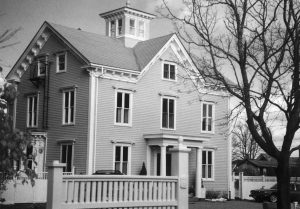
In 1998, the Sippican Historical Society commissioned an architectural survey of Marion’s historic homes and buildings. The survey was funded one-half by the Sippican Historical Society and one-half by the Massachusetts Historical Commission. Because of the limits of funding, not all of the historic buildings were surveyed, but over 100 were catalogued and photographed. The results of the survey are in digital form on the Massachusetts Historical Commission’s website and in four binders in the Sippican Historical Society’s office (and at the Marion Town Clerk’s office). Marion (Old Rochester) is one of the oldest towns in the United States, and the Sippican Historical Society maintains an extensive collection of documentation on its historic buildings. The Sippican Historical Society will preview one building a week so that the residents of Marion can understand more about its unique historical architecture. This installment features 13 Cottage Street.

This house was built in 1880 as Taber Hall to house Tabor Academy’s first principal, Clark P. Howland. Mrs. Taber, the founder of the school, called the school “Tabor” after Mount Tabor in the Bible, instead of naming it after herself. Thirteen Cottage Street is an example of the Italianate style of architecture, which was popular in America between the late 1840s and early 1880s. Mr. Howland, a graduate of Yale University, lived on the first floor, while Mrs. Elizabeth P. Taber lived in two rooms on the second floor. Born in Marion in 1791, Elizabeth Pitcher married Stephen Taber, who left her a considerable fortune upon his death in 1862. She then became Marion’s most important benefactress and lived in Taber Hall until her death in 1888 at the age of 97.

‘Two Spirits’ Third Film in Winter LGBTQ Film Series

With two amazing films already, the New Bedford Winter LGBTQ Film Series promises another knock-out documentary with Two Spirits on Sunday, March 25 from 2:00 – 5:00 pm at the New Bedford Whaling National Historical Park located at 33 William Street, New Bedford.

Co-Partners of the event are: the Greater New Bedford Community Health Center, New Bedford Art Museum/ArtWorks, New Bedford Historical Society, New Bedford Whaling National Historical Park, Seven Hills Behavioral Health, South Coast LGBTQ Network, The Women’s Center, UMass Dartmouth Center for Women, Gender & Sexuality, and YWCA Southeastern Massachusetts.

Mattapoisett Congregational Church

During this special season, the Mattapoisett Congregational Church invites the community to a week of beautiful services.

Holy Week begins with Palm Sunday on March 25. Please join us, and don’t forget to get your palm.

On Thursday, March 29, please join us in a special remembrance of the Last Supper with a simple, family-style soup supper and shared communion at which everyone is welcome. Our Communion Milestone Class has a special presentation. Please join us at 6:00 pm in Reynard Hall for this Maundy Thursday service.

On Friday, March 30, we commemorate Jesus’ words from the cross in a “Seven Last Words of Christ” service at 7:00 pm in the Sanctuary. This contemplative, candlelight service offers brief reflections on Jesus’ sacred words, beautiful hymns, and special music. Child care is provided in the nursery.

A long-standing community tradition continues with our Easter Sunday morning Sunrise Service at 7:00 am, April 1, at the Gazebo. We’ll welcome Easter this year with two baptisms. All are welcome and there’s coffee.

Our glorious traditional, family-style service is at 10:00 am in the sanctuary, featuring special music, time with the children, and celebration of the Lord’s Supper. Everyone is invited and welcome to partake in communion.

Whoever you are, wherever you are on life’s journey, you are welcome at Mattapoisett Congregational Church, serving the community since 1736.

ORR Basketball Surpasses Preseason Expectations

At the start of the 2017-2018 boys’ basketball campaign, Old Rochester head coach Steve Carvalho wasn’t entirely sure what to expect from his team. Bulldog fans had become accustomed to star-studded teams that included the likes of Noah Fernandes and Matt Valles, among others. The depth eliminated most, if not all, the concern.

Except for Bennett Fox and Jason Gamache, who were both named South Coast Conference All-Stars in their senior season, there was some initial uncertainty regarding the other members of the ORR team. So finishing the regular season 17-3 did come as a bit of a surprise.

“Not to take anything away from our talented players, but the word ‘overachieve’ does come up,” Carvalho said. “To go 17-3 in the regular season, with a couple of veterans and all-stars, dealing with an injury of such a good player like Jason for seven games, collectively they did a heck of a job on both ends of the court.

“We’re always shooting for the stars, but you got to have the horses, too. And we weren’t sure, I knew we would be able to compete, I felt like we could get this team in the tournament – I felt strongly about that – but I wasn’t penciling seventeen wins back in November.”

The seven-game stretch without Gamache was possibly the most surprising run throughout the regular season, where the Bulldogs somehow managed to go 6-1 without one of their two best players. As much as they would’ve liked Gamache on the court for every game, that stretch did force some players to contribute more, which in turn made them a more dynamic team.

“[Bennett and Fox] certainly played the two big roles, but the next one was Jake Asiaf,” Carvalho said. “He didn’t even play his junior year. You talk about a diamond in the rough, an unsung hero. That kid made plays down the stretch, Mr. Clutch. No one expected it. He came up on both ends of the floor; he had some double-figure games. But when the game was on the line, he made some big defensive plays. He’s very instinctual.”

Colin Fitzpatrick, Jake Yeomans and Joey Mckay are the other seniors who graduated and all made contributions throughout the season.

But there’s no question things started and ended with Fox and Gamache, and their presence will certainly be missed in 2018-2019.

“Obviously Jason has a lot of ability, but his steadfast determination, the way he comes to work today, we knew he could at least score fifteen points a game,” Carvalho said. “But his defensive prowess, his hustle, I think he ranks up there with a lot of [former Bulldogs] over the years.

“Bennett is very passionate about the game. In a lot of ways, he did it all for us this year. This was a kid who averaged eighteen points a game, he was one of the top-five or six scorers in the area,” Carvalho continued. “When Jason went out I kind of joked with him, I used to kind of put it in quotes with my fingers and say, ‘Hey Bennett, I need you to do it all out there.’ And I’d say it subtly, not to put pressure on a teenage kid. But in a lot of ways as a 6-3 point guard, a kid who had to play in the middle of my zone at times, because we weren’t that big and as a experienced there, and someone who could shoot the three and go to the basket, he did it all for us and for a good part of the season.”

Old Colony

The Cougars had another big year in the Mayflower Athletic Conference Small Vocational Division, winning both the boys’ and girls’ basketball regular season titles, while also winning the Vocational Tournament Championship – marking back-to-back Vocational titles for the girls.

Abby Cioper was named the conference’s Player of the Year, also reaching the 1,000-point mark in her senior campaign. Savana Halle and Katherine Kirby were each named Mayflower All-Stars. And for the second year in a row, Craig Lincoln was named Coach of the Year after coaching his team to a 16-4 regular season finish and winning the first round matchup in the MIAA Division 4 South Sectional Tournament 49-36 against Sacred Heart.

Jake Jason was once again named the boys’ conference Player of the Year, with Zach Soucy and Jeff Bechtold also being named league All-Stars. Matt Trahan also repeated at the conference’s Coach of the Year after leading the Cougars to a 14-6 regular season record and a first round 64-50 win over Diman in the MIAA Division 4 South Sectional Tournament.

High School Sports Update

By Nick Friar


The Art and Science of Textile Conservation

It is an art form that incorporates history, chemistry, crafting, and the ability to know the difference between good dirt and bad. It is a career path that can take the student from academic studies of ancient people to the closets of contemporary kings and queens. And for one Rochester resident, it has been a life’s passion of study and applied techniques of textiles.

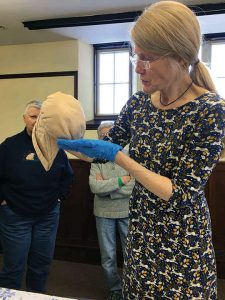
On Sunday, March 18, Kathryn S. Tarleton shared her experiences as a textile conservationist in a presentation given at the Mattapoisett Free Public Library. Tarleton, along with her business partner Charlotte Hamlin, provide the delicate service and sometimes forensic work of preserving and conserving historic textiles.

“It is really a disparate group of materials that together make up a textile,” said Tarleton.

Throughout man’s evolution, textiles have been used to clothe bodies, carry supplies, or make life more comfortable as blankets and quilts.

Tarleton pulled back the curtain so to speak on the role of a textile conservator in both private and public settings. She began with textiles made of organic fibers, such as animal hair and hides. And while early textiles contained natural fibers, the 20th century brought synthetic fibers into the picture changing the very chemicals that make up fibers.

Tarleton explained that her work has included cleaning fabrics, maintaining them, and preparing them for exhibitions, or a combination of these that may be singular or involve one or more skill-sets.

It became apparent during her talk that a conservator’s role is a very critical area of expertise necessary to ensure that our historic pieces survive as long as possible.

Tarleton has worked for the Smithsonian, Brown University, Rhode Island School of Design, Peabody Essex Museum, Tufts University and more recently the New Bedford Whaling Museum to name a few.

Textile conservation, Tarleton said, requires that the fabric be studied to determine just what its needs might be, whether it be restoring it to its original state or stabilizing it from further deterioration.

Through the review process, the conservator will produce a report on the current state of the item in question along with recommendations that may or may not include cleaning. It is interesting to note that a conservationist uses vacuuming to remove surface impurities that can include everything from household dust to insect body parts.

Tarleton drew the curtain back even further on the types of methods used by conservators when she displayed a photograph of a 19th-century dress before and after preservation. The dress had been on exhibit for some years without the proper supports, thus tearing and straining of the delicate old fabric and seams had brought on a great deal of deterioration. After a wooden loop frame constructed in the style of the period and proper mannequin were used to provide the correct support to the dress, it looked radically improved – like a facelift only without the telltale tucks.

Another fascinating set of images showed a very sad and sagging discolored wedding dress from 1840. After careful cleaning and proper support, the Flemish needle lace on silk garment appeared as crisp and bright as the day that long-ago bride had worn it.

But the most surprising item Tarleton displayed in photographs was a Union soldier’s cap from the Civil War. It had been almost completely consumed by insects and crushed due to the lack of supports. The cap was all but gone. After conservators built a support, the delicate work of applying the remaining fabric bits and pieces to the lining ensued. The finished product was a cap that was significantly returned to an original appearance without sacrificing what remained of the original wool and leather pieces. It is now on exhibit.

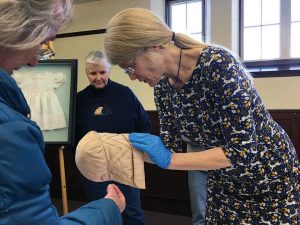
The audience was invited to show Tarleton some of their own historic pieces and to ask questions on how best to preserve and conserve them.

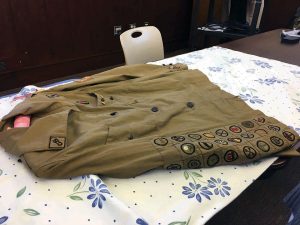
There was a 19th-century lady’s bonnet, a 1940s Girl Scout blouse, a baby’s christening gown, and an oriental silk-on-silk embroidered pillowcase. Tarleton apprised the owners of the best course of action with each as she studied the pieces with a reverence honed from years of understanding the importance of historic materials to the human experience. Tarleton said documenting the history of their pieces was necessary to maintaining their provenance.

“It doesn’t have to be technical, but write down the history of the object: who, what, when, where. That’s part of its personal history,” Tarleton said. Absent that, she added, the piece would likely have diminished value. She also told them to avoid wet cleaning. “The stain probably won’t come out anyway…” and to use acid-free storage boxes and tissue paper and to never let fabrics rest against bare wood, such as cedar chests.

One final word on what not to do: “Don’t use moth balls!”

Mothballs do little to keep insects away, she said, and are carcinogenic, and therefore harmful to people. “The best thing is good housekeeping,” Tarleton said with a smile.

She also recommended keeping historic textiles in rooms where temperatures remained around 70 degrees and maintained a humidity of about 50 percent year round.

When asked what her most challenging conservation project has been, Tarleton quickly responded, “The panorama I’m working on for the New Bedford Whaling Museum.”

The 8.5-foot by 1,300-foot piece of cotton muslin depicts a worldwide whaling voyage. The mammoth artwork is being prepared for a spring exhibition.

If you have questions about your historic fabrics or textiles, you may find answers at www.conservation-us.org, the Smithsonian Museum Conservation Institute, the Textile Museum www.museum.gwu.edu/textiles-care, or by contacting Tarleton or Hamlin at info@contextinc.net.

By Marilou Newell

Kenneth H. Briggs

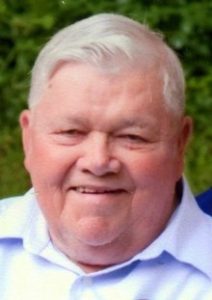
Kenneth H. Briggs, 85, of Wareham, formerly of Marion died Tuesday, March 20, 2018 at Sippican Healthcare Center in Marion after a long illness. He was the husband of Mary E. (Potter) Briggs.

Born in New Bedford, he was the son of the late Kenneth and Martha (Erickson) Briggs. A journeyman electrician, Mr. Briggs worked for Mass. General Hospital, Algonquin Gas Company, and Tabor Academy.

Mr. Briggs was a U.S. Army veteran and served in the Korean conflict from 1952 to 1955. He enjoyed spending time with his family.

He is survived by his wife, Mary E. Briggs; his daughter, Amy Shaw and her husband Mark of Rochester; three sons, Eric Briggs of Marion, Scott Briggs and his wife Linda of Denmark, ME, and Chris Briggs and his wife Tina of Toland, CT; his sister, Sandra Reinhold and her husband Richard of Franconia, NH; 7 grandchildren and 1 great grandson.

A funeral service will be held on Sat., March 24, 2018 at the Chapman, Cole & Gleason Funeral Home, 2599 Cranberry Highway (Rt. 28), Wareham at 12 pm. Relatives and friends are invited to visit from 11 am to 12 pm prior to the service. Interment will be in Old Landing Cemetery, Marion.

Donations in his memory may be made to Sippican Healthcare Center, (specify resident’s fund in the memo field), 15 Mill St., Marion, MA 02738.

Rochester Town-Wide Cleanup

Join the Rochester Women’s Club in conjunction with the Rochester Land Trust on Saturday, April 21 for a Town-wide cleanup. Trash collection bags and gloves will be available at the Rochester Women’s Club at 37 Marion Road, Rochester from 9:00 am to 1:00 pm.

The Rochester Land Trust will also be collecting old electronic items. Bring unwanted computers, household appliances, monitors, televisions, and metal objects to be collected for recycling. A fee may be charged for certain items. The MRC (Medical Reserve Corps) will have a station set up to pass along helpful information about tick prevention.

Mattapoisett River Reserve Hike

Join the Buzzards Bay Coalition for a 5-mile guided group hike through the Mattapoisett River Reserve on Saturday, March 24 at 10:00 am. We’ll meet at The Bogs (138 Acushnet Road, Mattapoisett) and explore the reserve’s extensive trail network that connects to Tripps Mill and two newly opened properties, Tinkhamtown Woodlands and New Boston Trail.

Portions of the trail are very wet. Please wear water-resistant footwear with good traction for walking in snow, dress in layers, and bring water and a snack. The hike should last approximately three hours.

To RSVP for this free hike, visit http://www.savebuzzardsbay.org/events/mattapoisett-river-reserve-hike-mar-24-2018/ or contact the Buzzards Bay Coalition at 508-999-6363 ext. 219.

This hike is part of Discover Buzzards Bay, a resource to find unique and exciting ways to explore the outdoors, get some exercise, and connect with nature. Use Discover Buzzards Bay to get outside and discover woods, wetlands and waterways from Fall River to Falmouth. To learn more, visit savebuzzardsbay.org/discover. Discover Buzzards Bay is sponsored by Southcoast Health.

Mattapoisett Conservation Commission

To the Editor:

I found Ms. Newell’s account of the recent Mattapoisett Conservation Commission’s March 12 meeting alarming.

I also find that when a local official says something is in the “town’s interest,” they don’t usually mean “in the interest of most town residents” but rather that it is in the interest of a tiny minority who might profit from it in some way.

We currently have a ConCom Chairman who voted against a wetlands protection act the commission had been working on for two years. He is also against any state level review of the current situation.

I disagree. I still have many unanswered questions about the legality of building any residences on a property that was listed as unbuildable for over 90 years. The Chairman wants to “condition as many projects as possible” as soon as possible.

I think that instead an objective analysis of the current projects before the ConCom is in the interest of a majority of Mattapoisett residents.

We won’t get an objective opinion from town officials.

I think we do need to ask the District Attorney or the Attorney General’s office to help us sort this situation out, as soon as possible.

Sincerely,

Beth Underwood


The views expressed in the “Letters to the Editor” column are not necessarily those of The Wanderer, its staff or advertisers. The Wanderer will gladly accept any and all correspondence relating to timely and pertinent issues in the great Marion, Mattapoisett and Rochester area, provided they include the author’s name, address and phone number for verification. We cannot publish anonymous, unsigned or unconfirmed submissions. The Wanderer reserves the right to edit, condense and otherwise alter submissions for purposes of clarity and/or spacing considerations. The Wanderer may choose to not run letters that thank businesses, and The Wanderer has the right to edit letters to omit business names. The Wanderer also reserves the right to deny publication of any submitted correspondence.