Summer Mindfulness Walk in the Woods

Spend time in the more than human world at the MLT Brandt Island Cove District. Join Kathleen Urquhart who will lead you through 90 minutes of quiet nature-focused time based on Kripalu’s approach to mindfulness outdoors. The walk will be on Saturday, August 16 at 8:30 am. We will meet at the Anchorage Way kiosk, on the corner of Anchorage Way and Tara Road.

            The Mindfulness walk will involve some gentle movement; slow walking over uneven terrain and participants will be invited to sit on the ground for a short period of time.

            This session is open to adults who are comfortable with the mobility described. Please bring a towel to sit on, sunscreen or bug repellent if that will make you more comfortable.

            Please dress for the weather and wear sturdy shoes. Carve some quiet time for yourself in the outdoors. Email manager@mattlandtrust.org with any questions.

Rochester Summer Remembrances

            Summers in Rochester haven’t changed in over a quarter century. They still carry the same vibe. I can attest to this from personal experience. When I was a child growing up in the North End of New Bedford, my father, John DeCicco, frequently took me to Snow’s Pond, where his cousin owned a cottage and we had a key that let us past a padlock-chained road to enjoy swimming and picnicking.

            Today, the roads we traveled to the cottage are still mostly pristine scenes of modest homes and open fields in shades of green and tree-bark brown. There’s still a crisp smell of pine and fresh air. Back then, “The Country Whip” near the top of Robinson Road had just opened. The same ice cream cone sign there now marked the spot (or it’s an exact replica of the original one). The only ice cream flavor choices then, though, were vanilla or coffee.

            Just past the “Entering Rochester” sign on Robinson Road, the “Ponderosa” was already open, though then my young mind wondered if it had any connection to the “Bonanza” television show. We’d pass the “Hartley Saw Mill” shack that’s still there on Hartley Road. A little farther down the road, I saw the early frame of the Rochester Memorial School.

            Then we arrived at my favorite place to swim as a child and my favorite memory of my late father. The visit to the cottage was our regular routine, Saturdays and Tuesdays in the summer (mom never liked going to the beach but also must have known that father-son time was important).

            Dad was the oven man at a baking company in New Bedford, and those two days were his only time off. His hands were rough (he was an army veteran of World War II, Pacific Theater, Philippines), but his touch was gentle when he made sure I was dry and clean after a day of swimming there, and he checked me for rashes.

            Old tire inner tubes were available at the cottage in place of the typical store-bought inflatable swimming tubes for floating in from the pond shore. They were a lot bigger, for sure. But I did end up with a red rash once or twice.

            I remember my dad’s patience on those days. Patience with my boyish energy back then. Patience as my older cousins that we sometimes brought along tried to get pop tunes from WPRO on his scratchy AM radio. The only time I ever saw him angry was when my younger cousin Jimmy spilled his ice cream (from “Country Whip”, of course) all over the back seat of his car. He stopped the car halfway down Hartley Road to tell Jimmy he was licking the cone the wrong way. I learned the right way to lick an ice cream cone that day!

            He called our “Snow’s Pond” destination, “Phil’s Cottage.” Only years later did I learn it was named after a cousin, Philomena. Maybe he didn’t want my young mind confused by his nickname for his female cousin.

            He always gave me a choice of going to “Phil’s Cottage” or “Mary’s Pond” (when it was more of a sandy beach). I always chose the cottage. I was more comfortable there. It meant more peaceful, quiet privacy.

            I dare say these attributes are more of what the summer swimming areas of Rochester and the roads that lead to them offer even today. Let it always be so. Rochester, thank you for the memories!

By Michael J. DeCicco

From the Files of the Rochester Historical Society

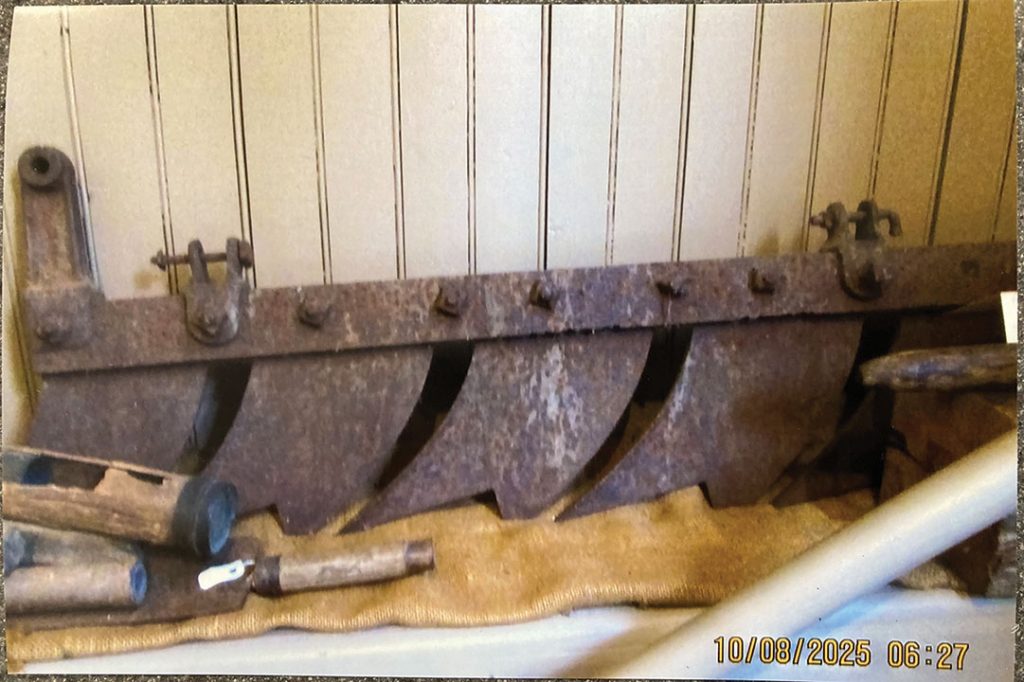
The new exhibit that will open at the Rochester Historical Society Museum this fall is ” The Tools and Industry that Made Rochester” and it is supported by the Rochester Cultural Council, a local agency which is supported by the Massachusetts Cultural Council, a state agency. The picture accompanying this article is one of the tools that will be part of the exhibit, and it is part of the museum’s permanent collection.

            Since it’s a very warm day today, it’s nice to think about a tool used in the winter. This ice axe was donated to the museum by Fred Tripp. When I was a pretty, young child, my grandfather took some of us over to Snow’s Pond in the middle of winter. The pond was solidly frozen in a way that doesn’t seem to happen these days. It was a sunny day with a blue sky, and we were bundled up against the cold.

            With Grandpa we walked out on the ice toward the center of the pond. After a yard or so, we stopped. I can still remember being in awe that we were standing on top of the water that we had been swimming in months before. The water was so clear that you could see all the way to the sandy bottom. I seem to remember seeing turtles hibernating on the pond floor.

            Grampa told us that when he was growing up, there was no electricity to run refrigerators and people had ice chests to keep their food cold. He explained how men would use ice axes to cut blocks of ice out of the pond. It would be loaded on wagons or trucks on beds of sawdust from the mill and delivered to homes around town. It wasn’t until I was at the museum that I actually saw an ice axe.

            We are looking for anyone who has an old tool that would/could have been used in Rochester’s past. It could be something used in farming, at one of the mills, in a dairy or used on a cranberry bog. Tools like the axe that were used to accomplish jobs around town are also welcomed. You can loan items for the length of the exhibit or donate them outright. If you have something that you are willing to share and that we are able to use, please, contact me at eshbach2@aol.com or call 508-763-5492 or 617-750-2818.

By Connie Eshbach

3 vs 5 Select Board

To the Editor;

            Much debate and awareness has now occurred regarding the 3 vs 5 select board vote taken at a recent town meeting where the 297 voters in attendance discussed this issue. The resulting “simple majority” spoke for the 5,970 voters in town. Here are some thoughts to ponder. A few years ago, Mr. George Pierce Randall upset a long-term incumbent to win a seat on the select board. His win ousted a long term, popular incumbent. His bid showed that if the message and timing are right, long-term incumbents certainly can be voted out.

            Diversity has many faces, and that particular select board proved to be one of the most diverse, having both the oldest (age 80) plus the youngest members in the state of Massachusetts. This certainly made for some robust discussions. Upon losing his re-election bid Mr. Randll did not seek to change the form of governmental structure – just to have a seat at the table. He continued to work for his town. He attended all town meetings in their entirety, and educated people on the history of his town.

            People come to, and remain for generations, in small towns for many diverse and meaningful reasons. Many changes within small towns are out of our local control Not this issue however.

            Let’s keep our government small to minimize costs and complexity. Why does one of the smallest towns in the state need one of the biggest select boards? If petitions are signed, as in the original effort to bring this before the town, and another town meeting is held, or better yet a special town election, I hope that more of my small-town neighbors will have the opportunity to voice their opinion to enable this to be a more complete picture of the will of the people in this special town.

            Respectfully,

Cheryl A. Randall-Mach, Mattapoisett

The views expressed in the “Letters to the Editor” column are not necessarily those of The Wanderer, its staff or advertisers. The Wanderer will gladly accept any and all correspondence relating to timely and pertinent issues in the great Marion, Mattapoisett and Rochester area, provided they include the author’s name, address and phone number for verification. We cannot publish anonymous, unsigned or unconfirmed submissions. The Wanderer reserves the right to edit, condense and otherwise alter submissions for purposes of clarity and/or spacing considerations. The Wanderer may choose to not run letters that thank businesses, and The Wanderer has the right to edit letters to omit business names. The Wanderer also reserves the right to deny publication of any submitted correspondence. All letters must be typed and submitted directly to: news@wanderer.com.

Athletic Fields Get Green Light

            The Old Rochester Regional High School’s athletic fields will finally be getting some much-needed repairs and improvements beginning with bids opening on August 20.

            Representatives Megan Kearns and Josh Millonig from the engineering firm Weston & Sampson stated during the August 11 meeting of the Mattapoisett Conservation Commission that the project is in buffer-zoned areas of the property, will be contained to the existing footprint and did not require a Notice of Intent filing. Instead, the project will require the lesser filing of a Request for Determination of Applicability.

            Mattapoisett Town Administrator Mike Lorenco said that the project is being funded in total by a $750,000 state bond bill authored by recently retired Representative Bill Straus. The estimated costs for the project were not discussed at this meeting, but Lorenco stated that funds are not coming from local taxes.

            Kearns and Millonig detailed the construction methods primarily noting that grassed areas will be contoured for better drainage and new grass planted. The commission rendered a Negative 3 decision.

            Mike Dahill, 0 Shore Drive, filed an RDA for the installation of a platform and stairs fabricated from aluminum to repair concrete stairs that allow water access to his property.  Dahill said the 4-foot by 8-foot platform will be constructed over existing stairs and footings, which are now under the beach sand. He also said that the stairs will be removed during the winter season. He received a Negative 2 decision.

            Bill Madden, 11 Melissa Lane, also filed an RDA request for the construction of a 26-foot by 20-foot garage with pea stone driveway. Madden, of GAF Engineering, represented himself. During the discussion, it was determined that the request would be continued, pending notification from Natural Heritage.

            Nat DaSilva of Farland Corporation, representing Adam Walorz of 0 Nantucket Drive, received conditioning for a Notice of Intent filing for the construction of a new single-family home. DaSilva discussed additional beefed-up conservation erosion controls necessary for the topography of the site.

            In other matters, the commission will be pursuing possible parking at the town owned Cove Street property for purposes of giving residents access to the area for recreating and shell fishing. The commissioners are researching options.

            The next meeting of the Mattapoisett Conservation Commission is scheduled for August 25 at 6:30 pm in Town Hall.

Mattapoisett Conservation Commission

By Marilou Newell

Journeying Through Time at Hampton Court and Other Gems of London

            Note: This is the first part of a series exploring Europe’s diverse landscapes and gardens, from formal designs to wild, natural beauty. The goal is to share my love for both cultivated and untouched nature.

            Travel, even today, is still fundamentally about exploration and discovery. When you travel for an extended period, it’s a delight for both the mind and the soul. I tend to capture these experiences mentally, as well as through my camera, and by taking detailed notes whenever I venture beyond my home. Whether it’s a visit to Walden Pond or a distant, far-flung destination, my approach is to stay open and let my senses absorb everything around me.

            Reflecting on my experiences from a month ago feels like a journey through time, especially when I think about the trees and gardens that have stood for centuries. It’s fascinating to realize how the landscapes I explored this summer are as unique as the people who created them – ranging from the Tudor monarch Henry VIII to the surrealist painter Salvador Dalí. The beauty of these gardens lies in their magical quality, born from imagination and vision.

            My adventure started in England and ended in southern Spain, with France and the Costa Brava in northern Spain in between. The purpose of the journey was my daughter’s wedding in the south of France, and around that the itinerary was shaped. We touched down in late June to London’s welcoming weather. A full-blown English summer is rare, but our three-day stint exceeded all expectations: dry, sunny, 80-ish temperatures; summer as good as it gets anywhere! After an extensive walk through Hyde and Kensington Parks, the heat moved us to remove our footwear and paddle in the Princess of Wales Memorial Fountain while children did the same. Hey, when in Rome (er London)!

            As always, part of my personal agenda would be looking at gardens and hoping to learn something new. As in my past travels here, my overwhelming realization was that England is one big, well-tended garden! In the height of summer this was peak floral season with explosions of growth of classic flowers that define English gardens: delphinium, roses, hardy geraniums, foxglove, poppies, hollyhock, and sundry tropicals. The flush of leaf growth on the trees that canopy meadows, roads and London’s lovely parks showed the mastery of planning such plantings.

            The London plane tree, impervious to pollution and known for its flaky, camouflage bark, caught my eye as it framed views of such architectural wonders as the Houses of Parliament and Westminster Abbey are as ubiquitous as red telephone booths and double-decker buses here. Walking the banks of the Thames in Richmond, I marveled at the age of the trees, imagining how it might have looked as Henry VIII sailed past on his barge headed home to Hampton Court. Talk about aging gracefully (the trees, not the king!).

            After touring Hampton Court Palace absorbing its storied past, we wandered its vast grounds. Just a few acres of its 60 acres are dedicated to assorted gardens. I’d had a glimpse of the grounds from inside and was utterly amazed at the green architecture that met me in the sunny outdoors: ancient trees sculpted to perfection. “How do they do it?” I wondered.

            I paused at the sight of the yew trees that fanned out in avenues in the great fountain garden. These ancient yews grew to their present height (between 33 and 66 feet) when Lancelot “Capability” Brown, known for his naturalistic landscaping, allowed them to grow more freely in the 18th century – resulting in gigantic topiaries.

            Formerly part of the monarch’s hunting park, this area is what you think of when you imagine palace gardens: rows upon rows of perennial borders flanking the outer walls of the castle, like foundation plantings on a grand scale. This area became more colorful with the introduction of seasonal and flamboyant bedding displays under Queen Victoria when the gardens were opened to the public in 1838.

            Over time and under different monarchs, the gardens have undergone alterations as with the transformation of the Pond Gardens. These sunken compartments of Henry’s ponds were stocked with fish for the palace kitchens but by 1690 the ponds had been drained. Queen Mary II thought it an ideal site to house the collection of ‘exotic’ plants she brought with her from the Netherlands… today these gardens are famed for their dazzling array of spring and summer flowers.

            Looking at the map given to me on the tour, I noted how the various compartments of garden space served the palace. From the Privy Garden with its hornbeam bower and cut parterres of pyramid yews and round-headed holly trees interspersed with summer annuals to the exotic Orangery Garden to the Rose Garden (with statues of Flora, Adonis, and Abundance within a fragrant cloud of scented roses) to the Wilderness Maze not to mention the Long Water and Tennis Courts, there seemed to be a garden for every sort of purpose. The Home Park, once part of Henry’s hunting ground, has today become a Site of Special Scientific Interest: its acid grassland and ancient oak and lime trees providing habitat for a variety of rare insects and other wildlife including a 300-strong herd of fallow deer derived from the king’s original stock.

            I would be remiss not to mention the Great Vine, located in the lower Orangerie in a sheltering glasshouse, planted by “Capability” Brown in 1768. After 250 years, the vine is still going strong, producing an average of 500 pounds of fine dessert grapes each year. The Great Vine came as a cutting from the Black Hamburg Vine in Essex, which no longer survives.

            As with all travel, we were momentarily transported to another time and space, but only temporarily. New adventures beckoned as we boarded the Eurostar to Paris, the train sweeping past vast, rolling landscapes that revealed the agricultural heart of Northern France. I couldn’t help but feel as though I was collecting a gallery of images: rich fields, quaint villages, and open skies – to fuel my imagination long after the journey had ended.

The Seaside Gardener

By Laura McLean

John Nicolaci Memorial Float Fly

The Bristol County Radio Control Club, Inc., will hold its annual John Nicolaci Memorial Float Fly on Saturday, August 16. The event will run from 10:00 am to 3:00 pm. It will be held at Mary’s Pond in Rochester, Massachusetts. Parking opposite 507 Mary’s Pond Road.

            This is a non-competitive AMA sanctioned event. All AMA members are welcome to fly. $10.00 landing fee. There is no fee for spectators. Electric and glow-powered planes only. No gas-powered planes. Come see scale models of World War II aircraft, light aircraft float planes like Piper Cubs, and a variety of sport models.

The Best of Broadway

On Friday, August 15, the Marion Concert Band continues its Friday evening concert series with a program of music from the Broadway stage. The program, which includes a vocalist and highlights from some of Broadway’s most memorable shows, is as follows:

The Showman – H. Akers

Lohengrin (Introduction to Act III) – R. Wagner

Broadway Show-Stoppers Overture – arr. W. Barker

Man of La Mancha – M. Leigh

Moon River – H. Mancini

            Jocelyn Paulo, vocalist

Make Our Garden Grow (from Candide) – L. Bernstein

Opening Night on Broadway – arr. M. Brown

Sondheim. – arr. S. Bulla

They Can’t Take That Away from Me – G. Gershwin

            Jocelyn Paulo, vocalist

Selections from My Fair Lady – F. Loewe

Them Basses – G. H. Huffine

            Jocelyn Paulo is a jazz vocalist from Berkley, Massachusetts. She is currently studying music at UMass Dartmouth, where she will be entering her junior year in the fall. A graduate of Bishop Stang High School, she is making her first appearance with the Marion Concert Band this season.

            The concert, under the direction of guest conductor Philip Sanborn, will begin at 7:00 at the Robert Broomhead Bandstand, Island Wharf Park off Front Street in Marion. All concerts are free and open to the public. “Like” us on Facebook at “Marion Town Band” for up-to-date announcements and rain cancellation notices.

Paul Martin McCabe

Paul Martin McCabe, age 82, of Mattapoisett passed away on August 6, 2025. He was the beloved husband of Gail McCabe for 59 years. Paul was a loving father to his three children and seven grandchildren; Sean McCabe and his wife Judith, their children, Jack, Colin and Bridget of Dartmouth; Ericka and her son, Alexander of Mattapoisett; Kristian and his wife, Michelle and their children, Madeline, Edith and Ryan of Norwell. Paul was also the proud family member of four late brothers – Frank, Steve, Phil, and John; and one sister Martha of Manchester, VT.

Born in Boston on December 5, 1942, he was the son of the late John F. McCabe and Frances M. McCabe. Paul graduated from English High in 1961, where he captained the football team and he was eventually inducted into the Athletic Hall of Fame. He went on to Holy Cross College after earning a full football scholarship where he received a BS in Social Studies in 1965. He later earned a master’s degree in counseling and guidance in 1971. His career started as a history teacher and football/track coach. From there his focus was as a guidance counselor and he retired as the Guidance Director at Fairhaven High School. He loved and respected his students and that was fully reciprocated.

Paul was an avid reader, especially nonfiction history. He also enjoyed sailing for many years, and he especially enjoyed his golf games with family and friends.

There was always a card game he never passed up with the brothers. He and Gail loved their winters in Ft. Myers Beach for over 20 years, inviting anyone who could join them. He traveled to Ireland with family to golf and with Gail to tour.

His main focus was family and attended all sporting events and recitals of his children, grandchildren, nieces and nephews alike. Paul’s warmth and kindness touched everyone he met, and the sound of his laughter will echo in our hearts forever, a cherished reminder of the joy he brought to his family and friends. Fair winds and following seas always.

His Funeral Mass will be held Thursday, August 21, 2025 at 11am at St. Anthony’s Church, Mattapoisett. Visiting hours will be Thursday, August 21st from 9:30-10:30am, prior to the Mass, in the Saunders-Dwyer Mattapoisett Home for Funerals, 50 County Rd., Mattapoisett. For directions and guestbook, visit www.saundersdwyer.com.

Manatee Sighting in Mattapoisett

            At 5:40 am on the warm morning of July 29, a group of friends were out running on the Mattapoisett Rail Trail.

            As Erin Carr of Mattapoisett explained, she and her friends, David Gerber, Stephanie Poyant Moran, Jonathan Barratt, Nicole Reedy and Allie Straus, were out on an ordinary run until they began crossing the bridge over Eel Pond, when they were stopped by a man walking his dog along the path. The man, Lou, told the running friends of an “unusual mass” he observed not far from shore.

            “From a distance, it appeared to be a large rock. But as he got closer, he realized that it was some sort of animal that was caught on the beach during low tide,” says Carr. The six friends, the man, and the dog all approached the shoreline together to ascertain what was out there.

            “As we got closer, we discovered it was a Manatee! We weren’t quite sure what to do. We would have liked to have helped it to deeper water, but we weren’t sure why it was beached in the first place,” Carr said.

            Wanting to help but not wanting to disturb or jeopardize the status of the creature, the group called the Harbormaster and Mattapoisett Police for help. She added that sharp oyster shells made it difficult to get close to the Manatee, which itself seemed to have been cut up by the sharp shells. The group waited with the Manatee until the officers arrived. Upon arrival, the officers stated nothing should be done until wildlife experts arrived and could strategize the best path forward. The six friends ran back to their cars quickly, promising to turn right back.

            About half-an-hour later, Carr says, “everyone was gone – including the Manatee!” Poof! The friends weren’t sure what happened. It seemed the whole ordeal had just disappeared without a trace. Upon calling dispatch, they were informed once the tide rose a bit, the Manatee was able to swim back out into the harbor unassisted. There were no signs the Manatee was seriously harmed from its stint on land.

            Carr added, “Stephanie called her husband who operates a local land trust and has connections with local wildlife rehabilitation organizations. He reached out to a contact that he had been in touch with on a different occasion to report another sea animal that washed ashore in Westport. Turns out, they had been tracking the Manatee!”

            Many local experts and organizations have been aware over Manatee presence in the area. Generally, this seems to be a worrying sign for the mammals. Per Rhode Island PBS, “A Manatee was recently spotted off the coast of Massachusetts for the first time in almost a decade, and scientists want to monitor its condition to see if a rescue is necessary before it succumbs to the cold water or lack of food.”

            Following the sighting in Mattapoisett, the Manatee has yet to be seen again. Manatees typically don’t go farther than the warmer waters of the Caribbean Sea and coast of Florida, leaving experts confused and concerned as to why exactly this “sea cow” is so far north.

The Bike Path Manatee Rescue

By Sam Bishop