St. Gabriel’s Church Rummage Sale

St. Gabriel’s Episcopal Church in Marion will hold its Annual Rummage Sale on Saturday, October 27, from 9:00 am – 3:00 pm. Sponsored by the Adult Choir of St. Gabriel’s, the sale will benefit both the music program and St. Gabriel’s outreach and relief efforts. The sale takes place in the Parish Hall of St. Gabriel’s Church, located at 124 Front St. in Marion, and will feature furniture, rugs, gift items, sporting equipment, antiques, housewares, tools, a Christmas room, and much more. This is our 8th annual event, and it just keeps getting better each year – shop early for the best selection. The choirs will also host a food sale at the same location, so plan to come and spend some time browsing and picking up some delicious baked goods, soups, and casseroles. For more information, contact Director of Music Leslie Piper at lesliepiper@msn.com.

Take Time to Remember on November 11

The peaceful and democratic society we enjoy was created by the efforts and sacrifices of generations of Americans who have put their lives on the line in the cause of peace and freedom around the world. Remembering and learning all that Veterans have sacrificed helps us better understand our nation’s history and its future.

At the end of the World War I, many people heard about the Armistice through bells ringing. When the bells rang out on the 11th month of the 11th day on the 11th hour in 1918, they announced the end of the most catastrophic war the world had yet seen. This year, 2018, marks the centenary of the Armistice, now called Veterans Day.

To collectively remember and honor those veterans who put their lives on the line on the battle field, the Mattapoisett Women’s Club launched a “Veterans Day Bells of Remembrance” project in 2017 to rekindle that spirit of togetherness. The Bells of Remembrance project is asking communities throughout Massachusetts to pause for a minute of silence and mark the centenary of the Armistice by ringing church and municipal bells on the 11th month of the 11th day on the 11th hour. Last year, several churches and municipal buildings from Wareham, Fairhaven, Marion, and Mattapoisett participated by ringing their bells and this year many more Massachusetts communities will participate.

There is a special free smart phone app “Bells of Peace Participation” that is available from iTunes and Android stores and that may be downloaded onto your smart phone. The app has a built-in countdown timer and will toll 21 times on 11/11/11 in remembrance of this very special moment when the fighting stopped.  Go to ww1cc.org/YourAce on your smart phones and the site will direct you how to set up Bells of Peace.

The Mattapoisett Woman’s Club has resolved to promote Bells of Remembrance on November 11 to remind the public of that Armistice Day peace pledge. We are also asking church members either in their bulletins or from the pulpit, to work for peace. One hundred years after the first Armistice Day, and given the special significance of this year, 2018, the commemoration takes on added importance. Let’s pause for a minute of silence and ring those bells on the 11th month of the 11th day on the 11th hour to commemorate the end of the “War to end all wars!” and recapture peace on 11/11/11.

Artistic Interpretations of Land Trust Properties

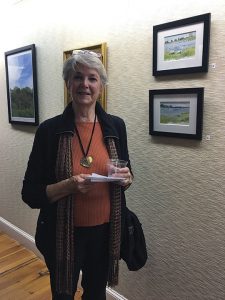
Wooded vistas, marshlands, trails thickly padded by fallen leaves, birds at rest, colors in shadow and light, the surprise of unexpected objects adorning a tree… The Marion Art Center’s show “The Lands of the Sippican Lands Trust” features all of these images and so much more, now on display through November 12.

The show is a masterful partnership between the Sippican Lands Trust and the Marion Art Center (MAC) that offered local artists the opportunity to render their impressions of these protected open spaces using a wide variety of mediums.

On October 12, the opening night reception quickly found artists and art lovers cheek to jowl as enthusiasm for the show swelled. The gallery walls were heavily covered with 39 pieces by 26 different artists whose creations were simply breathtaking.

Although this show was not juried, the level of artistic endeavor and achievement was unmistakable. From fabric to shadow box to oil pastel, from watercolor and oils to pencil images depicting land trust spaces, the artwork drew the viewers into a suspended moment in time.

While there were a fair number of local professional artists, works on display also included first-timers such as young Blake Gagne of Rochester, whose shadow box titled “Dragon Lair” delighted the attendees. His mother, Michelle Wood, also entered pieces of fanciful fairies created in pencil, making it a family affair.

Professional artist and teacher Sarah Brown selected the White Eagle property for her pastel landscape, while Janet Smith-Flaherty of Rochester, who has been painting for 18 years, joined her friend and fellow artist Jane Egan of Lakeville visiting land trust properties.

“We had a fun day making sketches and taking photographs to bring back to our studios,” Smith-Flaherty said.

Egan, a Mass Art graduate, has had her own exhibition in the past at the MAC. Working in oil pastels, Egan said doing so was a “messy affair,” but the end result is a rich, layered, dense work of art.

Sippican Lands Trust Director Jim Bride explained, “It’s the third time the art center has held this event. We take the artists out on walks in the properties so they can be familiar with the spaces.”

And finding inspiration in one of the many natural settings isn’t difficult. The artists selected locations such as Kenney’s Landing, Brainard Marsh, Peirson Woods, White Eagle, Ludes Estuary, Benson Brook, and Piney Point to name a few.

“I love the idea of this collaboration,” MAC board member Jennifer Webb said.

MAC Executive Director Jodi Steven added, “This is the third year we’ve done this show with the land trust … on an every other year basis. … The result is wonderful.”

Given the number of guests attending the opening reception, it is clear that the collaboration is a natural pairing. Visit www.marionartcenter.org for dates and times.

By Marilou Newell

Neighbors Oppose RCF Committee Requests

The Rochester Country Fair (RCF) Committee had its three requests approved by the Rochester Board of Selectmen on October 15, but not without opposition from neighbors near the Pine Street fairgrounds.

In light of a significant financial loss this year due to poor weather, the RCF Committee hopes to recoup the roughly $10,000 lost by adding four additional fundraisers during 2019. The committee also asked for approval to build a permanent structure at the site – a 40-foot by 100-foot pavilion – that could be used instead of renting a giant tent, an expense that suddenly spiked in cost this year.

The committee also asked for more leniency on alcohol consumption while allowing alcohol to be served at specified times during all four days of the fair.

Some residents who live near the fairgrounds opposed adding more fundraising events at the site, with one resident expressing his concern over the “slow creep” of the Country Fair within the neighborhood.

Richard Masciantonio of Quaker Lane said when the fair first relocated from Plumb Corner to Pine Street, the neighbors were reassured that no permanent structures would remain on the site after the fair was over, and the recent agreement between the RCF Committee and the Town provides for only 10 usable days for fairgrounds events, including the four for the fair. Now, he fears the RCF will continue to expand and ask for further exceptions that will affect the neighborhood.

“The fact that the fair didn’t make money shouldn’t be a burden for the neighborhood to assume,” said Masciantonio. “If the fair can’t make money, the fair can’t make money.”

RCF Committee Chairman Kelly Morgado said the RCF account needs to reach $40,000-$50,000 in its account in order to fully fund the fair, but this year it only reached a maximum of $32,000.

“We’ll have to significantly cut back on what we can do for the fair unless we increase some fundraiser dates,” Morgado said.

Leading up to the 2018 RCF, Morgado said the committee was unable to hold all of its six planned fundraisers at the fairgrounds, as allowed by the agreement, due to inclement weather. These fundraisers, said Morgado, are strategically planned to keep noise in the neighborhood at a minimum, which include tractor pull competitions of the quieter antique tractors.

Hartley was skeptical, and referred to the additional fundraisers as potential “Band-Aids” rather than solutions.

“To me, what this is about is a neighborhood who used to look at a field who now looks at a [fairground],” Hartley said. At the start, activities were planned for three days, he added. “[The neighborhood] is now looking at something going on over there one weekend every month. That’s not what was the original idea, in my mind,” said Hartley.

Selectman Brad Morse, who attended a recent meeting with the RCF Committee and spoke with some abutters, made the motion to allow the additional fundraisers, resulting in a unanimous vote to approve.

The proposed pavilion also got 3-0 approval; however, it was only a preliminary approval. The RCF Committee will have to return with a proposed design and a plan, subject to final.

RCF neighbor Jeremy Peck supported the committee’s requests, and cited concerns over development of the open field should the RCF no longer exist. Another abutter, Craig Parker, emphasized that he supports the RCF, but not an expansion of it.

“We were guaranteed that when the fair … was over, we would never know that the fair was there.” Parker said neighbors were also told a green vinyl fence would be put up around the fairground perimeter, but that didn’t happen either.

Resident Brad Correia, concerned about the fate of the fair, said, “The price of things goes up all the time. If we can’t evolve, I think this fair is going to be lost, and I’m not sure that’s what [we want] to happen.”

Scott Hartley wondered how the Town benefitted from the RCF, other than by simply having the event. He said he didn’t see how he personally benefited from the RCF.

“It’s pretty much the only community event this town has,” said Morgado, although Hartley replied that he attends plenty of little league games, equating that to a community event.

Resident Kevin Thompson, who also leads the local Scouts, said the community does benefit form the fair, especially the Scouts.

“The [country fair] is our single fundraiser for the entire year,” said Thompson. The funds pay for the kids to go to camp and host events and activities, he said. “Without that fundraiser, we have to get back to the drawing board. … The fair is extremely important to what we’re doing. … We have a vested interest in the fair succeeding as well.”

The committee also asked to expand alcohol consumption during the fair by adding additional days and opening up the entire grounds as opposed to offering only one small cordoned-off “beer and wine garden” that even had Hartley admitting, “The concept didn’t work.”

Morse said the police chief had no concerns, and an extra detail officer could be added for further security.

Alcohol consumption was unanimously approved for Thursday-Friday from 4:00 pm – 9:00 pm, Saturday from noon – 9:00 pm, and Sunday from noon – 5:00 pm, but the RCF Committee would still need to apply for an alcohol license when the time comes.

Addressing the residents, Hartley acknowledged, “There’s no way we’re gonna make everybody happy.”

In other matters, the board referred several zoning bylaw amendment articles to the Planning Board for inclusion on this Town Meeting’s warrant.

The board also approved and finalized the warrant for the Monday, November 19 Fall Special Town Meeting taking place at 6:30 pm at the Rochester Memorial School.

Also during the meeting, the board approved a renewal for a $192,000 bond anticipation notice (BAN) for the ambulance debt. The original BAN was $240,000.

The Rochester Town Hall Christmas tree lighting ceremony will be held on December 3 at 6:00 pm.

The meeting room that night was filled with local Scouts present to observe the meeting as part of earning their citizenship in the community merit badge.

The next meeting of the Rochester Board of Selectmen will be a special meeting for Friday, October 26, at 9:00 am at the Rochester Town Hall in order to hold a classification hearing.

Rochester Board of Selectmen

By Jean Perry


Sippican Historical Society

In 1998, the Sippican Historical Society commissioned an architectural survey of Marion’s historic homes and buildings. The survey was funded one-half by the Sippican Historical Society and one-half by the Massachusetts Historical Commission. Due to the limits of funding, not all of the historic buildings were surveyed, but over 100 were catalogued and photographed. The results of the survey are in digital form on the Massachusetts Historical Commission’s website and in four binders in the Sippican Historical Society’s office (and at the Marion Town Clerk’s office).

Marion (Old Rochester) is one of the oldest towns in the United States, and the Sippican Historical Society maintains an extensive collection of documentation on its historic buildings. The Sippican Historical Society will preview one building a week so that the residents of Marion can understand more about its unique historical architecture.

This installment features 309 Front Street. Built c. 1855, the home at 309 Front Street is a Greek Revival cottage, currently part of Burr’s Boat Yard. During the second half of the 19th century, it was owned by Leonard Bolles, master mariner. By 1903, Leonard Bolles, a laborer, lived here. Also in residence here during the first quarter of the 20th century was Sarah E. Leonard, the widow of Seth Leonard. Burr’s Boat Yard was established after the hurricane of 1938 on the site of the storm-destroyed Watts Boat Yard.

FCC Women’s Guild Christmas Fair

The First Congregational Church of Rochester Women’s Guild will be having its annual Christmas Fair, on Saturday, November 3from 9:00 am until 2:00 pm in the Fellowship Hall at the Church on 11 Constitution Way, Rochester.

There will be many tables with handmade items, silent auction, baked goods, jewelry, plants, hand carved birds, quilted items, indoor yard sale, knitted items, and special occasion cards. Delicious chicken soup and sandwiches will be served for lunch.

Neighbor Pushes to Question Wetlands Delineation

During an extensive discussion on October 15, the Marion Conservation Commission dissected the question of the wetland line at a proposed project off Converse Road.

Applicant Mark Ross’ engineer, Nick Dufresne of Farland Corp, as well as the wetland consultant hired to delineate the wetlands, defended the wetland line as Ross’ neighbor spoke at length, requesting more information about the contested wetland line.

The wetland scientist Rodrigue Sinnette stated that the wetland line was moved upland about 5-6 feet during the site visit with the commission. Commission Vice Chairman Shaun Walsh asked if it was moved because of the soils, to which Sinnette replied it was moved due to the dominance of wetland plants, which is the first criteria for defining the wetland line. He said he had first delineated the line in February 2018, and had used phragmites to define the limit of wetlands. Most recently, Sinnette had seen other wetland species in the mowed area and, therefore, despite there being hydric soils further inland, had placed the line where the dominance of wetland plants fell below 50 percent.

Chairman Jeff Doubrava raised his concern from last meeting regarding the project not conforming with the zoning bylaw, which requires a new construction project to make every effort to stay out of the Velocity zone. Doubrava asked the applicant if they had reconciled this issue at all and reminded the commission that he had spoken to town counsel and was told that the commission had “the ability and the obligation that permits [are not] issued that violate a town bylaw.”

Despite not having a building permit, Dufresne stated that he had spoken with the building commissioner, received setback relief, and that what Doubrava was questioning did not fall within the purview of the conservation commission.

Member Joel Hartley seemed ambivalent, saying that it was not the commission’s responsibility to enforce bylaws of other departments.

Walsh agreed, saying, “We are tasked with enforcing the Wetlands Protection Act if it comes before us. … In my opinion, it is not our job to enforce other municipal departments bylaws.”

Member Kristen Saint Don-Campbell suggested the commission send a memo to the building department that they had become aware of this issue.

The discussion moved to the mowing of the wetlands where the wetland line defines an area that includes a portion of the lawn the applicant claims has been mowed continuously for decades, beginning prior to the Wetland Protection Act (WPA), which was established in 1972.

Brandon Faneuf, owner of Ecosystem Solutions, informed the commission, “The use is pre-existing to the Wetland Protection Act. The owner would like to continue to mow the area, even though it is wetland: his use predates the WPA and, therefore, does not apply.”

Doubrava appeared incredulous, replying, “That’s a big loophole to drive through,” giving the example of other activities that had historically occurred that are not currently allowed, such as dumping sewage directly into the harbor.

Walsh proposed a compromise position in which the applicant install a permanent barrier along the wetland line, such as boulders or a split rail fence, which he surmised would result in everything to the east of the barrier revegetating with wetland species.

Hartley suggested the commission consider requiring the 15-foot buffer beyond the wetland line, which Doubrava anticipated would also revegetate with wetland species after three years of not being continuously mowed.

While Faneuf appeared immoveable on behalf of his client’s intentions to mow the wetland area, Dufresne reminded the commission that the limit of work of the project before them did not approach the wetland line; therefore, the issue of mowing had no bearing on their ruling. Hartley suggested a permanent fence with a 5-foot buffer, saying he did not like the idea of a fence on the wetland line.

Doubrava persisted with his concerns, saying “Let’s be clear – [he] plans to cut in the wetland area to the stone wall. … [If] anyone came before us to mow wetlands, we’d say no!”

Walsh countered that the cutting is not part of the project, and that the commission can impose a special condition of the permanent barrier, which the applicant could appeal.

Although Dufresne seemed amenable to this condition, landowner Mark Ross addressed the commission directly and affirmed his position, saying he’s been mowing the lawn since 1976.

“[If we’d] have to give that up, we’d prefer not to, [and] consider what our options would be,” said Ross. “[We’d] ask you to approve it so we don’t have to go to that extent.”

At this time, neighbor to the project, Caroline Elkins of 195a Converse Road, spoke before the commission. She contended that the commission did not know exactly where the wetland line was and that the area had not been mowed continuously as the applicant had stated.

“[What I am] wondering is this, to the degree of what is at stake,” said Elkins, “[should we] hire someone independent to measure the wetland line? We’d all benefit from that. That would give us a baseline. … What’s at stake is this incredible wetland.”

There was reluctance on the part of the commission to hire an outside wetland scientist, which would be an added burden to the applicant.

Elkins questioned the urgency of the decision, suggesting, “With all due respect, there’s really no rush. … [Getting] soil samples would be good – someone independent, not with a vested interest.” She continued, “A small price to pay to have the knowledge of the precise line. … Wouldn’t it be great to have all the info on the table?”

Doubrava interjected that, in the five years he has been on the commission, “I have never had anyone saying, ‘I’m going to mow the wetlands because I’ve been doing it for years.’”

Walsh spoke in favor of the wetland line, and against asking the applicant to hire another wetland scientist, citing the commission’s experience in accurately evaluating the veracity of a wetland delineation.

“Maybe I misheard,” said Elkins. “It wasn’t so much soils as plants were tested. [If it was] mowed for 50 years, plants that would typically be there may be gone. … [It’s] destroyed in its accuracy due to mowing.”

Dufresne reminded the commission that, at the site visit, they agreed where the wetland line was and confirmed that the distance from the wetland line to the limit of work is 45 feet.

Elkins pushed the commission to consider discussing both the wetland and zoning issues simultaneously with the zoning department. She continued to question the assertion that the area had been continuously mowed, which prompted Faneuf to tell the commission that the issue for his client is not the wetland line, but the potential for losing his lawn, adding, “My counsel is to not give up. Upon appeal, [Massachusetts Department of Environmental Protection] would say it’s a preexisting use and it would hold. … Preexisting use is the issue – that’s where the brick wall is.”

The commission closed the public hearing and will seek further advice from town counsel regarding the zoning issue. They must issue an Order of Conditions or deny the project within 21 days.

In other business, the commission issued an Order of Conditions for a project at 43 Dexter Road to demolish a cottage and construct a new single-family house. The commission required the applicants to install a pervious stone driveway and drywells for roof run-off.

The Tremont Christian Camp submitted a Request for Determination of Applicability to repair an existing seawall located at 45 Oakdale Avenue. The commission had visited the site, and believed the project required the use of machinery and other heavy equipment. They, therefore, issued a positive determination, stating that the work described is within an area subject to the Wetland Protection Act and required the filing of a Notice of Intent.

Annmarie Levins and Linda Severin were granted a three-year extension to their Order of Conditions for the eradication of phragmites at 53 Dexter Road.

The next meeting of the Marion Conservation Commission is scheduled for Wednesday, October 24 at 7:00 pm in the Marion Town House.

Marion Conservation Commission

By Sarah French Storer

District Adopts New School Improvement Plan

The Rochester School Committee approved the school district’s latest two-year school improvement plan on October 11, focusing on goals very much aligned with the newest, recently approved Tri-Town wide Old Rochester Strategic Plan.

The three areas focus on 21stCentury learning, global awareness and citizenship, and social-emotional learning.

The plan came as a result of intense team effort, said Rochester Memorial School Principal Derek Medeiros, and the adoption of the three goal areas by all schools will bring about more consistency as students advance to the junior high and high school.

In 21stCentury learning, the main objective is to integrate more project-based learning and technology into the classroom and providing teachers with the skills to prepare students for contemporary learning.

During the first year of the plan, teachers and staff will focus on assessing aspects of this area that have already been implemented and devise a plan to further incorporate other methods of teaching. The second year, teachers will implement at least one of those methods and, said Medeiros, “Engaging in learning purposely designed.”

Medeiros also spoke of the “four Cs”: creativity, critical thinking, collaboration, and communication.

Right away, teachers will observe the areas where the school is already working with the four Cs and in year two, again, implement an additional action.

Technology will also be assessed in year one, and in year two, bolster technology use with further training and support to strengthen research skills.

Focusing on the media center at RMS and in all the schools, Medeiros said, “How are they bringing those practices outside the media centers and into the classrooms?”

Teachers will make their assessments and decide how technology use could be improved in year two of the plan, while also integrating the goals into the core subjects.

In the area of global citizenship, during year one, teachers will focus on making those needed assessments in the areas in which the school is already practicing global awareness, whether it be in foreign language or international projects that foster communication with students of other countries and cultures. Year two will see the school implements at least one more action to further students’ development and awareness of a global community.

One additional area inserted into global awareness was civic literacy and citizenship, which resulted in School Committee Sharon Hartley’s suggestion that civic literacy and citizenship would be more suited in this goal rather than where it was originally included in the next goal, social-emotional learning.

In learning about civics, students will actively explore local and regional government, elections, and ways of understanding their rights and responsibilities as citizens.

Empathy and anti-defamation will also be assessed and implemented by year two, while another action area of safety and security will remain in focus, primarily through A.L.I.C.E. emergency training for staff and students.

“At the elementary level, it’s all about educating to really focus on the adults and really listen to those instructions,” said Medeiros.

Medeiros specified that, although these three areas are common across all three elementary schools, some individual initiatives amongst the three goal areas might vary from school to school.

The next meeting of the Rochester School Committee is scheduled for November 15 at 6:30 pm, which is usually held at the Rochester Memorial School, but the location has yet to be determined.

Rochester School Committee

By Jean Perry

Nasketucket Bird Club

The next meeting of the Nasketucket Bird Club will be on Thursday, October 25at 7:00 pm at the Mattapoisett Public Library. Alan Kneidel, biologist at Manomet, will present “Migratory Ecology of Whimbrels on Cape Cod and Beyond.”

Many shorebird populations are declining. To understand what threats are impacting survival, Manomet is conducting research to uncover habitat needs and migratory pathways of large shorebirds called Whimbrels.

Whimbrels breed on the tundra of Arctic and sub-Arctic North America and some migrate to the saltmarshes and beaches of Cape Cod, Massachusetts from July to October. While on the Cape, they feast on fiddler crabs by day and roost on barrier sand-spits at night.

In doing so, Whimbrels stockpile the energy reserves needed to fuel their subsequent non-stop flight to their coastal wintering grounds in the Caribbean and South America. Since 2015, Manomet staff has deployed five lightweight (5 g) satellite transmitters on juvenile Whimbrels in the marshes of Cape Cod during the first southbound migration of their lives.

These transmitters can relay specific location data for several years and allow us to answer specific questions such as: the timing and patterns of migration, identification of feeding and roosting locations at migratory stopover sites, location of nesting sites and wintering sites, and identification of threats the birds may encounter.

While our work has begun to reveal the migration secrets we seek, we plan to expand the scope of the project in the coming years so as to fully understand the resource needs of these birds. This study is the first to track Whimbrels during their first year of life. The results of this work will be directly applicable to shorebird conservation efforts throughout the Americas.

Alan Kneidel’s love for birds has been a driving force in his life for as long as he can remember. Growing up in North Carolina in a home of travel hungry ecologists, he has embraced that influence and devoted his adult life to bird conservation and research. Sandwiched between earning his B.A. in Biology from UNC Chapel-Hill in 2008 and his M.S. in Natural Resources from Delaware State University in 2016, Alan spent several years traveling throughout the Americas to work on bird-related research projects. His current work for Manomet centers around shorebird demographics research on the North Slope of Alaska and the use of satellite transmitters to reveal the migratory patterns of Whimbrel on Cape Cod, Massachusetts. If you were to ask him, Alan is most at home out in the elements, whether it’s wading through chest deep mud or walking face first into a raging blizzard.

The Mattapoisett Free Public Library is located at 7 Barstow Street and is handicapped accessible. The program is free and open to the public.

Find out more about the club and upcoming bird walks at https://massbird.org/Nasketucket/

Elizabeth Taber Library Director

To the Editor:

The town of Marion is about to suffer a significant loss with the resignation of Elizabeth O’Neill as Director of the Elizabeth Taber Library.

As a weekly “customer” of the library for more than sixty years, I can attest to the outstanding friendliness of the staff and general competency of the facility under “Libby’s” direction. In addition to the many innovative programs that she has established, “Libby” has spearheaded the cooperative community involvement that currently exists between the library and other local organizations – Marion Historical Society, the local schools, Marion Art Center, Marion Council on Aging, and others. The educational and cultural climate of Marion has profited greatly from this cooperative effort.

With her quick smile and gentle manner, “Libby” has achieved her goal to make the library “a welcoming, helpful and friendly space” where patrons “can really enjoy the programs and services that are offered.”

I wish the Library Board good luck in their search for a new Director – Elizabeth O’Neill will be very difficult to replace and sorely missed.

Joanne G. Mahoney, Marion

The views expressed in the “Letters to the Editor” column are not necessarily those of The Wanderer, its staff or advertisers. The Wandererwill gladly accept any and all correspondence relating to timely and pertinent issues in the great Marion, Mattapoisett and Rochester area, provided they include the author’s name, address and phone number for verification. We cannot publish anonymous, unsigned or unconfirmed submissions. The Wandererreserves the right to edit, condense and otherwise alter submissions for purposes of clarity and/or spacing considerations. The Wanderermay choose to not run letters that thank businesses, and The Wandererhas the right to edit letters to omit business names. The Wandereralso reserves the right to deny publication of any submitted correspondence.