Keeping History Alive: Celebration for One and All

The Sippican Historical Society invites one and all to join them in a joyous celebration of “keeping history alive” on Sunday, June 9from 12:00 pm – 3:00 pm.

            Along with the generous support of private donors, the two entities have worked diligently together to enable the recent renovation and reopening of the historic Marion General Store.  The goal of the project was not only the preservation of a historic building, but more importantly, to keep the General Store alive, the heart and soul of Marion’s community as a safe and viable destination for its residents and visitors alike!

            Front street will be closed off and the General Store parking lot opened to accommodate a community street party with festivities, food, and fun for the whole family! There will be multiple food trucks with food for sale, a bouncy house, face painting, and a DJ!  The General Store will be open for sales, as well as for tours to highlight their new interior and offerings of free new food samplings. The Sippican Historical Society Museum across the street will also be open for tours highlighting a special display of the General Store over the years.  In addition, Kate’s Simple Eats will be open offering alcoholic and non-alcoholic beverages for sale.  

            Please support the renovation by purchasing a commemorative t-shirt to mark the event! All proceeds will go directly to the project.

            The event is rain or shine.  Parking will be available in the public lot across from the Marion Music Hall on Front Street and street parking on surrounding streets.

            We hope to see you and your family at this exciting event to celebrate “keeping history alive” in our great town center of Marion!

Barbara Shapiro to Speak at the Mattapoisett Library

The One Book, Tri-Town series will wrap up on Sunday, May 19at 2:00 pm when “The Muralist” author Barbara Shapiro will be featured in conversation with Standard Times Booklovers editor Lauren Daley. Books will be available for purchase and signing following the talk, courtesy of Haley Booksellers.

            Since February, the three communities of Marion, Mattapoisett, and Rochester have sponsored events related to the novel by Shapiro that develops historical characters active in the WPA arts project including well known artists and Eleanor Roosevelt. Concerts, theatre, lectures, films, book discussions, and art projects have all supported the theme of the importance of public art raised in the novel. The public is encouraged to reserve seats by calling one of the Tri-Town libraries since space is limited. Those who reserve a seat will be eligible to win an autographed copy of “The Muralist.” This program is sponsored in part by the Cultural Councils of Marion, Mattapoisett, and Rochester that receive funds from the Massachusetts Cultural Council, a state agency. The Mattapoisett Free Public Library is located at 7 Barstow Street. Plan early because parking is limited due to other events in the area that day.

40R Study Shows Financial Benefit for Rochester

            The financial impact analysis of the proposed ‘40R’ affordable housing residential development in Rochester shows a net positive annual income for the town, news that developer Ken Steen happily shared during a public forum held May 8 to discuss the study’s findings.

            According to consultant Judy Barrett, the conservative estimate for the steady annual revenue the 208-unit development will generate is $499,300 for the Town of Rochester. She estimates that the increase in demand for municipal services – police, fire, and schools – will cost the town an extra $352,000 a year, leaving a remaining positive net income of about $147,000 for the town.

            The project will be one that is “revenue positive,” Barrett said. It’s able to pay for itself and will actually generate some surplus revenue.”

            Barrett’s calculations included a review of the town’s financial status, history, revenue sources, demographics, and data collected from similar 40R developments in other towns in Massachusetts, including one in neighboring Lakeville, to develop a snapshot of how she expects the 40R to impact Rochester.

            Barrett said she focused exclusively on police, fire, and schools in calculating her fiscal impact estimate, saying, “This study is clearly about school, police, and fire because those are the services that will be the most affected.” She called Rochester a “real well-run community” with relatively low debt service and spending that is inline with the size of the town.

            “It looks good,” said Barrett. “[Rochester] is a town that can absorb some changes like this.”

            The task of performing a technical analysis, Barrett said, is tricky since she is attempting to forecast the unknown situation of a development that has not yet been built. She started by looking back 10 years at the town’s spending habits, town growth, and how communities outside Rochester have been affected by 40R housing before determining that Rochester would experience a fiscal benefit from the development slated for the area of Routes 58 and 28 called Rochester Crossroads.

            Barrett dispelled some of the myths she said are common with 40R projects, such as the belief that affordable housing developments are inherently negative; not true, said Barrett. And, of course a higher density residential development will increase the demand on police services – police calls will go up in number, she said, “But to think it becomes a crime problem is not the case.”

            High-density residential zones are, according to Barrett, more beneficial to municipalities than more sparsely settled residential. Her academic research suggests, she said, “The more compact the development – the more efficient it is to serve,” in terms of services like police and fire.

            Barrett anticipates the 40R will bring between 45 and 55 additional students to the town, but trends show that oftentimes those students are comprised of students already living in the town who move into the development, mostly due to the availability of affordable housing units and also through non-custodial parents who wish to stay close to their children post divorce.

            Barrett said she was looking strictly at steady annual revenue for the town, not the 40R funds offered by the state as incentives for working with the project’s developer. She estimates around $50,000 a year from commercial taxes and $285,400 a year in residential taxes.

            “State aid comes and goes,” Barrett said. “I always encourage my municipalities … to pay attention to what that project is going to generate, because anything else that you get from state aid is really just [not guaranteed.]”

            Based on the 208 units, Barrett estimates the impact on the schools would be roughly $36,800 a year, and the impact on fire would be about $105,000.

            “The number of calls is higher, but also servicing those calls can take more time,” Barrett said, “So I just budget as generously as I can on fire calls.”

            Assuming 45-55 students, Barrett said the instructional impact would require an additional 1.1 teachers. Her cost impact included built-in services for special education, and she said she goes higher in her fiscal impact analyses.

            Barrett’s estimate for EMS is about $377,400, which the revenue from those receipts should offset, still keeping it revenue positive.

            State money under Chapter 40S, available only to 40R communities and not with 40B developments, would be offered if the additional students end up costing the town 52 percent more than the revenue the town receives from the 40R, Barrett said. Lakeville has received $353,000 in 40S funds, “And that’s pretty significant,” she said. Lunenburg has gotten $22,000, she said, and the amount is different depending on the town.

            “If number of kids is higher, then you’re golden because you’re going to get that subsidy,” said Barrett.

            Steen reiterated that the one-time incentives the 40R will bring to Rochester would total $974,000, plus about $135,000 in permitting fees.

            As a 40B, there would be no incentive money, a point Planning Board Chairman Arnie Johnson wanted emphasized as voters are asked to approve an article for a Smart Growth Overlay District to accommodate the 40R project.

            The 40R will bring Rochester’s state mandated ten percent affordable housing beyond that minimum, exceeding it by 29 units – more than enough to keep any 40B developers from moving into Rochester after the 2020 census.

            Steen’s project will still have to go through the Planning Board Site Plan Review process, and Conservation Commission and Building Department processes as well, and there will also be a “local preference” on affordable units available first to Rochester residents – all things that would not happen with a 40B.

            And these (40B projects) can be put anywhere in town,” said Johnson. “The town cannot deny a 40B until we meet the 10 percent affordable housing [minimum]. … Right now, as it stands, the entire town is wide open to a person coming in and putting a 40B in town anywhere. … If we meet the housing requirement … if this project does get approved,” Johnson said, then the town could deny a future 40B.

            Town Meeting is scheduled for May 20 at 7:00 pm at Rochester Memorial School.

By Jean Perry

Kim E. (Sterling) Anthony

Kim E. (Sterling) Anthony, 61, of Mattapoisett died May 15, 2019 at Massachusetts General Hospital after a long courageous battle with cancer.

            She was the loving wife of Thomas R. Anthony, with whom she shared 39 years of marriage.

            Born in Acushnet, daughter of the late Arthur E. and Barbara E. (Hathaway) Sterling, she was raised in New Bedford before moving to Mattapoisett in 1983.

            Mrs. Anthony was formerly employed as a medical laboratory technician at St. Luke’s Hospital for over 40 years until her retirement.

            She attended the Mattapoisett Congregational Church.

            She cherished her spending time with her grandchildren and enjoyed traveling with her family. Kim was an avid player of board games. She was always up for a game of cribbage, which she rarely lost.

            She is survived by her husband; her son, Marc Anthony and his wife Jessica of Mattapoisett; her daughters, Katelyn Schwebach and her husband Peter of Mattapoisett and Tracy Anthony of Fairhaven; brothers, Richard Sterling of Englewood, FL and Douglas Sterling of New Bedford; sisters, Lynne Rodriques of New Bedford and Cynthia Sterling of Cranston, RI; her three grandchildren, Elizabeth, James and Catherine; and numerous nieces and nephews.

            She was the sister of the late Sheila Ramos and Scott Sterling.

            Her Funeral Service will be held on Monday at 11 am in The Mattapoisett Congregational Church. Visiting hours will be held on Sunday from 4-8 pm in the Saunders-Dwyer Mattapoisett Home for Funerals, 50 County Rd., Route 6, Mattapoisett. In lieu of flowers, remembrances may be made to the American Cancer Society at 1324 Belmont Street, Suite 204-101 Brockton, MA 02301. For directions and guestbook, visit www.saundersdwyer.com.

Voters Accept ORR Project, Appointed Town Clerk

            The Old Rochester Regional High School athletic field, track, and auditorium project article was adopted by Marion Town Meeting voters on May 14, the second night of the Annual Town Meeting, allowing the project’s future to be determined by voters on May 17 during the Annual Election.

            ORR School Committee member Heather Burke of Marion gave what ultimately proved to be an effective presentation due to the voters’ ultimate resounding ‘aye’ followed by very few ‘nays.’ Meanwhile, a number of ORR students stood at the back of the room holding banners or simply biting their nails as they waited for the result.

            A slideshow emphasized the poor state of the main stadium field, the track, and the auditorium, which was supported by a photograph of the ORR Drama Club on the stage during a performance, half the cast in darkness due to broken lights also deemed unsafe to the students who operate them.

            On the fields, Burke said student athletes are suffering from sprains, knee injuries, and a variety of safety hazards, and the state of the track puts ORR at the top of the list for worst tracks in the conference. One student recalled times when she felt embarrassed when opposing teams’ coaches complained to referees about the state of the facilities.

            Burke said the project over the 15-years bond will cost the average Marion homeowner about $25.11 per year.

            “We can support our students, increase safety, and improve our facilities for less than the cost of a couple of pizzas a year,” Burke said.

            Burke fielded every question thrown at her and often elicited applause. When one voter asked her how she would choose between funding the classroom, the field, or the auditorium if there was ever a financial conundrum, Burke responded, “We make these types of choices every day because all sorts of [unexpected] things happen at the high school. … We look at the funds and we try to meet all needs.”

            Resident and Planning Board member Andrew Daniel said, although he does not oppose the project, it’s the timing that concerns him.

            “After we finish paying off one loan would be a good time to take out another,” Daniel said.

            Finance Committee Chairman Peter Winters reaffirmed the committee’s decision to not recommend the article because of the $12.5 million in water and sewer articles voters passed just the night before, and his opinion that the ORR School Committee did not follow a process agreeable to the FinCom.

            Resident Jennifer MacDonald pointed to the income the fields will generate once they are installed, saying the project could be paid off sooner, as other towns have done.

Breaking down the project costs, Burke showed the artificial turf field priced at $950,000, the LED field lighting at $195,000, safety fencing and netting at $52,500, the track and infield at $375,000, and the auditorium light and audio upgrades at $50,000.

            “We have no dog in the fight here, but I’ve been to the other schools and I’ve seen what they have and it’s an embarrassment what we have,” said resident Anthony Days. He asked for a show of hands for those who have either played on or watched someone play on the ORR field. Most hands went up.

            ORR senior Will Garcia, captain of the football team and track team, jazz band member, and drama club participant, said, “The big reason why we want to replace that field in the first place is safety.” Over the four years at ORR, he said, “I can’t say how many times I’ve blown my ankle out on the field.” As for the track, ORR is tied with Dighton-Rehoboth as “the two top teams in the conference … with the worst facilities in the conference.”

            On the stage, Garcia continued, ”I’ve seen people stumble” due to broken stage lighting while the drama club produces revenue for the school with its sellout shows.

            Resident Joe Zora could barely utter the words in support of the project due to his emotion over simply speaking about his grandchildren who will one day soon move through the ORR schools. His motion to move the question was barely coherent.

            The vote to adopt the article prompted loud applause and cheers, as the selectmen begged everyone not to leave.

            The debate over Article 58 to change the town clerk position from an elected position to an appointed one was split, but the resulting vote was an unequivocal and resounding ‘aye’ in favor of appointing the town clerk to somehow restore accountability to the position.

            The argument in favor of the change was an improvement in the professional delivery of services and accountability, while the argument against stemmed mostly from the concern that political power would become too concentrated.

            Helen Ostergaard, a former town clerk, defended the elected position, saying, “The duties of the town clerk are clearly spelled out in the general laws of the Commonwealth and it is the duty of any sitting town clerk to follow those,” regardless of whether he or she is considered “qualified” for the position. She supported the idea of Town Meeting adopting a mechanism to recall elected officials rather than making the position appointed. She alluded to current Town Clerk Ray Pickles and how he was appointed to the position of executive director for the Carver, Marion, Wareham Regional Refuse Disposal District decades ago, “But nobody held him accountable … so it doesn’t really matter whether they’re elected or appointed. The selectmen (or CMW board, rather) did not hold this individual accountable and that’s all I’m going to say.”

            Conservation Commission Chairman Jeff Doubrava and Selectman Norm Hills argued over whether there was a mechanism to remove appointed officials from their position when Doubrava said the selectmen once told him there was no process to remove an appointed commissioner who quit attending meetings. Hills disagreed.

            “There is due process,” said Town Administrator Paul Dawson, who used to be a town clerk – both appointed and elected – before serving as the TA of Marion. He said a meeting would likely be held in executive session, “And the rights of the affected employee and/or committee member would be protected through this … clause.”

            Barbara Sanderson wondered if it was just simpler to keep the position elected and establish a proper recall process, which Marion does not have.

            Christine Winters was concerned that the article was a “kneejerk reaction” to the Pickles matter, and any recall provision adopted should be applied “across the board in an orderly and well-defined policy that everyone can understand, and no one is picking and choosing.” For Winters, the article fails to address what is needed “to make all of our elected officials accountable.

            Finance Committee member Alan Minard supported the article, saying, “I have never seen our current clerk in the building  – this will allow us to set hours for this person … and there’s accountability, there’s oversight.”

            Kate Mahoney opposed the article, saying she worries about the usurpation of power on all levels of government because, obviously, the town clerk position was created as an elected one for a reason.

            “To answer to the citizens to now become someone who answers to three people,” said Mahoney, “there aren’t enough checks and balances. It all becomes one pool.”

            Peter Winters, in the last comment on the article before the question was moved, alluded that Pickles was first appointed to the town clerk position before he was subsequently and repeatedly elected.

            The article received the two-thirds vote it needed to pass. The town clerk position will remain elected until either Pickles resigns or until his term expires in May 2020.

            Residents rejected an article to create a bylaw that would add a new section to the Marion Code to require property owners to properly maintain vacant properties by, including but not limited to, mowing their grass, landscaping upkeep, removing litter, and replacing broken windows.

            The article was a response to a number of vacant buildings in town being left overgrown for years, said Selectman John Waterman, creating a ‘blight’ “that hurt the image of Marion and the value of all properties in Marion,” he said.

            Zora questioned the language and the extent of the bylaw’s reach and objected to the discretion being left to one person only, the building commissioner.

            Mahoney was concerned that the bylaw overreached by putting the control and decision making into one person’s hands. She recalled a time when serving on the ZBA that the board grappled with the definition of “vacant” in one zoning bylaw.

            “It’s too vague,” said Mahoney. “I think this is, like, big overkill.”

            A motion to table the article indefinitely failed 66-49 – in favor, but in need of a two-thirds vote, the town moderator insisted – and ultimately the article failed to garner the two-thirds vote to pass.

            Article 37, $268,000 to fund the extension of the Creek Road pathway southward adjacent to Point Road up to Jenna Drive, passed, but not without some debate over the project’s merit.

            Some considered the proposed .75-mile-short shared-use path no more than a sidewalk, while another looked at an existing nearby path as the “bike path to nowhere.” Minard, who said he often rides his bike from his home in that area, thought the path would be more valuable if it were redirected toward Route 6 for a connection.

             “If we spend this money to go south, we come to what is my estimation, a dead end,” Minard said. “[The path is] a great idea, but we’re going the wrong way here.”

            Waterman suggested this path was just one small step closer to connecting Marion with a network of paths.

            “The only way we’re gonna get here is to do a small piece at a time,” Waterman said, adding that the study of Route 6 could one day lead to bike paths there. “I think this is one small step, to use a term, but we need to start and I think this is a start to making our town more pedestrian friendly.

            Voters passed Article 38 to appropriate $20,000 from CPA reserves to install a handicap access lift and game management/press box at the ORR main athletic field, but not without 

Justin Shea’s endorsement on behalf of the ORR Athletics Booster Club. According to Shea, ORR is the only conference school without a press box, and the school has been without one since the renovation 16 years ago. Now, permitting requires a new press box be built to withstand 120-mile-an-hour hurricane winds and must be handicap accessible. Shea said the boosters raised $50,000 in private donations to fund the project, but he’s asked the three Tri-Towns to each contribute $20,000 for the ADA compliance features to move the project forward. One day, Shea said, someone in a wheelchair will want to operate the scoreboard, manage the music, or wish to video record games for ORCTV. “With your help tonight, we can support that,” he said.

            The vote was unanimous.

            Voters approved Article 40 to appropriate $800,000 in CPA funds to restore the exterior of the Town House. A full renovation project was defeated at Town Meeting last year. Bob Raymond of the Town House Study Committee commented that this proposal at least lets the town preserve some of the historic features of the exterior and protect the interior from further damage.

            Article 26 for $582,090 to purchase a new trash truck was passed over as a result of adoption of Article 25, $420,000 to outsource the town’s curbside trash and recycling collection.

            Articles 44 through 54 were passed over due to a clerical error in the warrant not discovered until after it went to print and was posted.

            Article 59, to prohibit adult-use marijuana and establishments in Marion, was passed over. According to Dawson, the Attorney General would not approve the article, as it was not drafted properly.

            Articles that passed with minimal to no discussion: Article 27, $48,000 for a new work truck for the Facilities Department; Article 28, $21,000 for two riding lawn mowers for the Recreation Department; Article 29, $13,000 to replace five garage doors at the Silvershell Beach house; Article 30, $18,850 to eradicate invasive species at the Planting Island Causeway and at Sprague’s Cove; Article 32, $100,000 to fund the OPEB (other post employment benefits) Liability Trust Fund; Article 33, $50,000 to fund the School Department Stabilization Fund; Article 34 to fund the Capital Improvement Project Stabilization Fund; Article 35, $2,000 for the Community Preservation Committee’s administrative costs; Article 36, to appropriate $84,000 and $194,000 for Community Preservation Act purposes; Article 39, $60,000 in CPA funds for digitization of town records; Article 41, $2,000 from the Chester A. Vose Fund for the Assessors for the reduction of taxes; Article 42, to create a Recreation Revolving Account and cap the annual expenditure at $15,000; Article 43, to create a Board of Health Revolving Fund and cap the annual expenditure at $17,500; Article 56, to authorize a land swap of town-owned land on Boat Works Lane for AJ Boat Corporation’s property off Point Road; Article 57 to accept the gift of Grassy Island granted 20 years ago by Jeanette V. Speranza after-the-fact; Article 60 to authorize the Board of Selectmen to apply for grants on behalf of the town; Article 61, to allow the Board of Selectmen to litigate on behalf of the town; Article 62 to allow the Board of Selectmen to sell excess town-owned property no longer of use to the town; Article 63 to allow the Board of Selectmen to sell or transfer taxation possession property; Article 64 to consider the reports of town officers and committees; Article 65 to place the five questions on the May 17 Annual Election ballot.

            The polls at the Benjamin D. Cushing Community Center open at 8:00 am on Friday, May 17 and close at 8:00 pm.

Marion Town Meeting Part 2

By Jean Perry

Touch-A-Truck Attracts Hundreds in Marion

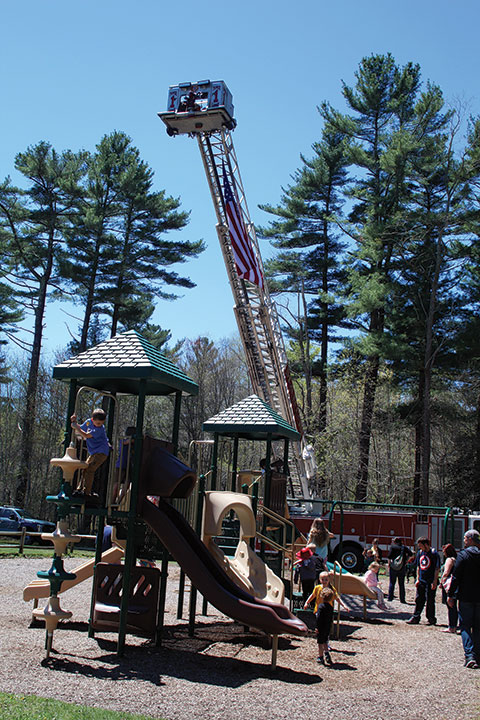
The weather – perfect. The turnout – remarkable. Hundreds of children and their families came out on Saturday, May 11, for the Marion Recreation Department’s 8thannual Kids Equipment Fun Day, aka Touch-A-Truck, at Washburn Park.

            Recreation Director Jody Dickerson was busy with his crew serving up hot dogs and handing out plastic firefighter and construction worker hats beneath a tent that overlooked the playground and field full of fire apparatuses, police cruisers, the harbormaster’s boat, earth diggers, a school bus, tow truck, and more. There was even a group of horses brought over by members of the Massachusetts State Police Mounted Unit.

            “This is one of those events for giving back to the community,” said Dickerson. “We give out free lunches – it’s like a kick off to our spring and summer programs. The kids love it.”

            The event was rained out in 2018 on more than one attempt to reschedule, and eventually the event was cancelled for the year. But the wait was worth it, given the perfect spring weather and the bigger and better-than-ever turnout.

            The Marion Recreation Summer Program is June 24 – August 26 at Silvershell Beach. Registration is available online by visiting https://www.marionma.gov/recreation-department/pages/current-programs.

            The next public event put on by the department is the Marion Village 5k on June 22 at 9:00 am at Tabor Academy.

By Jean Perry

Forest Management/Logging Walk and Talk

The Rochester Land Trust invites you at attend a “Forest Management/Logging Walk and Talk” with Forester Phil Benjamin on Saturday, May 25, 9:00 am at the Church’s Wildlife Preserve on Marion Rd in Rochester (across from 194 Marion Rd. if using GPS). The Land Trust recently completed an intensive logging operation on this 20.8 acre property. Phil will explain how this process benefits the forest over the long term. Refreshments will be served. For more information contact info@rochesterlandtrust.org or 706-675-LAND (5263).

SLT Hosts The Long Walk

Join Sippican Lands Trust (SLT) for The Long Walk on Sunday, May 19starting at 1:00 pm through Aucoot Woods. Alan Harris, Sippican Lands Trust’s Board President, will highlight the various features of our White Eagle, Radio Tower and other properties that make up Aucoot Woods.

            The walk will begin at our White Eagle Property kiosk and will last approximately two hours and cover approximately five miles. White Eagle is located off of Route 6 in Marion. Take Parlowtown Road across from the town cemetery and follow the road until you reach the cul-de-sac. Bear left onto the dirt road and follow it past the abandoned cranberry bog on your right. Parking is available directly past the bog and along the dirt roadside. The kiosk is a short walk beyond.

            Aucoot Woods is comprised of multiple properties including the 248-acre White Eagle property which supports a rich diversity of habitats including upland pine, mixed hardwood forest, shrub and wooded swamp, and freshwater marsh.

            The walk is free and no registration is required. Dress appropriately for this walk in the woods and be prepared for a two hour walk that will traverse some wet areas. If the walk is canceled due to inclement weather, then information will be posted to SLT’s website and Facebook page. For directions or further information visit www.sippicanlandstrust.org or call Sippican Lands Trust at 508-748-3080.

ORRJH Students of the Month

Kevin T. Brogioli, Principal of Old Rochester Regional Junior High School, announces the following Students of the Month for April 2019:

Green Team: Gabriella Berg & Sage Petrocelli

Orange Team: Lauren Rapoza & Colin Carroll

Blue Team: Macy Ingham & Theo Jacobsen

Red Team: Corinne Hibbert & Rylee Kouta

Special Areas: Sarah Adams & Taylor Londergan

Mattapoisett Recreation Summer Programs

Mattapoisett Recreation registration is open for the following Summer Programs:

Brian Rudolph Basketball Skills Clinic at ORR High School –July 8-12 from 9:00 am – 12:00 pm. This clinic will focus on ball handling, footwork, shooting, and defensive techniques. Nature Explorers Camps will run July 22-26and July 29-August 2from 9:00 am – 12:00 pm. Join us to explore Mattapoisett’s unique natural areas. Each day participants will enjoy endless activities including hands on exploration. Reservation Golf Club Clinics will be offered 3 weeks this summer- July 22-25, August 5-8 and August 12-15. This program runs Monday-Thursday from 10:00 am – 12:00 pm and includes lunch after camp. Sessions focus on the fundamentals of golf, rules, and course play.

            Online registration is available at www.mattrec.net