Buzzards Bay Water Quality

Water quality conditions measured in Buzzards Bay last summer (2019) offer a stark reminder about the impact of land development, outdated infrastructure, and climate change on the health of the Bay, according to data collected by the Buzzards Bay Coalition. A majority of locations around the Bay showed slight declines in water quality during the summer of 2019. 

            Each week in summer, the Coalition’s volunteer corps of Baywatchers collect water quality data at more than 200 monitoring stations on 30 major harbors, coves, and rivers across Buzzards Bay. These trained volunteers measure temperature, salinity, water clarity, dissolved oxygen, and general weather conditions. This data is combined with laboratory analysis of nitrogen and chlorophyll levels by the Marine Biological Laboratory in Woods Hole. These two data sets are combined to produce the Bay Health Index, which scores the health of harbors, coves, and rivers from 0 to 100. 

            Overall, about 37 percent of Buzzards Bay’s waterways are now considered healthy, with “good” Bay Health scores. These waters are characterized by clear waters with visibility greater than six feet deep and high dissolved oxygen levels that allow fish and shellfish to thrive. Another 47 percent of waterways are in “fair” condition. In these areas, algal blooms grow causing cloudy water that makes eelgrass beds become sparse or completely disappear and dissolved oxygen levels periodically drop. The number of waterways in “poor” health, that are severely impacted by too much pollution resulting in murky waters and unhealthy underwater habitats, ticked up slightly to 16 percent. 

            “This year’s data include measurements that were taken shortly after a major rainfall last July that washed elevated levels of nitrogen pollution into the Bay,” said Dr. Rachel Jakuba, the Coalition’s science director. 

            Heavy rainstorms increase nitrogen pollution in the Bay in two ways—through stormwater runoff from properties throughout the region and by overloading wastewater treatment systems that serve our area’s most populated communities. Stormwater runoff washes nitrogen and phosphorus pollutants from failing wastewater systems, fertilizers, and hard surfaces—buildings, parking lots, and roads—directly into the Bay. Heavy rainfall moves the nitrogen quickly in the Bay, short-circuiting the natural processes that remove nitrogen as it percolates from soils or is absorbed by wetland plants. In addition, combined sewer overflows in New Bedford discharge excess untreated sewage directly to nearby streams, rivers or other water bodies. 

            Water quality tests taken last July followed a two-day storm on July 23 and 24 that left between two to three inches of rain throughout the region. An intense storm, such as the one experienced last year, significantly increases pollution in the Bay over the short term. The effect of that event led to a decline in Bay Health index, albeit a modest decline, because the scores reflect a five-year average. 

            Heavy rains delivering huge amounts of runoff to the Bay are expected to be an increasing problem for water quality in the years ahead as climate change increases the frequency and intensity of storms.

            The 2019 Bay Health results, however, also demonstrate the potential for reducing human impacts on the Bay. New Bedford Harbor, for example, continues to show gains in water quality that reflect the city’s efforts to remove combined sewer overflows from its wastewater system. While not yet eliminated, the work that has been done so far has resulted in noticeable improvements in the outer harbor and stabilized readings for the inner harbor, both of which are classified as being in “fair” health.

            “While the high nitrogen levels in many places following the July rainstorm showed the often negative impacts of development on water quality, the 2019 data also show the potential for smart development to have a beneficial impact on water quality,” Jakuba said. 

            The vast majority of nitrogen pollution to Buzzards Bay comes from traditional home septic systems and wastewater treatment plants. Although weather can play a big role in year-to-year changes in the Bay’s health, the largest long-term improvements will happen when we continue to reduce nitrogen from wastewater. 

            Red Brook Harbor in Pocasset demonstrates what can be accomplished by improving wastewater treatment. A private wastewater system that removes nitrogen from the water was built to support a condominium development as well as Kingman Marina and its associated businesses. Since the wastewater plan began its operation, the water quality scores throughout the harbor have climbed, and the outer harbor’s health is now classified as “good,” the result of several years of improved water quality.

            The Coalition is spearheading a regional collaboration among the upper Bay communities in Wareham, Bourne, Plymouth, and Marion that aims to substantially reduce the amount of nitrogen discharged into the Bay. The project would connect more homes to the Wareham wastewater treatment plant, which removes as much as 95 percent of nitrogen from its treated wastewater. First, however, the plant’s discharge pipe must be relocated from the Agawam River to a less-sensitive location. 

            Local residents are also making a difference to reduce nitrogen pollution from septic systems. From Westport to West Falmouth, property owners are upgrading to nitrogen-reducing septic systems through a program organized by the Coalition. The effort, which provides funding and technical support for homeowners to upgrade their septic systems, has resulted in the installation of more than 30 of these systems. 

            These efforts to reduce nitrogen pollution from wastewater around Buzzards Bay will drive long-term water quality improvements. When the baseline water quality is higher, the Bay ecosystem will be able to better handle short-term pulses of nitrogen input from rainstorms.

Academic Achievements

Leah Przybyszewski of Mattapoisett, has been named to the spring 2020 Dean’s List at American International College (AIC). Dean’s List students are full time students who have achieved a 3.3 to 4.0 GPA. The College commends the extraordinary achievement and commitment of this scholar’s accomplishment during an unprecedented time.

            Late this spring, Worcester Polytechnic Institute (WPI) celebrated the Class of 2020 with a socially distanced commencement season in place of its traditional 152nd Commencement exercises.

            Nicole Mattson of Marion was awarded a bachelor of science degree in biomedical engineering with high distinction.

            Alex Tavares of Marion was awarded a bachelor of science degree in computer science with distinction.

            Edward Krawczyk of Rochester was awarded a bachelor of science degree in electrical and computer engineering with distinction.

            Drew Robert of Mattapoisett was awarded a bachelor of science degree in robotics engineering with high distinction.

            Michael Gifford of Marion was awarded a master of business administration degree.

            The following local residents made the Dean’s List at Rochester Institute of Technology for the 2020 spring semester. Degree-seeking undergraduate students are eligible for Dean’s List if their term GPA is greater than or equal to 3.400; they do not have any grades of “Incomplete”, “D” or “F”; and they have registered for, and completed, at least 12 credit hours.

            Daniel Bailey of Rochester, who is in the business administration management program.

            Meghan Johnson of Rochester, who is in the software engineering program.

            Noah Quintin of Marion, who is in the game design and development program.

            James DeMailly of Mattapoisett, who is in the environmental sustainability, health, and safety program.

            The following students have been named to the Dean’s List at the University of New Hampshire for the spring 2020 semester:

            Victoria Quinlan of Marion for earning High Honors. Quinlan is majoring in Women’s and Gender Studies.

            Olivia Ucci of Marion for earning Highest Honors. Ucci is majoring in psychology.

            Taylor Swoish of Marion for earning High Honors. Swoish is undeclared.

            Kristina Sauerbrey of Marion for earning High Honors. Sauerbrey is majoring in nursing.

            Amanda D’Amico of Marion for earning Highest Honors. D’Amico is majoring in musical theatre.

            Megan Iverson of Marion for earning Highest Honors. Iverson is majoring in outdoor education.

            Lauren Pina of Marion for earning Highest Honors. Pina is undeclared.

            Carli Rita of Mattapoisett for earning High Honors. Rita is majoring in occupational therapy.

            Abigail Stark of Mattapoisett for earning Highest Honors. Stark is majoring in occupational therapy.

            Jason Gamache of Mattapoisett for earning High Honors. Gamache is majoring in business administration: management.

            Alexandra Nicolosi of Mattapoisett for earning High Honors. Nicolosi is majoring in biomed/science.

            Caitlyn King of Mattapoisett for earning High Honors. King is majoring in health management and policy.

            Emily Ziino of Rochester for earning Honors. Ziino is majoring in chemical engineering.

            Amanda Colwell of Rochester for earning Highest Honors. Colwell is majoring in environmental conservation and sustainability.

            Carly Demanche of Rochester for earning Honors. Demanche is majoring in business administration: management.

            Aidan Thayer of Rochester for earning Highest Honors. Thayer is majoring in ocean engineering.

            Students named to the Dean’s List at the University of New Hampshire are students who have earned recognition through their superior scholastic performance during a semester enrolled in a full-time course load (12 or more graded credits). Highest honors are awarded to students who earn a semester grade point average of 3.85 or better out of a possible 4.0. Students with a 3.65 to 3.84 average are awarded high honors and students whose grade point average is 3.5 through 3.64 are awarded honors.

            The following local residents were named to the Dean’s List at Saint Michael’s College for the Spring 2020 semester.

            –Justin Shay, a Senior physics major from Rochester (02770) and a graduate of Old Rochester Regional High School.

            –Elsie Buckley, a Sophomore psychology major from Rochester (02770) and a graduate of Old Rochester Regional High School.

Historical Society Donates $150,000 to Town House

            The work being done around the Marion Town House will continue, thanks to a $150,000 donation from Sippican Historical Society.

            Frank McNamee and Will Tifft represented Sippican Historical Society at Monday’s special, remote access meeting of the Marion Board of Selectmen where the latter’s membership voted to accept the donation.

            Selectman John Waterman told the meeting that the work on the front of the Town House has exhausted Community Preservation funds, and that this donation will see the project through its next phase, which includes work on the shrubs out front to open up the front entrance area, along with the addition of new soffits and fascia boards to the building.

            Waterman said that work has started on the roof on the annex that, without this donation, would not be happening, and that next year significant work will be done without needing to ask the taxpayers for help.

            “Without their help right now, our project will be at a standstill,” said Town Administrator Jay McGrail.

            McNamee, who is handing over the reins as president of society to Tifft, said that the late 19th-century architectural gem built for Elizabeth Taber when she was in her 80s may be Marion’s most significant historical building. Having been placed at the center of Tabor Academy’s original campus, McNamee noted that someday the Town House and adjacent Taber Library will look across the park at a bronze statue of their famous benefactor.

            After the board approved the $150,000 donation, McNamee said, “We appreciate working with all of you, and we’ll be part of this project for many years.”

            Also in the meeting, the board voted to approve the proposed pay scale for union employees in the Fire Department.

            “This is sorely needed for the Fire Department; it stabilizes where we are today and where we’re going in the future,” said Fire Chief Brian Jackvony, who said the deal allows Marion to remain competitive and employ the best paramedics available. “The captains look like they fall off the scale over the next two to three years so we will take a look at that.”

            The approved pay grid for union employees begins July 1.

            McGrail noted that the impact on employees in the town’s personnel policy was approved for the FY21 budget at the June 22 town meeting.

            The board also voted to ratify union contracts for the Department of Public Works and for the Marion Town Employees Association, which serves the clerical union.

            McGrail said the deals are one-year extensions of existing contracts with a few terms added in and a plan to launch negotiations on a three-year deal in September or October. “It’s been vetted through town counsel as well; both have been ratified by their unions,” he said.

            Waterman congratulated Hills on his reelection to another three-year term on the Board of Selectmen. Hills was also reelected for three more years on the Planning Board.

            Chairperson Randy Parker took the opportunity to applaud all candidates. “Thanks to all who put their name in the hat to run for the positions… congrats to those who won their elected offices,” he said.

            Waterman noted that, while there were no names on the ballot for Marion and ORR school committees, write-in campaigns produced three winners (see story on Marion election).

            McGrail said he was happy to have a successful town meeting (June 22) in the rearview mirror, and Waterman jokingly referred to the feat as “the ninth wonder of the world.” Hills added that the town can look back at 2020 and how successful Marion has been in its approach to “the whole problem” of the COVID-19 pandemic.

            Marion’s website announced that town offices will be closed on Friday, July 3, and will reopen on Monday, July 6. The next meeting of the Board of Selectmen is scheduled for Tuesday, July 14.

Marion Board of Selectmen

By Mick Colageo

Elizabeth Taber Library

Curbside pick-up has begun at the Elizabeth Taber Library. Place a hold on Marion library materials online through our website or over the phone. Library staff will call to schedule your curbside pick-up appointment on Tuesdays, Wednesdays, or Saturdays. For more info on curbside pick-up please email ETLibrary@sailsinc.org or call the library Monday through Thursday from 12:00 to 4:00 pm at 508-748-1252.

            The library is now accepting returns. You can drop off returns at bins provided in front of our book drop Monday through Thursday from 12:00 to 4:00 pm.

            We are once again accepting donations. Please leave donations in provided bins at the rear door of our library Monday to Thursday from 12:00 to 4:00 pm. Please only donate materials in good condition.

            Virtual Summer Reading Programs: Join us Tuesday at noon for Lunch Bunch. Mrs. Grey will read a new chapter each week of Marvin and James Save the Day by Elise Broach.

            Join us Wednesday mornings for Story Time. Mrs. Grey will read three new stories each week.

            Join us for YOGA for Kids. With Elke Pierre Wednesday, July 1 at 2:00 pm for a virtual and interactive event on our Facebook page.

            Take our STEAM Challenge each Thursday at 2:00 and get creative.

Check out our website and Facebook page for more info.

Members of the Tri-Town Communities

Today, Governor Baker’s Office and the Department of Elementary and Secondary Education released (DESE Press Release) their initial guidance about reopening schools this fall. We share its goal of safely returning as many students as possible to in-person school settings in order to best meet students’ academic, social, and emotional needs.

            We will immediately start reviewing this guidance and collaborating with key stakeholders to begin to understand how we can best implement it. We also acknowledge that these initial guidelines do not address every topic and that there will be additional guidance coming from the Department of Elementary and Secondary Education throughout the summer. The full version of the initial guidance is attached to this email correspondence. Here are some key components from the initial guidance to review:

            Current medical research supports a safe in-person return to school – with preventive measures in place – as infection and transmission rates are lower for children than adults

Preventive measures include masks/face coverings, physical distancing, handwashing, and cleaning frequently touched surfaces

            Masks/face coverings will be required for all students in Grade 2 and above and for all adults; they are recommended for students in Grade 1 and below

            Based upon current medical research, and in conjunction with other preventive measures, a minimum physical distance of three feet has been established

            Our schools will need to develop three separate plans – one for return to full in-person instruction with safety requirements, one for full remote learning, and one for hybrid learning that combines in-person and remote learning. Based upon the current medical situation, the expectation today is that students will return to full in-person instruction in September; however, that is subject to change based upon how the medical situation develops.

            We acknowledge that there are likely to be more questions than answers at this time, and we will continue to communicate with you in the coming weeks and months. We also encourage you to read the full document to best understand this Initial Fall School Reopening Guidance. 

            Thank you for your support, patience, and understanding.

            Respectfully,

Michael S. Nelson, Superintendent-Elect

Old Rochester & MA Sup. Union #55

Mary C. (Riley) Youngberg

Mary C. (Riley) Youngberg, 98, of Port Charlotte, FL and Wareham died June 30, 2020 at Lee Memorial Hospital in Fort Myers, FL after a brief illness. 

Born in Buffalo, NY, daughter of the late Harry and Anna (Rutledge) Riley, she lived in New York City, Somerset, NJ and Barnegat, NJ and later summered in Wareham, MA and wintered in Port Charlotte, FL. 

She was formerly employed by Johnson & Johnson for many years until her retirement. She enjoyed traveling, reading and doing puzzles. 

She was a communicant of St. Anthony’s Church in Wareham and St. Charles Borromeo in Port Charlotte. 

Survivors include her son, Robert Youngberg and his wife Vivian of Mattapoisett; a daughter, Diane Sivertsen of Jamesberg, NJ; 6 grandchildren, Alexander Youngberg, Riley Youngberg, Lily Youngberg, David Lamoureux, Jeffrey Lamoureux and Kenny Lamoureux; and 8 great-grandchildren.  

She was the mother of the late Mary Ann Bulas. She was the last survivor of four sisters and three step brothers: Anna Ryan, Rosemarie Moore, Theresa Reilly, Harry Mahoney, Edward Mahoney and Daniel Mahoney. 

Mary will be missed by her family and her many friends at The Mary Lu Park And the Royal Crest. 

In lieu of flowers the family requests contributions to the National Breast Cancer Foundation, Inc. 2600 Network Boulevard Suite 300 Frisco, TX 75034. 

Her private Funeral Mass will be celebrated at St. Patrick’s Church followed by burial in St. Patrick’s Cemetery. Arrangements are with the Saunders-Dwyer Mattapoisett Home for Funerals, 50 County Rd., Mattapoisett. For online condolence book, please visit www.saundersdwyer.com.

Mattapoisett’s New Fire Station Breaks Ground

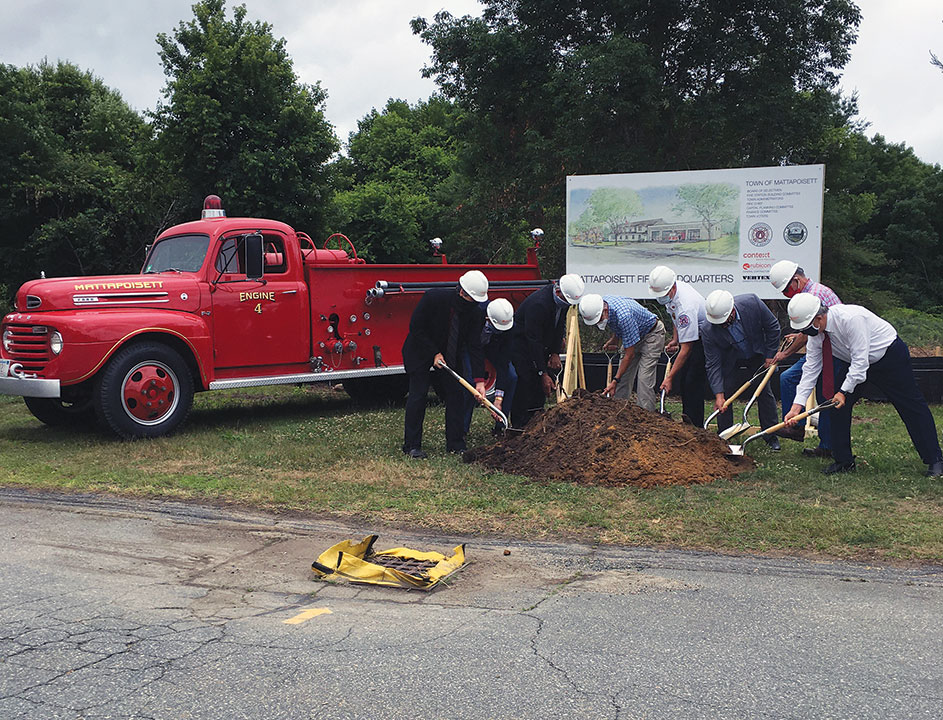
            On June 30 the skies may have been gloomy, but faces were beaming with joy as local officials along with project planners, engineers and construction teams ceremonially broke ground for Mattapoisett’s New Fire Station. On hand to celebrate the moment were State Representative William Straus, Selectmen Jordan Collyer and John DeCosta, retired Town Administrator Mike Gagne, current Town Administrator Mike Lorenco, Director of Inspectional Services Andy Bobola, Police Chief Mary Lyons, Fire Chief Andrew Murray, and retired Fire Chief Ronald Scott. Rounding out those who gathered were members of the architectural group Contex, construction management team Vertex, and contractor Rubicon.

            One volunteer whose leadership and expertise were acknowledged by Murray was Mike Hickey, chairman of the Mattapoisett Fire Station Building Committee. Hickey brought his many years of engineering know-how to the effort, along with volunteer Bill Cantor. The other Building Committee members included Collyer (who is also a captain on the Fire Department), Bobola, and Murray.

            Leading up to the event, Murray told The Wanderer, “As far back as 1980 when apparatus started getting bigger, the old station was out of date.” For 12 years, a new fire station was placed on the Capital Needs list. Murray said that the need for a modern building was increasing year over year as safety standards issued by OSHA and the NFPA put firefighter safety at the forefront of regulations, as well as the increasing size of fire trucks. Murray said that one engine was designed to fit the station, not the needs of the department.

            But the voters were not always ready to fund a new fire station. In fact, Town Meeting rejected an article to provide funding a new station some 10 years ago when then-Chief Ron Scott spearheaded what many believed was necessary even back then – a station that could house the increasing size of modern fire-suppression apparatus and meet OSHA standards geared to ensuring the health and safety of the department.

            By May 2019 Town Meeting and after a yearlong effort on the part of the Mattapoisett Fire Station Building Committee, there was a sea change in attitudes based in understanding the issues the town faced with the aging station.

            From that Spring Town Meeting, The Wanderer reported, Article 14: Fire Station Construction Project Funding was presented by Mike Hickey the chairman of the committee that spearheaded the project and Fire Chief Andrew Murray. Their presentation included a video that demonstrated the lack of safety systems inside the aged firehouse, health concerns when firefighters cannot adequately decontaminate personal gear and equipment as well as the lack of conformity to current OSHA standards.

            Murray ratcheted up his campaign for funding a new fire station for over two years, making it clear that the town was in imminent danger of losing staff to health conditions and being hit by large fines for a building lacking modern-era safety standards. He would hit on the importance of having “…decontamination capabilities… shower, and vehicle exhaust systems.“ He stated, “These issues not only jeopardized the safety of the staff but put the town in harm’s way for fines imposed by regulatory agencies, namely the National Fire Protection Association and Occupational Safety and Health Administration… fines are estimated at over $100,000 for each offense.”

            Yet pushback from downstream abutters persisted as concerns over stormwater runoff into the Pepperbush Lane neighborhood kept the engineering consultants seeking new solutions to old drainage issues, issues that emanated from the Police Station property. There was also concern expressed by homeowners living in the Mattapoisett Villages condominium complex next door. Lingering concerns were expressed on this day by Steve and Debra Pickup, who wanted to discuss tree removal and screening. A member of the Vertex team assured the couple that their concerns were being addressed and that ongoing dialogue was encouraged.

            During the Planning Board meeting held on September 16, 2019, Katie Enright of Howard Stein Hudson explained in detail the new drainage system that would first address existing drainage problems and then the new drainage from the fire-station site.

            Enright would show that a large underground drainage pipe that ran 500-feet from the police station to wetlands behind the skate park had for years dumped water in a manner that would not be allowed today. She said that plans for the new fire station would address those drainage issues, while also planning separately for drainage of the fire station itself.

            Finding a way to fund the new station fell to Gagne and the Finance Committee. During the April 23, 2019 Board of Selectmen meeting held in advance of the May town meeting, Gagne explained the $9,275,000 funding by likening the financing to a “three-legged stool,” one that included new growth from solar P.I.L.O.T programs, retiring debt, and moderate override that would cost homeowners $13.38 per year. “It’s very doable,” Gagne said. He pointed to retiring debt as the biggest contributor to the financing plan with approximately $8,000,000 freed up within the next six years.

            Murray explained during one of his many presentations to town departments, clubs, boards, and committees that modern-day construction materials contain glues and chemical-rich combustibles that emit particulates and other highly carcinogenic elements. The dust and smoke associated with structure fires today present far more exposure to dangerous soot than ever before, he said.

            As the shovels were being passed around, Collyer told the assembled, “It’s been a long road; the department needs this to support and protect you.”

            Hickey said the process of securing funding and moving a project of this size from concept to completion required, “need, timing, planning, selling and support.” He noted the support of all the town’s committees and boards and the voters. He said that Town Meeting support and the ongoing encouragement of the fire department members were appreciated.

            The 14-month construction phase has begun with new drainage systems being installed behind the police station. There are pending items on the to-do checklist according to Hickey, such as traffic lights and curb-cuts on Route 6. But he said those matters were being dealt with and expected closure soon.

            Seeing is believing, they say, so when Murray had the 1949 Engine Four brought to the construction site and parked beside the modern Engine One, it was clear that size matters. The older engine was dwarfed by the newer version. And, if you are wondering, the current fire station was opened in 1954 under the supervision of Chief George C. Bradley. The building was obsolete by the early 1970s.

Murray said the new fire station is planned to have a shelf life of 50 years.

By Marilou Newell

Bishop Stang Fourth Quarter Honor Roll

Bishop Stang High School is proud of the accomplishments of our students, and recognizes those students earning Honor Roll distinction. Students on the President’s List have an average 95 or above, and a 90 or above in all courses. Students receiving First Honors have an average 90 or above, and an 85 or above in all courses. Those with Second Honors have an average 85 or above, and an 80 or above in all courses.

            The following students from our area are being recognized for their academic achievement at Bishop Stang High School for their performance in the fourth quarter:

            Marion, President’s List: Raquel da Costa ’21, Maeve Egger ’22, First Honors: Fiona Lonergan ’20, Sophie Lynch ’21, Redmond Podkowa ’23, Luke Tougas ’23, Laurenne Wilkinson ’20, Second Honors: Bridget Clavell ’21, Morgan Miedema ’22, Matthew Quinlan’23, Catherine Russo ’20, Aaron Wilkinson ’20, Nellie Zygiel ’22

            Mattapoisett, President’s List: Julia Downey ’23, Kathleen Downey ’20, Liam Downey ’21, Ella Meninno ’21, Hannah Ramalho’23, Eleanor Senna ’23, First Honors: Chloe Lanagan ’20, Claire Surprenant ’22, Second Honors: Cole Dube ’21, Christopher Gauvin’21, Lauren Lapointe ’20, Cameron Letourneau ’23

            Rochester, First Honors: Dylan Aguiar ’21, Maxwell Brulport ’21, Briana Pothier ’22, Second Honors: Isaac Ouellette ’21

St. Philip’s Episcopal Church

St. Philip’s Episcopal Church, next to the Town Beach in Mattapoisett, will have 8:00 am-only services from July 5 through September 1. Masks will be required and all other safety precautions will be in place at the church. 

            All are welcome to attend services using the 1928 Book of Common Prayer and conducted by the following visiting clergy:

July 5: The Rev. Philip C. Jacobs III, Retired Rector, Trinity Church, Canton, MA.

July 12: The Rev. Nathan J.A. Humphrey, Rector, St. John the Evangelist, Newport, RI.

July 19: The Rev. Robert Malm, Interim Rector, St. Gabriel’s Church, Marion, MA.

July 26: The Rev. Marc Eames, Rector, The Church of the Advent, Medfield, MA.

August 2: The Rev. Robert Malm

August 9: The Rev. Marc Eames

August 16: The Rev. Philip C. Jacobs

August 23: The Rev. Nathan J.A. Humphrey

August 30: The Rev. Jeffrey Paull Cave, Retired Diocese, Atlanta, GA.

September 1: The Rev. Jeffrey Paull Cave

The Migration Loons of Summer

            If you are a bird watcher along the coastline of Buzzards Bay, loons may still appear coming in from the ocean where they spent the winter.

            They started inland in spring when warmer water and prevailing onshore breeze pointed them northward in the direction of the Atlantic Flyway along with other sea bird migrations. They might then be seen and heard flying about 20 feet above the water at a speed of about 30 miles per hour. They often may land to rest for the night, but are not easy to recognize in their pale salty plumage to camouflage in a freezing environment. After their long journey beyond the reaches where the headlands of Massachusetts take them past Cape Ann, they soon must turn inland towards the northern lake country.

            As they pass overcrowded cities and towns with factory smokestacks clouding the air and long lines of cars along thruways belching carbon monoxide, they probably fly higher to a quarter-mile up, and as fast as 60 miles per hour.

            They do not assume any formation such as the “V” as with Canada geese, but call to each other, particularly when up ahead over the horizon appear the endless expanses of water in the White Mountains of New Hampshire. The largest promise of migration is the vision of Lake Winnipesaukee, an Indian name for “smile of the great spirit,” a welcoming human image of appreciation for migrants. The lake is also the headquarters of the Loon Preservation Committee. It annually distributes loon nesting platforms to make them feel at home once they are there.

            The male usually selects the nesting site. Because their legs are so far back in their body, like their reptilian ancestors, they cannot stand or walk on land; it must be at the edge of water to be approached underwater. Both the male and female help furnish the nest, hatch, and guard one or two chicks who are born precocial, already covered with down, and able to swim the same day.

            In the first two weeks, the iconic spectacle of back-riding may occupy 65 percent of their time. If approached by intruders to this family scene of security, the father will rise up in stature on the water with a ferocious beating of wings, thrashing the water with a territorial display while loudly yodeling an irate warning to scare anyone and everyone away. It makes a lasting impression when you have been close enough to cause the commotion called a Tremolo.

            Loon occupancy to rear their young is an excellent, bellwether indicator of crystal-clear, pristine water quality to see prey far down at great depths for ample food supply to satisfy their needs. Both parents are seasoned divers and anglers propelled by active feet to shoot through the water like a torpedo or turn on a dime in direction by coursing wing movements. They also have solid bones for submerging with waterproof plumage, permitting them to drop their heads far enough underwater while swimming along the surface to scan far down for fish. They are able to drop out of sight completely for some length of time, only to resurface far away in a different direction, to mislead onlookers with predatory intent. They typically stay close to shore, able to disappear from sight, just around the corner of an island.

            The loons’ survival instincts and evasive behavior down through the ages made it one of the oldest species on earth. Estimated by fossils of stratified lake-bottom pages in almost endless time, they are estimated to be billions of years old.

            The uncanny spirit and mysterious evolution of this almost paranormal clairvoyance to live through the ages and harsh cataclysms can be heard in the wail of loons to mourn the hazards of survival. The wail is often a call from one Loon to locate another, or from one that has somehow lost its mate. Henry David Thoreau at Walden Pond described it as the most unearthly sound he had ever heard. As the midsummer sun goes down across the lake-side wilderness, the loon’s incredible annual migration is still only halfway complete. What lies ahead is the journey back again, to complete the unbroken chain of survival from the past into the future.

By George B. Emmons