MNHM After-school Program

The Marion Natural History Museum will hold the program; Rock-Hound 101 on Wednesday, January 29 from 3:30 to 4:30 pm. Cost is $6 for members, $8 for non-members.

            Jim Pierson will be in to talk about his favorite topic, rocks, minerals, and fossils. A geology enthusiast, Jim continues to be passionate about collecting these artifacts. He will be sharing his interest with us by showing us some specimens from his own collection, as well as looking at some specimens from the museum’s collections.

            Please go to www.marionmuseum.org, to see upcoming programs and to fill out the registration for this program.
Sippican Historical Society

In 1998, the Sippican Historical Society commissioned an architectural survey of Marion’s historic homes and buildings. The survey was funded half by the Sippican Historical Society and half by the Massachusetts Historical Commission. Due to the limits of funding, not all of the historic buildings were surveyed, but over 100 were cataloged and photographed. The results of the survey are in digital form on the Massachusetts Historical Commission’s website and in four binders in the Sippican Historical Society’s office (and at the Marion Town Clerk’s office).

            Marion (Old Rochester) is one of the oldest towns in the United States, and the Sippican Historical Society maintains an extensive collection of documentation on its historic buildings. The Sippican Historical Society will feature one building a week so that the residents of Marion can understand more about its unique historical architecture.

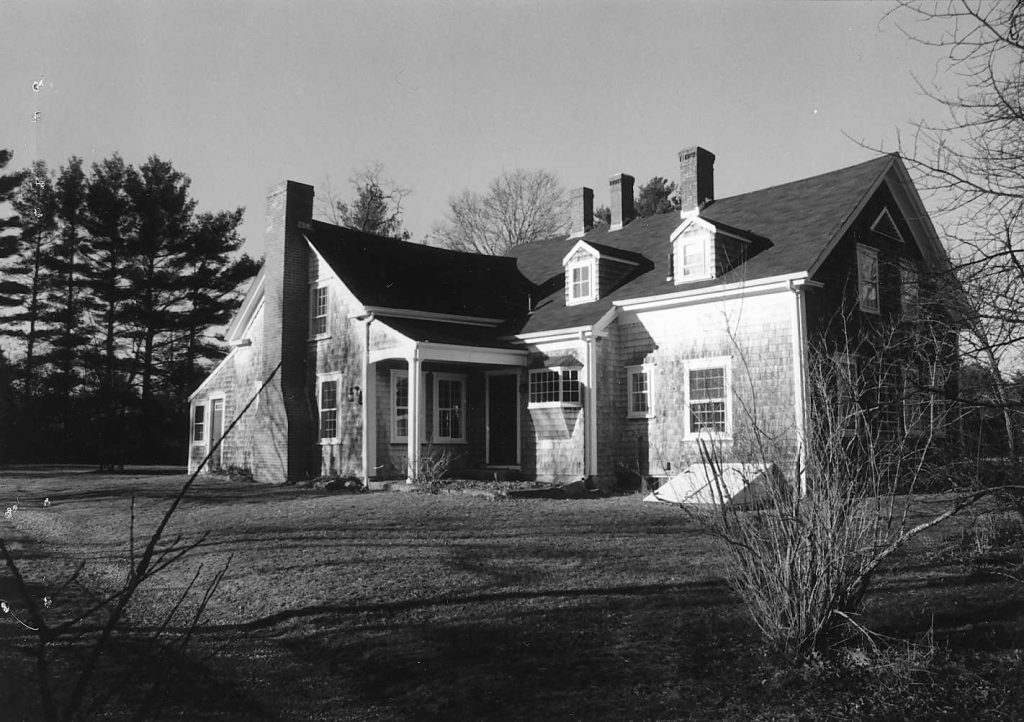
            This installment features 391 County Road. The home at 391 County Road is said to have been a wheelwright’s shop. Around 1830, it was enlarged into a Greek Revival cottage to become the residence of Oren Vose, a farmer. Oren Vose was probably related to a leading family doctor in Wharf Village in the late 19th century, Dr. Albert C. Vose of 45 Main Street. Oren Vose lived in the house on County Road until at least the mid-1850s. Benjamin F. Vose operated a garden market and poultry farm on this property from the 1870s until his death on May 7, 1926.

Nancy (Cleveland) Kimon

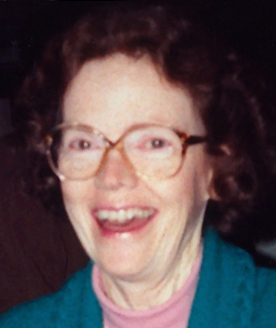
Nancy (Cleveland) Kimon, 89, of Mattapoisett, Massachusetts passed away peacefully at Sippican Healthcare Center in Marion, Massachusetts on Thursday January 16, 2020. She was the beloved wife of the late Peter M. Kimon, a native of Athens, Greece. 

            Born in Medford, Massachusetts to the late Richard M. Cleveland and Ellen (Conneely) Cleveland, Nancy grew up in Belmont, Massachusetts, attending Belmont High School and then Pembroke College in Brown University. She went on to complete an Associate in Arts from the College of Practical Arts and Letters in 1954 from Boston University.

            While a Junior at Belmont High School, Nancy met her future husband, Peter who at the time was studying Engineering at MIT as an international student from Greece. They married in Cambridge in 1953, and so began an exciting life of adventure and travel and active participation in the communities in which she lived whether in the United States or Europe. Contributing to the betterment of society, Nancy volunteered for causes close to her heart throughout her life that led to meaningful change. 

            Mattapoisett always held a special place in her heart. From 1939 she began spending her summers on Angelica Point and then Point Connett. In 1986 following the death of her husband, she relocated from Mendham, New Jersey to Mattapoisett to be nearer to her family. She quickly became involved in the community, becoming an active member in the Christian Women’s Club of Cape Cod, the Mattapoisett Woman’s Club and the Sandwich Glass Museum in Sandwich, MA. Having a passion for historic Sandwich Glass, Nancy was a Trustee for thirteen years, an officer of the Board for four years and on Accessions Committee for ten years. In addition, she served on various committees including the Centennial Celebration Committee, Board of Advisers and the Strategic Planning Committee and was an important part of the evolution of this institution. In 1991, she restored the Carriage House at the Congregational Church in Mattapoisett, as a memorial to her husband Peter and her father Richard. 

            Nancy is survived by her daughter, Sandra (Kimon) Brattstrom and her family who reside in Australia, and would like to acknowledge and thank all the staff at Sippican Healthcare Center for the love, support and care her mother received, for which she is truly grateful. 

            Family and friends are invited to attend visiting hours on Tuesday January 21, 2020 from 4-6 pm at the Saunders-Dwyer Mattapoisett Home for Funerals,, 50 County Road, Route 6, Mattapoisett. A Funeral Service for Nancy will be held on Wednesday January 22, 2020 at the First Congregational Church of Marion at 11 am. A private burial will take place on Thursday 23, 2020 at Hilltop Cemetery in Mendham, New Jersey. In lieu of flowers, donations can be sent in Nancy’s memory, to the Sandwich Glass Museum, P.O. Box 103, Sandwich MA 02563. For directions and guestbook, please visit www.saundersdwyer.com.

Principal Shows How RMS Assesses Student Skills

            The Rochester School Committee on January 9 listened to a brief presentation from Rochester Memorial School Principal Derek Medeiros about the way teachers and school administrators assess student performance and skill growth beyond MCAS score data.

            During the last month’s meeting, Medeiros presented the RMS MCAS data, which Medeiros was relatively proud of; however, School Committee Chairman Sharon Hartley was not as impressed with the results, which led to her questioning whether any analysis of the data was performed in order to make changes to curriculum and instruction to improve student performance.

            Medeiros explained during that meeting that the school would continue to utilize its school-wide “flex-time” for intervention to target specific skills and areas of learning where individual students struggle, and that the MCAS does not quite capture all the evidence of growth in students’ learning.

            RMS teacher Tara Nelson also spoke out that night against putting too much emphasis on MCAS scores as the most important assessment of students’ overall performance in school, advocating for the inclusion of other data such as report cards, teacher comments, and other proof of performance.

             Medeiros asserted that he and his administration and teachers are “constantly looking at [student performance]” and “constantly looking at ways to improve.”

            On January 9, Medeiros presented the school’s main medium for performance assessment in Math and ELA, an online platform called Freckle, that collects data generated from students completing assignment questions in targeted areas that are then looked at by teachers and both the principal and vice-principal.

            Using that data, students are grouped and oftentimes assigned a different teacher as a group during the students’ flex-time. Teachers, Medeiros, and West then meet twice a month as a group to review the data to assess student performance and skill proficiency in each grade level.

            The Freckle assessments can then shift to practice assignments students complete at the individual level on a computer, which is then used for further reassessment.

            Freckle, said West, is aligned with the school’s Math curriculum, Go Math!, and used to supplement the curriculum.

            “Which is a nice option to have and can be utilized in a number of ways,” said West, adding that this platform leads to more targeted intervention methods.

            This system is only used for grades 2-6, Medeiros said, since it is not practical for the younger students at RMS.

            Medeiros assured the committee that the Freckle data is looked at closely every six to eight weeks as a whole team and discussed.

            “It’s one of the major focuses of planning time,” said Medeiros.

            West added that teachers appreciate the ability to have conversations as a team to reassess benchmarks, identify where students are struggling to keep up, and how to set learning goals.

            “We’re now heading back in as we approach [MCAS],” said Medeiros. “Teachers are starting to think about what they’re going to be doing in preparation for that as well, and how we can support them as well.”

            The next meeting of the Rochester School Committee is scheduled for February 6 at 6:30 pm at Rochester Memorial School.

Rochester School Committee

By Jean Perry

Expect the Unexpected at MAC Winter Show

            When you walk through the doors of the Marion Art Center at any given point in time you are bound to find something unexpected, surprising, thought-provoking, and exquisitely beautiful. No small feat for a petite building with limited gallery space. But once again that is exactly what is happening right now as the MAC’s galleries host the 2020 Winter Members Show, now through February 15.

            Gracing the walls will be perennial favorites such as works from Anne T. Converse, Sharlie Sudduth, Peter Stone, Sarah Brown, Russell Saunders, Diana Parsons, Tom Geagan, and Alice Shire, to name a few of the more than 50 artists who participated in this year’s show.

            Two new members have added their works to the stunning display. John Magnan and Diane Kelley have only been MAC members for a relatively short period of time, but already they are making an impact by way of their chosen artistic expressions.

            Magnan is a woodcarver whose use of electric carving tools to find the inner messages deep within wood boggles the eye, followed by the heart and mind. The three pieces Magnan brought to the MAC show represent more than 25 years of expertise in sculpting and in woodcarving.

            “I retired and took up sculpting,” he said. His love of natural materials and the challenges of finding that hidden “something” deep within a log can be seen in the three pieces now on display.

            Located on the first-floor gallery are two smaller works: Diorama, and a self-portrait titled ‘Fibonacci Blindfolded’.

            Diorama came out of an opportunity Magnan received when invited to participate in an exhibition at the Philadelphia Athenium. Artists were asked to use books located there as a source of creative inspiration. Magnan selected an “old architectural” book.

            “It’s about a dozen individual pieces,” Magnan said of the completed work, intricately carved pages of a book that was then glued into a cover with a majestic Greek Revival entranceway. One can almost imagine shrinking to Lilliputian size and walking into the book’s pages.

            Opposite this piece is ‘Fibonacci Blindfolded’. The self-portrait is layers of purple heartwood and maple with a studded band around the eyes and skull representing a blindfold.

             Magnan is a retired career mathematician with the federal government.

            “I’m a lifelong wood carver,” said Magnan. “When I retired, I studied at the Maryland Institute in the first postbaccalaureate program that allowed you to pursue a degree in a non-related field.”

            After completing that program, he was accepted into the master of fine arts program at the University of Massachusetts Dartmouth where he studied sculpting earning an MFA.

            “I’ve been here ever since,” he said with a chuckle. 

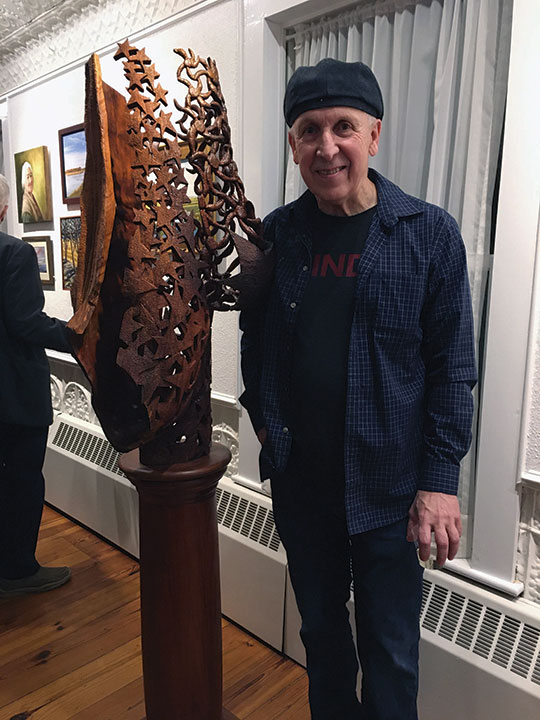
            Standing more than five feet tall in the second-floor gallery is Magnan’s third offering titled Artemis. It rests on pillar also carved by the artist. Artemis is a daughter of Zeus, and as the story goes, the goddess of the hunt, animals, the moon, and the entire wilderness. Magnan’s take is otherworldly. The lattice-like trunk appears as stars in the sky suspended for eternity.

            One more word on Magnan: there will be a solo showing of his installation Thor’s Hammer at the MAC from February 21 through March 28.

            “It’s social commentary using the imagery of Marvel Comics,” he said.

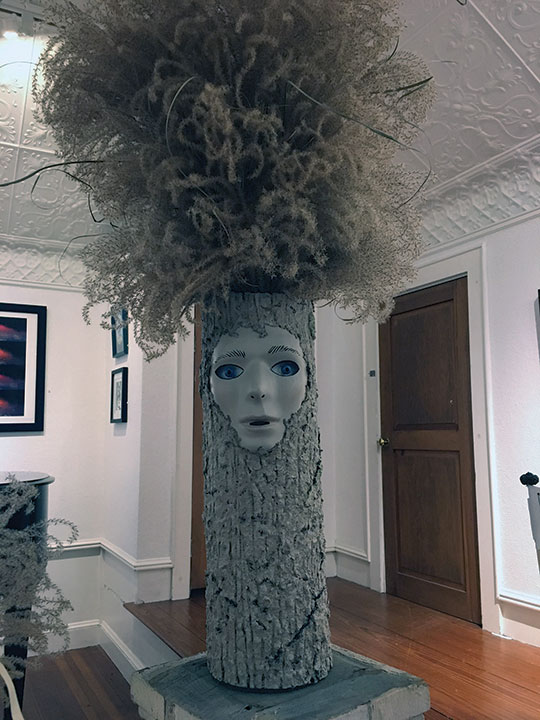
            Also on the second floor is the whimsical yet breathtaking installation of Kelley’s mixed media works of art. Here we find a combination of elements depicting human features in a “tree trunk” made of paper-mâché “bark” over PVC conduit like slices of tree branches stacked to make a small sentry.

            The larger piece, titled ‘Mother Earth Vessel’, has a delicate face peering out inviting all to stop for a moment and notice the pampas grasses currently adorning the top of her head.

            “At Christmas time I placed willows and lights there,” Kelley said, making this piece changeable according to the season. She said that it first graced a table at the Rotch-Jones-Duff House in New Bedford during the holiday season. 

            Kelley, a gifted interior designer who has given classes at the MAC in the past, enjoys working with a variety of natural and manmade materials. Her ‘Celebration Sentry’ could easily become a lifeguard in the summer or a nutcracker in December. Its eyes were cleverly crafted from black beans and pistachio shells. She said she has been very encouraged by the public’s response to her works and was eager, as many other artists were, to receive feedback. Kelley plans to continue working with a wide selection of materials to achieve something new as she explores the depths of her creativity.

            A third piece by Kelley titled ‘Elegant Earth Angel’ is a delicate combination of dried grasses, leaves, and flower heads. It seemed at any moment it would gently flutter its grass wings and rise into the heavens.

            Whether you are drawn to photography, watercolor, pastels, oils, acrylics, or the use of assorted materials, there is something for everyone at the 2020 Winter Members Show at the Marion Art Center.

By Marilou Newell

Autism Awareness Workshop

For adults who have children with autism in their lives, whether through work or home, Mattapoisett Public Library is hosting an Autism Awareness Workshop titled “Understanding Autism Spectrum Disorder” on Wednesday, January 29 at 3:30pm. Presented by Jan Randall, Community Autism Resources Specialist, this two-hour workshop for adults will provide a basic introduction to Autism Spectrum Disorder (ASD). Content will include current statistics on ASD, and an overview of the central areas of challenge often associated with ASD including: communication, sensory, social, executive function problems, and behavior. 

            Please register by January 22. Light refreshments served.

            All programs are free and open to the public. If special accommodations are needed, please contact the library at 508-758-4171 for assistance. For more information on up-coming children’s programs, please visit our website at www.mattapoisettlibrary.org/children.asp.

A Proposed Reconfiguration of US Route 6

To the Editor;

A Proposed Reconfiguration of US Route 6 in Marion Gateway Area. 

            Marion Village is accessed primarily by Front St. South of I-195 at Exit 20, crossing US Rt. 6 (also called MA Rt. 105). The main intersection region of Front St. and Rt. 6 with surrounding streets is known as the “Gateway” area to Marion. Our desire now is to update the Gateway by reconfiguring Route 6 to improve connectivity across, and improve safety on Rt 6, plus add a bike/intermodal lane, all within the existing curb width. We believe there is an economical, effective and practical solution that could appeal to MA DOT which has not yet been included in the studies recently presented in Marion. This would also include much-needed updated sidewalks, improving safety and appearance. Plus, we can address special concern & relief for traffic entering or leaving Rt. 6 businesses.

            We have proposed a 3-lane layout with two travel lanes, central left-turn-only lane, and intermodal (“bike”) lane on the village side, but only in the central Rt 6 Gateway area of Marion, starting at Ryder Lane, Eastbound by Spring & a signalized Front St., continuing over the hill and descending to Creek Rd. The bike lane would then meet up with the Creek Rd. bikeway and beyond into E Marion, This intermodal connection was also identified as an important need in the recent Marion Master Plan. At Front St, the central lane would be a signalized LT lane, greatly improving safety there plus room for possible small island areas for pedestrian relief. The remainder of Rt. 6 would remain the same, but of course all drains and pavements would be repaired and restored to permit smooth travel near the edges, which is not the case now in most areas, diverting fast-moving traffic to the center lane.

            This 3-lane layout would allow all 3 lanes to be wider than the present ones, also eliminating very close opposing traffic in the center as at present. Also, this would allow a 6+ft bike lane, and increased setbacks of the sides from the curbs. (This is similar to central Mattapoisett but with standard lane widths, allowing the bike lane.) These features received support by several attendees at the recent well-attended Rt. 6 meeting in the Marion Sippican School, feeling that a generous, well-marked bike lane on the pavement would be safe and a major improvement.

            There would be appropriate transitions at each end, and significantly address the present “no warning” and inadequate sightlines of close, fast-moving traffic for vehicles attempting to enter Rte 6 from adjacent businesses, especially in the curve between Ryder Lane and Front. St.

            Present-day traffic counts averaging about 10,000 vehicles per day (occasional summer or rush-hour peaks under 15,000) are easily handled by single-lane travel through this limited area with a reduced—and appropriate speed limit, possibly 30-35 mph. Also, the high spot on Rt. 6 in vicinity of the Hilltop and Over-55 housing impairs visibility ahead both ways, making safe entry and turning near these Marion facilities difficult. Updated sidewalks, improved safety, and appearance are also essential and are included.

            For some reason, this configuration which has been circulated in Marion and Rte 6 meetings for over a year was not included as an option in the recent studies of options to improve Rte. 6. I and others have urged that this be added to the choices, and in my opinion, remains the best balance of safety, economy, and ease of construction. Drivers in a single-lane area would naturally travel slower and abide by a reasonable posted limit. The center LT-only lane naturally provides some merging and departing space for travelers.

            In summary, there are many benefits to Marion if we can adopt this or a similar layout for Rt. 6, which today divides our town, providing a badly-needed and much-desired bike/intermodal portion, and dealing with the daunting and sometimes dangerous traffic situations we now encounter in this most important area of Marion. Please participate in the continuing gatherings in Marion to improve our town. Thanks!

Steve Kokkins, P.E. (Ret.), Marion

Applicant Prevails After ZBA Struggles to Agree

            The Rochester Zoning Board of Appeals did not take a vote on January 9 to approve or deny a variance request for Tom Kennedy, 177 Marion Road, and instead voted to simply overturn the building inspector’s decision to deny Kennedy a building permit for his garage.

            It was a long and winding discussion, though, one that included two recesses and a teleconference with town counsel before four of the five ZBA members formed an opinion and concluded that Kennedy did not need a variance. The Board invoked the Mullen rule to allow all members to participate, including members who had not attended the previous meeting.

            Kennedy is seeking a variance to allow for a garage to be built in his front yard; however, the zoning bylaw prohibits accessory structures from being built in the front yard.

            The hearing was continued from December, and during that meeting, the crux of the matter was a porch at the front of the main structure – the house – and whether that porch was substantial enough to be considered a “front wall of the house” under the bylaw with its foundation, full length of the house, and roof.

            ZBA Chairman David Arancio, absent from the last meeting when the hearing was opened, contacted Town Counsel Blair Bailey on that matter; Bailey told him that the intent of the bylaw was that the porch was not considered part of the main house and therefore the setbacks that define the “front yard” must be calculated from the front wall of the house. Anything beyond that main house wall would be considered the front yard, placing the proposed garage in the front yard.

            If that porch was considered a part of the main structure, though, the proposed garage location would not be considered the front yard and no variance would be needed.

            “He’s (Bailey) considering the house itself as the main structure,” said ZBA member Richard Cutler, “but we have a porch that has a foundation as… it could easily be enclosed, so I would consider that in this case the main structure, part of the main structure.”

            “It’s not a simple platform with a couple of steps,” said ZBA member Davis Sullivan.

            “I want to make sure the petitioner tonight walks away with the ability to do this,” said ZBA member Tom Flynn. “I want to make that clear, but I don’t think there’s any other way to interpret it than that the porch has to be part of the main structure.”

            The problem facing the Board was the fact that the bylaw does not address whether a porch like that was considered part of the “main structure.” It does leave a subjective interpretation of a “wall”, though, and the board struggled to conclude whether the foundation of the porch qualifies.

            If the board considered the porch to be part of the main house, then the garage would technically be outside the front yard. But if the board considered the front wall of the house as the main structure, the garage would be about two feet into the front yard.

            Arancio was not convinced the porch should count as part of the main structure.

            “Every time this body talks about how close something is for setback requirements, we go from the closest point,” said Arancio. “So the porch, the overhang, the gutter… if we are now to define it differently, I think that’s problematic.”

            Arancio also had a problem with an inconsistent setback that was presented in the plan before them, the plan that was approved for the placement of the garage, and the mistake the contractor made in pouring the foundation of the garage in a different place.

            Arancio insisted on a recess to consult with Bailey, and then returned to open session even more convinced that he was right. Furthermore, the project would not meet the three criteria required to grant a variance if a variance was needed.

            “Most of us don’t believe that this… variance is even necessary,” said Cutler.

            Arancio said he asked Bailey for clarification, and, “He has not instructed this board to discontinue this hearing base off of what he believes…”

            “Respectfully, I disagree with town counsel,” said Flynn.

            Arancio lamented that Bailey was not present at the meeting, so he called for another recess to again phone Bailey, and the meeting was reopened with Bailey on speaker.

            Bailey said, to the best of his knowledge, the bylaw has never been applied to anything attached to the structure – no porch, landing, or stairs. And to consider the porch as part of the main structure, where does the board draw the line?

            “The issue becomes… if you start using decks and front porches as that limitation, I think you’re going to start bringing into question… how big a deck does it have to be?” said Bailey. “My problem is, where are you going to draw the line on the deck?”

            Bailey cautioned the board by setting a precedent by interpreting the porch as part of the main structure.

            “I think in this case… if you want to change that interpretation… I think the problem becomes – unless and until you… rewrite the bylaw, you’re going to be in a really subjective realm.”

            That won’t help the board that night, though, Cutler pointed out.

            “Tonight, it’s really within your discretion,” said Bailey. “If you don’t feel that a variance is needed… I would just say to you, you should be very specific as to where you’re going with the definition of wall so that there’s some direction for [the building inspector].”

            “I know I am in the extreme minority in this,” said Arancio, “and I understand that; and I am well aware of the optics of that. I believe that this could’ve been 100 percent avoided… if [the garage foundation] was put as placed at the 55 [feet] and this wouldn’t even be a talking point.”

            No abutters contested the application, and none were present that evening.

            “In this case, I think that the porch is part of the main structure,” said Cutler.

            “This porch is part of the main structure,” said Flynn. “It’s substantial, and I think we can exercise our authority.”

            “I also think that this is the intent of the bylaw,” said Cutler.

            Cutler made a motion to overturn the building inspector’s denial of the building permit, and the motion was then amended to specify that the nature of the porch made it part of the main structure.

            The vote in favor was 4-1. Arancio dissented.

            The next meeting of the Rochester Zoning Board of Appeals is scheduled for January 30 at 7:15 pm at the Rochester Town Hall.

Rochester Council on Aging

            The full monthly newsletter and calendar are available on our website www.rochestermaseniorcenter.com. Like us on Facebook! www.facebook.com/rochesterma.com

            The Rochester Senior Center will host the monthly Senior Book Club on Tuesday, January 21 at 10:15 am. The meeting is led by Gail Roberts, Director of the Joseph H. Plumb Memorial Library in Rochester. The book being discussed this month is, The Daring Ladies of Lowell, written by Kate Alcott. It is the story of the original mill girls of Lowell, their friendships, hardships, and bravery. The story takes place at a mill in Lowell where single young women work cotton looms in the early industrial age. They are considered pioneers, and although this gives them opportunity and freedom, the working conditions can be dangerous. The mill girls strive for better, safer conditions, and this is met with complications and conflict. Next month’s book is Silas Marner and will be discussed on February 18.

            The Fitness Room at the Rochester Senior Center has new hours. The new hours are; Monday, Wednesday, Thursday and Friday from 9:00 am to 12:00 pm, and Tuesday 10:00 am to 1:00 pm. The fitness room is open to all seniors. There is a monthly fee of $10 to join. Please call the Senior Center at 508-763-8723 for details.

            The Rochester Senior Center is hosting AARP trained tax-aide volunteers for Free Income Tax Preparation Appointments in February. Free tax preparation is provided for all moderate-low income individuals with special consideration for those over 60 years of age. This service is offered every other Wednesday beginning in February and ending April 15. Please call the Rochester Senior Center to schedule an appointment in advance. You must bring all pertinent paperwork with you to your appointment. This is a very popular program, so appointments are required to meet with a trained tax-aide volunteer.  Please call 508-763-8723 for information or to make an appointment.

It’s a Global Community – Basic Language Lessons

Language is a gateway to a culture. Come to the Mattapoisett Free Public Library and learn some friendly greetings and conversational phrases in other languages. Townsfolk in the community will share some of these basics from their native languages in a casual informal setting. One class for each language for thirty minutes – no pressure – and leave with a list of words and phrases so you can practice them and try them out with your neighbors or on your travels. All are welcome.

            This will be an ongoing program with more languages to come so check back! First round:

Japanese – Sunday, February 2 from 1:00 to 1:30 pm

Spanish – Sunday, February 2 from 2:00 to 2:30 pm

Chinese – Wednesday, February 12 from 6:30 to 7:00 pm

Portuguese – Sunday, February 16 from 1:00 to 1:30 pm 

French – Sunday, February 23 from 1:00 to 1:30 pm

            The Library is located at 7 Barstow Street and is handicapped accessible.