Albert E. “Butchie” Hartford

Albert E. “Butchie” Hartford, of Mattapoisett, formerly of Randolph, passed away unexpectedly on August 18, 2020, at the age of 63. Born in Boston, Butchie grew up in Randolph and graduated from Randolph High School. He was a handyman who turned his passion into his career as a contractor working in the construction industry in various roles for many years. Butch was a “Gentle Giant”, world traveler and avid car collector. He was as strong and calm as the ocean. He had many passions in life including sailing, painting and drawing, fishing, going to the movies and or just being content sitting at the beach. No matter where he was, he made the most out of every situation. No matter where you were, somehow, someone always knew of him. He had an energy that made you feel relaxed and that everything would be OK, no matter what. He was always willing to help anyone in need. Butch was a mindful, stoic, modest man who just appreciated everything about life. A devoted father, friend, uncle, brother and mentor, Butchie will be greatly missed by all who were blessed to have known him. Butchie was the loving father of Courtney Hartford, Shannon Hartford and Megan Hartford all of Mattapoisett. Devoted brother of Donna McMahon of Middleboro, Diane Brady of Weymouth and the late Jimmy Hartford. Son of the late Albert and Estelle (Jule) Hartford. Former husband to Clare (Murphy) Hartford. Also survived by many aunts, uncles, nieces, nephews, cousins and friends. A private Celebration of Butch’s life will be held on Wednesday, August 25th amongst friends and family. Arrangements under the care of the Cartwright Funeral Home, 419 No. Main St., Randolph. To leave a message for the family, visit www.cartwrightfuneral.com.

Sippican Historical Society

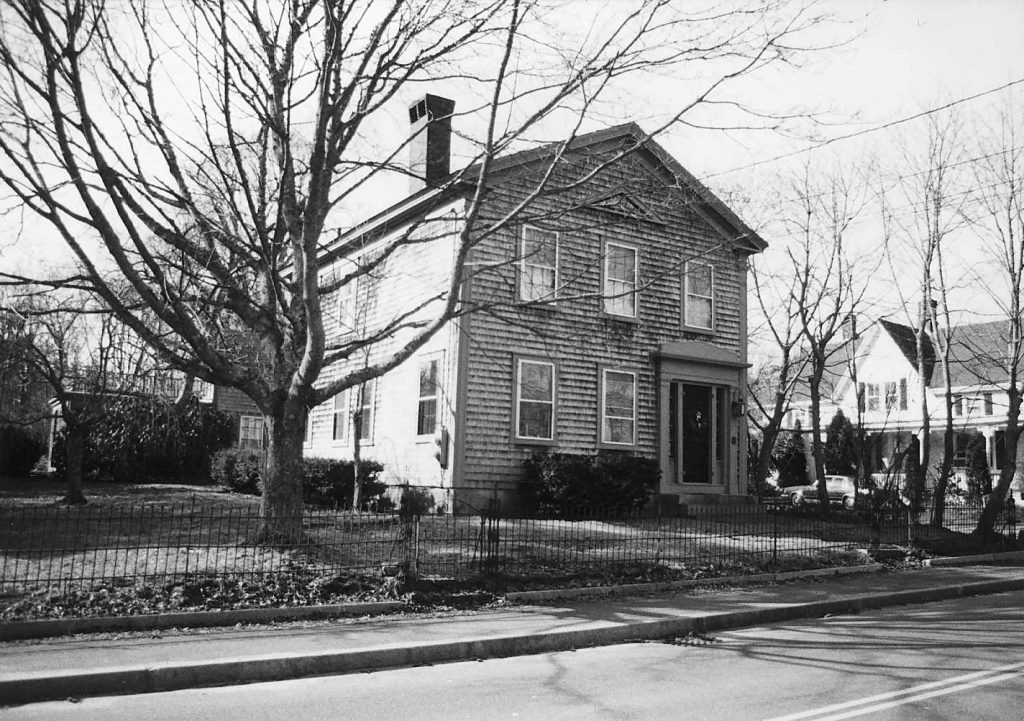
Marion (Old Rochester) is one of the oldest towns in the United States, and the Sippican Historical Society maintains an extensive collection of documentation on its historic buildings. In 1998, the Sippican Historical Society commissioned an architectural survey of Marion’s historic homes and buildings. Over 100 were cataloged and photographed. SHS will feature one building a week so that the residents of Marion can understand more about its unique historical architecture.

            This week we feature 314 Front Street. The Captain Henry Delano House at 314 Front Street presides over a front yard enclosed by a simple mid-19th-century cast-iron fence in the heart of the Old Landing area. This house was built for Captain Henry Delano in 1837. The distinctive attic window also appears on the Reverend Leander Cobb House at 28 South Street and represents the only other residence with this Greek Revival-style window in Marion. This house was owned by Laura J. Gibbs from 1900 until her death on August 12, 1925.

Gibbs’ Sign Stuck in Limbo

            Town Counsel Jon Witten will consult with the Marion Planning Board to parse out the implications of a zoning bylaw that has Dan Gibbs Jr. at odds with an abutter to his father’s property over the proposed placement of a sign advertising the former’s roofing company.

            Daniel Gibbs Sr., the resident at 459 Mill Street, is technically the applicant for a Special Permit to place a sign for his son’s business that was once his own, and before that his father’s. According to Daniel Gibbs Jr., he has permission from his father to place the sign at the property, where he regularly stores “two (dump) trucks and one or two dumpsters.”

            The Planning Board held a public hearing on Monday to discuss and potentially determine a judgment on the matter, but a discussion focused on the nature and exact location of the sign itself took a hard turn after hearing from an abutter. Ryan Cusick, a neighbor to Daniel Gibbs Sr., asked for clarification on a stipulation in Section 230-6.4 of the Marion zoning bylaw that states that the owner of the business must occupy the property.

            While it was uncertain from the discussion the reason(s) for the stipulation, Cusick sought to find out if the sign should be disallowed on that basis.

            “I’m caught off guard here,” said Cusick, referencing the required letter to abutters that omitted the fact that Dan Gibbs Jr., the owner of the business, does not live at 459 Mill Street, but at 4 Derby Lane.

            “The business has been at that location for a long, long time,” said Dan Gibbs Jr., whose situation at 4 Derby Lane is not as conducive to visibility as his father’s residence. Dan Gibbs Jr. explained that his father is technically the applicant “because he is the owner (of the property). He gives me access to it.”

            Town Manager Gil Hilario reread the zoning bylaw and admitted a lack of certainty as to its implications where it concerns this matter.

            “We can review this later if you like… If, in theory, what you’re saying is I could put up a Dunkin’ Donuts sign on my property,” said Cusick.

            Chairperson Will Saltonstall said, “I take Mr. Cusick’s point, I’m just not sure how to respond at the moment.”

            Planning Board member Eileen Marum agreed, saying, “Mr. Cusick has a valid point.”

            Hilario suggested Town Counsel Jon Witten be sought for an interpretation.

            Planning Board member Chris Collings was sympathetic toward Gibbs’ predicament, but admitted the board had reached a hard-to-crack nut with the bylaw.

            “I get it; it’s been a roofing business worksite for a long time… His site (at 4 Derby Lane) isn’t as visible, and his desire to have a shingle (at 459 Mill Street) is pretty strong, but… I think we need Mr. Witten’s opinion here to define,” he said. “There’s no specificity (in the bylaw)… but I think there’s enough question that we need Mr. Witten. The abutting owner deserves at the very least a professional review.”

            Saltonstall questioned if the board previously misadvised Dan Gibbs Jr. based on the incorrect assumption that he lives at 459 Mill Street, the proposed location for the sign.

            “Part of the reason I suggested home occupation is because I guess I assumed Dan lived there. I didn’t know he didn’t live there,” said Saltonstall.

            Planning Board member Norm Hills said, “We need to talk to Town Counsel and get back to the applicant.”

            Asked by Saltonstall if it could be solved by amending the language and not starting from ground zero, Hills answered, “Ask Town Counsel that, too.”

            Hilario suggested the case will require a new application.

            Saltonstall told Dan Gibbs Jr., “I’m sorry if we misadvised you here, but your neighbor brings up a relevant point and we need to get some advice.”

            The proposed sign measures 3×5 feet and would be designed and installed by Village Signs.

            Before the discussion shifted to Cusick’s question on the legality of the sign at the proposed address, Marum analyzed the sign and its location and reported to the board after a site visit her concern over a blind spot for drivers exiting Mill Street extension onto Route 6. She also noted that, given the elevation of the sign on two posts topping out over 7 feet high and over 5 feet across, the sign will obscure 38 square feet of driver vision. “That’s almost twice the size of the sign which you’re giving as 20 square feet,” she said.

            Hills said location of the sign is covered by the bylaw.

            Marum suggested lining it up with the Council on Aging sign. “My concern is there is a lot of traffic that goes through there… Safety should be a prime issue in the placing of that side,” she said.

            Collings echoed Marum’s sentiments, asking about lighting of the sign. “I think it needs to be as far back as reasonable as can be accounted for,” he said.

            Dan Gibbs Jr. said the ground light can be timed to shut off at a certain hour to accommodate for traffic.

            The public hearing was continued to Tuesday, September 8, at 5:05 pm as part of the 5:00 pm Planning Board meeting on Zoom.

Marion Planning Board

By Mick Colageo

Photo Contest

Time is running out to enter the Photo Contest sponsored by The Rochester Land Trust/Rochester Historical Society. September 7 is the deadline for entries. Anyone and/or any town can enter, but the photo must be taken in Rochester. Contest rules: The subject must be sites and scenery in Rochester; no people in photo; both black and white or color are acceptable; Age categories are: Youth = 16 and under/ Adult = 17 and up; One entry per person; give location of photo, your name, address, phone number, age category; any photo not following the rules will be disqualified. Email entry to rochesterphotocontest@gmail.com. Board members of the Historical Society and Land Trust will be judging and monetary prizes will be awarded to top three photos. Winners will be announced on the Rochester Historical Society and Rochester Land Trust Facebook pages.  

Waiver Holding Up Cranberry Highway Project

            In a remote access meeting held August 18, the Rochester Conservation Commission moved to address an outstanding Notice of Intent that was filed by Steen Realty surrounding its proposed development at 22 Cranberry Highway.

            Phil Cordeiro, representing Steen Realty, came before the commission with the hope of receiving a positive Order of Conditions that would allow his business with the commission to conclude. Cordeiro has been working with the commission for months, and his presence at this commission meeting marked the second time the Notice of Intent has been refiled.

            The majority of delays surrounding the 208 residential unit and commercial space project within the Cranberry Highway Smart Growth Overlay District derived from Cordeiro’s struggle to simultaneously satisfy the needs of the Rochester Planning Board and the Conservation Commission. With Henry Nover, the commission’s review engineer, submitting a letter confirming that the conditions for the project have been met, Cordeiro hoped to finally conclude the public hearing.

            “Mr. Nover agrees that our plans satisfy the Wetlands Protection Act regulations,” Cordeiro explained. “This is an opportunity to close public hearing and move the project forward.”

            While commission members agreed that their requirements had been met, there was one hurdle remaining. Cordeiro and Steen Realty require a waiver from the Rochester Planning Board that would allow them to bypass a regulation pertaining to the groundwater mounding on the site.

            Conservation Agent Laurell Farinon told commission members that a denial of that waiver would require a complete reapplication of the site plans from Cordeiro to address potential changes. Farinon cautioned that it would be more prudent for commission members to continue the hearing until that waiver was soundly in Cordeiro’s hands.

            Cordeiro cited numerous examples of other projects that had received similar waivers in an attempt to convince commission members to grant the positive Order of Conditions. Further, he asserted that since the matter at hand did not fall under commission jurisdiction, they should consider taking a vote despite the potential hindrance that might come in the future.

            Vice Chairman Daniel Gagne took a more unique approach to the conundrum. He agreed that the conditions had been fully satisfied by Cordeiro, and the decision on whether the commission should vote on the issue despite potential conflicts should be left solely to Cordeiro.

            Ultimately, the commission swayed Cordeiro toward a continuance of the hearing. Chairman Michael Conway explained that he was reluctant to grant the positive Order of Conditions with so much still relying on planning board decisions. With that, Cordeiro agreed, and the commission voted to continue the hearing until September 15.

            The Commission moved to discuss a Notice of Intent application for a potential solar development on Featherbed Lane. Eric Las, representing the development, presented plans originally drafted in July to the commission members.

            The proposed site would encompass 11 acres and produce 2.5 megawatts of energy. Las explained that he has a vast amount of experience developing these kinds of solar sites and is able to draft the plans in such a way to avoid as many potential conflicts as he can. As such, the proposed plans require no work in the 25-foot, wetlands no-disturb zone. In addition, the site will include two sediment-control barriers to minimize any potential runoff from entering the surrounding wetlands areas.

            Commission Member Christopher Gerrior questioned why the proposed project had taken such a limited size, as many other solar projects of this kind are larger. Las told the commission that the size of the site is as small as possible while still maintaining its financial viability. Las employed unique innovations in order to fully maximize the area of the site, including the addition of solar panels in the stormwater basin.

            Even with the relatively small site and the measures Las took to satisfy commission requirements, the plan still calls for work within the 100-foot buffer zone. In order for the site to effectively catch enough sunlight to function in certain months, the proposed plans also call for tree clearing around certain areas bordering the site.

            The commission showed general support for the proposal, but there is still more work for Las if the project is to attain approval. The commission voted to continue the hearing until October to provide ample time for a review of the plans to take place.

            The final public hearing to come before the commission involved another solar proposal, this one from Greg Carey. The solar site to be located on Sarah Sherman Road is nearing a final decision from the Planning Board and is to be voted on in its Tuesday, August 25, meeting.

            The solar project will have little environmental impact as the majority of the work is to be done in a large field that will require minimal tree clearing. Moreover, the equipment and battery pad has been moved out of the 100-foot wetlands buffer zone to further minimize conflicts. Nover was able to confirm that all of the conditions from the commission have been successfully met and that the project is ready to go forward.

            Even with some confusion surrounding a second set of plans that had been submitted to the commission by Steve Kohm, who is also working on the project, the commission was able to move past the confusion and render a decision on the project. The commission voted to order a positive Order of Conditions, allowing the project to go forward with the stipulation that a preconstruction meeting be held.

            The next Rochester Conservation Commission meeting is set to take place on Tuesday, September 1, at 7:00 pm and will be held remotely via Zoom.

Rochester Conservation Commission

By Matthew Donato

Mattapoisett Master Plan “Discovery” Workshops

The Discovery Workshop’s live events will take place on Zoom. The project consultant will be available to listen to you, Mattapoisett residents, business owners, and officials. We call this a “Discovery” Workshop because it allows us to do just that, discover Mattapoisett as you describe it. In this way, we can identify consensus, discover your big-picture goals as a community, and identify the strategies needed to make those goals real. Register at www.srpedd.org/Mattapoisett-master-plan/discovery-workshop

Mattapoisett Master Plan “Discovery” Workshop #1

Time: Wednesday, August 26, 2020, at 7:00 pm 

Join Zoom Meeting

https://us02web.zoom.us/j/89388628012?pwd=QStIUTNKdlcxVnBBTHRtY3JhL1dpUT09

Meeting ID: 893 8862 8012

Passcode: 605304

Dial by your location

            +1 646 558 8656 US (New York)

            +1 312 626 6799 US (Chicago)

Mattapoisett Master Plan “Discovery” Workshop #2

Time: Saturday, August 29, 2020, at 10:00 am 

Join Zoom Meeting

https://us02web.zoom.us/j/86087486374?pwd=VXBxeFNWZmozNTNRc3dGMFNmbEFXQT09

Meeting ID: 860 8748 6374

Passcode: 843289

Dial by your location

            +1 646 558 8656 US (New York)

            +1 312 626 6799 US (Chicago)

STEAM Projects to Go: Handheld Projector

This is the second month for the successful STEAM Projects to Go! STEAM Projects to Go are created for busy teens, grades 6 to 12, who still want to engage with library programming and their community. This month’s project will explore light science and teens will be creating a handheld projector. Further, it will inspire teens to take it one step further with a list of extension projects.

            Each Steam Project to Go includes: supplies needed for the project (except flashlight), instructions, information about the theme, a library book related to the theme, and ideas for more projects. If you are interested in getting a STEAM to go project, register at the library’s website (mattapoisettlibrary.org) on the calendar or by calling the library. Once you have registered, you will be contacted to arrange pick up (library card required). If there are no spots left, please register for the waiting list.

            The Teen and Adult Summer Programming is coming to an end fast! To be eligible for any prizes, please email Michelle Skaar or call the library and say what you have done before August 28th! You don’t want to miss out on these prizes.

            Please contact Michelle Skaar at mskaar@sailsinc.org or call the library for more information. All programs are free and open to the public.

Mattapoisett Free Public Library

Postal Services

To the Editor:

            As a longtime member of our local League of Women Voters which has always promoted free and fair elections, I am outraged by the recent moves by this Administration to curtail the services of the United States Postal System.  Whether you are a Republican, Democrat or Independent, you too should be outraged.

            The slow down of services; cutting hours, personnel, sorting machines etc is nothing more than a move to disempower the voters who want to send their ballots in by mail rather than risk going to the polls.  President Trump says these are cost cutting measures and that mail in voting creates fraud.

            In fact the slow down does nothing more than disenfranchise the voter so that many votes will arrive too late to be counted.  Then what about the prescriptions and paychecks and important letters that will also be held up?  For many people living in rural areas the postal service is a critical link in their lives.

            I urge everyone to get a mail- in ballot ASAP as the deadline is August 26 and it needs to be returned before September 1, primary day. You can also do absentee by going to your Town Hall as there are additional hours set up for doing that. You can check your town website or go to the League’s site, 411.org, for further information.  In addition in Marion there are 2 drop boxes outside the Town Hall for your ballots and other towns do the same.

            Furthermore, you can support your local Post Office by buying stamps and doing all your mailing there. (It has been said that if everyone bought $20 worth of stamps that would go a long way to meeting the deficit). In many small towns like Marion the Post Office serves a central part of the community where neighbor meets neighbor.

            So please exercise your right to vote by getting your ballot, urging your legislator to defend the USPS and telling your neighbors to do the same.  “Democracy is not a Spectator Sport.”

            Thank you,

            Margie Baldwin

The views expressed in the “Letters to the Editor” column are not necessarily those of The Wanderer, its staff or advertisers. The Wanderer will gladly accept any and all correspondence relating to timely and pertinent issues in the great Marion, Mattapoisett and Rochester area, provided they include the author’s name, address and phone number for verification. We cannot publish anonymous, unsigned or unconfirmed submissions. The Wanderer reserves the right to edit, condense and otherwise alter submissions for purposes of clarity and/or spacing considerations. The Wanderer may choose to not run letters that thank businesses, and The Wanderer has the right to edit letters to omit business names. The Wanderer also reserves the right to deny publication of any submitted correspondence.

Marion Gears Up for Return to Schools

            August 19 was originally scheduled to be the last day on the job for Marion Public Health Nurse Kathy Downey, but her retirement is on hold until the second weekend of September so she can assist her newly-appointed replacement, Lori Desmarais, who will start on September 8.

            In reporting to the Board of Health on return-to-school plans for the Old Rochester Regional District and Tabor Academy, Downey stressed how those plans are dynamic. 

            “Fluid is a good way to describe it, too. What I say to you right now might be different in the morning,” said Downey during the August 18 Zoom meeting. “Tabor’s is a little bit more urgent.”

            Downey said that all Tabor faculty, staff, and students are presently in quarantine off site for 14 days. Once back, she said, the plan has changed from one parent to two parents allowed to help move students into their rooms. Once the move has taken place, parents will leave campus.

            There will be COVID-19 testing and flu shots for students and COVID-19 testing for faculty. Tabor’s health services will operate on a 24/7 basis as usual; the facility has been moved from near the playing fields toward the admissions building. “Healthy-sick kids” (with illnesses or injuries unrelated to the coronavirus) will also go to the admissions building but to a separate section with separate bathroom facilities.

            It’s expected that 600-700 COVID-19 tests will be conducted on the first weekend; in 14 days everyone will be tested again.

            On-campus classes will be held through the third week of November, then the students will take a prolonged break from in-person education and attend remote-access classes in December.

            Adults on campus will be referred to their own primary-care physicians.

            “We all appreciate how quickly things change… and Lori and I appreciate how closely we need to stay with them … because if something does go haywire at Tabor, it will impact the whole community,” said Downey.

            Board of Health Chairperson Ed Hoffer interpreted Tabor’s stay-on-campus policy to include walking to the Cumberland Farms convenience store at the corner of Front Street and Route 6 “so clearly what happens on campus won’t stay on campus,” he said.

            Flu clinics are scheduled for Tabor during the last weekend in August.

            Desmarais reported on August 18 meetings with Marion Fire Chief Brian Jackvony and Chief of Police John B. Garcia. “I did meet with both of the chiefs today, and we were throwing out the idea of doing the drive-through for the flu clinics so we’d have an idea of what we’d do for COVID,” said Desmarais, who said she can do some preparation work remotely.

            While Downey strongly suggested getting flu testing done sooner rather than later to avoid the “nightmare” of overlapping with COVID-19 testing, Hoffer said a COVID-19 vaccine would become available at the earliest at the end of the year and, if so, will not have been adequately tested.

            Desmarais, currently on a pre-planned, two-week vacation, attended the Zoom meeting and said, “I’m excited to get started.”

            Old Rochester schools, as reported elsewhere in this edition, will begin the 2020-21 academic year with a hybrid attendance model based on a “cohort ideology” dividing the student body into non-overlapping halves, one half in school two days a week while the other half is engaged in remote learning, then vice versa. The Joint School Committee voted last week to truncate the academic calendar from 180 days to 170 to allow faculty and staff to use the first two weeks for preparation.

            The Marion Board of Health voted on Tuesday to approve ORR’s plan and send the district a letter of support similar to the approval recently sent to ORR by the Rochester Board of Health.

            In his report, Health Director Dave Flaherty said that Monday’s tests resulted in no closings and that Marion is “batting 1,000” at the beaches.

            Aerial spraying for mosquitoes by Plymouth County has been completed, but Flaherty noted that those wishing to have their yards sprayed can call 781-585-5450.

            Marion, said Flaherty, is still considered low risk for EEE virus, while neighbors Rochester and Wareham rank in the high-risk category. Carver and Middleboro are still considered critical. Flaherty said that the entire south coast is at low risk for West Nile virus.

            The Board of Health remains concerned over the age and presumed vulnerability of volunteers on its CERT team. Flaherty indicated he will expand his research for a younger body of volunteers with groups like the Boy Scouts and church groups. Hoffer suggested that Medical Reserve Corps volunteers could be eligible. Town employees are under consideration.

            Hoffer said that, while Cumberland Farms has entered into a cease-and-desist agreement with the state regarding the use of self-serve drink stations, the Marion store has not been a problem. “They knew about this and asked me to give them any updates,” said Flaherty. “It looks like they might be going back to full-service coffee.”

            The board conducted a walkthrough of Sippican School and determined that the building would need additional staffing to serve as a quarantine place in the event of a hurricane necessitating home evacuations.

            Hoffer said he reached out to two areas hotels, one at Wareham Crossing that is prohibited by corporate policy against accepting patrons under coronavirus-related quarantine or isolation orders, but also noted the manager encouraged him to call in the event of a crisis and he would do what he could to help Marion residents. A Fairhaven hotel checked has no generator.

            Marion may have escaped a pickle with state funding dating back to the former Marion-Rochester Health District that received $50,000 for coronavirus-related expenditures. While the town split the funds down the middle with Rochester, the latter did not spend and report as quickly as Marion, which had to wait so the district could report as one. But, in the interim, state guidelines changes on what would be approved, putting Marion into a precarious position.

            Marion had spent the money on plexiglass and restructuring of rooms in public buildings, but was later told the funds were earmarked for food pantry, etc. Fortunately for Marion, Downey reported having been given a verbal okay on spending according to the originally prescribed categories.

            Citing the day Marion will eventually no longer be in the advantageous position of having two licensed physicians (Hoffer and John Howard) on the Board of Health, Downey suggested the board have a policy to seek medical advice. “Even if you don’t have somebody lined up,” she said, “it’s good to have a policy while we have medical professionals on (the board).” Hoffer agreed to draft a policy to address the matter.

            Marion has produced an Emergency Dispensing Site (EDS) Plan. Hoffer said it is part of the town’s emergency preparation plan and is 40 pages in length.

            Downey reported that Marion is getting close to receiving much of its delayed order for personal protective equipment from vendor McKesson.

            The next meeting of the Marion Board of Health is scheduled for Tuesday, September 1, at 4:00 pm.

Marion Board of Health

By Mick Colageo

How Can We Live with Sharks?

            For many, the idea of living with sharks is a fairly new phenomenon. After all, sharks like warm water – right? Sharks are not that common around the northeast – right? Most sharks stay in tropical locations – right? Wrong! Spend a little time with well-known and highly-respected shark expert Dr. Greg Skomal, and you’ll soon have all your long-held misconceptions about sharks, especially the great white variety, dispelled.

            Skomal, a Sippican Lands Trust director, was hosted as guest speaker on August 11 by the SLT via remote access. The event gave attendees an opportunity to follow Skomal as he tagged great white sharks around the Cape Cod peninsula and to learn more about his decades-long pursuit in understanding one of the ocean’s greatest hunters.

            Skomal’s research in understanding the white sharks’ habits of daily living is thrilling to hear about from the man himself and entertaining as evidenced in his frequent appearances on National Geographic’s Discovery programs. His ability to plain-speak the technicalities of his work grants the layperson insights into the lives of sharks. And who hasn’t thought about sharks especially now when we are all trying to enjoy beaches and swimming?

            Skomal began his talk by providing a rather shocking bit of historical data. As far back as the 1800s, great white sharks have been reported and recorded as being in the North Atlantic seas. Records indicate that great white sharks have been found as far north as Newfoundland, he said. Taking written eyewitness accounts and adding to that all other forms of data reporting, including modern satellite technology, Skomal surmised that sharks have always been in the northern seas.

            Adding to the historical perceptive, Skomal discussed shark attacks in the northern region, noting the infrequency while acknowledging the slight uptick. “There was a fatality in 1936 off Mattapoisett,” he stated. Calling shark attacks “mistakes on the part of the shark – they don’t hunt humans,” he chronicled non-fatal incidents in 2012, 2014, 2017, two mistakes in 2018 of which one was fatal, and the more-recent 2020 fatal attack of a woman in the Gulf of Maine. He attributed the rising frequency of “mistakes” as a direct result of the rising seal populations in the area. Skomal’s studies over the last 10 years have focused on tagging sharks that frequent the area. The data collected points to predators that are finding an availability of prey.

            The first shark was tagged in 1979; today some 200 sharks are wearing sophisticated acoustic tags that are helping scientists around the world come to a better understanding of the wild, underwater master of the hunt. Using computer graphs and modeling Skomal’s research reveals a direct correlation between where seals congregate and where sharks roam. “Cape Cod is like a rest stop on (Interstate) I-95 for some sharks on their north way,” he quipped. But the data as visually displayed told the full story. Data points indicating where seals are located and data points indicating where sharks are present overlap.

            Yet humans want what they want, when they want it, and so summer on Cape Cod attracts thousands of humans. The local economy depends on tourism. There have been serious discussions in some lower Cape towns about finding ways of getting rid of the sharks. For Skomal and his team of researchers, finding a way to explain shark movement and activity is a primary goal. With understanding, he believes that the safety of both marine life and human life can be achieved.

            “Sharks are in the area in greatest numbers between August and October,” Skomal explained. “They spend their time where the food is plentiful.” This happens not only along the eastern edge of the peninsula (outer Cape from Provincetown to Chatham), but also in a few hot spots along the northern edge, he said.

            Skomal said that sharks are not able to react swiftly or catch food easily if one compared the agility of a seal to the cumbersome movements of a great white shark. Thus, sharks need to be where the greatest numbers of prey can be found in order to have any level of hunting success. He said that there is a distinct seasonality to Great White shark movements; mid-summer to early fall when the seal populations are at their peak, the dinner bell rings for the sharks. Once a shark has fed on seal, it might not eat again for two months due to the nutrient-rich blubber the seal contains.

            The seals enjoy the beaches where they sun themselves, venturing only a few feet from shore when returning to the water. Guess where the sharks are waiting – that’s right, a few feet from shore, hunting in the shallows. Researchers are hopeful that the data will provide information on times of the day when sharks are most likely to be hunting. Some of that detail has already been collected from tagged sharks. If the data can shed light on when sharks are most likely to be in the area and what time of the day they are hunting, swimmers will be able to make better decisions about when and where – or not – to go into the water, Skomal said.

            Skomal’s tagging efforts have paid off in ways that are immediately useful and in ways that will add to the future understanding of the massive fish. One interesting fact, one that has more recently been uncovered via tracking technology, is that sharks are in the Northern Atlantic Sea throughout the winter. Not all great white sharks migrate south. Studies have found that many of those that remain along the continental shelf dive 3,000-feet into the deep where food commonly consumed by sharks is not available. “We don’t really understand what they are doing down there. We are collecting millions of data points,” Skomal said of the ongoing east-coast research.

            All along the western (inner) edge of Cape Cod, Skomal’s teams have placed receivers that pick-up tagged sharks if they are in the area. He also had one placed near Mattapoisett. “In three years, not one tagged shark has gone by there,” he shared with a chuckle. Good news for those recreating in Mattapoisett Harbor.

            To say marine studies is Skomal’s lifework is a bit of an understatement. The good doctor has been a senior fisheries biologist with the Massachusetts Marine Fisheries since 1987 and currently heads up the Massachusetts Shark Research Program. He is also educating future researchers as an adjunct faculty member at the University of Massachusetts Marine Science and Technology program in New Bedford, an investigator for the Woods Hole Oceanographic Institute, and an adjunct scientist with the Center for Shark Research in Sarasota, Florida. Skomal’s work for the Division of Marine Fisheries has been partly funded by the Atlantic White Shark Conservancy, an organization whose mission is to provide research opportunities, education, and public safety.

            To learn more about Dr. Greg Skomal and his work, visit www.atlanticwhiteshark.org, or the Massachusetts Division of Marine Fisheries at mass.gov. You may also be interested in an educational YouTube video geared toward early learners, featuring Skomal, titled “Q/A with Shark Scientist, Dr. Greg Skomal” and produced by the AWSC on April 9, 2020.

By Marilou Newell