Nature is Powerful Medicine

            People who garden are people that like to engage with the outdoor world. For many it’s task-related with an end goal of having a lovely garden landscape. But nature can give more than just beautiful gardens – it can in fact improve your well-being.

            This column was inspired by a pamphlet I kept from a visit to Hampton Court Palace in London, which boasts many wonderful and assorted gardens with different purposes. At the palace you will find two circular paths around the gardens to help you explore mindful walking in nature. The emphasis is to make a connection for mental and emotional wellbeing using step-by-step directions with suggested sensory and grounding exercises. This lends insights into the benefits of nature.

            Spending time in green space or bringing nature into your everyday life can benefit your mental health. It can benefit your physical wellbeing too. There are ways you can connect with nature. Doing things like growing food or flowers, exercising outdoors or being around animals can have lots of positive effects. It can:

            Improve your mood, reduce stress, help with anxiety, depression and seasonal affective disorder (SAD), help you take time out and feel more relaxed, improve your physical health, improve your confidence and self-esteem, help you be more active, help you meet new people and reduce loneliness, connect you to your local community, help you feel more connected to nature, and provide peer support.

            Take the opportunity to slow down, connect with the present moment, and gently tune into the natural world. Think of it as yoga without all the contortions! So, what is mindful walking? “Mindfulness is a widely practiced approach to supporting mental health and wellbeing, bringing attention to the present moment,” states the pamphlet. It helps to ground us in our bodies and surroundings and can be incorporated into everyday life. Maybe you are already doing it without labelling it. If so, you know how much better you feel afterwards. Here’s why:

            Mindful time in nature can help lower cortisol levels, reduce blood pressure and steady the heart rate – making it a powerful way to relieve stress and support a balanced lifestyle. Although these instructions are for walking in nature, I think it could be transferable to other outdoor activities. The guide offers suggestions rather than rules. There is no right or wrong way to mindful walk, “do what feels right to you.” The key principles of mindful walking are:

            1. Give yourself permission. Taking time out just for you is essential. See this walk as an act of self-care.

            2. Remove distractions. Silence or switch off your phone if you can. A little digital detox allows you to be less interrupted and more connected to the environment around you.

            3. Slow down. How often do you walk quickly, always on the move? Let this walk be different – slow your pace and notice what you see and feel. This is about connection, not completion.

            4. Connect with your senses. Your senses connect you to the present moment. Listen, look, smell, hear: sound of birdsong, scent of herbs, texture of leaves. Let your senses guide you.

            5. Be curious. Let yourself explore, look closer at patterns, textures or tiny movements. There is so much to discover.

            The guidebook dispenses advice and fun facts that I will extract here: During a 20-40-minute walk through the rose garden and the tiltyard (a historical enclosed area designed for jousting – common to Tudor era castles and palaces), and kitchen garden it suggests pausing before beginning – noticing your breath, your body and how you’re feeling. Notice the transition into the peaceful green space. Stand still and let your feet feel rooted. Let your eyes scan the space: colors, textures, and movement. Notice the scents in the air and the sounds near or far.

            It suggests wandering slowly through the tiltyard observing the shapes of the leaves and textures of the bark and how their branches stretch or twist “If a particular tree draws your attention, pause beside it. You don’t need to know its name – just enjoy its form and imagine its journey of growth.” Much the same applies to the kitchen garden where scents of aromatic herbs and the vibrant earth shout out. A fun fact: soil contains a natural microbe (Mycobacterium Vaccae) that boosts serotonin levels. Simply breathing in while walking, gardening or sitting outdoors can lift your mood. Nature is powerful medicine.

            Finishing the tour, it suggests getting up close to observe the detailed patterns of leaves, flowers, and stems. Yes, stems. Take a seat on one of the benches and absorb the richness of the garden. Having a seat within your home garden is essential for this reason. Upon the return to the rose garden, you’ll notice the palace rising in the distance, states the guidebook. “These gardens have long been a place for people to pause, reflect and find peace.” Reflection is part of the reward: Reflect on the footsteps that came before you and, on your journey, comparing how you felt at the finish to when you began.

            There is an additional nature walk of 60-90 minutes covering the wilderness, yew trees, fountain garden and the long water at Hampton, with lots of great suggestions such as pausing at the water’s edge and “let its vast expanse create a sense of stillness and perspective.” Did you know that trees release phytoncides, a natural compound that supports your immune system. Breathing in while among trees can boost your wellbeing. Another footnote noted in the guide state that natural settings offer ‘soft fascination’ – effortless attention that restores clarity, concentration, and mental energy.

            These are good take-aways for us to apply here whether walking through a woodland path or along the shore or in your own private space. Take nature in and disconnect. Try it now!

            “The lover of nature is he whose inward and outward senses are still truly adjusted to each other; who has retained the spirit of infancy even into the era of manhood.” – Ralph Waldo Emerson.

The Seaside Gardener

By Laura McLean
Support From Abroad

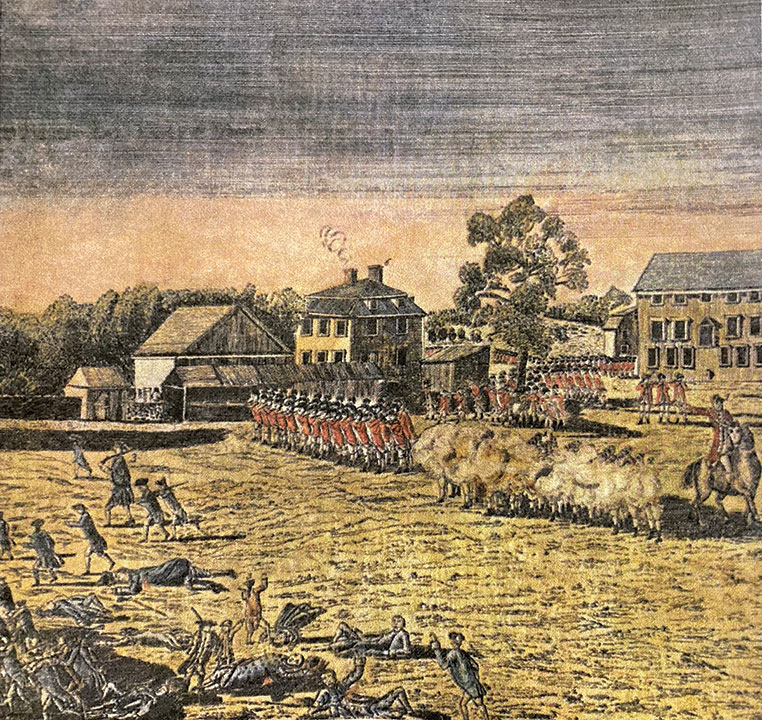
            This week in Revolutionary War history, let’s check up on what was going on 250 years ago in New England and the northern Thirteen Colonies. Last week, General George Washington recognized one year since the Battles of Lexington and Concord. Though there were no events to commemorate it, as fighting continues and fortifications around New York require the full focus of the army as Washington is generally disappointed in the current state of the city. To the south, Charlestown, South Carolina presets arguments against the King and calls for a new government.

            On April 26, 1776, Washington writes to John Hancock, President of the Continental Congress in Philadelphia. There has been pressures to send men and munitions to Canada, and the general writes, “I could wish indeed that the army in Canada should be more powerfully reinforced. At the same time I am conscious, that the trusting this important post (which is now become the Grand Magazine of America) to the handful of men remaining here is running too great a risk – the securing this post & Hudsons River, is to us also, of so great importance, that I cannot at present advise the sending any more troops from hence.”

            Though he states the city has become a hub of troops and arms, he adds, “our strength at present is, in reality, on paper only.” Men are untrained, undisciplined, and still under-armed for what will likely be a vengeful counter-attack from the British.

            Speaking of undisciplined troops, the next day, in his General Orders, Washington condemns “The riotous behavior of some soldiers of the Continental Army.” The day prior, soldiers staged a riot near Washington’s headquarters at 1 Broadway. In response to this, he writes, “the authors will be brought to the severest punishment if taken, or treated as a common enemy, if they dare to resist.”

            The same day, the general receives a letter from Captain Henry Miller in New Utrecht, a small town today a part of Brooklyn on Long Island. Miller writes, “this morning a small sloop came down the river the sentry on Staten Island hailed her as also those on our side but she would not come too each of the sentries fired several guns at her which she disregarded & passed under a smart breeze to the Asia Man of War.” Worrying reports that if true, showing a ship left New York and met with the British ship the Asia, signify British surveying or espionage.

            On April 28, Washington writes to Rhode Island Governor Nicholas Cooke, who had written to ask for supplies and personnel for the defense of Narragansett Bay. He says, “we have no engineer that can possibly be spared from hence, indeed we are very deficient in that department, & the state of this place is such, that had we many more than we have, there would be full employment for them.”

            This day would also be important in a different sense, as April 28, 1776 is the 18th birthday of James Monroe, the man who would eventually become the 5th President in 1817. Though he had taken up arms in Williamsburg, Virginia the year prior, he maintained his attendance at school up until the time around his 18th birthday, when he dropped out of school and joined the Continental Army.

            Though Washington is urging focus on New York, on April 29, a delegation arrives in Montreal. Benjamin Franklin and other delegates from the Continental Congress meet with General Bennedict Arnold in the city to assess the status of the northern campaign. Though the delegates received a warm welcome from the general and the troops, it ultimately pushed congress to oppose Canadian campaigns. Franklin would leave a little under two weeks later, remarking “it would have been easier if the Americans had tried to buy Canada than invade it.”

            May 2, 1776 may be one of the most consequential days of the Revolutionary War. 22-year-old King Louis XVI of France secretly agrees to provide funds and arms to the American revolutionaries. The material would be discretely given to America through the French company Rodrigue Hortalez et Compagnie. That same day, King Charles III of Spain also vowed to secretly support the rebels.

This Week in Revolutionary War History

By Sam Bishop

New Language Clarifies Parcel Swaps

            The Rochester Planning Board on Tuesday adopted new bylaw language for swapping conservation, recreation, or open-space parcels within a subdivision.

            In essence, this addition to town zoning regulations sets the necessary steps that had not previously been specified when a subdivision permit is reopened for the purpose of swapping one open-space parcel for another within that project.

            In the public hearing that preceded the vote, board member Ben Bailey, who recommended the change, said other town officials agree it is worth doing. His only suggestion before the approval was that the parcel being swapped should be located as close as possible to the subdivision requesting the move.

            Chair Arnold Johnson explained that in prior years the panel held that a Conservation Restriction land such as this cannot be privately owned. However, the board has encountered more than one request from subdivision developers for such a swap of one open-space parcel for another within their projects. Thus, the board decided to create a way to make such a move possible with the necessary steps. Bailey emphasized that this change is not due to one project but inspired by several.

            Next, the board met with John Alfonso of Townhome Development, Rochester Crossroads, to scold him about beginning foundation construction work on new homes without a preconstruction meeting first or other notifications. Johnson said he was disappointed with project’s main engineering consultant. “He knows our rules,” Johnson said. Alfonso apologized and promised not to repeat the oversight.

            In other action, the board continued to May 12 its Site Plan Review and Special Permit hearings for High Street Solar 1 and 2 at 0 High Street.

            The board also continued to May 12 its Site Plan Review hearing on a proposal to clear and regrade land behind Town Hall for an 8,220-square foot parking lot.

            The board continued to June 23 its hearing into a proposed land-swap modification of the Definitive Subdivision permit for the previously approved Snipatuit Pond Estates at Gerrish and Bishop roads, and the panel extended the project’s decision deadline to July 14, 2026.

            The board appointed Town Planner Michaela Shoemaker as its representative on the SRPEDD Commission board for 2026-27.

            The board scheduled two site visits for May 20: Connet Woods at 6:00 pm and High Street Solar at 7:00 pm.

            The Rochester Planning Board’s next meeting will be Tuesday, May 12 at 7:00 pm at Town Hall, 1 Constitution Way.

Rochester Planning Board

By Michael J. DeCicco

America 250 Author Talk: Patriots of the South Coast

Plumb Library and the Rochester Historical Society are excited to be hosting local author Robert Barboza on Saturday, May 9 at noon to talk about his latest book: Patriots of the South Coast. He will be talking about South Coast soldiers, sailors, and ship builders who played important roles in the American Revolution, including two senior officers in the American Revolution who were from Rochester. Copies of the book will be available for purchase at the event, and refreshments will be provided courtesy of the Rochester Historical Society. This event is free – please save your seat by registering on the library’s online Events Calendar today.

            Retired journalist and local history researcher Robert Barboza has published a second book about South Coast soldiers, sailors, and ship builders who played important roles in the American Revolution (1775 – 1783), Patriots of the South Coast.

            The 140-page book is a collection of newspaper articles on Revolutionary War history printed over the years in area publications, revised and expanded with new research materials. The new book is a follow-up to his first book on local history in the War for Independence from Great Britain, Patriots of Old Dartmouth: Local Heroes of the Revolutionary War, published in 2014 to help celebrate the 350th anniversary of the town’s incorporation.

            For the past two decades, Mr. Barboza has often lectured locally about the region’s Patriot heroes such as Continental Marine Captain Stephen Earl of Westport; Fairhaven militia captain Nathaniel Pope, who led a 1775 raid to capture the Royal Navy sloop Falcon in Dartmouth waters; and Captain Job Tripp of Dartmouth, wounded and cast ashore far from home after his merchant vessel was battered by cannon fire from a British warship.

            The new volume was assembled and published in time to coincide with the ongoing nationwide celebration of the 250th anniversary of the American Revolution, starting in 2025. His goal was to ensure that these little-known local stories were collected and preserved for posterity as part of the permanent historical record of the South Coast.

            Mr. Barboza is the former editor of Dartmouth’s weekly newspaper, The Chronicle, and served as a correspondent for many other South Coast newspapers over the years. He has been a student of local history for 20 years, and authored dozens of articles on local history during his long journalism career. Two of those articles won awards from the New England Press Association for historical reporting.

            He currently serves on the board of directors for the Dartmouth Historical & Arts Society, and formerly served on the board of directors for the Dartmouth Heritage Preservation Trust, which helped subsidize the publication of his first book on local history.

North Rochester Congregational Church

The North Rochester Congregational Church, 247 North Avenue, Rochester, has services at 10:00 am on Sundays. The services are conducted by Reverend Merrily Harris, guest ministers, as well as members of the congregation. Communion is on the first Sunday of each month. Paul Sardinha is the longtime organist. Food and fellowship follows. Everyone is welcome.

OCRVTHS District Provides Information on Building Project Vote

The Old Colony Regional Vocational Technical High School District is sharing updated information with residents in advance of a June 20 districtwide vote on a proposed school building project.

            The School Committee voted Wednesday to place the question before voters in the district’s five member communities – Acushnet, Carver, Lakeville, Mattapoisett and Rochester. The vote will be held from 10:00 am to 6:00 pm on Saturday, June 20.

            “This date was selected to help avoid additional construction cost escalation and to keep the project timeline moving forward,” said Superintendent-Director Aaron Polansky. “Holding the vote on a Saturday also allows residents an entire day to get to the polls without needing to work around weekday schedules.”

            The district forwarded the same proposal to voters last year. Only 5,035 residents – out of more than 39,000 across the district (less that 13 percent) – cast ballots.

            “As we prepare for another vote, it’s important for residents to understand that bringing the project back is not about ignoring the previous outcome,” said Superintendent-Director Polansky. “The district believes it is the fiscally responsible decision to give voters another opportunity to consider a project that could allow the district to build a new school with significant state reimbursement, rather than relying solely on local taxpayers to fund major repairs to the existing building. It will never be less expensive to build a new high school than it is today.”

            The current school opened in 1975 and no longer allows the district to deliver a 21st century technical education that allows students to succeed post-graduation.

            As part of its Massachusetts School Building Authority (MSBA) application, the Old Colony School Building Committee, comprised of community representatives and those with finance and construction expertise, studied both new construction and renovation at scheduled and announced public meetings.

            The Building Committee determined that a new school would be the most educationally and financially responsible option.

            The MSBA has approved the project for an estimated reimbursement of approximately 60.49% of eligible costs. About $140 million of the cost will be covered between MSBA reimbursement and additional Inflation Reduction Act (IRA) and Mass Save grants and incentives.

            Maintaining eligibility for that state reimbursement requires the project to remain the same as the one previously submitted and approved by the MSBA.

            Under MSBA rules, communities cannot substantially change the project’s scope or cost and remain in the program. Making major changes would require the district to withdraw and restart the process, which could delay a project by six to 10 years.

            If approved by voters in June, the new school is expected to open in 2030.

            According to district estimates, if the proposed project does not move forward, the existing school building is projected to require at least $157 million in repairs from 2026 to 2035 to address aging infrastructure and building systems. Local taxpayers would pick up the entire cost because MSBA does not reimburse most repairs.

            Needed repairs would address facility conditions but would not expand the building or add new programs in high-demand careers such as HVAC, Plumbing, and Dental Assisting.

            Additionally, the current building has aging systems and limited space when demand for career technical education is rising.

            For more information about the project, including frequently asked questions and a tax impact calculator, visit OldColonyBuildingProject.com.

            “Our goal is to make sure that residents have clear and accurate information about the condition of the current building, the proposed project, and the process ahead,” said Superintendent-Director Polansky. “We encourage anyone with questions to review the information available and participate in the upcoming opportunities to learn more.”

Two New Health Inspectors

The Marion Board of Health met on Thursday, April 23 and began with appointments.

            There was a Continued Public Hearing from the prior meeting at the front of the agenda, though the item was delayed in order to wait for others to arrive and to allow more people to join the discussion.

            Moving to the front of the meeting was the appointment of Ethan Coggins and Arden Edouard as Health Inspector/Shared Services Health specialists. The two have been traveling around Marion and learning about the town and various regulations. The board agreed to their nominations and unanimously voted their appointment.

            After the approval of the minutes from the last two meetings, March 16 and April 16, the board heard an update from Public Health Director Lori A. Desmarais. She noted the town has not performed many vaccines recently, though the flu, specifically the strain Influenza B, is currently circulating with the year-to-date confirmed infections in town being 34. She added that for the full year of 2025, there have been 41 total, confirmed flu cases. “This year, we’re definitely seeing more influenza show up,” she said, explaining that most cases are in children.

            For Lyme Disease, Desmarais stated three cases have been documented so far in April, as temperatures rise and ticks become more prevalent. She emphasized the importance of checking skin, with spring being the time when nymph ticks, those that are smaller, younger and thus more difficult to spot, are emerging. She also noted for the Community EMS service, there have been 179 visits so far this year.

            The board began the public hearing continued from their last meeting, being the amending of “Section 8: Food Service” from the Marion Sanitary Code. Desmarais explained most of the changes are to put on writing many of the daily tasks already performed by the Board of Health and other town health officials. She explained it also empowers the Board of Health to make health recommendations to the town, as well as guaranteeing them the right to health and safety inspections for restaurants and retail.

            With a unanimous vote, the hearing was continued again to their June 4 meeting, primarily to allow for more public input.

            The next meeting of the Marion Board of Health is scheduled for Thursday, May 7 at 4:30 pm in the Marion Police Department.

Marion Board of Health

By Sam Bishop

BBC Gets Amended Order of Conditions

            The Buzzards Bay Coalition requested and received an amendment to a restoration Order of Conditions for “The Bogs” off Acushnet Road for trail improvements. Discussion centered around the need to control flooding and ponding in some locations in the recreational acreage and how well the project is progressing as an oasis for small, native species.

            A Notice of Intent filed by Brett and Emily L’Esperance of Tupola Lane for the construction of a single-family home was conditioned. The project includes plans for new plantings as part of a restoration plan required, given the size of the disturbed area measuring 1,062 square feet.

            A Notice of Intent filed by Jason Fredette, 2 White Tail Way, was continued pending a DEP file number and comments, if any, from the Massachusetts Department of Natural Heritage. Represented by consulting engineers Zenith LLC, the project is for the construction of a roadway that will eventually service two new house lots. The case was continued to April 13.

            A request for an Amended Order of Conditions filed by Marcus Baptiste was granted for property located at 0 Starboard Way.

            Also continued was a Notice of Intent filed by Stephen Vaitses, Bryne Way and Shell Beach Road. Ongoing discussions regarding abutters’ rights to trim, cut and restore the historical shared pathway were once again sent back by the commission to attempt an amical way to satisfy several landowners who claim easement rights.

            The next meeting of the Mattapoisett Conservation Commission is scheduled for April 13.

Mattapoisett Conservation Commission

By Marilou Newell

What’s Up There?

            This is the continuing monthly column for the astronomer in all of us, or the aspiring astro-physicist. Compared to areas near Boston or New Bedford, generally speaking, the Tri-Town has pretty good dark skies and thus are very fortunate in that regard. Last month, we even witnessed humans re-enter the orbit of the moon on the Artemis II flight!

            On May 1, the first full moon of the month will occur. This one is referred to as the “Flower Moon,” due to the blooming of spring. It is also referred to by others as the “Milk Moon” or “Corn Planting Moon.”

            On May 2, the asteroid Vesta will be at its brightest. Though it is visible all year, this is the best time to spot it. The asteroid was discovered in 1807 and is the second largest in the solar system. It won’t be visible to the naked eye in our area due to light pollution but is visible with a high-powered pair of binoculars or a telescope.

            On the night of May 6, the Eta Aquarids Meteor Shower hits its peak. Though it is currently ongoing, occurring between April 19 to May 28, it will hit its height with around 30-meteors-per-hour. Meteors from this shower are produced by the famed Halley’s Comet!

            A few days after, on May 10, the Eta Lyrids Meteor Shower hits its peak. It is known as a “low activity” shower, with its peak being around 3-meteors-per-hour. Its meteors originate from the comet C/1983 H1.

            On May 12, the Messier 5 star cluster will be visible. The cluster contains 105 closely packed stars. Well, they’re closely packed relative to our eyes. In reality, they are many quadrillions of miles apart.

            May 16 will be the month’s new moon, making a good time to look for fainter objects.

            On May 20, the Moon, Venus, and Jupiter will be visible in a bunch together.

            As with earlier in the month, on May 28, the Messier 4 star cluster will be highly visible. It contains around 43 stars over the span of 35 light years.

            On May 31, another full moon! This one is the Blue Moon, and as it happens only once every few years, it lends itself to the saying, “once in a blue moon.”

Astronomy Update for May

By Sam Bishop

From the Files of the Rochester Historical Society

As anyone who’s been reading Sam Bishop’s articles on Gen. Washington’s correspondence, it is evident that one of the biggest problems in the fight for independence was the shortage of ammunition (shot and powder). Prior to the start of the hostilities, some towns like Rochester voted to purchase firearms, powder, lead and flints. Later, it was even voted “to send to the West Indies by Capt. Moses Bartlett for powder, firearms, molasses and other war supplies”. My first thought was, “that’s a long way for a town to send someone”, but I remembered Rochester at the time was a seafaring town. Also, there was not a central government actively acting against Great Britain in 1774 and the town fathers were preparing for what most saw as the inevitability of war. Of course, any munitions gathered at that time didn’t last long when fighting began.

            Because of the scarcity of powder and shot throughout the colonies, people were taking advantage of any materials at hand to create them. In New York on the Bowling Green in Manhattan, a gold-leaf lead statue of King George III had been erected in 1770. After Gen. Washington had the Declaration of Independence read aloud to the continental troops stationed there on July 9,1776, a crowd pulled down the statue. The horse section was cut up and sent to Connecticut where the lead was melted down to create more than 42,000 bullets. I’m sure there was more than the need for ammo that motivated that event.

            While there wasn’t as great a need for the actual firearms due to the requirement that each man provide his own weapon for his militia duties, there was a pressing need for gun powder. The colonists were an ingenious lot and went about searching for ways to increase supplies. Gun powder was 12 parts saltpeter to 2 1/2 parts charcoal and 1 1/2 parts sulfur. Charcoal and sulfur were easier to come by than saltpeter which was essential.

            Not to be deterred, they sought out “refuse” in stables, cellars and even outhouses. Boiling this material and the mold it engendered down would leave saltpeter.

            Here in Rochester, the Prince family home, Whitehall or White House, was left abandoned after the family moved to Middleboro in 1723. The floors of the house were torn out to be used “to procure materials for making saltpeter for use of the army”. Stories like this show the lengths that people all over the colonies went to in order to aid in the fight for separation from England.

By Connie Eshbach