Solar Developer Will Spare Stone Wall

            Things continue to progress for the two large-scale solar energy installations slated for Rochester on Cushman Road and Snipatuit Road, and the Rochester Planning Board on July 27 began with an update on the ongoing negotiations between abutters and the solar developer’s engineering representative, Eric Las of Beals & Thomas, Inc., who spoke that night on behalf of both solar project applications.

            Since June, Las has been negotiating with abutters to the Cushman Roadproject who are particularly concerned about an access road that would traverse their properties via an easement and potentially cause a detrimental impact on a nearby stone wall. For Las, the project is on the “home stretch” of the permitting process with his submission of a construction narrative that Planning Board Chairman Arnie Johnson requested and an update on changes proposed for the access road.

            According to Las, changes to the alignment of the access road relative to the stone wall and a shift away from a patch of trees containing parts of the stone wall should rectify abutters’ concerns for the wall.

            “I think the board will be pleased with the changes,” he stated, emphasizing that they would bypass the stone wall completely and still accommodate fire trucks and construction vehicles. All the updates he said, “make the construction of this access road … much more realistic … and that’s the progress we’ve made.”

            Johnson said he appreciated the narrative Las provided, and Planning Board member Ben Bailey called Las’s negotiations with abutters “nice work.”

            Abutters Julie and Mike Koczera still had concerns about their underground septic pipe over which heavy trucks would have to travel, but Las stated that the written decision would include the laying of concrete to protect the pipe. In response to the Koczeras’ question, Las said construction of the access road and preparation of the solar array site would take approximately two weeks to complete.

            The Koczeras’ engineer, Dave Davignon, stated his few concerns, including a request to relocate the laydown area where grinding will occur from the northwestern corner to the southeastern corner to mitigate noise the Koczeras would experience. He also asked about hours of operation, which Johnson said, typically, are restricted to Monday through Friday, excluding holidays, from 7:30 am to 5:00 pm.

            The hearing was continued until August 10.

            Just after, the board approved the previously discussed waiver requests for the Snipatuit Road solar project before continuing the hearing until August 10.

            Breaking slightly with tradition, the board voted to approve the draft decision for the Site Plan Review for Robert Ferreira, 92 Pine Street, instead of reviewing the draft decision and waiting until the next hearing for a vote.

            This was Town Planner Steve Starrett’s last meeting in the position, and he thanked the board, which thanked him in return.

            “Steve’s been a big asset,” said Johnson, who wished him luck.

            Unfortunately, the candidate the Board of Selectmen chose as Starrett’s replacement accepted an offer of employment for a different position elsewhere, so the town will have to readvertise for the job and start over the hiring process.

            “Hopefully, we won’t be without a formal planner for too long,” said Johnson.

            The next meeting of the Rochester Planning Board will be held on Tuesday, August 10, at 7:00 pm in person at the Old Colony Regional Vocational-Technical High School library and via Zoom.

Rochester Planning Board

By Jean Perry

David John Randall

David John Randall, 62, of New Bedford, formerly of Brockton and Mattapoisett, died Monday, July 19, 2021 at St. Luke’s Hospital.

            He was born June 7, 1959 in Crestview, Florida to Elizabeth (Taylor) Randall and John Wadsworth Randall, who was stationed at Eglin AFB. From there the family was assigned to the U.S. Embassy in Asunción, Paraguay, South America.

            Upon returning to the United States, David attended Center School in Mattapoisett and later attended Old Rochester Regional High School.

            After high school, David joined the U.S. Navy and served on the USS Inchon.

            He is survived by his son, Joshua and twin grandchildren in California; his mother, Elizabeth of Carver; his brother, Gary T. Randall, of Portland, Maine; and his sister, KC Randall of Carver.

            No funeral services are scheduled at this time. In lieu of flowers, donations in David’s memory may be made to the Wounded Warrior Project, P.O. Box 758516, Topeka, Kansas 66675. For online guestbook, visit www.saundersdwyer.com.

From the Files of the Rochester Historical Society

The Church family has a long history in Rochester, as well as in other Massachusetts towns and in Rhode Island. Richard Church of Oxford, England is the first Church to be recorded as living in New England, and he settled in Plymouth in 1632. His eldest son was Benjamin Church who gained fame in the Indian Wars of 1675-76. Many of the battles in this war (with atrocities on both sides) took place in this area.

            It was another Richard Church, four generations later, who was the first to live in Rochester. Born in Scituate in 1697 where he became a carpenter and boatbuilder, he emigrated to the new town of Rochester in 1725 and purchased a tract of land along the Mattapoisett River. It encompassed 350 acres. He resumed work as a carpenter and was hired to build the first meeting house in Rochester center. By 1748, he had built and was operating the first sawmill on the Mattapoisett River. The area of the sawmill along Mattapoisett Road continued to be occupied by his descendants until the death of George Church in 2014.

            As one reads through the Church family tree, there are enough stories to fill several articles, but my focus here will be on those who followed their ancestor Benjamin as soldiers. Charles Church (sixth generation) was a Captain in the Revolutionary War. His cousin, Earl, also fought in the War for Independence, and on his return home, it was he who built the home that still stands today.

            Moving on to the eighth generation, we have Walter Scott Church, born in 1837, who was in whaling until the War of Rebellion (Civil War) broke out. He joined the U.S. Navy as an Acting Ensign. As part of Admiral Farragut’s Union fleet, he was present at the capture of the Rebel Ram Tennessee in Mobile Bay on August 5, 1864. Church was one of the first Union sailors to jump onto the Tennessee and was able to secure the ship’s pennant as a trophy, which has been in the family’s possession for many years.

            Another eighth generation Church, George Earl, born in 1835, fought Indians in South America as part of a commission of military and topographical engineers examining the southwestern frontier of Chile.

            On a side note, the museum will be presenting “A Curator’s Show, Part II,” beginning September 25. Some new displays will focus on military history. If anyone has any local military artifacts that they would be willing to loan to the museum, you could contact Sue at 508-295-8908 or Connie at 508-763-4932. We’re also looking for the loan or donation of a high button shoe.

By Connie Eshbach

American Legion Boys Nation

Edward Anthony Gonet IV, a senior this fall at Old Rochester Regional High School, was elected President Pro Tempore of American Legion Boys Nation on Saturday evening, July 24.

            Gonet emerged victoriously from a field of 11 candidates for the position of President Pro Tempore, which presides over the Boys Nation Senate in the Vice President’s absence.

            Gonet previously served as Governor of Massachusetts Boys State. He is representing Illinois at Boys Nation, one of 30 senators randomly selected to fill the 100-delegate field after some Boys State programs were unable to meet this summer due to pandemic restrictions.

            The Boys Nation senators caucus at the beginning of the session, organize into committees, and conduct hearings on bills, allowing delegates to learn the proper legislative procedures according to the U.S. Senate.

            American Legion Boys Nation provides aspiring young men with the opportunity to learn about the federal government while participating in a hands-on experience with the electoral process.

            This year’s session of American Legion Boys Nation is the program’s 75th.

The Wanderer Announces 2021 Keel Award Recipients

            The Wanderer created the Keel Award in 1994 and ever since has recognized a dedicated person in each of the three Tri-Towns whose actions exemplify the spirit of community and volunteerism. Like the keel of the ship that keeps the vessel from sinking, the recipients of the annual Keel Award are recognized for their stalwart efforts in keeping the community on an “even keel.”

            The year 2021 has been one of recovery on multiple fronts, albeit under the caution flag of abiding uncertainty in the effort to sustain a post-pandemic lifestyle. A potential resurgence of the coronavirus lurks amidst a recent uptick in local cases and the worldwide threat posed by COVID-19’s variants.

            Local questions abound, such as can the Old Rochester Regional School District sustain the great work accomplished through the 2020-21 academic year in providing an anti-racism environment and in maintaining safety in school buildings? Will the economy continue to thrive as evidenced by the spike in property values and the price of a gallon of gasoline? As entrepreneurs and business owners, educators, first responders, healthcare workers, and public safety officials march on, the 2021 Keel Awards recognize special contributors to our local society.

            We are proud to present to you the 2021 Wanderer Keel Award winners: Alan Harris (Marion), Mike Hickey (Mattapoisett), and Laurell J. Farinon (Rochester).

            Understanding Laurell Farinon‘s impact on the Town of Rochester would take almost as many years of research as the 27 she served, but a clear indicator of her importance as the town’s first conservation agent and environmental planner is that the occasion of her resignation resulted in a detailed analysis of her job, the extra things she did, and how the town can realistically define her title and divvy up her duties going forward.

            In other words, it will never be the same without her.

            “In Rochester, we’ve been lucky enough to have an agent who prioritizes what she does. She’s an extremely nice person, highly, highly ethical,” said Rochester Land Trust Treasurer Russ Keeler. “She works well with people in all walks of life, very fair…. I’ve seen her deal with very difficult people in a very productive way.”

            For 15 years, Keeler has worked alongside Farinon mainly on land conservation projects. “In that 15 years, she was always bend-over-backwards to do whatever she could to help,” said Keeler, who was RLT president for five years, vice president for three, and treasurer the last seven.

            Noting that Farinon helped get the Rochester Land Trust started several years before he would join, Keeler said Farinon was “always enthusiastic, always helpful, and always made time for us…. She’s one of the rare people who makes time and gives you her best.”

            Whether it was assisting in the arduous application process for grant funding, conducting site visits for wetlands delineation purposes, or researching topics that will affect the fate of substantial projects, Farinon consistently went the extra mile to put Rochester in the best possible position to succeed.

            “The more things get developed, the more valuable each piece gets. What’s left is a lot of land that’s challenging from a wetlands’ standpoint,” said Farinon. “I’m lucky to have worked with a town that takes that seriously.”

            Rochester Selectman Woody Hartley worked with Farinon as an elected official but also as a citizen in the building of his cranberry bogs. Hartley said Farinon was known to always be ultimately prepared at Town Meeting.

            “I’m not a big fan of giving people awards just for showing up and doing their jobs, but in this case she did much more than her job. In this case, she goes above and beyond in many ways,” said Hartley. “All the town boards trust Laurell as being a person of reason, and all the town boards trust Laurell as being a person of thoughtfulness.”

            Originally from Somerville, Farinon attended college in North Adams (now Massachusetts College of Liberal Arts) and wound up in the region because her husband worked in textiles. Rochester, she said, was attractive because of its commitment to the environment.

            “I chose to be with the town for that reason,” she said, referencing the “very committed Conservation Commission” along with the Board of Selectmen, town administration, and co-workers in each department. “It’s a great, great group that’s dedicated to public service. I’ve worked in other communities and I can tell you that Rochester employees see themselves as public servants.”

            Farinon’s transition into a nursing career is something she has thought about for a little while now, but she reckons every day with the sadness she feels leaving her Rochester family behind. “It’s been a struggle just because of how much I’ve enjoyed it,” she said.

            She will engage in an intense, seven-month LPN program that could take her in many directions.

            Mattapoisett Fire Chief Andrew Murray says Mike Hickey‘s involvement has been crucial in the role of Fire Station Committee chairman. Clearly visible from Route 6 east of North Street, the new facility has taken shape and is nearing completion.

            “It’s been a long time coming,” said Hickey. “There was an attempt to do this about 12 years ago; it came very close but didn’t make it. [The matter] sat dormant, but the need just continued to grow and grow.”
            “Mike’s knowledge and expertise in this field has been invaluable to the project,” said Murray, who noted that the effort toward a new fire station predated his 13 years as chief by 17 years.

            A retired engineer and former call firefighter for a decade that spanned from the 1970s into the ’80s, Hickey said, “It gets in your blood.” So, when he learned three years ago that funds were being sought to establish preliminary planning for a new fire station, he offered his experience.

            Hickey was “just trying to give back to the community,” according to Murray. “We were fortunate to be able to take advantage of that. He’s gone above and beyond in every aspect of his role as the building committee chairman. He worked on this project every single day.”

            Having been raised in Mattapoisett and returning to the town after college, Hickey’s volunteerism extends back to involvement on building committees and additions to existing school buildings.

            In summarizing the 2017 planning for the new fire station and its 2018 approval at Town Meeting, Mattapoisett residents Ann and Bob Marklin wrote to The Wanderer about Hickey’s leadership.

            “Mike heard the call for volunteers and stepped up. It was then that Mike’s former experience as a Mattapoisett firefighter and his 50-plus years as an engineer made him a perfect fit for the many responsibilities he has, including becoming the chairman of the committee,” the Marklins wrote in an email.

            “Since then he has worked countless hours on the new station, educating all of us how important a new station was, hosting meetings, and passing out information on the dire conditions the current fireman must endure without a proper firehouse. He hosted small citizen, town organizations informational sessions, and was the spokesman for the project at town meetings.”

            “Up to today, Mike has spent countless hours of his time devoted to bringing this major project from concept to completion for the benefit and enhancement of safety for present and future Mattapoisett residents,” said Alan Apperson.

            “The Fire Department and the town are extremely grateful for everything he has done,” said Murray. “It’s been an honor to be associated with Mike, and I look forward even after this to continuing with my friendship with him. I couldn’t be happier that he was selected for the Keel Award.”

            From the 2018 Town Meeting vote approving the project to the ballot override that reinforced the town’s support, Hickey has continued on to this day meeting with the Fire Station Building Committee. “It’s been a labor of love; it’s been a lot of work,” he said. “I’ve enjoyed it, seeing it come to fruition.”

            Hickey noted that the new facility will provide public meeting space that the current town hall does not have.

            Recently retired from his membership on Marion’s Open Space Acquisition Commission, Alan Harris is the president/director of the Sippican Lands Trust where he continues to help Marion conserve its land and create walking paths for public access.

            “Alan’s been an amazing, great board member. He’s a great team player and great at soliciting ideas from other board members to advance the mission of the Sippican Lands Trust. He’s always thinking strategically, but also thoughtfully about that. And he’s always bringing energy and joy to it, too,” said Jim Bride, executive director of the Sippican Lands Trust.

            Harris has served on the SLT’s board of directors for over 20 years, including the last three as president/director. “He’s given his heart and soul to the Sippican Lands Trust. Every day he’s doing something for our organization, truly personifying the spirit of volunteerism,” said Bride, telling of Harris’ creative additions to nature hikes, such as an expert to talk about using found mushrooms to cook healthy meals and the shark fin signs he and his family crafted and posted around town to promote a July 20 event.

            “It’s been great fun; you get to know people in town,” said Harris when informed of the Keel Award. “It’s great working with all the folks who have come through there. It really has.”

            A devoted husband, dad, science teacher at Middleborough High School, and former assistant scoutmaster of Troop 32 Boys Scouts, Harris’ volunteerism even takes on informal shapes; helping others, including animals, have a better world to live in is his lifestyle.

            “He deserves this award for his selflessness. He is an inspiration to me and everyone who volunteers. Being around Alan makes me want to be a better person; my son is better for being around him in Troop 32 and in other adventures he has gotten to experience with Alan,” said Kristen Saint Don-Campbell, a former member of the Marion Conservation Commission and Planning Board who chairs the town’s Cultural Council, sits on its Master Plan Committee and Sippican School Council, is a Scouts leader, and volunteers for Marion’s upcoming Town Party.

            Harris’ knowledge in the preservation of wildlife habitats has been especially helpful in land acquisitions and conservation restrictions.

            “Alan was always good to give a naturalist’s view when we’re looking up properties. He was always looking up the wildlife habitat and he’s a lot of fun to work with,” said MOSAC Chair John Rockwell, who has served on the commission since 2004 and has served on several boards in town.

            For over a decade, Harris and his family have been involved in the Buzzards Bay Coalition swim and collecting donations. He has been known to hold a raffle for donors and make the winner a pie.

            After serving two terms on MOSAC, Harris is confident the commission has landed an excellent replacement in Debbie Ewing. “She’s going to be great,” he said, alluding to her extensive work with the Buzzards Bay Coalition and the New England Coastal Wildlife Alliance (NECWA), an all-volunteer, non-profit organization that works with turtle habitats in the southeastern region of the state.

            Harris may have gotten out of the way to garner MOSAC new blood, but he shows no signs of slowing down in the volunteerism that typifies his identity around town.

            “I cannot think of a more calming, level-headed, fair, trustworthy, or phenomenal individual to receive this award,” said Saint Don-Campbell. “I feel if you ask anyone who has had the pleasure of meeting Alan, they would say the same.”

            Editor’s note: The Keel awards are traditionally limited to residents in the Tri-Towns. The Wanderer has waived the residency requirement for the 2021 awards.

By Mick Colageo

‘Wonky’ Lot Granted Garage Variance

            Marion Zoning Board of Appeals Chair Cynthia Callow met a milestone on June 22 in presiding over her first public hearing for a variance that was ultimately granted by the ZBA.

            Alan Minard and Nan Johnson applied for a variance seeking relief from the side setback requirements under Marion Zoning bylaws in their proposed addition of a garage at their house at 123 Allen’s Point Road. Because of the odd shape of their lot, Minard and Johnson have had difficulty locating a 22 or 24-foot garage. Either size would violate the setback requirements.

            “For many years we have been trying to build a garage,” said Minard in presenting their case. Citing the leaching field and setbacks that, he said, “really limit where a garage can be built,” Minard said he has thought that he would need to build the garage in the 3.1 acres of open space across the street. “Basically, all that land is wetland or flood zone…. I don’t think it’s responsible in this day and age to build anything in a flood area.”

            Theoretically, Minard and Johnson could build the garage closer to the main house by destroying the old horse stables that exist. Menard would dearly love to preserve those stables that he said are 100 years old.

            Calling the lot “wonky,” Callow acknowledged the applicants’ hardship.

            While his abutter, Rid Bullerjahn, 111 Allen’s Point Road, would support the project, including if it required the transfer of some property to help Minard and Johnson achieve compliance, Minard said such a project needing demolition would cost approximately $10,000.

            “I don’t think that particular expense does anything for the town or the neighborhood, so I would like to avoid that expense if we can,” said Minard. “I don’t think there’s any public impact here.”

            Requested for comment by the ZBA, the Planning Board deferred to the ZBA, and the Conservation Commission considers the matter non-jurisdictional.

            After ZBA member Will Tifft posed the question as to the potential of changing use in the future, Marion Building Commissioner Scott Shippey advised the board that the members can only vote on what is in front of them in the case and, as a hypothetical example, noted that should Minard and Johnson seek to build an apartment atop the garage, they would need to apply for a special permit.

            ZBA members Margie Baldwin and Ed Hoffer supported the project.

            The ZBA, with alternate member Tucker Burr in attendance, had five voting members present. Needing a supermajority of four out of five votes to approve the granting of the requested variance, a unanimous vote granted the variance.

            Callow commended the applicants on a well-founded and presented petition.

            Because a public hearing originally advertised for an in-person ZBA meeting on Thursday, August 12, at 7:00 pm will now be held via Zoom, that public hearing will be readvertised.

            The next meeting of the Marion Zoning Board of Appeals will be on August 12 at 6:30 pm.

Marion Zoning Board of Appeals

By Mick Colageo

What’s Happening at the Elizabeth Taber Library?

On July 31, 12:00 pm, come celebrate the summer with an ice cream party at the Elizabeth Taber Library! Come for games, crafts, and ice cream! Thank you to Fieldstone Farm Market for their generous donation.

            Outdoor story times with Children’s Librarian Ms. Heather occur every Friday at 10:30 am in our reading circle. All ages are welcome, no sign up is required, weather permitting.

            Adult Craft Classes Take and Make project for August: Design your own journal with gel ink pens! All materials and instructions are included. Distribution of take and make crafts begin in August, available while supplies last.

            Drop in crafts every Saturday in our children’s room!

            Lawn games all summer long! Practice disc golf, play giant connect four, explore with giant Legos, and more! Located outside at the library.

            Visit the Library to browse the Lucky Day Collection! Waiting for a popular title? We have multiple copies of the most requested books in the SAILS library network. If it’s on the shelf, it’s yours to borrow. Our Lucky Day Collection is only available inside the Elizabeth Taber Library.

            Don’t forget to sign up for the Tales and Tails summer reading program throughout August! Sign up at the Elizabeth Taber Library to receive a Reading Buddy Kit that comes with a reading log and a surprise mini zoo animal reading buddy. Earn prizes for reading! Additionally, every hour you read equals a dollar donated to Heifer International with the help of Eastern Bank. Heifer International donates animals that provide families all over the world with food and livelihood! So, keep reading for a good cause!

            For more information, visit us online at www.ElizabethTaberLibrary.org or follow us on Facebook and Instagram. To speak to a librarian, call 508-748-1252.

Ocean Waves Lift Body, Mind

            Entering the harbor’s waters where our small town beach affords easy access to swimming, a spiritual sensation overcomes me. Immediately I feel released from the hold of time and place and am transported where worry and health issues do not weigh me down. I don’t have to experience space flight to experience antigravity.

            Since I was a little kid, I’ve always enjoyed swimming and its associated weightless sensation. But things were different for my parents. They never learned how to swim. They were firmly rooted to the dry ground by gravity. That is amazing to me, given that they both spent their entire nine decades on earth within easy walking distance of a saltwater beach.

            I don’t recall my mother ever explaining why she didn’t learn to swim. Maybe it was her birth order, fourth child, second girl surrounded by boisterous boys hellbent on proving their superior swimming talents to one another, leaving her alone on the beach. The age difference between her and her older sister, number one in birth order, probably inhibited their play, leaving my mother to her own devices. Or perhaps it was because her recreational years were short, over by the age of 12. By then she was taking care of her stroke-stricken father. She just wasn’t given the chance.

            Dad worked almost as soon as he could dress himself. His father was a shore fisherman, rowing his boat out to lobster traps or angling for sea bass coming into shore chasing herring as they rushed to upstream breeding areas. He simply did not have recreational downtime either. If he swam, it would have been by accident after being tipped out of his father’s boat. He never said. When asked if he could swim, he’d respond, “Of course.” But that was never demonstrated. End of conversation.

            We, my parents’ children, were never taken to the beach to play or learn how to swim. We were, however, given ample time to learn on our own or take the swimming lessons offered at our local beach. I took full advantage of the swimming lessons. I was determined to learn how.

            Similar my other athletic attempts like running or cycling, I was merely adequate. I learned how to swim well enough not to drown. If I got tired trying to master a breaststroke, I’d stretch out on my back and float. From this position I could observe the summer sky. Being able to float also provides a bit of safety; by learning how to float, I surmised, I’d never drown.

            Today I am a champion bobber. I can bob around in the water for a long time, but I can’t perform any regulation stroking of any kind. Correction: I can do the doggie paddle and frog crawl. These limitations do not hinder my love of being in the saltwater.

            You might wonder how I passed the swimming tests to advance from one class to the next. In my youth, my body was far more responsive to commands. Today, well, I can still float if need be.

            I don’t have a swimming partner or pal to accompany me on my high tide glides at town beach. But, frankly, being solo gives me the space to just let my thoughts ebb and flow. I can resolve old conflicts, dream up a recipe, or unpack my thoughts for a story.

            As I enter the water, my spirit is lifted, and the weight of living becomes a flight high above Earth’s gravitational pull. Antigravity is blessed relief.

            Frog crawling my way to deeper waters, voices on the beach become a low murmur, almost chant-like, occasionally augmented by children’s playful squealing as if a finger cymbal has been struck.

I think about the people on the beach and I send them a mental postcard that reads, “Having a great time. So glad you are here to enjoy it with me.”

            Looking out toward the horizon, the view of boats tethered to their moorings is a real life watercolor. All the blended tones of ivory, cream, blue, black, brown, and green play against one another for my personal enjoyment. I never tire of the singular theme; for each time, each moment, it changes just enough to be new again, thanks to sunlight playing off the water. Wasn’t it Monet who painted the same scene repeatedly in different lighting? These are my harborside masterpieces.

            From my watery perch, I can return to those days when I was learning to swim. The complete sense of accomplishment is felt again. I can still paddle myself back to reality, but I don’t rush. This water therapy allows me to be master of myself in my totality – body and soul – if only for a while.

            My thoughts achieve antigravity status while I’m in the water. I’m at peace. Dangling in the water, one with the universe, I invite my parents to return from their resting places to join me for a brief dip in “what could have been,” but without the regret. No regrets now, not here, just acceptance.

This Mattapoisett Life

By Marilou Newell

ZBA Considers New Use for Center Property

The Rochester center property of 0 New Bedford Road was back on the radar of Rochester on July 22 for the Special Permit application before the Rochester Zoning Board of Appeals filed by two potential new property owners looking to use the 10.19-acre wooded lot for a private workshop and garage to restore and keep collectible and antique motor vehicles.

            Under the Limited Commercial District Zoning Bylaw, however, such use isn’t immediately allowed. And although this request so far has garnered less resistance from abutters and townspeople than the failed 2016 proposal to install a large-scale solar farm smack dab in the middle of the historic center, there were still a few concerns and questions about the size of the proposed building and its impact on neighbors.

            Mark and Ashley Briggs, residents of Marion, have a purchase and sale agreement to buy the primarily wooded lot nestled inside the Residential/Agricultural Zone as a spot to build a hobby-style

collectible car restoration, detailing and storage facility. The vision is to have a place for Mr. Briggs to work on his passion, restoring antique vehicles, with the benefits of a climate-controlled space large enough to store the vehicles, restore them, carve out a woodworking carpentry shop, and have a bathroom and kitchenette close by. He does plan on occasionally selling a car or two that he restores at the site, but not enough to require a car dealership license from the town (more than two car sales per year). Speaking on the Briggs’ behalf was Bill Madden of G.A.F. Engineering.

            “Mark restores cars and other motor vehicles … in some way, shape and form,” explained Madden. The applicants are looking to erect a 100-by-20-foot building while maintaining generous setbacks that exceed the stringent zoning requirements, minimize disturbances to existing vegetation and trees, and keep adequate buffers so that abutting residences won’t be disturbed by their presence.

            Straightaway, Madden addressed Mr. Briggs’s intent to likely sell about two of his restored cars a year but without planning to use the location as a “sales facility” of sorts.

            “We wouldn’t want the ZBA to believe that this is going to be abused … or [used as] a place where cars are going to be sold on a regular and consistent basis,” said Madden. “That is absolutely not what is intended here.” He said sales would be by online appointment only and with no need for a formal parking lot. All that is required is an access driveway off New Bedford Road that also provides access around the building to accommodate fire apparatuses and a circular flow of traffic.

            Madden emphasized that, after ZBA approval, the project will undergo a Site Plan Review with the Planning Board when all the details would be finalized and conditioned.

            Overall, the property would undergo development in 30 percent of the property, said Madden, to “really [maintain] some of the rural character of the town.” Madden also does not expect to need Conservation Commission approval. The project will, though, require Natural Heritage & Endangered Species Program permission and, possibly, Historic District Commission review.

            “To summarize, we think that the use is pretty innocuous, the building is well sited [and] we’ve kept it away from the abutting properties to the maximum degree possible, we’ve preserved as much natural buffers as we can … and we’ve minimized the views from public ways…. We think this is an appropriate use for … this zoning district,” concluded Madden, especially given that “much more intense” uses are allowed in the Limited Commercial District than the one Mark and Ashley Briggs propose.

            ZBA Chairman David Arancio asked about outdoor lighting, an exterior elevation plan, and why the building has to be so large in scale. Madden said he did not have all the information Arancio was looking for, and the Briggses, away on vacation that night, could appear at the next meeting to answer any questions about building size.

            The hearing was continued until August 12.

            The next meeting of the Zoning Board of Appeals will be held on Thursday, August 12, at 7:00 pm in-person at the Rochester Town Hall and via Zoom.

By Jean Perry

Sippican Historical Society

Marion (Old Rochester) is one of the oldest towns in the United States, and the Sippican Historical Society maintains an extensive collection of documentation on its historic buildings. In 1998, the Sippican Historical Society commissioned an architectural survey of Marion’s historic homes and buildings. Over 100 were cataloged and photographed. SHS will feature one building a week so that the residents of Marion can understand more about its unique historical architecture.

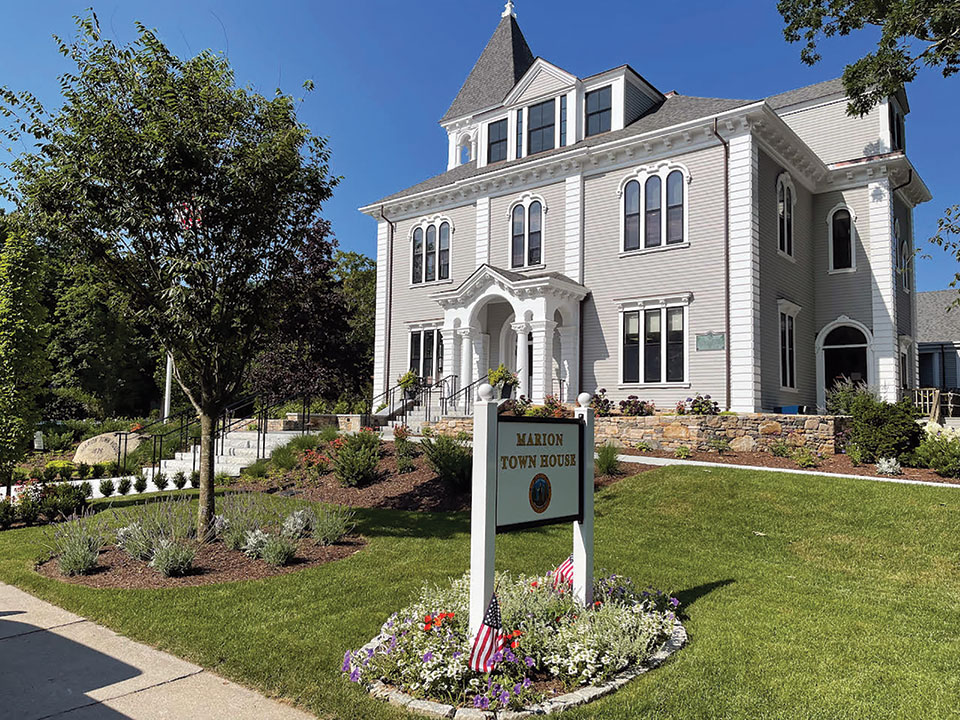
            The property of 2 Spring Street started out as a country lane leading to a stone building associated with Captain Allen’s salt works. The Marion Town House at 2 Spring Street is an Italianate building erected in 1875-1876 as Tabor Academy’s recitation or classroom building. The school owes its existence to Elizabeth Taber, who purchased the rock-strewn land from Capt. Henry M. Allen in 1871. Tabor Academy opened on Sept. 13, 1877 with 21 students.

            The restoration of the Town House exterior was recently completed with funds from the Sippican Historical Society and many generous donors. The elegant front entryway is now open and features photographs of the building’s interior from the SHS archives, as well as a recovered stone plaque which graced the original town hall.