Eleanor’s Splendor Brought to Life

            Taking on the story of a person as wrapped in 20th century history on a global and local level as Eleanor Roosevelt takes an equally brave and insightful person. But to take it on as an actress inhabiting such a large personality is something else – it is epic.

            Equal to the character she portrayed for an hour on May 13 in a one-woman performance, Linda Monchik of Marion took us on Eleanor’s journey from shy lonely child to world-renowned, human-rights advocate. The title is “An Hour with Eleanor.”

            This performance is the first in in a series of Marion Art Center Theater Playwriters Incubator productions.

            “It’s a program for first-time play-writes. The goal is to aid the writer through the creative process with mentors …,” MAC Director Jodi Stevens explained. The press release noted, “Finding theaters to produce new or unpublished plays can be an obstacle … the MTPI is a structured program that aims to discover and support, through workshop and production, new stage plays from the region.”  “An Hour with Eleanor” was written by Cynthia Krause, who states, “My interest in theater is a central theme.” A graduate of the University of Wisconsin with a Bachelor of Arts in history and Masters of Science in Education, Krause has acted, worked on Broadway plays and performed in “Scrooge,” “Social Security” and “A Little Night Music” to name a few.

            Under the direction of Maura Barry Van Voris and Richard Van Voris (daughter and father), Monchik’s flawless telling of Eleanor’s life in the first person was tender, humorous, sorrowful and profound.

            The play covered the vast range of experiences and events that placed Eleanor in the center of world events, sometimes to the chagrin of her husband, you know, the President. President Roosevelt.

            His presence in the play is there, of course, but the “hour” hardly long enough to cover one political event Eleanor participated in, never mind a quarter century of the country’s history, is a telling of life lived through her experiences, not his. In the hands of Krause and Monchik, it is masterfully crafted.

            If you are not of an age to remember Eleanor when she walked amongst us, you’ll get an enjoyable history lesson.

            This lady, who was born into privilege, never felt wanted or loved. With the passing of her father (Teddy Roosevelt’s brother), she went to live with her grandmother. Her father was an alcoholic far removed from caring about the small child he had fathered as told in this anecdote: “Father took me to the Knickerbocker and told me to wait on the step, he’d be right back.” Four hours later, the doorman arranged for the four-year-old Eleanor to be sent home.

            One can only imagine what early, inner fortitude she possessed. Krause’s words spoken by Monchik left us deeply moved.

            And while there were many moments when we were left wondering where Eleanor found the strength to persevere, there was humor as well. But methinks the humor came when Eleanor was able to best naysayers.

            One singular event, the development of the United Nations, speaks volumes to Eleanor’s brilliant, possibly superior ability to bring disparate parties together, find the common ground and work together for the good of all.

            “My job was to be useful,” she is quoted as saying.

            Indeed. She was the first (and only for a long time) woman who helped create the U.N. Universal Declaration of Human Rights and later became the first chair of the United Nations Commission on Human Rights. Eleanor spent many years both before President Roosevelt’s death and after working on projects intended to improve the lives of those whose voice was not often heard. Such groups as the League of Women Voters, Women’s Trade Union and the Red Cross she would put her shoulder to the wheel for progress of human rights.

            Today, the following would be just a small footnote to Eleanor’s history, but in 1940 she was successful in securing freedom for 83 Jewish refugees. She knew it wasn’t enough, but for those who were spared a death sentence, it was.

            Krause didn’t shy away from the personal and painful moments when Eleanor questioned President Roosevelt’s faithfulness and then the ultimate betrayal. It is all there in emotions worn by Monchik to perfection. You want to cry at the reality of her passionless marriage and daughter Anne’s part of organizing trysts for President Roosevelt with his longtime paramour, but in the next moment experience the joy and freedom the grand lady knew through her work and her relationships.

            Whether you know the story of Eleanor Roosevelt or only recently heard her name, do yourself a favor and see this play. The writer, directors and the actress have prepared a feast for you.

            The next and final performance is scheduled for Sunday, May 28, at 2:00 pm. For tickets, visit MarionArtCenter.org.

Marion Art Center

By Marilou Newell
Marion Trees and Parks Committee

Many streets in Marion have recently experienced heavy tree removal, particularly Converse Road, Front Street and Spring St. Every 10 years or so, Eversource comes through to inspect power lines and remove trees where they think they are in danger of coming down over the wires. Large orange trucks have been doing the work- hard to miss.

            The Marion Tree Committee is working to replace some of these lost trees where possible. In some instances, we will need to speak with individual homeowners to see if they are willing to have a tree planted in their yard near the road and away from the power lines. We hope to plant in the fall and Eversource will help with this effort with smaller trees under the wires.

            Last year in honor of our 25 years as a Tree City, we raised funds to plant 25 trees within the village area. This year so far, we have planted 13 new trees in Evergreen Cemetery, 7 trees in the newly replanted Childrens Garden between the school and library and donated 4 more trees to the COA for their walking path.

            If you have any questions, please contact Margie Baldwin, chair of The Marion Trees and Parks Committee- 508 748-2080

Restoration Plan Anticipated

            Rochester’s Conservation Commission Tuesday gave the owner of property at 89 Box Turtle Drive a new ultimatum in the year-long dispute over the clearing of land too close to wetlands without a permit.

            The commission approved giving owner Doug Rose until June 6 to provide an acceptable restoration plan without being fined for his noncompliance. But no plan by then will mean the fines will start up again.

            Town Counsel attorney Elizabeth Lydon told the panel that the judge in a Magistrate Hearing on the fining issue has continued the case until September, and she and Rose’s attorney have agreed his client might have a restoration plan ready before then, in time for the commission’s next (June 6) meeting or shortly thereafter.

            “My recommendation is to stop the fines until then,” Lydon said.

            The commissioners agreed to suspend the fines, but they also decided that June 6 should be the hard and fast deadline to receive a restoration plan. Or the fines will begin again.

            Commission member Mike Gifford emphasized how important it is that the board see the right plan by then. “Everyone in this room just wants to get past this,” he said. “I think it’s a good compromise. He needs to come here and work with us.”

            Lydon said Rose’s attorney’s availability on June 6 is in question. Commission member Ben Bailey debunked that sticking point, saying if the attorney is part of a law firm he can send someone else. This dispute has dragged on long enough, he said.

            “And when we have the plan, they have to lift the no-trespassing notice,” Bailey demanded. “We have to have that lifted for site visits.”

            A year ago, the board voted to begin delivering “noncriminal enforcement tickets,” fining the property owner on a climbing scale of $50, then $100, then $300 per day for having done clearing work closer than 25 feet from wetlands without a permit. This vote came after the board asked the property owner to file a restoration plan with erosion and sedimentation controls in late July 2022.

            In April of this year, the board reviewed a plan Rose had submitted that Bailey said lacked sufficient detail. The resulting vote at that meeting to continue fining Rose for his noncompliance was unanimous.

            In other action, the commission voted a “negative determination” for a plan to install a set of exterior stairs to an existing garage within 70 feet of wetlands at 24 Mayflower Lane. The board decided the proposal would not result in any wetlands impact after Conservation Agent Merilee Kelly reported the garage is ‘a good distance’ from wetlands area.

            The commission responded to a Notice of Intent to sell an acre of Chapter 61A agricultural and horticultural land for residential use off Mary’s Pond Road by recommending the Select Board not exercise its right to purchase the property under 61A regulations.

            The Conservation Commission announced its next meeting will be held on Tuesday, June 6, starting at 7:00 pm at Town Hall, 1 Constitution Way.

Rochester Conservation Commission

By Michael J. DeCicco

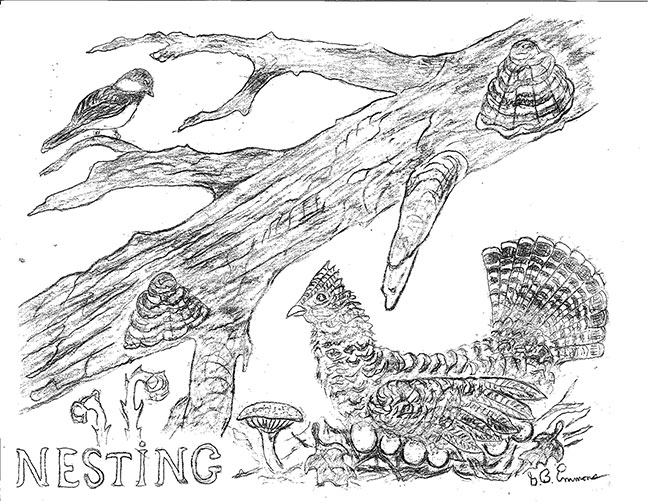
Partridge Plumage Matches Earth Below

The Ground Nesting Partridge in spring is hard to locate and identify because the color of its plumage is camouflaged with one of two earthly color phases.

            Here in New England, the Partridge feathers match the dark gray shadows of the surrounding conifer forest. Further south, the Partridge plumage has a rusty cast to match the brick-colored, red-earth shade of more colorful soil below the Mason Dixon line. Either one of the two Partridge camouflaged shades can readily be recognized in the feathers of a Ground Nesting Partridge.

            As in my illustration, the mother Partridge is sitting on a clutch of six eggs that she started incubating after they were all laid so that all would hatch out at about the same time. Then all would match the others and coincide with one of the two earthly colors. Both can be easily identified to match the nesting Partridge coloring that came about from the geographic origin of the Partridge ground nesting location at the time the eggs were laid and incubated.

            The mother Partridge, out of habit, builds a bowl-shaped nest of sticks so she can pluck loose vegetation into it because it probably contains high-level protein and rich vitamins to grow on and develop into bigger fledglings.

            They quickly learn to move about into groves of aspen, pine and birch, and later to develop an appetite for fruit buds, ferns and shrub berries and then later in the season nuts and acorns that have a high content of cellulose, which after digesting makes it later possible to survive harsh, winter-weather conditions.

            Even after forced to move about more than a half-mile for a plentiful, unexpected, different food supply that pops up, their location is observed by a nearby Partridge drumming male that has no secrecy by loudly making his observation known. When he may mount a hollow log as a convenient drum, he can thunder some 40 wingbeats against his chest that sounds like some person trying to start up a two-cycle engine with a sputtering burst of a loud static tattoo.

            The plump Partridge has a cocky crest on its head and a tail marked with a broad, dark band near the tip, which when displayed gives the displaying male a rich, black ruff around the neck, giving it the well-known other name of “Ruffed Grouse.“

            The thumping, rousing beating like a drum carries up to a quarter of a mile and announces its message like a barnyard rooster beating its chest like Chaucer’s Chanticleer literary bugle announcement of the coming dawn of a new day.

By George B. Emmons

Upcoming Events at the Elizabeth Taber Library

Book sale and Book Worm’s Bake Shop and Café Friday and Saturday May 19 and 20, 10-3 – Support the Elizabeth Taber Library by visiting our outdoor book shop. Find books in all genres in great (and giftable) condition. $4 for hardcovers, $2 for paperbacks. Find puzzles, games, DVDs, audio books, T-shirts and library merchandise, and more. Treat yourself to coffee and homemade snacks at the Book Worm’s bakeshop and café. All proceeds benefit the library.

            Banned Book Club Tuesday May 23 at 6:30 – Join us for a special presentation from the ETL’s Banned Book Club to discuss the noir suspense novella “The Postman Always Rings Twice” by James Cain, and the notorious history of censorship efforts in New England, from the moral crusades of the Watch and Ward Society who banned modern classics by Hemingway, Faulkner, Walt Whitman and more, to current attempts at banning books. Learn about James Cain’s obscenity trial in Boston and why Upton Sinclair once said “When you are banned in Boston, you are read everywhere else.”

            Discover Shanghai and Hong Kong Tuesday May 30 at 6:30 – Join Librarian Marie Yang to share photos and travel tales from visits to Hong Kong and Shanghai. Explore local food, hidden gems, and cultural highlights.

            For more information on the Elizabeth Taber Library, visit us at www.ElizabethTaberLibrary.org or call us at 508-748-1252.

Academic Achievements

Abigail Rose DaCosta, of Mattapoisett, BBA Finance Graduated from the University of Georgia during Commencement exercises this week.

A Rail Trail of Ideas

            The missus and I ventured down to the finally opened “Shining Tides Mile” section of the Mattapoisett Rail Trail. As an original skeptic, the curmudgeon in me wants to say something critical about it, such as the peace and quiet we once experienced walking along the dirt railroad bed communing with nature in peace and quiet is no more.

            The views are beautiful, though I remain saddened that the gigantic steel superstructure dominates the perimeter of the beach. If one stays on the boardwalk and ignores the speeding cyclists whizzing by your ear – they ought to be required to ring a bell as they approach from the rear – sharing the spectacular vistas with the cyclists, joggers and walkers is an afternoon is well spent.

            A walk along the trail is a great place to get away from the incessant talk about the 2024 presidential election, which the media is already dominating the news cycle by reporting early polls. I trust you will also agree that it is much too early to talk about Christmas, though I expect stores will be putting out holiday merchandise in the next month or two. But, is it too early to talk about New Years Eve? Hear me out.

            I suspect people are already dreaming of cross-country skiing or snowshoeing on the trail … assuming we ever get snow again. I have an idea that can make the boardwalk an idea venue to celebrate the New Year. Boston has its First Night, New Bedford has its own celebration and Newport has its Water Fire. Why not Mattapoisett? We could call it “First Night Mattapoisett.”

Imagine the whole community … families, mom, dads, kids, grandparents, seniors walking the trail on New Year’s Eve. Town organizations could sponsor sections setting up hot chocolate or cider stations along the boardwalk. Restaurants could offer food as they do at the “Taste of the Town,” or food trucks might provide refreshments.

            A deejay or the Old Hammondtown School Band could supply music. (Auld Lang Syne at midnight might be a nice touch, wouldn’t you agree?) Generators could be placed under the boardwalk to provide power. Temporary lighting could be set up. (Solar lights embedded in the railings for nighttime walks wouldn’t be a bad idea anyway.)

            A New Year celebration along the Rail Trail is not unprecedented. One town that I am familiar with has been doing it for several years. (Ya, I confess I stole the idea.) They set up fire pits along the trail for roasting marshmallows. Instead of firepits, we could have the Fire Department start mini-bonfires along the beach for warming.

            At midnight, all the revelers could stand at the railing and watch a laser show or better yet, a gigantic fireworks display over the west harbor. (Like they did over the town beach when I was a boy.) You’ve got to think big.

            Now you may ask, how do we pay for all this? I don’t know. I’m just the idea guy. That town I mentioned, they use volunteers, private citizens, civic organizations and a few deep-pocketed benefactors.

            Here is one idea, we could have a footrace in the fall along the Rail Trail from Fairhaven to the village, entry fees to pay some expenses, for example. We could call it the “Boardwalk Blister Mini Marathon.” Well, we can work on that.

            Perhaps some group could “sell” boardwalk planks like the engraved bricks at Shipyard Park. The buyer would get a small brass plaque with their name engraved attached to their plank. Well, that’s all I have. Do you expect me to think of everything?

            If “First Night Mattapoisett” comes to pass, I might just stay up past my 9:00 pm bedtime.

            Editor’s note: Mattapoisett resident Dick Morgado is an artist and retired newspaper columnist whose musings are, after some years, back in The Wanderer under the subtitle “Thoughts on ….” Morgado’s opinions have also appeared for many years in daily newspapers around Boston.

Thoughts on…

By Dick Morgado

Stricter Agenda for Agendas

            Rochester’s Board of Selectmen won’t find it as easy anymore to bring up topics on the spur of the moment in its meetings.

            Town Administrator Glenn Cannon informed the board Monday that the new Town Counsel has said that from now on, every meeting topic must be on the agenda, no exceptions.

            To adhere to the state’s Open Meeting Law, the Old Business and New Business items on a meeting agenda must never be blank. Board members must call the town administrator before the closing of the agenda to have a topic placed on the warrant. The selectmen can no longer include “Any Topics the Chairman did not reasonably anticipate would be discussed” on its agendas.

            Of the latter requirement, Cannon explained that anything important enough to be a last-minute topic should require an emergency meeting instead.

            Select Board Chairman Woody Hartley and member Paul Ciaburri, who attended the meeting in person, and member Brad Morse, who was attending on Zoom, seemed happy with this change.

            In answer to Hartley’s question seeking clarification, Cannon told the board that should a member request that the town administrator put an issue on the meeting agenda, “I’ll be glad to do it.”

            Cannon was also upbeat in acknowledging that next Monday, May 22, is the date of the Annual Town Meeting, to be held at 7:00 pm at Rochester Memorial School, 16 Pine Street.

            “We’re excited for it,” he said. “It’s a big warrant, 32 articles. But we hope to get it done in one night.”

            The warrant features a $25,000,000 FY24 budget and a move to cease the town’s participation in the Green Communities program and rescind its adoption of the Stretch energy codes that tighten the base building codes in the name of more energy-efficient construction. Proponents of the exit strategy assert that the Stretch Code makes Green Communities participation too expensive, especially for a town studying potential expansion of its public-safety facilities. Other articles will include a move to change the town clerk’s position from elected to appointed.

            In other business on May 15, the board approved a draft letter to the regional planning agency SRPEDD, requesting assistance for collecting data for a study of Route 28. “This study will make way for a better corridor,” Cannon said, noting the review will also affect, positively, Lakeville and Middleboro.

            The board reappointed Stanley Moszczenski to the Historical Commission, after he noted in a letter that he had failed to reapply for the seat in time for the last appointment cycle.

            The board appointed Rochester Police officers Don Kemmett and Steve Reimer to provide police details during the Wednesday, May 24, Town Election to be held from 8:00 am to 8:00 pm at the Senior Center on Dexter Lane.

            The board voted to not exercise its right to purchase 2.45 acres of Mary’s Pond Road under 61A regulations. The board had to revote this action after the property owner’s attorney had reported the previous vote did not specify only a portion of a larger parcel.

            The next meeting of the Rochester Select Board is scheduled for Monday, June 5, at 6:00 pm at Town Hall, 1 Constitution Way.

Rochester Select Board

By Michael J. DeCicco

Mattapoisett Library Leave No Trace Workshop

Bob Sirhal, Rhode Island’s Leave No Trace State Advocate, will provide a free orientation on Tuesday, May 23 at 6:00 pm in the Community Room of the Mattapoisett Free Public Library, 7 Barstow Street. This program is a joint effort of the Mattapoisett Land Trust and the Mattapoisett Sustainability Partnership. Registration is necessary to participate and is available on the library’s events calendar at mattapoisettlibrary.org. Sirhal will present the seven principles of the Leave No Trace philosophy and discuss how to lessen human impacts on the environment and nature trails. Materials and handouts will be provided.

            The Mattapoisett Land Trust is a nonprofit organization dedicated to acquiring and preserving natural resources and wildlife areas in Mattapoisett for the use and enjoyment of present and future generations, educating the public about the wise use of natural resources and collaborating with other organizations that have similar goals. Learn more about the Land Trust at mattlandtrust.org.

            The Mattapoisett Sustainability Partnership is a group dedicated to promoting sustainable living in the community. Meetings are typically the first Saturday of the month at 10 am; schedules are subject to change so check the library’s events calendar for updated information. To be a part of this group, stop in for a meeting or email mfpl@sailsinc.org to get details.

            For more information about this event or to register, call the library at 508.758.4171 or email to jjones@sailsinc.org. Check the library’s events calendar at mattapoisettlibrary.org for more upcoming programs and book discussions.

Marion Community Preservation Committee

To the Editor;

            I have been a member of the Marion Community Preservation Committee (CPC) for the past 9 years, its Chair for the past 6 years. I understand that there was a great deal of discussion regarding the CPA articles and process at our recent Annual Town Meeting. Unfortunately, I was traveling on business and unable to attend the May 8 meeting and would like to provide some additional detail.

            Marion adopted the Community Preservation Act (CPA) in May 2005, replacing a historical 2% tax surcharge that was used to fund the Land Bank with a 2% surcharge funding the CPA. The CPA surcharge includes an exemption for the first $100,000 of assessed value. In the 19 years since Marion’s adoption of the CPA, tax surcharges have totaled $5.15M and Marion received a total of $1.83M in state matching funds. The state match varies and has ranged from 100% to 17%.

            The CPC is composed of representatives of 7 Town boards: Conservation, Planning, Select Board, Open Space, Affordable Housing, Historical and Recreation. The CPC, coordinates the applications process and makes recommendations at Town Meeting, with voters making the final funding decision. For the season just completed we held five open meetings, the last a public hearing. The articles were also reviewed at the Select Board’s May 2 meeting.

            Town meetings have funded 77 CPA projects with a total value of $6.53M. The remaining CPA balance is $478k. I have grouped these 77 awards into 11 categories:

-Restore Town Buildings – 13 projects, $2.57M

-Restore Private Buildings – 6 projects, $311k

-Land Acquisition – 3 projects, $507k

-Open Space Planning – 3 projects, $16k

-Watershed Protection – 3 projects, $170k

-Pathways – 3 projects, $636k

-Recreation – 19 projects, $511k

-Veterans’ Graves – 3 projects, $21k

-Document/Artifact Catalog, Preserve – 12 projects, $399k

-Affordable Housing – 8 projects, $1.23M

-Other – 4 projects, $152k

            Marion’s exit from CPA is a complex question. While a CPA exit would eliminate the 2% tax surcharge, this action would also end the state match – $1.83M over the past 19 years. If Marion exits the CPA how would the projects funded by the CPA be financed? More than 93% of CPA monies were used to fund Town properties and projects ($6.1M). These projects would have to be included in the Town’s conventional operating or capital budgets, wait for the generosity of outside groups, or be deferred for later decision. Unless one argues that most CPA projects are unnecessary, exiting the CPA would likely increase taxes because of the loss of the State match. If projects proposed for CPA funding are not worthwhile, they should be voted down at Town Meeting. During the last 10 years I recall only one project that was rejected with few articles generating any questions.

            My opinion, and I am speaking as a citizen, not on behalf of the CPC, is that the CPA is a valued resource that provides an alternative funding process, supported partially by State funds, that remains in full control of the voters. The Town House provides an example of the value of CPA funding. The Town House was the victim of 50 years of deferred maintenance, and recent failed attempts to restore or replace the building through conventional funding. CPA monies, with some supplemental private funds, restored at least the outside of the building and made it an asset to the Town.

            My suggestion is that we retain the CPA and that interested townspeople become active in the entire funding process. We would welcome the participation of interested citizens throughout the process.

Jeff Doubrava, Marion

The views expressed in the “Letters to the Editor” column are not necessarily those of The Wanderer, its staff or advertisers. The Wanderer will gladly accept any and all correspondence relating to timely and pertinent issues in the great Marion, Mattapoisett and Rochester area, provided they include the author’s name, address and phone number for verification. We cannot publish anonymous, unsigned or unconfirmed submissions. The Wanderer reserves the right to edit, condense and otherwise alter submissions for purposes of clarity and/or spacing considerations. The Wanderer may choose to not run letters that thank businesses, and The Wanderer has the right to edit letters to omit business names. The Wanderer also reserves the right to deny publication of any submitted correspondence. All letters must be typed and submitted directly to: news@wanderer.com.