Swordfish Tales

By the age of ten, Tom Brownell had witnessed the thrill and the danger associated with swordfishing.

One day, while hunting for swordfish, about 30 miles south of Martha’s Vineyard with his Dad, a fish was “ironed.” But on this day, the enormous animal reared up from underneath their boat and pierced the deck clear through the planking with its massive sword. The surprised youth and his father quickly stuck rags into the breach not unlike putting a finger in a dike.

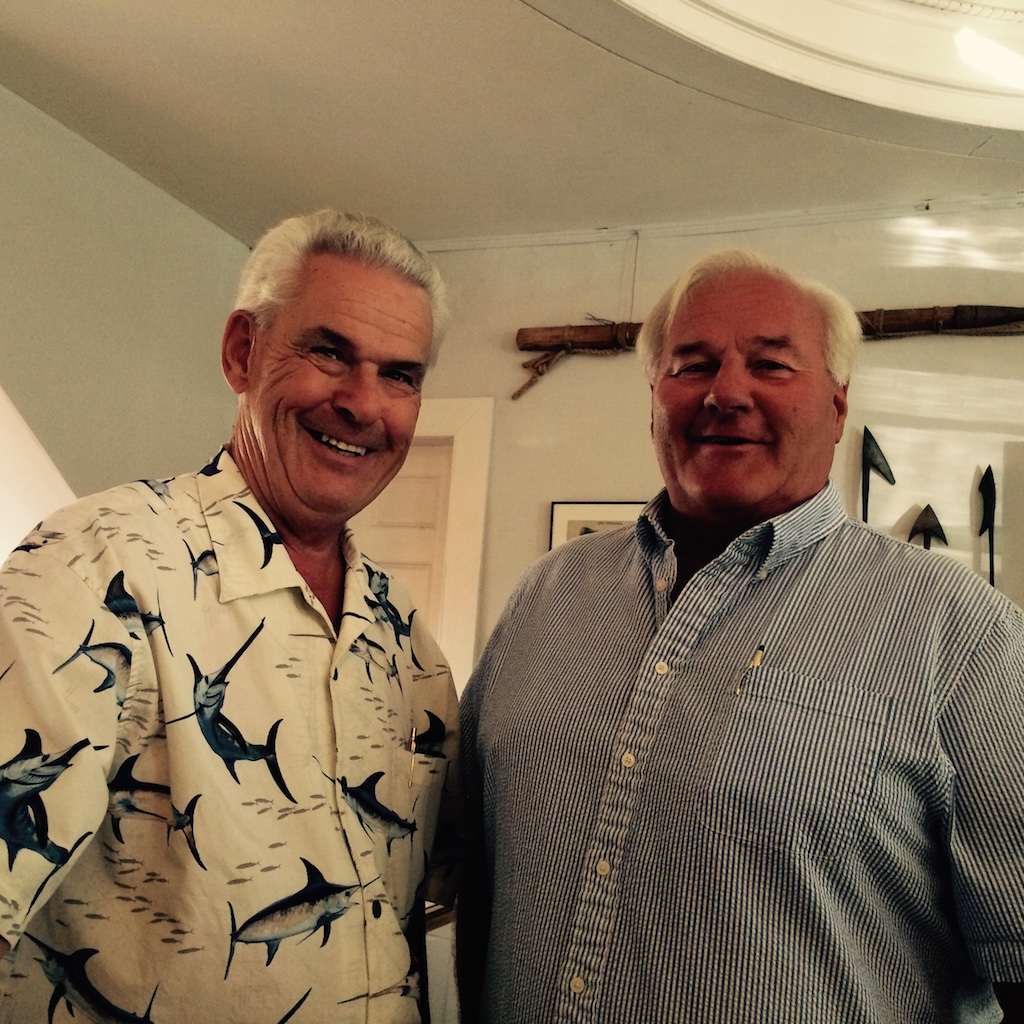
On July 23, Brownell and his hunting partner of many years, John Clark, told a group gathered at the Mattapoisett Historical Society Museum to hear fishing tales, “…we’ve got so many stories…” Thus, Brownell and Clark shared a few of those tales and, as they spoke, their eyes seemed to view the scenes they were describing in that far distance of time where the horizon meets the sea.

They talked about the mechanics involved in hunting these great fish. To ‘iron’ a swordfish means to spear it with a special tool that allows the spearhead to disengage from the shank. The spear is attached to a long rope line. On the other end is a large ball. Once speared, the swordfish swims until exhausted while the hunters follow, waiting for the opportunity to bring the huge animal aboard the boat.

Brownell said, during his youth, he fished with Earl Broadman of Hollywood in a boat built by Brownell’s family business. Each summer, he would go on as many as 35 fishing trips.           After that, Brownell began partnering with Tommy Borges (now deceased) and John Clark. He said each man had his own finely-honed individual skills and jobs during the hunt. Borges was the wheelman, Clark was the spotter and angler, and Brownell was the striker, spearing the fish. They were tuned in to each other, had confidence in each other, and were successful for that reason the men shared.

“Johnny would tend the line. Tommy would steer the boat, putting the sun to my back, said Brownell. “Tommy knew just how I liked it and put me right on the fish. I was the striker.” Brownell demonstrated the stance he would take as he spoke.

Striking the fish needed to be precise to set the spearhead. Then the fish would take off trailing 300 feet of line. It would take up to 60 minutes before they could attempt landing the fish. Clark never took his eye off the ball and when the time came, Brownell said, “Johnny did most of the fighting with the fish.”

Brownell described the perfect hunting day as one where “we had popcorn skies” and flat calm waters. He said Clark could spot a swordfish fin yards away.

Fishing began in June and ended in September. They went out to sea “every good day,” Brownell remembered. And for more than 30 years, he remembered many good days.

During the season, swordfish migrate north following baitfish. The men would head out around dawn and return after dark. It took two to three hours to reach the hunting grounds some 30 miles south of Martha’s Vineyard.

And swordfish weren’t the only fish they saw.

He said the ocean was full of all types of sharks and whales. Clark remembered what he saw on one day in particular.

“Acres of black whales, as far as the eye could see, sleeping on the surface of the water,” said Clark.

Seth Mendell, who was among the assembled to hear these men speak, offered the following explanation, “Whales are mammals and have to sleep on the surface of the water so they can breath. They are the only mammals who can shut off half of their brains while sleeping, while the other half keeps them breathing.”

The biggest swordfish the trio ever brought in weighed 504 pounds after being “dressed.” But the very best day of his fishing life was July 17, 1983. On that day, they landed six fish weighing from 190 to 400 pounds.

Brownell said that swordfishing’s heydays ended around 1985 with the arrival of factory ships from Russia invading George’s Banks.

“At night, there were so many huge ships from Russia all lit up, it looked like a city on the ocean,” said Brownell. He said these industrial ships used long nets sweeping everything out of the water from fish, to sharks, to whales, everything. “And the water seemed to warm up a lot,” which Brownell said contributed to the decline of baitfish.

When the fishermen first began selling their catch to local restaurants, the price was around 25 cents per pound. That figure rose to six dollars per pound by 1985.

Brownell said, of the years he fished with Tommy Borges and Johnny Clark, “We never really grew up.” He concluded wistfully, “It was the best time any three guys could have!”

You can view photographs of Brownell and his partners during their days at sea and related tools of the trade at the Mattapoisett Historical Society Museum through the summer season.

By Marilou Newell
Swordfish

Solar Project Will Not Disturb Wetlands

A community solar farm project developed by Clean Energy Collaborative, slated for a parcel of land off Tucker Lane, will have no impact on wetlands, Wetlands Engineer Mark Arnold told the Marion Conservation Commission July 22.

The wetlands at the parcel consist of cranberry bogs, swampland, and bona fide vegetative wetlands (BVW). Some trees within the BVW will be lopped off at 10 feet to mitigate shading on the solar arrays. Trunks will remain with the root system left intact, avoiding the disturbance of the ground vegetation and shrubs. No heavy machinery or trucks will enter the BVW because the work will be done by hand.

The Massachusetts Department of Environmental Protection did issue a comment on the project plan, voicing concern over impact on the BVW and possible loss of wetlands at the site.

“It’s not really a loss,” said Arnold about the roughly 3,000 square-foot area of concern. “It’s really just an alteration…. We’re actually not disturbing any groundcover.”

Conservation Commission Chairman Norman Hills requested a copy of a long-term maintenance plan for the project site, but neither Arnold nor the developer’s community solar manager, Greg Carey, had one for submission that evening.

Arnold’s plan, which he submitted with the Request for Determination, reflected a 25-foot “no-build zone” within the 100-foot buffer zone, but as the commission pointed out, the no-build zone actually extends to 30 feet.

The commission continued the hearing until August 12 and requested that Arnold return with a plan reflecting the accurate 30-foot no-build zone as well as a maintenance plan. Hills – also a member of the Planning Board – said the Planning Board had about 20 or so items that still need to be resolved before that board approves the site review. Hills suggested the ConCom refrain from making a determination on the solar farm project until those Planning Board issues are resolved.

Also during the meeting, the commission issued a negative determination for the Tremont Advent Christian Camp Association, located at 45 Oakdale Avenue, to rebuild an existing structure damaged by snow over the winter. Located within a flood zone, the structure will be raised an additional 4 feet to meet flood zone construction regulations.

In another matter, the commission accepted a change to the previously approved plan for Sid Bowen of 16 Vine Street. Bowen’s wife, Angela Watson, present on Bowen’s behalf, said the proposed structure, due to zoning setback requirements, will be relocated to the opposite side of the driveway on the property. The footprint, she said, would be smaller, an existing garage that was slated for removal will now remain, and the distance to the drainage area would remain the same.

The commission granted a negative determination for Judith Cope of 16 West Avenue to re-grout a stone groin (a jetty-like structure usually placed to hold sand in place).

The RDA hearing for Chuong Pham was continued until August 12, the next meeting of the Marion Conservation Commission, to be held at the Marion Town House at 7:00 pm.

By Jean Perry

MRcc_073015

Wells Gas Station in Marion

To the Editor:

“Adios” to the Wells Gas Station in Marion.

We wish we could say farewell to our dependence on poisonous petroleum products that power our motor vehicles and boats. And, we would really like to say “adios” to the Wells gas station that was closed for six years and now is preparing to reopen on a triangular patch of property within the borders of Wareham Road, Wells Road, Mill Street and some wetlands.

However, because a senior healthcare facility (Sippican Healthcare) and a senior/handicapped housing complex (Marconi Village) are abutters; we first have to say “so long” to our outdated perception about the elderly and the handicapped. NO! It is not okay to view us as expendable and unworthy residents by simply deeming the area where we live a “sacrifice zone,” out of sight, out of mind. It is easy for these profiteers to ignore us when they do not live in the neighborhood.

As senior citizens, we should not have to bear the disproportionate burden for toxic pollution at the hands of those who will make a quick profit. There are no benefits for us, only the external costs of a gas station: the fumes, the traffic, the tailpipe emissions, the glaring lights and the inescapable noise. Yes, it is easier to ignore the elderly and handicapped for many of us are too old and too weak to fight big corporate gas stations, but those of us with the ability will carry on the struggle in the name of environmental justice.

We invite the pastors of our local churches, the Marion and Massachusetts Department of Health, the Executive Office of Elder Affairs, the Department of Environmental Protection and Coastline Elderly Services to connect with us and take a toxic tour and evaluate the potential human health risks from exposures to chemicals in the ambient air because the risk or probability of developing adverse effects increases with intensity and frequency of exposure to these harmful chemicals.

We have to change our thinking, just because we are elderly and/or physically handicapped does not give anyone the right to disrespect, disregard or devalue us as human beings. Rather than a gas station pushing poisonous chemicals within 100 feet of our front yard, we suggest installing a quiet, non-polluting, clean energy producing solar farm on that property.

Sincerely,

Eileen J. Marum, Marconi Village, Marion


The views expressed in the “Letters to the Editor” column are not necessarily those of The Wanderer, its staff or advertisers. The Wanderer will gladly accept any and all correspondence relating to timely and pertinent issues in the great Marion, Mattapoisett and Rochester area, provided they include the author’s name, address and phone number for verification. We cannot publish anonymous, unsigned or unconfirmed submissions. The Wanderer reserves the right to edit, condense and otherwise alter submissions for purposes of clarity and/or spacing considerations. The Wanderer may choose to not run letters that thank businesses, and The Wanderer has the right to edit letters to omit business names. The Wanderer also reserves the right to deny publication of any submitted correspondence.

RCF Pie Bake-Off Contest

The Pie Bake-Off contest at the Rochester Country Fair is on Sunday, August 16 at 2:00 pm. We will be under the big tent. The application can be found on the Rochester Country Fair website or in the fair program. Dessert pies only please. The rules are as follows: Two categories-one-crust and two-crust pies; you may only enter in one category; home-made pies only, no pre-made crust; include your recipe; include your name on the bottom of the pie plate; and if you would like your pie plate returned please write “return” on the bottom. Mail your application to: Nancy Boutin, 128 Marion Road, Rochester, MA 02770 or Nancy.boutin@comcast.net. Attach your recipe to your application. Happy baking!

Tabor Academy to Construct Bleachers

Tabor Academy will begin construction shortly on a set of concrete bleachers to be installed on the hillside above the school’s football field. The bleachers will step down from the Spring Street parking area, and span across the 35-yard lines. Will Saltonstall, the architect on the project shared, “The bleachers will provide fans with easy access to more comfortable seating with midfield views of all the action. Part of the plan also includes handicap parking spaces in the Spring Street lot so that everyone can enjoy the games.”

Head of School John Quirk said, “We are pleased to be able to provide townspeople and our community, as well as people from visiting schools, with a comfortable and safe place to view the games and to cheer on the competitors. Whether hosting games for Tabor teams or from other area athletic programs, we are excited to know that we’ll have much improved seating for the great and supportive fans that so often join in the competitive spirit of our school.”

Will Saltonstall shared the project with Marion’s Planning Board on July 20 as a courtesy to make them aware of the upcoming construction and field any questions.

The Barnacle Whisperer

Michelle Cusolito is an educator, naturalist, author, and to a group of folks gathered at the Mattapoisett Library on July 28, she was the “Barnacle Whisperer.”

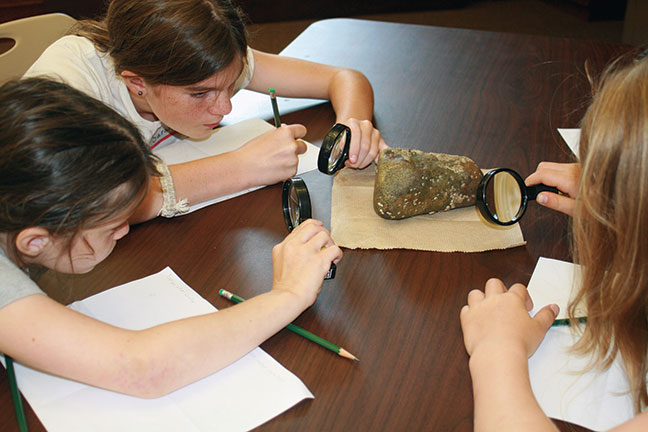
Cusolito told about 20 young people from ages 8 to 12 that barnacles are amazing animals, whose lives along our coast can only be seen at low tide. But it is during the high tide that they are active, albeit rather hard to see without a magnifying glass or a snorkel.

Before arriving at the Mattapoisett Library to impart barnacle wisdom to this thoroughly engaged group, Cusolito made a visit to Ned’s Point and collected rocks encrusted with barnacles and brought them in large pails of seawater.

First, she had the children examine the rocks, noting that the barnacles were very tiny. She then handed out magnifying glasses in order to bring the tiny crustaceans into better view.

After asking the kids to jot down some thoughts about what they observed, she placed the rocks into clear bins and then slowly splashed sea water over them, mimicking a rising tide. She told the children to give the barnacles a bit of time and then to observe any changes.

Aubrey, Daniel, Sarah, Annie, Connor, Cameron, Meghan, Violet, Alex and others waited patiently, just as scientists in all disciplines must when studying nature. They were waiting for the barnacles to open up and release their feeding legs.

Sarah said, “Oh, that smell!” as she peered into the container on her table and waited for the barnacles to open. Cusolito cautioned the kids that when studying nature, one had to be patient – there was a great deal of waiting involved in science.

As they waited, Violet asked Cusolito, “Do you know what happens?” Science involves a bit of skepticism, too, it seems. Cusolito chuckled and replied that yes, she did.

Cusolito has given talks on barnacles to students and to educators helping the latter group to understand the complexities of these tiny creatures as they develop materials for their own classes.

This group of curious minds learned that barnacles will attach themselves to any slow moving or stationary object – be it a ship, a whale, or a rock. They are hermaphrodites and their offspring voraciously consume plankton, grow, molt, and then settle down to find a home. They excrete a type of organic brown glue used to attach their bodies to the object of their desired home site. This substance is so strong that it is being studied for possible use in dental applications. Things that make you go “hmm,” or from this group, “Oh, yuck!”

Earlier in the afternoon, Cusolito pointed out that the Tri-Towns’ libraries are part of the MOBY program, which stands for My Own Back Yard. The program encourages youth in the communities to explore their own towns to search out nature in pastures, streams, seashore, or even the night sky.

The MOBY program offers backpacks at each library that are filled with exploring materials for specific study in such topics as organic gardening, insects, the beach, or bird-watching and available for check out.

By Marilou Newell

Barnicles_1

Ticks, Drugs, and Section 8 Control

With the help of an intern, the Marion Board of Health and Public Health Nurse Kathy Downey are getting the word out about tick-borne diseases through multimedia presentations – for all ages from kindergarten to adult – and other tools such as new and more detailed signs placed strategically at popular hiking paths and conservation lands warning the public about ticks.

Intern Jenna Kiridly reiterated that Marion is in fifth place for the highest prevalence of tick-borne diseases in Massachusetts, with incidents in Plymouth County nearly doubling the amount of Lyme disease, Babesiosis, and other tick-borne diseases in Cape Cod.

Kiridly said the Center for Disease Control has now declared Lyme disease an epidemic, with Tri-Town at the epicenter of it all.

“It is an issue that we need to tackle,” said Kiridly, “both by increasing education … and vigilance and preventative measures.”

Kiridly said the multimedia program she developed is sustainable and can be managed after her internship is over.

The signs she designed and placed at hiking trails are “more attention grabbing.” Therefore, she said, people will pay more attention.

In other matters, during the July 28 meeting, the board discussed ongoing work unfolding under a grant to fund opioid abuse and abuse prevention programs in the area. Through collecting data and organizing the results, including data collected from the recent youth risk survey undertaken at Old Rochester Regional Junior and High Schools, Downey is now heavily involved in addressing seven main problems divided into two types: use and consequence.

“I’ve looked at ‘use’ as more like ‘first use,’ and ‘consequence’ as anything after first use,” said Downey. She addressed issues like Narcan and how to get more people to possess it to prevent overdose deaths.

The board discussed possible root problems that lead to opioid abuse in youth, such as initial use of painkillers for dental work and orthopedic issues. Downey said, as she has spoken to different people dealing with opioid dependency, that most say their primary care physician was not the initial prescribing doctor. Most of the time, the pills are prescribed through emergency room physicians.

The grant will also fund the development for a school curriculum about drug use prevention and addiction.

Before adjourning, Health Director Karen Walega said Ken Steen, developer of the Marion Village Estates 40B housing development, called her to perform two inspections on two units – inspections Steen said the housing authorities of other towns had demanded. Walega wondered what she should charge for these inspections.

Board members had several different amounts in mind – from $50 to $150 – but the board decided to investigate what they charge for other types of inspections before settling on a price.

The board wondered why the Town of Marion would be asked to perform an inspection they viewed as being state jurisdiction.

“They (the housing authorities) don’t know that its brand spanking new, and I didn’t find any problems,” said Downey.

The next meeting of the Marion Board of Health is scheduled for August 25 at 4:30 pm at the Marion Town House.

By Jean Perry

MRboh_073015

David J. Olney

David J. Olney, 80, of Mattapoisett passed away on Wednesday, July 29, 2015 at St. Luke’s Hospital in New Bedford. He was the husband of Margaret “Peggy” (Leask) Olney.

David was born and raised in Waltham, MA, the youngest child of Charles E. and Loraine (Caul) Olney. A life-long summer resident of Mattapoisett, he moved there year-round upon retirement in 1996.

David graduated from Bates College in 1956 and earned Masters degrees from Johns Hopkins Univ. and Cornell Univ. He taught high school chemistry and physics for 38 years, including 15 years at New Rochelle, NY, H.S. and 23 years at Lexington, MA, H.S. During his teaching career, David received several regional and national awards for Excellence in Science Teaching, the highlight being selected in 1985 as one of two Presidential Award recipients for Massachusetts. For several years he was a volunteer tutor at the Hayden-McFadden School in New Bedford.

David was a member of the Mattapoisett Congregational Church and sang in the church choir. He also sang with the Sippican Choral Society and volunteered at the Mattapoisett Council on Aging, Mattapoisett Land Trust and Mattapoisett Historical Society. He loved playing folk music on his guitar, entertaining family and friends. David called himself a “puzzle nut” and liked all kinds of word, number and logic puzzles. He constructed puzzles for students and various publications. He especially enjoyed family card games and playing bridge with his friends at the Mattapoisett and Wareham COA. When the breezes were fair, David sailed his beloved “Sea Jay” on Buzzards Bay.

David is survived by his children, Douglas of Brooklyn, NY, Jonathan of Bel Air, MD, and Katherine and her husband David Kleinschmidt of Acton, MA; four grandchildren, Maggie, Caroline and T.J. Olney and Nathan Kleinschmidt; his sister Dorothy Davies and her husband Julian of Vancouver, BC; several in-laws, cousins and many nieces and nephews. He was predeceased by his brothers Charles Jr. and Robert and his sister Loraine McConnell.

His memorial service will be held on Sunday, August 9 at 1 p.m. at the Mattapoisett Congregational Church. Donations in his name may be made to the Mattapoisett Congregational Church or the Mattapoisett Land Trust. Funeral arrangements are provided by Saunders-Dwyer Home for Funerals in Mattapoisett. For online condolence book, please visit www.saundersdwyer.com.


Family Scavenger Hunt

Join the Mattapoisett Historical Society and the Mattapoisett Land Trust for a Family Scavenger Hunt on Thursday, August 6 at 2:00 pm at the Munro Property west of the Town Wharf. Families will get a chance to explore the wharf and waterfront while learning about our town and its environment. $5 Donation, Members Free. For more information, please call 508-758-2844 or visit www.mattapoisetthistoricalsociety.org.

Azerbaijan Today

On Tuesday, August 11 at 7:00 pm at the Marion Music Hall, the Sippican Historical Society will present a special lecture by Richard L. Morningstar, former United States Ambassador to the Republic of Azerbaijan, and his wife, Faith P. Morningstar. The Ambassador’s lecture will provide an update on the issues of greatest interest in the relationship between the United States and Azerbaijan. Mrs. Morningstar, who initiated two programs related to the empowerment of Azerbaijani women and girls, will speak about the Azerbaijani women’s issues on which she has worked.

The former Ambassador was appointed by President Obama and sworn in by Secretary of State Clinton in July of 2012. He served until July of 2014. Prior to his appointment, he was the Secretary of State’s Special Envoy for Eurasian Energy. Having begun his career as an attorney, he also spent many years as a corporate professional, then as a lecturer at the Kennedy School of Government at Harvard and Stanford Law School. He has also taught at Brown University and Boston College Law School. During the Clinton Administration, he served as Ambassador to the European Union. Faith Morningstar is a developmental psychologist with a primary interest in the development of respect and has created and implemented educational programs designed to increase children’s positive regard for both themselves and others.

The lecture is offered free of charge to the public, and no reservations are required. The Music Hall is located at 164 Front Street in Marion; ample parking is available across the street at Island Wharf. For more information, contact the SHS at 508-748-1116.