Elizabeth Taber Library Teen Drop-in Activities

Elizabeth Taber Library will be hosting Teen Drop-in Activities. Enjoy our complimentary cookies while you create. Event dates are:

Tuesday, November 21 from 3:00 to 4:30 pm, Make Beaded Jewelry

Tuesday, December 5 from 3:00 to 4:30 pm, Make Duct Tape Wallets

Tuesday, December 19 from 3:00 to 4:30 pm, Make Origami Gift Boxes
Wareham Street Lots Clear First Hurdle

With few items to discuss on Monday evening, the Marion Planning Board on November 6 efficiently dispensed with its business. The board approved an Approval Not Required proposal and took the opportunity of a light agenda to discuss, among other things, the process with which they hire consulting engineers.

Engineer David Davignon of N. Douglas Schneider & Associates represented Henry and Judith Dejesus in a proposed ANR plan.

The land, located off of Wareham Street (Route 6) at Marion’s boundary with Wareham, is a large parcel that currently has on it what Davignon described as a “dilapidated house.”

The applicants want to divide the parcel into four buildable lots, all with 250 feet of frontage on Route 6, and ranging in size from 2.67 acres to 11.95 acres. Currently, the intent is to market three of the four lots, setting the parcel with the house aside for sale at a later date.

The address for the entire parcel is 3 Bournhurst Road, further described as a paper street by Davignon. The wetlands have been flagged, but the applicant has not gone before the Conservation Commission as of yet. Board member Steve Kokkins asked what flood zone designation the land was in, to which Davignon replied that all the lots are out of the floodplain except Lot 1. Part of Lot 1 is in the velocity zone, but the house is built in the “A” zone due to the significant amount of saltmarsh in front of it.

Kokkins also asked about the driveway access to the lots and the need for additional curb cuts. Davignon said the intent is to use the current curb cut, which is wide and eminently useable, either as a common drive for all lots or in another configuration to be determined at a later date.

Board member Norm Hills asked if the lots would be serviced by sewer or septic. Davignon assured the board that the perc tests were excellent and all lots would be served by septic systems.

Davignon has also spoken with the fire chief about bringing a hydrant to serve the site.

The ANR plan was approved unanimously, including board member Jennifer Francis calling in from California.

At a previous meeting, the board had appointed members Will Saltonstall and Steve Kokkins as the point people for the site plan review for 111 Wareham Road. Saltonstall reported that they had received the plans and would like to recommend hiring Tibbetts Engineering as the consulting engineer for the board. Saltonstall reviewed for the board its process for hiring consulting engineers, noting that a few years ago the board sent out a Request for Proposals and G.A.F. Engineering, Tibbetts, JC Engineering, and Beals & Thomas responded. He added that if the cost of the consulting was under $5,000 then it didn’t have to go out to bid.

In his town planner report, Gil Hilario briefed the board on a new effort by the Marion Historical Commission, with encouragement from the Plymouth County Registry of Deeds, to create deed summaries of the ‘historic’ buildings in the town. This summary would include not only structures of historical age and significance, but also homes of important historic figures. This summary would be recorded at the registry to be accessible for researchers so that vital facts regarding important properties would be less likely to be lost over time.

In other business, Chairman Eileen Marum reported on her attendance at the Office of Technical Assistance and the Massachusetts Chemical Safety and Climate Change Preparedness Seminar. In light of the catastrophe after Hurricane Harvey, in which toxic chemicals were introduced to the air and water in and around Houston, Texas, she urged the town to take advantage of SRPEDD’s offer to hold a seminar in town. Marum underscored the hazards present within Marion as a coastal community, specifically the risks associated with boat yards and the wastewater treatment plant. The toxins potentially released into the environment, she said, due to a catastrophic storm “…into our water and harbor and could contaminate our seafood.” Marum’s report will be available on the town website.

Francis suggested that a new subcommittee be created to help guide the implementation of the Master Plan, including members from the Planning Board, the general public, and other stakeholders. Marum suggested there be a “robust discussion” at the next scheduled meeting.

The next meeting of the Marion Planning Board is scheduled for November 20 at 7:00 pm at the Marion Town House.

Marion Planning Board

By Sarah French Storer


Katherine I. (Majahad) Gayoski

Katherine I. (Majahad) Gayoski, 95, of Rochester, died Nov. 11, 2017 in Tobey Hospital, Wareham. She was the widow of the late Thomas Gayoski and daughter of the late Simon and Ida (Fields) Majahad.

She was born in Carver and lived in Rochester for most of her life.

Mrs. Gayoski graduated from Middleboro High School and Diman Vocational School.

She worked as an LPN at Tobey Hospital for many years before retiring.

Mrs. Gayoski was a member of the Rochester Women’s Club and the Rochester Grange. She enjoyed playing Bingo, canning, baking, and cooking.

Survivors include her son, Thomas Gayoski, Jr. and his companion, Beatrice Renauld of Rochester; 2 daughters, Sandra Hardy and her friend, Rene Depot and Kathleen Gayoski and her friend, Lesly Mellberg all of Rochester; 8 grandchildren; 12 great grandchildren.

Her funeral will be held at 9:00 am on Wednesday, Nov. 15, 2017 from Chapman, Cole & Gleason Funeral Home, 2599 Cranberry Hwy., Wareham, followed by a Mass of Christian Burial at 10:00 am in St. Rose of Lima Church, 282 Vaughan Hill Rd., Rochester. Burial will follow in Union Cemetery.

Visiting hours are from 4 to 7 pm on Tuesday at the funeral home.

The Spectacular Spectrum: Learn About Autism

The experience of autism varies for each person, just like experience varies for neurotypical individuals. However, there are some characteristics that we can all learn about that will make the day-to-day world of those with autism an easier place to navigate. Who better to learn from than someone with autism?

Join Charles McIntire at the Mattapoisett Free Public Library on Wednesday, November 15 at 6:30 pm to learn more about the strengths, quirks, and challenges for people on the autism spectrum.

“I’d like to change some misconceptions about autism and address the stigma that autistic people can feel. We would like to take charge of the conversation around autism,” stated McIntire.

McIntire is a founding member of Intelligent Autistic Media, a group of autistic self-advocates and their allies. He will be sharing information and experiences to help the audience better understand autism and to learn to be better allies and advocates to those in our community.

His paintings and drawings will be on display the evening of the talk and for several weeks afterward.

Please register to attend the program by calling the library at 508-758-4171 or email Susan Pizzolato at spizzolo@sailsinc.org.

The Mattapoisett Library is located at 7 Barstow Street, and is handicapped accessible. Refreshments will be served.

Mattapoisett Yacht Club

Mattapoisett Yacht Club wrapped up the 2017 Season with its Annual Meeting and Awards Banquet at the Waypoint Center in New Bedford. Rachel Westgate was installed as Rear Commodore to join returning Flag officers Commodore Ed Sargent, Vice Commodore Kai Srisirikul, Treasurer Charlie Smith and Secretary Stephanie Ducharme.

The year’s racing and cruising events were reviewed and awards presented. First place overall summer PHRF class “A” went to Mark Thornhill in J-30 No Quarter Given, first place overall in PHRF “B” Fleet went to Don Ross in Frers 33 Coconuts, and the overall winner in the Ensign Class was John Mello in One Love. 2017 marked the beginning of an annual Buzzards Bay Trophy, a six-race competition to determine an overall PHRF champion. Area yacht clubs each sponsor a distance race. MYC ‘s Bob Warren in Dufour 38 In Deep took third place in the Cruising Division.

In addition to the racing awards, Charlie Smith received the Ann Donald Award for distinguished service to the Club. Charlie has served as the Club’s treasurer for over eight years. His contributions have extended well beyond the duties of treasurer.

Special recognition went out to Charlie Prefontaine for winning his 14th Figawi Race. Charlie has raced the Figawi race for over 30 years. For his outstanding accomplishment, Charlie was awarded the Figawi’s highest honor, the 2017 Howard K. Penn Award.

Although the official season is over, the MYC advisory board will be meeting regularly over the coming months to plan for next season. MYC has been selected by the Ensign Class to host the 2018 Regional Championship Regatta in July.

If you would like to learn more about the MYC, please visit our website at mattapoisettyc.org or contact us at info@mattapoisettyc.org.

The Truth About Ticks

Here’s a startling, and more so, horrific truth – Plymouth County leads the country in tick bites that result in the spread of disease; and not only one disease like the notorious Lyme disease, but other “co-infections” where a tick bite induces more than one illness in humans.

On November 4, Blake Dinius, entomologist and Plymouth County extension educator, spoke at the Mattapoisett Free Public Library to a full house on the theme of all things ticks. For a solid hour, Dinius gave a comprehensive presentation, enlightening the group on everything from the lifecycle of ticks to best practices in managing the spread of tick-borne diseases.

Starting with types of ticks found in the area – those being deer, lone star and dog ticks – Dinius said that only the deer tick spreads Lyme disease. He said that the name “deer tick” is a nickname for the blacklegged tick abundant throughout Massachusetts.

Many were surprised to learn that ticks were not insects but instead arachnids – you know, spiders with eight legs. Dinius said ticks sit “waiting” for hosts to pass by. It is then that the tick’s hooked leg parts attach themselves.

Ticks also respond to the emission of carbon dioxide from mammals, using senses other than sight and sound, which they do not possess, to find their prey. Once attached, the tick moves around the host until it finds a warm, moist location to begin feeding.

The audience was also surprised to learn that ticks only feed three times during their two-year life cycle. At the beginning of each stage of development – from larva to nymph to adult – the tick must feed. Dinius said that when the tick is passing through the first two stages of life, it will feed on small mammals such as the white-footed mouse, chipmunks, shrews, and even robins. The small animals infect the ticks with disease bacteria such as Lyme, babesiosis, anaplasmosis, and relapsing fever. Then when they arrive on a human host during a feeding phase, the disease is transmitted. When the tick becomes an adult, it seeks larger prey like deer, dogs, and, unfortunately, humans.

Ticks survive in all climates, said Dinius, even in the harsh climates of the north and south poles feeding on polar bears and penguins. Here in New England, ticks easily winter over during their short, but ruthless, lifespans.

Ticks are most active between May and August, Dinius said, and due to their incredibly small proportions – the size of a poppy seed when they are nymphs – they can be very hard to locate on skin and clothing. Even an adult deer tick is no bigger than a sesame seed, he said.

Disease strategies tell the story of just how profoundly the northeast, and specifically Plymouth Country, has been affected by the spread of tick-borne illnesses. In 2014, based on a group of 100,000 people, the national rate of reported infection increased 7.9%. Massachusetts, though, reported a 54% increase over previous years. Plymouth County’s reported rate of infection increased a whopping 109%, much higher than the 2005 reported increase of 71%.

There are presently over 500 new cases of infection reported every year in this region.

While there currently is no government advised protocol issued to control what Dinius described as a “public health crisis,” there are things that we as individuals can do to protect our pets, as well as ourselves, from ticks. On these points, Dinius was very clear: “Protect yourself, your pets, and your yard.”

First, it is imperative to use products designed to kill or repel ticks from your body. Dinius said that applying DEET solutions directly on the skin is critical, followed by spraying clothing, including shoes, with products containing permethrin. Permethrin is not to be used directly on the skin, Dinius said, although it is not a carcinogen, dispelling concerns some in the audience expressed. Dinius stressed the importance of using all repelling agents by “following the directions.”

Dinius noted that ticks do not survive well in open, airy spaces such as lawns and sporting fields. However, they do thrive in warm, damp places like inside leaf litter, wood piles, and lushly vegetated grounds.

“Ticks can’t jump or fly,” Dinius chuckled while impressing upon the assembled the importance of wearing clothing that covered as much as one’s body as possible while outdoors– especially when planning a day of hiking in the woods. Since the ticks are lying in wait in low locations, keeping cuffs tucked into socks and wearing long pants is helpful, he said, along with light-colored clothing. “All the better to see any tiny dark dots.” He also said to check your body thoroughly from head to toe, including the use of a mirror to check those hard-to-see places.

Second, dogs should be treated with permethrin products developed for canines. Cats cannot have permethrin introduced into their bloodstream, but other products are available that are equally as effective, Dinius said. He urged everyone to consult with their veterinarian.

Third, he said for our yards that sprays were fairly ineffective and costly, suggesting that open spaces are preferable when planning one’s landscaping.

While the news Dinius shared was shocking, it was not without hope. Through educating people and medical professionals in the development of better diagnostics, he hopes that infection rates will begin to decrease as they recently have in Barnstable County.

Dinius said if you are bitten, you should collect the offending tick and have it tested to find out what diseases it may carry so you receive proper treatment(s).

“It takes twelve to twenty-four hours for the tick in infect you,” he said. “Seek treatment right away, even though Lyme is hard to diagnose.”

In conclusion, Dinius said, “Our main task is to educate people as means of protection.”

If you want information on ticks, you may contact Blake Dinius at bdinius@plymouthcountymas.gov or by calling 774-773-3404.

By Marilou Newell


Rochester PD Strutting Scruff for No-Shave November

As we make our way into November, don’t be surprised if your local police officers look like they haven’t shaved in weeks.

For the privilege of growing out their facial hair, officers from Rochester are paying up and participating in “No-Shave November” in support of veterans and military families.

Traditionally, police departments have a grooming policy where officers must remain clean-shaven. However, for the 30 days of November, police officers in Rochester will be permitted to grow beards and goatees in exchange for donating $100 to Home Base, a Red Sox Foundation and Massachusetts General Hospital program whose mission is to help veterans and military families heal from invisible wounds – like traumatic brain injuries and post-traumatic stress disorder – regardless of their financial means or discharge status.

The movement is spearheaded by MBTA Transit Officer, Army veteran, and Purple Heart recipient Kurt Power who sought care for his own invisible wounds at Home Base.

“The only wish I have is that we give the gift of hope. Hope to all the veterans that don’t believe reintegration is possible. Hope to the approximately twenty veterans a day that may give up tomorrow,” Powers says. “If I can convince just one person who needs help to listen to me and put their trust in the treatment at Home Base, this will all be worth it.”

This month, Powers and fellow responders at the Rochester PD will go “beyond the badge” to not only help raise money for a program that is changing the lives of veterans and their families, but to evoke conversation, raise awareness, and break the stigma associated with getting care.

“We are doing this to honor those who sacrificed for us and asked for nothing,” said Powers.

To date, the first responder No-Shave November campaign has raised $75,000 for Home Base. Rochester has a goal of $2,500 and is asking community members, business owners, and family members to join the cause and donate.

The Rochester Police Department is among 46 Massachusetts police departments to participate in the No-Shave November campaign supporting veterans and military families.

Distractology: The Science of Distracted Driving

Last week, a traveling road safety awareness initiative called “Distractology” was at Old Rochester Regional Hight School. Run by Arbella Insurance Foundation, the interactive driving simulation allows student drivers to have a firsthand look at the true dangers of driving distracted.

“We run Distractology all across Massachusetts, Connecticut, Rhode Island, and New Hampshire,” said Nick Romani Prpich, who was running the driving simulations for the students. “We ask the students to text, play music, take a photo, open a water bottle, and look for specific signs while in different simulations so they can see the outcomes of driving distracted.”

Students with a driver’s permit or license signed up for appointments throughout the school day to use one of two simulators in the Distractology trailer. They were seated in a car seat with a seatbelt and were surrounded by three monitors to represent the windshield and front seat windows, with the gas and brake pedals at their feet.

At the time, senior Tanner Figueiredo was in one of the simulation’s driver’s seats. Figueiredo was in a highway environment with a 55 mph limit and had been instructed to play music on his phone and then change the song. In the second it took to look down at the screen, he crashed into another ‘car.’

At the same time, junior Caroline Thomas was going 40 mph through small town scenery in the other simulator when a line of cars formed in the left lane. A van in front of her drove through a crosswalk without stopping, and she prepared to do the same while taking a photo. However, she hit a pedestrian that the other cars had stopped for.

In between different scenarios, the screens would display harrowing statistics about the dangerous consequences from distracted driving: “[Thirty-six percent] of teens say they have had near-accidents from distractions, 1 in 4 teens text and drive, over 5,000 accidents are caused by distracted driving every year.”

The simulation also explained what to properly do in each situation after the run was over. When Thomas was turning left and was hit by an oncoming car that had been obscured by a large truck blocking her view, the simulation explained the proper way to slowly approach so a driver can see before turning. She was also asked to play music on her phone on the highway scenario, and when trying to change the song, a car from the right lane merged into hers and she rear-ended it.

“I’m such a bad driver!” Thomas said, laughing in shock.

Some simulations also focused on defensive driving. While the simulator drivers weren’t in the wrong, a motorcycle blowing through a stop sign and hitting them served as a caution to always be on the lookout for other drivers.

The final run was in a small town community, not unlike the Tri-Town: there were woods, farms, and a pedestrian downtown area. Figuerido stayed at the proper 35 mph limit, not speeding, and made it through almost the entire run. Both he and Thomas tripped up on the left-hand turn, though, as another vehicle obstructed their view and they were hit by a second oncoming car.

“I learned a lot from this,” Figueiredo said in the aftermath.

“I thought I was a decent driver,” Thomas added. “I wish we did this simulation in Driver’s Education before we even start actually driving.”

For their participation, each student received a gas card, goodie bag, and the opportunity to go online and take a further challenge session to test their knowledge from the simulation.

By Jo Caynon


Nemasket Group Holiday Stroll

Holiday shoppers of all ages are cordially invited to join The Nemasket Group in celebrating the beginning of the Holiday Season at our Holiday Stroll on Saturday, December 2 from 9:00 am – 4:00 pm. The Holiday Stroll features some of the finest craftspeople in Southeastern Massachusetts, as well as our Chance Auction and Basket Raffle. There will be food trucks, pony rides, entertainment and opportunities for vintage holiday selfies.

The Holiday Stroll is the place to find affordable, one-of-a-kind gifts of extraordinary quality for children, friends and family members along with everything you’ll need to deck the halls in style. Set up throughout The Nemasket Group’s home in Mattapoisett will be exhibitors featuring, pottery, jewelry, textiles, ornaments, gift baskets, stained glass, knitwear and photographs.

Proceeds from The Nemasket Group’s Holiday Stroll benefit individuals and families served by the Nemasket Group. Our mission is to offer personalized, flexible support to families and individuals with disabilities to live, work and develop relationships within our communities.

The Holiday Stroll opens its doors on Saturday, December 2 at 9:00 am. There is no charge for admission and free parking is available in The Nemasket Group’s parking lot at 109 Fairhaven Road, Mattapoisett, MA. For more information about the Holiday Stroll, please call The Nemasket Group at 508-999-4436 or e-mail Stroll2017@NemasketGroup.org. To learn more about The Nemasket Group, visit www.NemasketGroup.org and please take a minute to like us on Facebook.

Chickens – Affection and Omelets

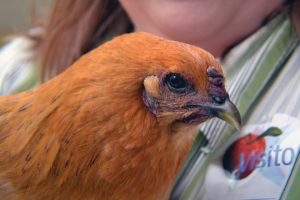
Rochester parents … if your preschool son or daughter came home from school on Monday afternoon and asked you if they could raise chickens at home, you can blame it on a rather handsome hen named Dorothy.

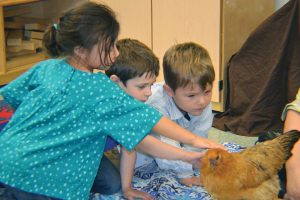
Dorothy came to Rochester Memorial School on Monday, November 6, for a little story time with the youngest of the students at RMS – and you could say that the gentle, social, and generally unaware-that-she’s-a-chicken Dorothy charmed the children right to the very heart of their giblets.

“We like to say that Dorothy is the most well-behaved chicken there is,” said Evelyn Golden, Dorothy’s beloved owner and also the Plymouth County 4-H Extension program assistant. Along with Molly Vollmer, 4-H extension director from the Plymouth County 4-H Extension, Golden brought Dorothy to RMS to introduce the students to the science of embryology before the students endeavor to incubate and hatch chicks of their own in the spring.

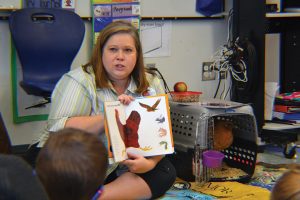
Golden read the children’s book A Chicken Followed Me Home by Robin Page – rather apropos, since that is exactly how Golden began keeping chickens.

The book mesmerized the kids with fun facts about the ‘familiar fowl’ and introduced the topic of embryology, explaining the life cycle of the chicken from egg fertilization, the 21 days of incubation, all the way through to adulthood.

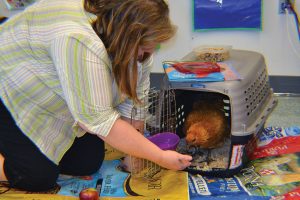
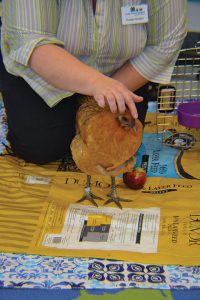
Golden then took a handful of seeds and slowly coaxed Dorothy out of her crate where she had been waiting, nestled comfortably in the warmth of her wood shavings. But Dorothy was still content from her last feeding on one of her favorite snacks, an apple, so Golden gently picked her up and placed Dorothy on the floor (atop a plastic protective barrier, of course) in front of the youngsters. Above the ‘oohs’ and ‘aws,’ one could hear the sound of little hearts melting.

“Not all chickens can handle a crowd like this, so Dorothy is pretty special,” said Golden. “She likes children and people, but I think that’s because she doesn’t know she’s a chicken.”

But don’t tell Dorothy.

Half of the time, Golden says Dorothy might actually think she’s a human; the other half of the time, she acts as if she were part chicken/part dog. Either way, Dorothy is one chillaxed individual. So, how chillaxed is she?

“Last year during the 4-H fair, Dorothy was so relaxed that she laid an egg right in my lap. That’s how chill and relaxed she is,” said Golden.

Thus, Dorothy is the perfect poster hen for spreading the joy of raising chickens to kids.

Not only was this the first time RMS has ever welcomed a chicken for story time, but this was Dorothy’s very own first visit to a school – and during a follow-up interview, when asked if she would like to visit a school again, Dorothy said nothing would delight her more.

“We’ve never had a real chicken in here before,” said Project Grow teacher Cindy Baronas. Only one student in class raised his hand when the teacher asked if anyone had chickens at home. Half the rest said no, and the other half said “not yet.” But if Dorothy has her way, RMS parents will cave to the request of their kids to keep chickens – if not for the sheer fun of it alone as the kids perceive it, but for the farm fresh eggs. (After all, one hen can lay up to around five eggs per week. With five hens on your yard, that’s a lot of omelets.)

So, perhaps it’s not a question of which came first, the chicken or the egg, but rather which one is the most treasured part of keeping chickens, the affection or the nutrition – the chicken or the egg?

If your little one expresses an interest in animals, including chickens, and would benefit from a youth development program that teaches about leadership, citizenship, and life skills, 4-H can offer a hands-on approach to learning in addition to providing opportunities to make new friends, learn from an adult leader, and gain exposure to things like animals, crafts, sewing, science, fishing, and the environment.

RMS kindergarten teacher Melissa Weigel leads a local 4-H group based out of the First Congregational Church of Rochester known as “Tails n’ Trails,” now in its third year. The group recently won 1st place in Plymouth County for its window display, now on display at RMS. For more information on local 4-H groups, contact the Plymouth County 4-H office at 781-293-3541.

By Jean Perry