Sunday was the morning of the annual Turkey Trot 5K in the center of Marion. Yes, it was rainy and windy, but the 80 turkeys (we mean participants) that showed up anyway still enjoyed the scenic village trot. Photos by Glenn C. Silva

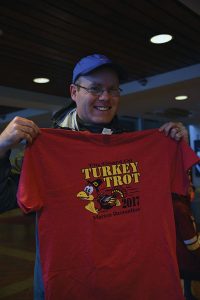












Sunday was the morning of the annual Turkey Trot 5K in the center of Marion. Yes, it was rainy and windy, but the 80 turkeys (we mean participants) that showed up anyway still enjoyed the scenic village trot. Photos by Glenn C. Silva
The following students were named to the 1st Quarter Honor Roll at Upper Cape Cod Regional Technical School:
– Grade 11 High Honors: Delaney Gosse of Marion
– Grade 11 Honors: Christopher Rogers of Marion
– Grade 12 Honors: Christopher Parisi of Marion
Get outside and take a Sunday Stroll with the Buzzards Bay Coalition and Southcoast Health at Doggett’s Brook Recreational Area (55 Dexter Lane, Rochester) on December 3 at 10:00 am. During this leisurely one-hour walk through the woods alongside Doggett’s Brook, you’ll get some fresh air and exercise while learning how to maintain a healthy, active lifestyle.
In addition to the walk, the Southcoast Health Wellness Van will be available to provide free health screenings for participants and members of the public.
Sunday Strolls are a monthly series of free mid-morning walks led by a Buzzards Bay Coalition environmental educator and health professionals from Southcoast Health. The next Sunday Stroll will take place on January 7 at the Lyman Reserve in Wareham.
To RSVP for this walk, visit www.savebuzzardsbay.org/events/sunday-stroll-doggetts-brook-recreational-area-dec-03-2017/ or contact the Buzzards Bay Coalition at 508-999-6363 ext. 219.
If you are aiming big this holiday shopping season, your local shopkeepers, who also happen to be your neighbors, ask only this of you – please, start small.
Small businesses make up our local economy – the restaurants, specialty shops, markets, galleries, and boutiques – and the folks who own them are the faces of these small towns of ours that most visitors to this area become familiar with first. They are the faces you won’t find at the mall, the faces you won’t see while online shopping on the Internet.
Here we are, now at the cusp of the holiday shopping rush, and by the end of the day on Black Friday and Cyber Monday we will officially be in the throes of the busiest and most important period for business owners.
But what does that look like on the local level?
When you choose to do your holiday shopping in the local stores that line the quaint streets of Tri-Town, you’re doing more than spending money – you’re seeing neighbors, interacting with the people of the community – the ones whose kids go to school with yours, the ones you attend church with, the ones whose businesses make our towns truly unique.
Not so much when you hit the big box stores or the mall or add items to the virtual “cart” on your computer screen.
If you spend your money on gifts this year in local stores, you will personally contribute to the prosperity of your community, while buying your gifts at big box or online stores (although more convenient and perhaps a bit less expensive) translates into a simple transfer of cash from your wallet to some far away retailer.
Essentially, when you give a gift from a local shop, you really are giving two gifts at the same time – one to the recipient and one to the local families of your local businesses.
Studies find that local businesses recirculate a greater share of every dollar back into the communities in which they serve.
Money that is spent locally is re-spent locally.
According to the Michigan State University Center for Community and Economic Development, for every $100 spent locally, $73 stays in the local economy – local taxes, wages, social investments in the community, donations, supplies purchased by other local businesses. When that same $100 is spent at a non-locally owned company, only about $43 stays in the community, with $57 leaving the local economy.
Local shops invest in their communities through charitable donations (and if you have ever attended any one of the major community events in Tri-Town, that is abundantly clear), much more than the physical, big box stores or the online ones.
According to the Institute for Self-Reliance, locally owned businesses nationwide donated roughly $4,000 per $1 million in sales, while a mega-business like Wal-Mart donated just $1,000 per $1 million in sales.
This weekend, nestled between Black Friday and Cyber Monday, is the more socially conscious alternative day of thoughtful spending – Small Business Saturday. The spirit of Small Business Saturday is simple – connect with your community, contribute to the local economy, pick out meaningful gifts and actually touch them, see them with your own eyes, and maybe have them gift-wrapped.
It’s also about sharing in the experience of walking into one of the community’s one-of-a-kind shops – the scents, the twinkling lights, the cozy, eclectic, or holiday style atmosphere that someone curated and created especially for you to enjoy.
Local Mattapoisett business owner Louise Rogers says that is precisely what she and her gallery associates strive to offer– a unique environment to shop for special, hand-picked gifts while experiencing the joy of the holiday season.
Shopping local is personalized, says Rogers. So much thought is put into giving the shopper an experience that makes them feel connected to the community, a part of something.
“We always try to remind people that we’re here,” said Rogers. “People tend to start out at the malls, and then they end up here and then they say, ‘I should have started here, you have everything that I needed.’”
“It maintains the fabric of the town,” said local sales associate Carole Rogers. And when buying a gift for someone that is truly special, one needs to see it, touch it, connect with it in a way that one cannot while staring at a computer screen.
Louise Rogers has been doing the local business thing for 40 years now – providing the kind of service and items that the big box stores can’t. Remember to shop locally this year, she says. “Because all our local stores need it.”
“You need us, and we need you,” said Rogers. It’s a classic example of a happy symbiosis.
And don’t forget, it’s the local businesses that advertise in your community weekly newspaper The Wanderer. They are the local sponsors of the local news you receive every week. It’s safe to say, without our local businesses there would be no local newspaper.
Commit this year to buying at least one gift at a local shop. Thumb through The Wanderer at the many unique, locally owned businesses. Tell them you saw their ad in The Wanderer, and give this holiday season by giving back to your local townspeople who help make this area as unique as it is.
By Jean Perry
Turkey FOG – it’s not that supposed tryptophan-induced Thanksgiving post-dinner coma that you, Grandpa, and everybody experiences after a heaping plate (or two) of a turkey-with-all-the-trimmings meal. That kind of turkey ‘fog’ can be remedied with a nap followed by a sweet slice of pecan pie to ground you back into your body.
No, this kind of turkey FOG is an acronym for the less-than-savory byproduct of a home-cooked Thanksgiving meal. This FOG includes, but is not limited to, the turkey, the drippings in the gravy, the buttery mashed potatoes and, if your family prefers the cheerful more contemporary version of a Thanksgiving turkey, the oil used to fry it in.
This is the story of FOG – fat, oil, and grease – and its destructive journey down your drain and through the sewage system.
FOG has made headlines in some places recently. Take London, for example. Enormous monster globs of FOG weighing tons are clogging up the pipelines and costing equally enormous globs of cash to mitigate. These FOG globs now have an actual name: fatbergs.
OK, so there are no official fatberg sightings in Marion or in Mattapoisett where a portion of residents receive municipal sewer service from the Fairhaven wastewater treatment facility. But FOG is still an issue, and it’s one that holidays like Thanksgiving and Christmas can exacerbate with every other house cooking a turkey with gobs of gravy and all the other buttery, fatty, greasy delights.
From pouring turkey fat down the drain, to rinsing off greasy pots, pans, and plates in the sink, to even flushing old leftovers down the toilet – all of this contributes to FOG causing extra wear and tear on grinder pumps and clogging up the sewer lines with fat, oil, and grease and wreaking havoc in municipal sewer systems everywhere. In the United States, in fact, it accounts for 47 percent of the 32,000 sewer overflows every year.
Frank Cooper is Marion’s wastewater treatment plant supervisor, and he is an experienced FOG mitigator in his off-duty time. He says, although Thanksgiving (and Christmas) isn’t solely responsible for any immediate and observable uptick in FOG in the sewage system, all those turkeys and all that greasy gravy surely contribute to wastewater woe.
“There’s always grease,” says Cooper. “There’s always that kind of thing that’s a concern to us. It’s something that can be mitigated, but not eliminated.”
Cooper knows exactly what FOG can do to sewer pipes and grinder pumps, having had many years’ experience in the field of wastewater management, even long before he joined Marion.
Cooper lives in Mattapoisett, and while he is at home away from the wastewater treatment facility he runs, his respect for the system and how it works governs how he himself uses sewer service at home.
First, he never lets the grease run down the drain.
“If I fry in a pan, after it cools I take a paper towel and wipe it up and I throw it away in the trash,” he said. “You actively remove the grease before it goes down the drain.”
Bacon, steak… You can’t avoid that stuff entirely, but the bacon grease and steak fat – and Thanksgiving turkey oils – travel from your house where it meets up with your neighbor’s FOG and your neighbor’s neighbors’ FOG. Add all that in with the rest of the actual waste that belongs in the sewer line, including toilet paper but excluding pretty much everything else (including so-called ‘flushable’ wipes, another wastewater article topic entirely), it all mixes together and binds itself with FOG, making one big nasty mess.
In Marion, Cooper and his staff use different ways to emulsify or mitigate FOG in the lines. The preferred method is through the use of biology, employing trillions of microscopic bacteria to munch on and break down FOG buildup.
“We run a hose down the pipes to try to clean them out,” said Cooper. “Stuff gets bound up in grease, and now you’ve got a large slug of grease and materials all bound up and trying to get through a pump.”
At the wastewater treatment plant itself, there are further modes of mitigation of FOG to collect it and separate it from the clear water that will eventually flow to the outfall.
We know, all this wastewater talk isn’t exactly the most appetizing of topics leading up to the Thanksgiving Day feast, but wastewater, historically, isn’t the most soothing subject just before a town meeting, either. Wastewater treatment and sewer service costs money, and repairs add to that cost. So, ratepayers – you users of municipal sewer – the FOG begins with you, and it can stop with you.
Now, back to that Thanksgiving turkey…
“Let’s look at the meal itself. If I’m cooking a turkey dinner,” says Cooper (and yes, he has done that), you’re making gravy from the drippings.” After that, he added, “Even when people are done eating, you’ve got plates with a lot of grease on it.”
What does the responsible one do with that? They consciously reduce their FOG contribution. They soak the grease up with paper towels and toss them into the trash before washing the plates and dishes – with a non-powder dish detergent, by the way. Cooper said powder soap wreaks havoc on sewer lines, acting much like grease when it doesn’t fully dissolve before it goes down the drain.
One can also locate a local organization that welcomes used frying oil and recycles it into biofuel.
“When you make your mashed potatoes, let’s face it,” said Cooper. “There’s going to be some butter in there.”
And that spells F-O-G.
Over in Fairhaven, DPW Superintendent Vincent Furtado said pretty much the same as Cooper in Marion when it came to FOG concerns.
“Typically, even though there’s a lot of turkeys cooking at the same time, the plant has no issue handling grease generated from households,” Furtado said. “The only grease issues that we ever have in town do not occur at the treatment facility, but rather in the collection system where a sewer line will get blocked up from grease…” Especially from restaurants that cook with a lot of oils, he said.
But wait, you have a septic system so you don’t have to worry about dumping your drippings down the drain? False.
Much like a municipal system, your septic system is designed to break down waste and toilet paper, and not much else. FOGs can still accumulate precisely because it cannot be broken down. What’s more, the fat, oil, and grease build up in your plumbing and sewer line to the septic tank, potentially causing blockages before the grease even makes it to your septic tank.
We usually start things out by pouring fats and oils down the drain with warm water, but when the liquid cools, the grease and fats become a hardened mass.
The equation is simple, really: FOG + sewage waste = fatbergs
So, this Thanksgiving, when you’re pouring that glorious gravy and watching it flow down into mashed potato mountain valleys, stop for a second and think about FOG – fat, oils, and grease – and what you can do to keep it where it belongs … in your arteries, not in the sewer pipes.
By Jean Perry
On April 1, 2018, businesses may begin to apply for licenses to operate recreational marijuana establishments in cities and towns throughout the Commonwealth. On November 20, 2017, a mere six months from that date, the Mattapoisett Planning Board along with Police Chief Mary Lyons, Public Health Nurse Amanda Stone, and Town Administrator Michael Gagne, as well as members of the community heard the straight news – time is running out for local regulation of recreational marijuana.
Katherine Laughman, an attorney with Kopelman and Paige, the town’s legal counsel, gave an in-depth presentation on the current state regulatory processes of medical marijuana and more importantly, what cities and towns can expect of statewide regulations after the April 1, 2018 roll out.
If cities and towns do not have bylaws in place by then, their right to regulate recreational marijuana activities at the local level will have gone up in smoke.
Laughman explained that zoning bylaws may be implemented along with prohibition(s), but such rules would require a town meeting vote. With Mattapoisett’s Fall Special Town Meeting scheduled for Monday, November 28, Laughman suggested holding another special town meeting after the first of the year solely asking for a moratorium on recreational marijuana business activities.
Lyons advocated for a moratorium, airing her concerns that center around the sale of recreational marijuana, a “cash only business,” making retail establishments prime targets for crime. She said that with the proximity of Interstate 195, criminals would have a quick getaway route. “Nothing’s saying someone isn’t already looking where they can put one near 195,” Lyons said. “They’re going to go where they can.”
During the statewide elections in 2016, Mattapoisett voted ‘No’ on Question 4 that ultimately legalized recreational marijuana use in Massachusetts, but by a very slim margin. Board member Nathan Ketchell pointed out that it was 2,200 opposed, 2,073 in favor.
Planning Board Chairman Tom Tucker said, “If someone was on the fence about whether or not to allow it, hearing from Chief Lyons may tip them towards a moratorium.”
Board members felt that residents who voted for legalization may have only been thinking about personal cultivation and use versus commercial sale, cultivation, and manufacturing within the township. With a public discussion, the board hopes to spark-up the conversation in an effort to determine exactly what the majority in the town wants.
Beyond a short-term moratorium, options as described by Laughman include local bylaws that might ban or place restrictions on “time, place, and manner” of marijuana sales. She said in the absence of local regulations, state requirements would be fully implemented. But with a moratorium in place, the town would have more time to weigh options.
Gagne said a panel that included the Board of Health, Board of Selectmen, public health nurse, and Police and Fire Department representatives was important to helping residents understand the full implications of recreational marijuana sales.
“The town has a character, an image,” said Gagne, noting that the intensity and scale of what might come into the town could be problematic.
The next Planning Board meeting is scheduled for Monday, December 4, at 7:00 pm with the venue to be announced. The public is urged to attend and participate in this critical conversation.
“If it’s important to them, they will come,” said Tucker, as some wondered if the holiday timing might impede community participation.
Other business handled on this night was a vote by the Planning Board to support acceptance of parts of Reservation Road and Goodspeed Island Road for Phase 1B of the Mattapoisett multi-use recreational path, a.k.a. bike path, for improvements mandated by the Massachusetts Department of Transportation, and Perkins Lane off Harbor Road for a sewer easement.
The next meeting of the Mattapoisett Planning Board is scheduled for December 4 at 7:00 pm at a venue to be announced.
Mattapoisett Planning Board
By Marilou Newell
Name: Micah Kidney
Age: 43
Lives in: Rochester
What he does: ORRHS math teacher and Gateway Gladiators ice hockey head coach
How he got here: Originally from Dennis, Massachusetts, he moved to Vermont and taught math for 13 years, joined the military in 2003, and then moved back to the region after returning from a military deployment to Afghanistan in 2010.
An Exceptional and Unregrettable Path…
By Jean Perry
When you think about all the possible roads one could take in life, there is a whole separate list of particularly challenging professional paths that only those with a distinct dedication and daring decide to venture down.
Micah Kidney has chosen to walk not only one such path in life, but two of the most challenging and also vital roles – soldier and teacher.
Kidney is most recognized in Tri-Town in his role as math teacher at Old Rochester Regional High School for the last seven years, but the United States Armed Forces just this month recognized the U.S. Army Rangers Major and HHC Commander of the 86th Mountain Infantry Brigade for his exceptional service and leadership as commander of the Mountain Brigade Combat Team and presented him the esteemed Meritorious Service Medal.
For most Americans, the events of September 11, 2001 changed everything. Kidney wanted to join the military right away, but a physical problem with his left eye delayed the start of that journey down the road of defending the country. It took him a year and a half, actually, and a little assistance from a Vermont senator who petitioned for Kidney’s acceptance on his behalf.
Kidney joined the U.S. Army Rangers based near Mount Mansfield, the highest mountain peak in Vermont, serving in the last mountain qualified unit in the entire Army.
“I love the mission because we do rock climbing and rescue,” said Kidney. “I decided to stay for the rest of my career.”
During this time, Micah continued to teach math in Vermont for 13 years before he moved back to Massachusetts and started teaching at ORR.
Later he spent 14 months in the Afghanistan mountains of Jahi Valley near the Pakistan border, “Interestingly enough, I was deployed to the valley where Osama bin Laden was captured,” Kidney said.
For Kidney’s wife Heather and their four children, it can be difficult with Kidney away so often – for a cumulative four out of the last 15 years, in fact, Kidney said.
“My family has been super supportive,” Kidney said. “My wife, she’s been a trooper, always supporting her husband, and she’s always been super supportive of my love for this country.”
Kidney’s kids now range in age from 12 to 20, and when it came time to announce that Kidney would be the recipient of the Meritorious Service Award this year, ”They knew it was a big deal from the look of surprise on my face,” said Kidney.
Here is the deal, according to Kidney. If you do a decent job you get the opportunity to command a company. Well, Kidney has now thrice served as commander, which alone speaks to his superiors’ confidence in his capabilities.
The way the medal is awarded, said Kidney, is that the recommendation has to be made by a colonel and then approved and signed off on by a general, of which there are only two in Vermont.
“It was definitely unexpected,” said Kidney. “The only other time I’ve ever seen it awarded was the end of a 30-year career.”
The Math Department at ORR wasn’t about to let this event go by quietly unnoticed by the community, either, although Kidney wasn’t inclined to announce the recognition he had received. It’s hard for him to stand in the spotlight for a duty he has committed himself to selflessly.
“Attention, for most soldiers, is hard,” Kidney admitted. “We have a hard time when there’s any attention shined back at us.”
Major Kidney is still a member of the Vermont National Guard, travelling twice a month to his northern Vermont military reservation, with the full support of his wife and kids.
“The thing that I am most proud of is that I had the privilege of serving with so many heroes. Our unit spent a year in the most violent and least free place on the planet deep in Taliban country. Some of my closest friends didn’t make it home, but the American soldiers that I served with continued to fight for each other every single day with honor, selflessness, and true valor,” Kidney said.
“Throughout the last 15 years of my time in the service, throughout all of the challenges involved with being an Army Ranger and serving in a high tempo unit, I haven’t regretted a single moment. I have truly loved every second of my military career, and I love being able to say that I served my country to the extent that I have.”
The following is a timeline of Kidney’s ongoing military career:
2003-2005 – Platoon Leader – Alpha Company/3rd Battalion of the 372nd Mountain Infantry, Camp Ethan Allen, Jericho, VT
2005-2007 – Scout Platoon Leader – Headquarters/3rd Battalion of the 372nd Mountain Infantry, Camp Ethan Allen, Jericho, VT
2007-2009 – Detachment One Commander/3rd Battalion of the 372nd Mountain Infantry, Camp Ethan Allen, Jericho, VT
2009-2011 – Executive Officer (2nd in command) during deployment to Jaji, Afghanistan in support of Operation Enduring Freedom (OEF2010) – Alpha Company/3rd Battalion of the 372nd Mountain Infantry, Combat Outpost Herrera, Paktia, Eastern Afghanistan
2011-2014 – Commander – Alpha Company/ 3rd Battalion of the 372nd Mountain Infantry-Camp Ethan Allen, Jericho, VT
2014-2017 – Commander – Headquarters Company 86th Mountain Infantry Brigade, Camp Ethan Allen, Jericho, VT

To the Editor:
On behalf of the grateful senior citizens of Mattapoisett, I would like to thank all of the students and faculty members who made the Thanksgiving dinner on Sunday such a success. This is the first one I have ever missed. I am ill with bronchial pneumonia.
Jacqueline Coucci, Director of the Mattapoisett Senior Center, was kind enough to deliver me a meal. I cannot begin to tell you how much all of your hard work is appreciated.
I felt so badly that I was not able to attend. I certainly enjoyed the fantastic meal.
My husband, Richard Langhoff, driver of the Mattapoisett Senior Van, was even lucky enough to win a door prize – a huge apple pie.
Again thank you to all.
May you all have a Blessed Thanksgiving.
Sincerely,
Ilona G. Langhoff
The views expressed in the “Letters to the Editor” column are not necessarily those of The Wanderer, its staff or advertisers. The Wanderer will gladly accept any and all correspondence relating to timely and pertinent issues in the great Marion, Mattapoisett and Rochester area, provided they include the author’s name, address and phone number for verification. We cannot publish anonymous, unsigned or unconfirmed submissions. The Wanderer reserves the right to edit, condense and otherwise alter submissions for purposes of clarity and/or spacing considerations. The Wanderer may choose to not run letters that thank businesses, and The Wanderer has the right to edit letters to omit business names. The Wanderer also reserves the right to deny publication of any submitted correspondence.
The Marion Art Center announces it will host a new concept show and boutique starting this Friday, November 24 and running through Wednesday, December 20, called “Small Works on the Wall.”
During this show, more than 20 artists will present unique pieces (painting, fiber art, etc.) – each no greater than 144 square inches – all hang-able and perfect for holiday gift-giving. Artwork that is sold will be taken home at the time of purchase, so new pieces are expected to arrive throughout the four-week run. In turn, visitors are encouraged to stop in more than once to view the show during its stay. Opening reception will be held on Friday, November 24 from 6:00 to 8:00 pm.
The Marion Board of Health has seen larger turnouts and received more correspondences from organizations outside Marion than it likely ever has, and it all pertains to the board’s pursuit to ban all flavored nicotine products, combustible and smokeless, including the sale of menthol cigarettes.
On November 14, Nicholas John from R Street Institute maintained that flavored nicotine dispensing products such as electronic cigarettes and ‘vaping’ products help to reduce cigarette use in adults, and he urged Marion to follow in the footsteps of other municipalities in Massachusetts and preserve the sale of flavored non-combustible nicotine products.
“[Other municipalities] have preserved the option for smokers and of those of legal age to purchase safer forms of nicotine – e-cigarettes and vapor products,” said John. For example, in Canton very recently, he said, “Canton exempted menthol and wintergreen … and other smokeless tobacco [products]. They did so because they looked at it and said ‘No. We’re going to leave cigarettes on shelves but we’re going to take the safer alternatives away and make them less accessible?’
“They saw the issue in doing that,” John said.
John said he understands the board’s desire to keep these products out of the hands of kids, but a ban would remove a number of ‘safer’ alternatives to cigarettes.
“Part of public health regulation should take into account adult smokers and encourage them to use less harmful alternatives,” said John. “I respectfully request and urge you to keep that option on the table and to consider adult smokers…”
John, a long-time smoker himself, said he was able to quit smoking through the use of an e-cigarette, “And a lot of other people who have been smoking a long time want to do the same … and should be able to do the same.”
“You take that option away from them,” said John. “To make that better decision.”
Dennis Lane from the Coalition for Responsible Retailing (CRR), a “frequent flyer” at recent BOH meetings, pointed to the board’s consistent lack of questions or comments related to information that was submitted by groups who were against the proposed ban on flavored smokeless nicotine products, including the Massachusetts Association of Minority Law Enforcement Officers who oppose a ban on menthol cigarettes due to the effect it would have on minority groups, the leading users of menthol cigarettes.
“[It] suggests that you have possibly embraced the notion that these regulations won’t have their intended effect … and should be part of a reduction strategy,” Lane said, concluding by urging the board to take this flavor ban off the board’s agenda and focus on other strategies like tobacco use education and the strict enforcement of existing tobacco laws.
Lane said the CRR had sent out a mailing to all registered voters in Marion informing them on the ban the board was trying to implement, urging them to take action and sign an online petition against the ban. He said that within just a couple of hours he had received a good number of signatures in response.
“Trust the people,” said Lane, and trust the retailers. “We respectfully ask that you reject the proposed regulations.”
Board of Health member Jason Reynolds thanked all the guests for their input, but said that he was not swayed.
Articles from some journals that he has read, said Reynolds, still call into question the efficacy of e-cigarettes as a safer alternative to smoking cigarettes.
“I myself am not ready to close the issue at this time,” said Reynolds. “I still think there needs to be more…” Reynolds said he was also encouraged by some residents’ responses to the CRR’s mailing, and expressed a favorable opinion on the ban.
“We’ve actually had support from the community that looking into this idea is worthwhile, so I think we should continue with it,” said Reynolds.
According to Reynolds, there are no acceptable standards to measure nicotine delivery of electronic devices and the only approved products to help in smoking cessation are products like nicotine patches and nicotine gum.
Board of Health Chairman John Howard added that the use of prescription anti-depressants like Wellbutrin and Chantix along with a nicotine substitute is a successful protocol.
Bob Collett, director of the Cape Cod Regional Tobacco Control Program, who has been assisting the board for over a year, commended the board on its unwavering position on flavored tobacco and nicotine products and said, without citing any specific peer-review studies, that the science points to an increase in risk to menthol cigarette smokers in particular. He maintains that menthol cigarettes are more addictive, and smokers smoke more menthols than other smokers do regular cigarettes. “You become more addicted, you smoke more,” said Collett.
“This [ban] … is a nice, natural, logical step for this board to take,” Collett said. “Set an example for other towns who are waiting for this to happen so that they can be bold enough to move forward as well.”
Howard said, “This has been well talked about and a lot of listening going on up here, so – no decisions tonight.”
The next meeting of the Marion Board of Health is scheduled for November 28 at 4:30 pm at the Marion Town House.
By Jean Perry