Proposed Garage Determined Too Close

            On April 16, the Mattapoisett Zoning Board of Appeals denied the case filed by Shelley and Vincent Mondo for a Special Permit. The Mondos sought the Special Permit to construct an attached two-car garage with a great room. Further, the filing sought relief from side- and front-yard setback requirements. The property being reviewed is located at 26 Sagamore Road.

            The filing was represented by Andy Stackpole of Field Engineering, who described the request as being rather common for the Antassawamock Beach neighborhood. But the board was not convinced that other design options were not found, leaving the submitted design the only option.

            Several times during the hearing board members murmured that there wasn’t a hardship and that abutters had to be taken into consideration. ZBA members Aaron Goldberg, Tony Tranfaglia and Chair Susan Akin were like minded in their assertion that the design simply put the proposed garage and porch were too close to the abutter in question and that there really wasn’t a hardship. The Special Permit was denied.

            A Variance filed by Marcous Baptiste, 17 Shore View Avenue, for the construction of a new single-family home was withdrawn.

            A Special Permit was granted to Neil and Cynthia Musante, 4 Dyar Road, for reconstruction of a roof overhang.

            Returning to the board on this night was the Special Permit request filed by Patrick and Sharon Costello for the construction of a new single-family home featuring one-level living. The case received permitting.

            The next meeting of the Mattapoisett Zoning Board of Appeals is planned for May 14.

Mattapoisett Board of Appeals

By Marilou Newell
Non-Partisan Candidate Event

An informal meet and greet for Mattapoisett voters and candidates will be held Wednesday May 6, 5:30 pm to 7:30 pm, at the Knights of Columbus Hall, 57 Fairhaven Road. All are invited.

            This event has no podium or speeches. Community-minded individuals, board and committee members may appreciate an informal, non-partisan opportunity to meet the candidates and discuss local issues of concern.

            The meet and greet is organized by Bonne DeSousa, a community- minded, politically independent voter who has lived in Mattapoisett since 2002. This year’s six-person race for three seats on the new five-person Selectboard is an unprecedented opportunity for our community and local government. Candidates for any office who would like a table set up for them please email bdesousa43@comcast.net by May 4.

Friends of Mattapoisett Bike Path

The Friends of the Mattapoisett Bicycle and Recreational Path are hosting an Open House at the American Legion Post 280, 7 Depot Street, Mattapoisett, on May 2, from 9:00 am to 4:00 pm.

            Board members of the Friends will be at the facility to discuss the future of the rail trail and our programs. Come see us. Restrooms will be open to all.

ORRHS Students Participate in Third Annual Credit for Life Fair

Old Rochester Regional High School students recently received a hands-on lesson in financial literacy at the school’s third annual Credit for Life Fair.

            Juniors gathered in the auditorium on Tuesday, April 7 on the “5 Habits of Financial Wellness” and the Financial Fit Program. Seniors attended a similar presentation before participating in the Credit for Life Fair in the cafeteria on Friday, April 10.

            During the fair, students chose professions and were assigned monthly take-home salaries. They then navigated online checkpoints to either accumulate savings or make hypothetical purchases using imaginary cash or credit.

            The Credit for Life Fair is held in light of 2019 findings by the Barr Foundation showing that 86% of high school students say the most important skill they need after graduation is an understanding of personal finance, while only 30% believe their schools are preparing them on this topic.

            “We recognize the important roles that financial literacy and independence play in a student’s success as they transition out of high school,” said Superintendent Michael S. Nelson. “Events such as the Credit for Life Fair allow us to teach financial lessons in a fun and engaging way. I want to acknowledge Lauren Millette for her hard work and dedication in coordinating the fair, and Cape Cod 5 for their partnership. I also want to thank the other businesses who volunteered their time and helped make this event a success.”

            Volunteer bank representatives operated booths that provided students with insight into topics such as charitable giving, education and training, food and nutrition, health and wellness, housing costs, furniture spending, utilities, lifestyle choices, fun activities, part-time jobs, planning for the future, transportation and more, including one table devoted to prize giveaways for the event. Students had additional opportunities to win prizes by earning a Financial Fit Certificate prior to the fair, or by meeting with a budget counselor after the event.

            “For me, the Credit for Life was an incredible experience,” said senior Laila Brown. “Credit for Life influenced me and many other students how to properly manage your money in many efficient ways and made you think carefully about financial decisions. Throughout the fair, I was guided through different stages of life, where I had to budget for necessities like housing, transportation, food and unexpected expenses. It showed me how quickly money can be spent and how important it is to plan ahead and prioritize needs over wants. I also learned the basics of managing a bank account, including how to keep track of spending, not to overspend, and save responsibly. By the end of the experience, it felt good to see how my choices affected my financial situation. As a fun outcome, we were entered into a prize drawing and I was lucky enough to win a waffle maker, which made the whole experience even better.”

            Prizes were chosen to support students in their post-graduation journey. A range of helpful and entertaining items were offered, including dorm or apartment furniture and appliances, luggage, pickleball sets and shower speakers.

            “We are grateful to all of the volunteers who helped the fair run smoothly,” said Assistant Principal Millette. “The enthusiasm and expertise they shared with our students explained how to best approach their finances as they move into the next chapter of their lives.”

            The goal was for students to learn to live within a budget, learn fiscal responsibility and plan for the future, all while having fun.

            “Resources such as this fair are integral to setting our students up for success,” said Principal Michael Devoll. “The conversations that happen at the Credit for Life Fair empower our students to make informed decisions as they take control of their finances. In the three years we’ve held this event, students always leave the fair with a better understanding of fiscal responsibility.”

Thoughts on… Red Noses, Floppy Shoes and Modernization

            After a nine-year hiatus, the circus is back in town. Well not our town. The field near my backyard where it once visited now houses a funeral home, condominiums, and the police station. Instead, it stops at cities around New England and points west. The famous Ringling Brothers, Barnum and Bailey Circus is now called just Ringling. They stopped performing in 2017 after 146 years.

            Ownership said operating costs were high, audiences were growing smaller, and pressure from animal rights groups made it difficult to put on a proper show. So, they folded their tents (Actually, they hadn’t used tents in years, instead performing in vast arenas. I imagine the basketball and concert fans were glad to see them leave because it has been reported that the smell of the elephants left an unpleasant aroma behind for weeks).

            One of my favorite memories as a kid was when I would wake up in the morning to the sounds of the elephants trumpeting. Thanks to the generosity of the circus’s band leader, who stopped into my dad’s barber shop for a haircut, I got free tickets and the run of the grounds, meeting the performers and watching them rehearse. My favorite parts were the clowns. To this day I cherish those memories.

            According to Ringling’s website, management decided to “modernize”, to “re-imagine the circus”, and focus on “authentic human personalities” and avoid “pop-culture” tastes. They moved away from “corny, traditional tropes.” Hey, what’s wrong with tradition and what’s a trope anyway?

            Tradition is the circus arriving in town on a train or on trucks. Children and their parents would line the streets to watch the elephants and clowns marching to the fairgrounds in anticipation of a fun afternoon or evening of excitement and laughs.

            Alas, the “Greatest Show on Earth” is not so great as it once was. The new version has no elephants, no lions, no tigers, no dancing bears, no prancing ponies… no animals. They don’t even have a ringmaster or a live band. And no clowns! That’s right, no clowns.

            I can see getting away with eliminating wild animals, they were often abused. Living in small cages is no way for a wild animal to live. But clowns! Really? They also felt that clowns were creepy hiding behind heavy make-up, a stereotype associated with horror, and “scary”. What? Thanks Stephen King!

            Where are these hard-working funny folks supposed to go? Are they expected to pack up their red noses, giant shoes and tiny cars and move to Washington?

            Fear not, clowns are not going away. The World Clown Association held their annual convention in Boston this past March. (Imagine thousands of clowns roaming the streets of our state’s capitol city.) The top banana of the group visited nearby New Bedford, which is surprisingly, a mecca for clowns, and I don’t mean the city’s politicians. There is actually a clown school there. Really.

            If you are not afraid of clowns (coulrophobia) and have a love of clowns (a crurophilia) and have a desire to yuk-it-up, be silly and goofy just for the fun of it, you can enroll at the not-for-profit Smile Factory, which trains clowns for performances at hospitals, parties, schools and a three-ring-circus of other events… but not the Ringling Circus.

            Call me corny, but I say bring in the Clowns.

By Dick Morgado

            Mattapoisett resident Dick Morgado is an artist and happily retired writer. His newspaper columns appeared for many years in daily newspapers around Boston.

EPA Bottleneck Slows Pathway

Marion’s long-awaited recreational pathway has hit some minor snags but has moved forward on some issues.

            Pathways Committee Chair John Rockwell reported at the April 15 meeting, held at the Music Hall meeting room, that the March Special Town Meeting for a land swap with the town was approved and is now before the Massachusetts Legislature. However, an environmental firm appointed by the state Environmental Protection Agency has reported that it will not be able to conduct the report in a timely manner, which could delay the August 15 construction of the pathway.

            Other than that bad news, all aspects of the pathway project are moving along. Rockwell reported to committee members that the land swap, which requires 3,000 feet of Washburn Park to the committee, is now before the legislature for approval.

            The town held a Special Town Meeting last month instead waiting for the Annual Town Meeting in May to keep the project on schedule.

            Rockwell said the Massachusetts Department of Transportation has also conducted its critique of the project, with mostly minor issues such as the location of the path before a telephone pole as people from Spring Street cross to Front Street.

            Rockwell said the DOT is deliberating over some of the issues that were marked “with red ink” in the hopes of modifying the path to meet current safety and other guidelines.

            Rockwell said the project survey team has completed its work.

            The chair said the committee still awaits some funding, including a grant for an appraisal and for easements, which need an extension and will go before voters at the May Town Meeting.

            According to the Pathway Committee, the 3.8-mile, proposed pathway is designed for bicycling, walking and jogging. It would start around Point Street and end at the Mattapoisett line. The project calls on converting an abandoned former railroad trolley bed.

            The next meeting of the Marion Pathways Committee was not scheduled at adjournment.

Marion Pathways Committee

By Jeffrey D. Wagner

A Year of Fighting

            This week in Revolutionary War history, let’s check up on what was going on 250 years ago in New England and the northern Thirteen Colonies. Last week, General Washington and a long column of thousands of Continental Army soldiers finally arrived in New York City. The general would set up a temporary headquarters in lower Manhattan, 1 Broadway. From here, he prepares to inspect and strengthen defenses of the city.

            April 19, 1776 is the first anniversary of the Battles of Lexington and Concord. Therefore, the American Revolution had been raging, in its “hot” form, for a year. Patriots Day was this past Monday, and it commemorates the battles and the “shot heard round the world.” The holiday is not a federal one and is observed as a state holiday by Massachusetts and Maine.

            Back to 1776, Washington begins his General Orders for the day with “Parole Lexington,” choosing the town as the day’s password for guards and sentries. However, it is not evident that much more is done to highlight the anniversary. Washington instead writes to President of the Continental Congress John Hancock, urging the congress to act quickly in pressuring Native American tribes. He writes, “In my opinion it will be impossible to keep them in a state of neutrality – they must, and no doubt soon will, take an active part, either for or against us, and I submit it to the consideration of Congress whether it would not be best immediately to engage them on our side, and to use our utmost endeavors to prevent their minds being poisoned by ministerial emissaries, which will ever be the case while a King’s garrison is suffered to remain in their country.”

            With that, Washington is signifying to Congress to quickly press native groups to join the Continental’s ranks and also potentially suppress/outmaneuver (by what means, one can imagine) those that could ally the British. He also again highlights the importance of Canada, though doesn’t recommend a large-scale conquest of it, saying, “The security of that country is of the utmost importance to us, this cannot be done so effectually by conquest as by taking stronghold of the affections and confidence of the Inhabitants.”

            The next day, Washington writes to the New York Committee of Safety asking the body what measures are in place should British warships appear on the horizon. Along with requesting the manner in which 2000-2500 militiamen could be raised for such an instance, he asks for information on and men be stationed at “good lookouts on the heights and head lands at the harbor.” He also asks for signals to be developed and agreed upon across neighboring towns. Though not quite a beacon system like Byzantium or Gondor, he also asks for greater cooperation and understanding from New Jersey.

            That same day, as is the theme of the conflict, General Washington writes to Governor Jonathan Trumbull in Lebanon, Connecticut. He writes of the “the state of our ammunition,” saying, “I find we are greatly deficient in the article of ball, and as I understand a large quantity of lead has been manufactured at Middletown in your government.” Connecticut has recently increased production of war-time materials, while also receiving the pirated bounty of powder from Nassau. On that, he ends the letter, “P.S. As the quantity of powder here is much smaller than I expected, and the demand from Canada greater, I should be obliged to you if you would inform me how that has been disposed of which was said to be imported lately into your government on Continental account.”

            As Washington continues to be disappointed by the state he finds New York and Colonel Henry Knox continues to be delayed on his trudge from Boston with all the army’s artillery, on April 22 to the south, the Cumberland County Committee for Safety in Virginia drafts a declaration of sorts. Member Carter Henry Harrison reads it allowed on the steps of Effingham Tavern. To the people gathered, he calls on Virginia and the other colonies to “‘abjure any allegiance to his Brittannic Majesty and bid him a goodnight forever.”

            Similarly, further to the south, on April 23, the South Carolina Grand Jury in Charlestown issues “Presentments,” or arguments against the Crown and in favor of independence. It begins, “When by evil machinations tending to nothing left than absolute tyranny, trials by jury have been discontinued: and juries in discharge of their duty have assembled, and as soon met as silently and arbitrarily dismissed without being impaneled…” It goes on to state the Magna Carta has been breached, and in order to avoid anarchy, “a new continuation of government, independent of royal authority” is necessary.

            Slowly but surely, the war taking place is evolving from what was thought of as a civil war between subjects of King George III towards a war for independence, where by British subjects in the Thirteen Colonies are looking for separation. These acts by smaller town bodies are emboldening and inspiring voices in Philadelphia; especially those keen to write.

This Week in Revolutionary War History

By Sam Bishop

Sippican Choral Society to Celebrate “The Glory of Spring”

Join Sippican Choral Society in celebration of “The Glory of Spring” on Sunday, May 3 at 4:00 pm, at Wickenden Chapel, Tabor Academy. The featured work of this annual concert will be Antonio Vivaldi’s “Gloria,” one of sacred music’s most uplifting choral works, with solos by local singers Karen Antonsen-Devoe of Marion and Patrice Tiedemann of New Bedford. Other highlights of the program include selections from Haydn, Alice Harper, and Dan Forrest, together with the rousing sounds of “Down by the Riverside” and the humor of Gilbert and Sullivan. Ticket information can be found at sippicanchoralsociety.org.

From the Marion Town Clerk’s Office

It’s that time of year again when we find our Annual Town Meeting and Annual Town Election right around the corner. Here are some important dates for Marion town residents.

            On Wednesday, April 29, Ballot Machine Testing will occur in the Town Clerk’s Office at 10:00 am and Warrant Review will be held at the Marion Music Hall Located at 164 Front St, starting at 6:00 pm.

            Important dates: Friday, May 1, last day to register to vote. Thursday, May 7, first day of in person early voting. Monday, May 11, Annual Town Meeting at Sippican School Auditorium, start time: 6:00 pm (doors will open at 5:30 pm). Thursday, May 14, at 12:00 pm noon, last day for in person early voting. May 15, Annual Town Election from 8:00 am to 8:00 pm at the Benjamin D. Cushing Community Center.

            Vote by mail, vote by mail accessible, and absentee voter applications are available outside the Town Clerk’s office. All applications must reach the Clerk’s Office by noon on Friday, May 8.

            New this year, we will be introducing our new Polling Pads in an effort to streamline the check-in process for both Town Meeting and Town Election. Voters will now check in by Last Name vs Street Name. A driver’s license is not required but will expedite the check in process by means of a quick scan of the license bar code.

From the Files of the Rochester Historical Society

The Rochester Historical Society in collaboration with the Rochester Historical Commission are continuing with their project to make as many of our Revolutionary soldiers and sailors more than just names on a list. Any help with this would be greatly appreciated.

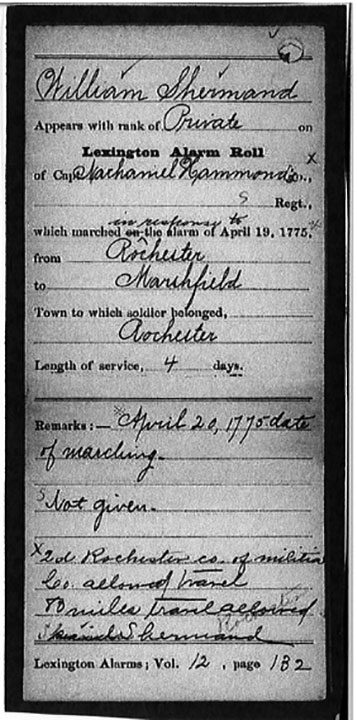
            While the muster cards and pension records tell the story of their service in the fight for independence from England, there are additional resources to further flesh out their lives. Shown here is a muster card for William Shermand (sic) which is really that of William Sherman about whom I have previously written.

            As regular readers know, I enjoy receiving responses to my articles. I was excited to hear from Cornelia Dougall. William Sherman, born in 1726 and dying in 1800, was her 5th great grand uncle. Through her ancestry searches, she had more information about him outside of his militia duties.

            His family (and hers) became Rochester residents in 1715 when John B. Sherman and Sarah Baker Sherman settled in Rochester on 80 acres granted to his father in 1697. Shermans can still be found on Snipatuit Rd. today.

            William married Abigail Handy in Sandwich on June 4, 1752. The couple had 14 children. At the time of his service, William was 49 yrs. old. His oldest child was 21 and his youngest was 1 yr. old.

            For context it is interesting to note that the average life expectancy of a male in 1775 ranged from around 36 years to 53.5 years. However, a man who reached 60 yrs. was more apt to live into his 70’s. The colonists actually had a longer average life expectancy than the average English working man.

            William responded to the Marshfield Alarm on April 19,1775, marching with his militia company under Capt. Nathaniel Hammond on April 20,1775. Marshfield was home to many loyalists (pro England) and after hearing of the colonists’ success at the battles of Concord and Lexington and the retreat of the British forces, they entreated then Commander in Boston, Gen. Thomas Gage, to send troops to protect them.

            On hearing of British troops being dispatched to Marshfield, the militias were called out. When the militia companies from across the south coast arrived, they were 2000 strong. The 100 British soldiers who had been sent there quickly departed. The militia men then returned to their homes.

            William Sherman’s muster card shows “80 miles of travel allowed” and 4 days of service. This was the only card that I found for him. Maybe the 80 mile walk for a false alarm discouraged him from future service.

            If anyone in our area knows that they have an ancestor who was a Revolutionary War soldier or sailor and doesn’t really want to research the military but has already done ancestor research, I would really appreciate it if you would share your findings with me. I can be reached at 617 750 2818 or eshbach2@aol.com. Also, reach out if you are interested in researching the veterans listed in the back of the book, “Mattapoisett and Old Rochester” that you can find at Plumb Library or on the town website under the Historical Commission.

By Connie Eshbach