Groundhog Day and a Snowy Owl

The annual observance of Groundhog Day has deep agricultural roots going back to 1887 when Pennsylvania Dutch Germanic farmers gathered to celebrate what had been an old-world religious observance called Candlemas. Candlemas was celebrated by lighting candles as a seasonal recognition of the celestial station of midwinter.

The badger was the original animal conjured up as the animated soothsayer of forecasting weather. If he saw his shadow, it was an omen of a long winter, although this interpretation has frequently been questioned as the other way around.

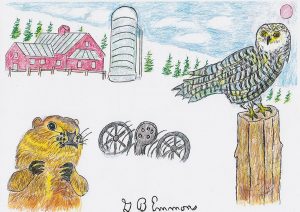
On this side of the pond, the groundhogfilled the part of the nearest indigenous species to the badger. And at this time of year, it similarly was aroused out of hibernation by a biological alarm clock to refresh itself and look around. Most of the year it was a spirit of light and shadow in a subterranean bedchamber. This is usually a two-entrance burrow, with one just a ground-level peephole for observation position without coming outside. It is usually dug into a hedgerow with a wide view of lush farm pastures and green meadows.

A dairy farm is an ideal habitat for a groundhog like the one near to my home on Sconticut Neck in Fairhaven. I have often seen them out and about early in the morning or late in the day. They frequently pause from feeding to stand up and look around as a familiar sentinel for approaching danger and between feedings. They look like a sentinel and a familiar landmark of a bucolic countryside.

However, the peace and tranquility here was about to change two weeks before Thanksgiving with the early seasonal arrival of a snowy owl.

This unscheduled appearance was not climate-driven, but caused by an artic shortage of the snowy owl’s staple diet, the lemming. Farmland somehow has a similar appearance to their native tundra with barnyard scattered grain attracting lemming-looking rodents of mice and rats. As one of the two largest owls, they will take squirrels, rabbits, ducks, and geese – or even a groundhog. This timing of the snowy owl’s appearance changes the playing field for our friend the groundhog.

The Amish’s culture of subsistence agricultural farming left them today with a unique plain living, disciplined earthly lifestyle. They often connected animals with meteoric seasons like Groundhog Day. The Yankee farmer generation similarly followed the Native Americans whose celestial almanac linked five of the moons with living creatures, and February as the snow moon. Regardless, spring will come on time during the March 20 Vernal Equinox at exactly 5:58 pm Eastern Time when light and shadow will be of equal length all over the world, passing overhead as a planetary movement turning winter to spring as we revel below.

By George B. Emmons
Winter StoryWalk Comes to Peirson Woods

Sippican Lands Trust (SLT) is featuring a Winter StoryWalk at its Peirson Woods property from February 1 to March 1in Marion. This year’s Winter StoryWalk at Peirson Woods features “Owl Moon” written by Jane Yolen and illustrated by John Schoenherr.

StoryWalk is an innovative and delightful way for children — and adults! — to enjoy reading and the outdoors at the same time. Laminated pages from a children’s book are attached to wooden stakes, which are installed along an outdoor path. As you stroll down the trail, you’re directed to the next page in the story.

Peirson Woods is a 30-acre parcel of land with woodlands and wetlands including a vibrant salt marsh. The property is home to numerous species of birds including herons, winter buffleheads, and osprey. Located at the head of Blankenship Cove, this property features a trail leading from Point Road to a viewing platform overlooking the head of the Cove. On a clear winter day, Cape Cod, Martha’s Vineyard, and the northern Elizabeth Islands can be seen.

The parking area for Peirson Woods is located just off of Point Road approximately 1.4 miles south of the intersection of Route 6 (Wareham Road) and Point Road in Marion. Parking is very limited so please be careful when parking your vehicle along Point Road.

The Winter StoryWalk at Peirson Woods will be open from sunrise to sunset starting Friday, February 1 through Friday, March 1, 2019. Adults and kids of all ages are welcome and for further information about the Winter StoryWalk at Peirson Woods visit www.sippicanlandstrust.org or call Sippican Lands Trust at 508-748-3080.

ORRJH Students of the Month

Kevin T. Brogioli, Principal of Old Rochester Regional Junior High School, announces the following Students of the Month for November 2018:

Green Team: Ava McLaughlin & Elizabeth Higgins

Orange Team: Addisyn Petrulli & Noah Sommers

Blue Team: Erin Eilertsen & James Kippenberger

Red team: Jaymison Gunschel & Anthony Marraffa

Spacial Areas: Felicity Kulak & Bruce Maksy

Constance Ann (Whittaker) Miller

Constance Ann (Whittaker) Miller died on Tuesday January 8, 2019. The youngest of three, Connie was raised in Marion, Massachusetts. She was one of the first girls ever to attend Tabor Academy in Marion. From a young age, Connie was a gifted musician and during high school was selected to attend the prestigious Tanglewood Music Summer Institute youth training program under the direction of Leonard Bernstein. Connie went on to attend Radcliffe College and the Boston Conservatory of Music. She then spent her entire professional career, which spanned more than 40 years, as a cellist for the Buffalo Philharmonic Orchestra. In her later career she also served as Artistic Administrator of the Philharmonic, selecting all of the guest performers.
Connie was deeply engaged in her community, serving for several years as the first female President of the Harvard Club of Western New York and actively competing in sculling at the West Side Rowing Club (including winning a medal at the Empire State Games). Upon her retirement in 1998, Connie returned to her hometown of Marion and enjoyed an active life, which included biking, walks on the beach, and undertaking copious amounts of yard maintenance and gardening on her own.
She loved lobster rolls, fresh fish, peppermint stick ice cream, and watching the birds outside of her sunny kitchen window. Inspired by the beauty of New England nature and childhood memories, she took up watercolor painting at the age of 75. Connie was also a lifelong advocate for animals and leaves behind her deeply loved cat, Emily.
Connie was preceded in death by her mother Constance Whittaker, her sister Elizabeth Bunnell, and her brother Edwin Whittaker. She will be lovingly remembered by her son David, her daughter Katherine, her daughter in-law Sarah, and her grandchildren Allison, Isabela, Sabine, Roman, and Henley.
A memorial service will be held on Saturday, February 16th at 10:30am in the Chapel at St. Gabriel’s Episcopal Church, 124 Front Street Marion, MA 02738. A reception will follow at Harriet’s Carriage House, 7 Cottage Street, Marion, MA. Charitable contributions may be made in Connie’s memory to the Buffalo Philharmonic Orchestra www.bpo.org or the ASPCA www.aspca.org.

Eight Continuances Makes for a Short Meeting

On January 28, as three members of the Mattapoisett Conservation Commission prepared to hear two cases, it was clear from the agenda that it could have been a long meeting. But with eight cases on the agenda being continued until February 11, those two remaining cases were quickly dispatched.

The two cases in question had already been before the commission during the previous meeting. However, because the engineering office handling those two cases advised their clients and abutters that the meeting began at 7:30 pm versus 6:30 pm, it was incumbent upon the commission to hear those cases again.

First up was a Notice of Intent application filed by Michael Smith for property located at 6 Whaler’s Way. Smith, represented again by Robert Field of Field Engineering, proposes the construction of a building addition to renovate an existing porch and deck. Field said that the property was located in a flood plain subject to stormwater flow and therefore the construction would consist of breakaway siding to allow such flow to pass under the structure.

There was some question of whether or not tree trimming and clearing along a property line fell under the jurisdiction of the Conservation Commission when an abutter presented a concern. But commission Chairman Michael King said that since the trees were not part of a wetland system, the commission would not have jurisdiction. He suggested that consultation with the tree warden and developing a line of communication between the neighbors could resolve those questions.

Field said the project would not increase the size of the residential footprint when asked if the addition would increase the home’s size.

Hearing no other comments from the public, the commission conditioned the project allowing it to move forward.

Also coming before the commission once again was another project represented by Field, Edwin Fernandes’ Notice of Intent filing for 0 Brandt Beach Road.

This filing, Field explained, was an attempt on the part of the applicants to demonstrate that the property could secure the necessary permissions for the construction of a single-family home. He said that currently the lot is undeveloped, but did include a sewer stub that could be tied-in to the public sewer system in the future.

When asked how common a practice it was for property owners to invest in speculative permits in order to market undeveloped parcels, King said that it was fairly common but might not appear as such, given that conceptual structural drawings were submitted.

Having reviewed the filing this second time, the commission again granted an Order of Conditions. Field said the next step for the applicants was to go before the Zoning Board of Appeals.

Conservation Agent Liz Lieldhold reported that property located at 0 Mattapoisett Neck Road owned by Vermette Development, LLC would be coming before the commission during the February 11 meeting, and that she and the engineer, SITEC, Inc., had achieved a consensus on wetlands flagging.

Also planned for the February 11 meeting are five Requests for Determination of Applicability for lots located along Split Road Lane in the Preserve at Bay Club, and one Notice of Intent filing for the extension of Split Road Lane.

The Mattapoisett Land Trust’s RDA application for the development of nature trails within the Hammond Quarry was also rescheduled for that time.

The next meeting of the Mattapoisett Conversation Commission is scheduled for February 11 at 6:30 pm in the Town Hall conference room.

Mattapoisett Conservation Commission

By Marilou Newell

Tabor Hosts Neuroscientist for next Science@Work Lecture

Learn more about the causes of depression, the functioning of the teenage brain, and positive steps to prevent the onset of depression at a young age during Tabor Academy’s third Science@Work lecture of the season.

Sage Aronson is a PhD candidate in the department of Neurosciences at the University of California, San Diego, where he studies the neurobiological underpinnings of how the brain processes valence (whether something is good or bad) and how the dysregulation of these systems can lead to depression. In addition to his role as a graduate student, in 2017, he started a company, Neurophotometrics, that manufactures an imaging device to record how signals propagate throughout the brain.

Many parts of the brain are involved in determining whether a particular experience or action is perceived to be good or bad. Our ability to appropriately assign these valence signals is fundamental to our everyday life. But what happens when this delicately balanced circuitry gets thrown out of balance?

In this talk, PhD candidate Sage Aronson will provide an overview of what we know about how the brain assigns and processes valence, how individual symptoms of depression can be caused by the up- or down-regulation of individual components of this circuitry, and positive steps we can take to help prevent the onset of depression at a young age.

The lecture is free and open to the public on February 11at 6:30 pm in the Lyndon South Auditorium in the Stroud Academic Center at 242 Front Street, Marion.

Sippican Historical Society

In 1998, the Sippican Historical Society commissioned an architectural survey of Marion’s historic homes and buildings. The survey was funded one-half by the Sippican Historical Society and one-half by the Massachusetts Historical Commission. Due to the limits of funding, not all of the historic buildings were surveyed, but over 100 were catalogued and photographed. The results of the survey are in digital form on the Massachusetts Historical Commission’s website and in four binders in the Sippican Historical Society’s office (and at the Marion Town Clerk’s office).

Marion (Old Rochester) is one of the oldest towns in the United States, and the Sippican Historical Society maintains an extensive collection of documentation on its historic buildings. The Sippican Historical Society will preview one building a week so that the residents of Marion can understand more about its unique historical architecture.

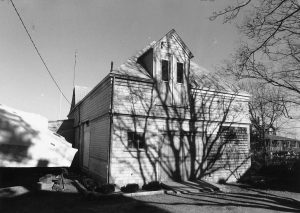
This installment features 13 Hiller Street. Extending eastward from Front Street and turning southward to meet Main Street, Hiller Street is noteworthy as a side street with a gritty appearance. It was named Hiller Street around 1900 after the enterprising family who owned most of the residences and utilitarian structures bordering this back street. The structure at 13 Hiller Street is a wood shingle Queen Anne building that may have been built as a stable. An off-center hayloft opening appears at the second story beneath the eaves. Built c. 1880-1890, this building was owned by Theodore J. Tripp, a baker, by the early 1900s.

Comfort in Candlemas

We made it. February 2 marks the halfway mark of winter and here we stand, relatively unscathed by the ghastly torrents that winters past have rained (and snowed) down upon us and winds that knocked us down along with everything else around us. On the seasonal front, I dare say we have fared well thus far, only having to tolerate the diminished light of these shortened days, the early onset of evening alleviated only by the steady sequence of astonishing sunsets, not to mention the sun’s exquisite apologies for its late appearance every morning by some equally astounding sunrises.

Groundhog Day, that February 2 quasi-holiday on which The Wanderer places an overemphasis every year started out centuries ago as Candlemas. The day has multiple significances in Christianity and the Pagan religions, and February 2 is significant in cultures all across the globe. My thoughts this year are of the old Western European tradition of clearing the fields for the first plantings of spring. And even so today, we move towards spring with the promise of the returning light, the rebirth of life and the world around us, and perhaps even within ourselves.

During Candlemas, people would light candles blessed at church to dispel the darkness. My very close Danish friend in Copenhagen hated this dark half of the year. Over in Scandinavia during winter the sun would never truly rise high in the sky, instead slanting its light burning long shadows all across the daylight. She would burn white candlesticks every day to penetrate the long nights that would extend late into the morning and return early in the afternoon. I embraced her tradition a couple years ago to see me through the dark half of the year she died. After all, it was never the cold of winter or even the snow that got to me; it was always the darkness, which I have come to accept and even now find comfort in with my white candles glowing and the promise of a slow, gradual return to the light half of the year.

That slow, gradual return to light is the predictable part of winter. But we are yearly at the mercy of the uncertainty of winter as inhabitants along the coastline of New England. The 2019 Old Farmer’s Almanac predicts more rain than snow for us in the Tri-Town with mostly average temperatures for the most part through February.

And what say you, groundhog? To what are we beholden to endure these next six weeks? Will that traditional first spring flower cover of The Wandererbe in February like it has been in the past, or in March as it was last year? And, speaking of covers, congratulations to Hannah Ramalho of Mattapoisett, the winner of the annual Wanderer Groundhog Day cover contest. Thank you to all the participants who entered their artwork into the contest, and we hope to see you again in October for our next Halloween cover contest. Until then, go Patriots! And come on, spring!

By Jean Perry

Tri-Town Kindergarten Registration

Sippican School – Marion – Registration and Orientation: February 12at 6:00 pm – 7:00 pm – Multi-purpose room

Center School – Mattapoisett – Parent Orientation: Wednesday,January 30at 6:30 pm – Center School cafeteria

Parent Registration: Wednesday, February 6, 2019 at 3:00 pm – 5:30 pm or Thursday, February 7at 8:45 am – 11:00 am – Center School cafeteria

Rochester Memorial School – Rochester – Parent Orientation Information Session: Wednesday, January 30at 5:45 pm – RMS cafetorium. Followed by Kindergarten Classroom Orientation at 6:00 pm – 7:00 pm. Registration: February 5, 6, 7at 9:30 am to 11:30 am and/or 1:00 pm – 2:30 pm.

SLT Leads Superb-Owl Walk

Join Sippican Lands Trust (SLT) for a winter “Superb-Owl” Walk in honor of Super Bowl Sunday on February 3. This crepuscular walk in the woods will start at 4:00 pm and end by 5:30 pm back in time to leisurely head off for the Patriots-Rams’ kick-off.

The walk will start behind the Marion Institute and Baldwin Brother parking lot located at 202 Spring Street in Marion. The walk will head to the railroad bed and paths behind the Marion Institute and Baldwin Brother and continue down the railroad path within walking distance of some Sippican Lands Trust properties as well as town open space properties in this forested area. While hearing an owl early in the evening would be nice, it isn’t a sure thing. Owls are busy with their nesting time and hopefully calling more than often.

The walk is free and no registration is required. The walk is weather dependent and participants should be dressed for muddy paths and/or frozen stretches. Headlamps or flashlights are suggested for the walk back to the parking area and the walk will cover approximately 1.5 to 2 miles depending upon the pace of participants. If the Superb-Owl Walk is canceled due to inclement weather, then information will be posted to SLT’s website and Facebook page. For more information about this walk contact SLT at info@sippicanlandstrust.org, 508-748-3080, or visit www.sippicanlandstrust.org.

Thank you to the Marion Institute for permission to park in their lot for this walk.