Nasketucket Bird Club

Join the Nasketucket Bird Club on Thursday, September 26at 7:00 pm at the Mattapoisett Free Public Library.

            We will be featuring a program called “The Art of Aves.” Professional Photographer Arthur Rainville will share insights and delights in the world of art that birds inspire. Along the way, he’ll share tips and tricks to making better images of birds with whatever your skill or equipment… even your cell phones. 

            The meetings, open to the public and handicapped accessible, are held at the Mattapoisett Free Public Library, located at the south door entrance on Barstow Street in Mattapoisett.

            Check our website at: massbird.org/Nasketucket/ or email President Justin Barrett at jmbarrett426@gmail.com
Friends of the Mattapoisett Council on Aging

The Friends of the Mattapoisett Council on Aging want to extend their thanks for the wonderful support of all involved in the Plant Sale on September 14. This includes all who helped set up, donate and sell plants and to the many people who purchased the plants and gave them a new home. Special thanks to Susan Pizzolato for letting us hold the sale at the library again, the Mattapoisett Highway Department for their assistance in bringing the plants to the library, and the local businesses that donated. The winner of the hanging basket of gourds and squash was Shiela Niksa. Look for us at the Fall Festival on September 28 and 29 held by the Mattapoisett Knights of Columbus. We will be selling our signature clothing and other merchandise. Also, you can take a chance on the wheelbarrow filled with garden items, valued around $100. Proceeds from all our activities are spent on our seniors. Thank you, from the Friends of Mattapoisett’s COA, for your continued support.

Apple Pie Tasting Contest & Sale

We invite you to bake your favorite Apple Pie and enter the Apple Pie Contest on Saturday, October 19. To enter, bake two pies. One will be submitted for judging, the other will be available for purchase. Pies must be dropped off between 10:30 am and 11:30 am at the Benjamin D. Cushing Community Center, 465 Mill Street, Marion. Judging will take place at Noon.

            Not a baker? Then just stop in and buy a whole pie or just enjoy a slice. Pies will be on sale from 12:00 – 2:00 p.m. Proceeds from sale of pies will go to the FMCOA to sustain programming at the Marion Council on Aging.

Sippican Historical Society

In 1998, the Sippican Historical Society commissioned an architectural survey of Marion’s historic homes and buildings. The survey was funded half by the Sippican Historical Society and half by the Massachusetts Historical Commission. Due to the limits of funding, not all of the historic buildings were surveyed, but over 100 were catalogued and photographed. The results of the survey are in digital form on the Massachusetts Historical Commission’s website and in four binders in the Sippican Historical Society’s office (and at the Marion Town Clerk’s office).

            Marion (Old Rochester) is one of the oldest towns in the United States, and the Sippican Historical Society maintains an extensive collection of documentation on its historic buildings. The Sippican Historical Society will preview one building a week so that the residents of Marion can understand more about its unique historical architecture.

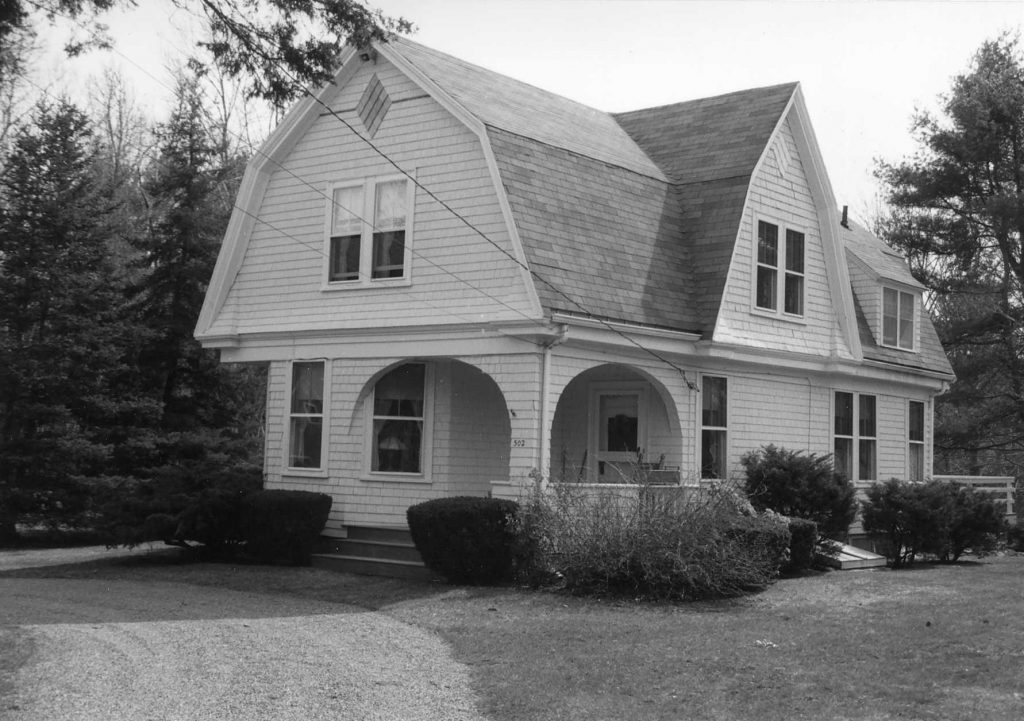
            This installment features 502 Point Road.  This home is a Queen Anne and Shingle Style house built in 1905.  The property was carved from the extensive holdings of Charles D. Ellis.  This house is historically significant as a modest, inland version of the more substantial summer cottages that were being built near Marion’s shores during the late 19th and early 20th centuries.  It was built at about the same time that Point Road was extended to Ruggles Point.

Solar Power Lights up ConCom Agenda

            Solar energy fueled the meeting of the Rochester Conservation Commission on September 17, even if the majority of the agenda items were simply to confirm the wetlands lines of properties slated for future solar energy projects.

            Five of the seven applicants that night were solar developers looking to confirm a collective 26,273 linear feet of wetland lines – over 4.5 miles – an awful lot for one conservation agent to walk and review herself. And with one solar developer with three separate Abbreviated Notice of Resource Area Delineation filings and a desire to have them approved sooner rather than later, it was time to hire a peer-review wetlands scientist to assist.

            The three ANRAD applications filed by Joe Harrison, SunRaise Investments, LLC – all continued from August 20 – were again continued until October 15 to give Conservation Agent Laurell Farinon enough time to traverse all those linear feet before the commission can approve the wetlands lines. Julie Goodwin from Prime Engineering said she understood that it would take some time to review the lines – 2,900 feet at 0 Braley Hill Road, 5,423 feet at 0 Featherbed Lane, and 4,000 feet at 0 Snipatuit Road – and offered up a check for $3,000 for Farinon to hire a consultant to take on some of the work.

            The three applications are all for the same wetlands system. Goodwin pointed out that she herself has not yet walked the wetlands at 0 Snipatuit Road, so she is unsure of the density of those wetlands.

            Being realistic, Farinon said, the job would certainly be completed faster if she had peer-review consultant John Rockwell’s help at 0 Featherbed Lane to “get this buttoned-up” as soon as possible.

            “I know that they want it done quickly… so it’s an opportunity to use John [Rockwell] before he goes away and it helps everybody,” said Farinon.

            The three ANRAD hearings were continued until October 15.

            The ANRAD public hearing for SWEB Development, LLC was re-opened in order to allow Sara Rosenblat of Weston and Sampson to submit an updated wetlands line for approval in the form of a wetland comparison map showing where the changes occurred. The date of the plan she brought forth, however, did not match the date stamped on the plan, which was prior to the date listed on the updated plan.

            The commission asked her to resubmit a plan with consistent dates, “And that’s all we need,” said Chairman Michael Conway.

            The owner of the property, Craig Canning of Rochester Farms, LLC, is planning on leasing his agricultural land as the site for the largest megawatt output solar energy field in Rochester.

            The public hearing as continued until October 1.

            Continued from September 3, the ANRAD filed by Erica Buster and Simpson Solar, LLC for 102 Quaker Lane to confirm 10,100 linear feet of bordering vegetated wetland and 1,600 linear feet of a riverfront area was also continued until October 1.

            Aside from being unable to confirm some of the flags that continue on past the Acushnet town line, the application brought up the matter of issuing a standard for wetlands flagging in Rochester pertaining to flag color and flag quality. The commission needs to consider a standard, Farinon said, “…so there’s no discrepancy.”

            In other business, the commission issued a Negative Determination (no Notice of Intent filing required) for the Request for Determination of Applicability filed by Tim Lynch, 257 Walnut Plain Road, to demolish a collapsed barn and install a 14’x36’ shed within the 100-foot buffer zone of the wetlands.

            Daniel Paradis, 443 Neck Road, received a Positive Determination (work will alter but not impact the resource area) for his RDA to raze a single-family cottage and construct a new single-family house with a new septic system and associated work within the 100-foot buffer zone of wetlands along Snipatuit Pond. The plan, updated since the September 3 meeting, was corrected to redirect work outside of the 25-foot no-touch zone.

            The next meeting of the Rochester Conservation Commission is scheduled for October 1 at 7:00 pm at the Rochester Town Hall.

Rochester Conservation Commission

By Jean Perry

All Hands & Hearts Around the World

            There are many hands and hearts in the little town of Mattapoisett, Massachusetts. Hands that wave with a friendly ‘hello’ and thousands of hearts inside these 18 square miles that beat with a love for this town and are full with compassion during times of struggle.

            We all watched earlier this month as Hurricane Dorian slowly churned in the Atlantic and hoped that the storm would no more than graze us as it moved northeast in our direction. We saw the destruction left in its wake as it battered the Bahamas and we were struck by the footage that accompanied the headlines in the storm’s aftermath. We clasped our hands in prayer and hoped with our hearts for a quick recovery.

            But then our attention turned toward another direction. Dorian swept itself out to sea and dissipated. The Bahamas disappeared from the headlines. Our hands became busy with other things and our hearts were again occupied with matters closer to home – but not for ‘all hands and hearts’ in Mattapoisett.

            You’ve probably driven past the nondescript office along Route 6 in Mattapoisett a hundred times, perhaps even during the week after Dorian devastated the Bahamas, and saw the sign “All Hands and Hearts” without realizing its significance. Regardless, situated in that small, inconspicuous plaza is a hub of international relief efforts that is mobilizing hands and hearts from all over the world to send to the Bahamas just as the rest of us have nearly stopped thinking about it.

            The non-profit organization All Hands and Hearts has its headquarters in Mattapoisett and is overseen by Mattapoisett resident and CEO Erik Dyson, Dyson and his team are the first-responders of sorts whenever disaster strikes somewhere on the globe. When a natural disaster devastates an area, Dyson and his team organize the deployment of some 50 to 60 volunteers every day to survey and assess the damage. Their disaster response is the critical first step after the storm for a place like the Abacos Islands, the region hit the hardest on the island chain nation of the Bahamas.

            Last week, the volunteers made their initial assessment of the islands to ascertain the areas that need the most help and how to begin to provide support. As Dyson put it, All Hands and hearts “arrive early and stay late,” sometimes even years after the impact. Disaster response happens in phases, said Dyson. Phase 1 is the “cleaning up, mucking and gutting, removing debris…

            “Which, of course, there’s lots of debris to be dealt with,” said Dyson.

            There’s tarping of roofs, schools, and medical posts, “And, really, just listening to the community on where the short-term goals are,” said Dyson. And it’s often done without clean running water or reliable electricity amidst relative chaos and shock. These volunteers’ hands do the dirty work, the cleanup.

            The initial team figures out where rescue planes can land when airports are badly damaged, and where they can set up a base of operations to welcome more volunteers – dozens that arrive every day from different countries, including the U.S. The team works with local NGOs to understand the areas of highest need.

            “Based upon the needs we hear, then we send an assessment team to do a detailed outline of the scope of work, the budget of the materials needed,” said Dyson. The cleanup phase alone can take months, sometimes three to four and, in the case of the Bahamas post-Dorian, four to five months, even.

            “It’s such an extreme impact level of damage,” said Dyson. “But then we’ll transition to long-term recovery beyond the ‘taking-apart’ phase – the phase of rebuilding.”

            The Abacos Islands will need schools, houses, medical posts, community centers, evacuation centers, all its community infrastructure rebuilt after Dorian. And there are still other devastated areas – Puerto Rico, the Florida panhandle, Mozambique, the Philippines, and Nepal, to name a few – where that rebuilding is still taking place years later.

            All Hands and Hearts will likely spend two years rebuilding in an area affected by a natural disaster. The goal in The Bahamas is to help at least 2,500 people by mobilizing a minimum of 1,000 volunteers. But to succeed, it will also need to raise around $5 million. It takes a lot of money to rebuild, and in the case of the Bahamas, an island nation, it’s already expensive to import building materials even without the added disruption of the supply chain.

            Mattapoisett is where it begins with the help of the local hands and hearts the organization employs at its headquarters, the people that perform the administrative duties, financial matters, human resources, and public outreach. Sometimes, though, it’s the local people who arrive at ground zero to assess, like one seasoned “logistics guy” from New Bedford that has assisted in many assignments, said Dyson. This one, however, was different. “He was struck by just the absolute destruction,” Dyson said.

            Right now, there are no operating gas stations, no baseline infrastructure, nothing.

            “It’s still really slow getting started because it’s – there’s just nothing there,” said Dyson. “It’s not just shut down, it’s gone.”

            In disasters like this, about 80 percent of the funding to rebuild is raised during the first 60 days before interest fades. “It’s already happening,” Dyson lamented. “Initial interest is high… but now, a week later, it’s fallen off the news…This is something that will take five or more years for the community to get back to normal and we’re already in week two and we’re seeing a huge drop off in interest.”

            This goes not just for money, but for volunteers, too. There was a huge interest in volunteering, said Dyson, with around 5,000 signing up, but they will need about 1,000 steady volunteers a year in the Bahamas. “It’s always a challenge,” said Dyson, when that interest starts to wane months into the efforts.

            This is where the rest of the hands and hearts of Mattapoisett come in – the volunteers and people of the Abacos need your hands; they need your hearts.

            Please considering making a donation to All Hands and Hearts, or consider taking a chance on volunteering. No skills are required, the group will teach you everything. You can make a donation or apply to volunteer (it’s a rather quick process) by visiting their website www.allhandsandhearts.org.

            Although water, food, and clothing drives are often a response to an effort such as this, monetary donations or volunteering are the best ways to help. It’s expensive to ship material goods abroad and ineffective compared to the power of an express donation of money, of any amount.

            Dyson urges his neighbors to follow the organizations efforts by visiting the website or signing up for updates. “Also, please think about other places with impacts that aren’t obvious on the front pages, but are affected,” said Dyson. “Those people need our help.”

By Jean Perry

Quaker Open House and Historic Graffiti Clues

Curious About Quakers? The Mattapoisett Friends Meeting will hold an open house on Sunday, October 6 at 10:00 am in the historical Quaker meetinghouse at 103 Marion Rd. Members will share interesting facts about Quakers, including the cannibal Quakers of Nantucket. Afterwards, there will be coffee and conversation in the meeting’s community hall. Assistive listening system available. Please contact mattquakers@gmail.com for more information. 

            Speaking of historical, an update to the “historical graffiti” discovered in the fall of 2017 is finally available. About 12 feet above ground, on the trim board of the meetinghouse roof, there’s a carving that says 10/10/68 Allen Ashley. However, nobody knew if it was 1868 or 1968 since there were Allen Ashleys recorded to have lived locally in both time periods. Somebody in the area wrote to the meeting and let them know that there was an Allen Ashley who lived in Fairhaven and was a painter and wallpaper specialist who could have carved his name in 1968. Much later, Michael Emmons, an architectural history doctoral candidate at the University of Delaware, happened upon the article online. Mr. Simmons studies historic graffiti for his doctoral thesis. He had this to say: My gut sense, looking at the style of the lettering, is that this is a 20th century graffiti—so 1968, not 1868. Typically, mid-19th century graffiti has a bit more style to it. It was the age of penmanship education, so the lettering usually exhibited serif “fonts” and was less boxy. Also, the date in the format xx/xx/xx, rather than Oct 10, 1868, seems more 20th century. 

North Street North

To the Editor:

            I would like to address my fellow Mattapoisett residents who share with me what I would affectionately refer to as the “North Street North” neighborhood which I consider to be both North Street itself, as well as its many adjoining streets that are situated north of Route 195 which house almost one fifth of our town’s residents. 

            Specifically, I would like to bring to your attention that there is a neighborhood meeting being scheduled for Oct.3 at the Center School at 6:30 for all those who share with me a desire to see the creation of safer walking and biking options for our area. I have spoken to many residents who have also shared a concern that there are currently no safe options available to us to walk (either alone or with our children and grandchildren or pets) or to ride our bikes without risking life and limb on North Street.

            Your input and suggestions are very important and needed in order for the town to possibly prioritize this neighborhood as it seeks to create a greater network of safe, interconnected paths which promise to create new and exciting options for recreation and exercise in an area that has few amenities.

            So I ask you to please come out and make your concerns and opinions known to the committee about the importance of this issue to you personally. The Pedestrian Bike Committee can then take them into consideration before formulating a proposal to the state for possible funding initiatives. Your opinions and concerns are critical in helping the town to actually get something accomplished for our neighborhood. Hope to see many of you at this important meeting. 

Robert Teixeira, Jr,, Mattapoisett

Learn What a New Volcano Reveals about Mars

Tabor Academy is pleased to announce the opening of the fifth year of their Science@Work lecture series on September 23with an intriguing lecture about a newly developed volcanic island and what it may teach us about Mars.

            At 6:30 pm, Tabor Academy will welcome Captain Jay Amster of SEA Semester’s sail training vessel, SSV Robert C. Seamans, and geoscientist Kim Reed Nutt, SEA’s Science Program Coordinator, as our first Science@Work lecturers of the year. Sea Education Association is located in Woods Hole, MA, and runs a college-level sail training semester at sea for those interested in marine and geoscience, sailing, and adventure.

            Captain Amster and Ms. Nutt will share news of their recent collaborative research project with NASA where they were instrumental in providing access to an important research site from their vessel, as well as securing research permits, and training capable student researchers for the project. The students and crew from SEA transported and worked closely with a team of scientists from NASA to study a newly-formed volcanic island in the South Pacific as a way to better understand our neighboring planet, Mars. Come learn about their findings as they searched for clues on the young island, Hunga Tonga-Hunga Ha’apai, about how water may have shaped Mars.

            This fascinating lecture, featuring Captain Amster’s incredible photography of the volcano, will take place at Tabor Academy in the Stroud Academic Center’s Lyndon South Auditorium, 242 Front Street, Marion, on September 23 at 6:30 PM. The event is free and open to the public.

            Kerry Saltonstall, Director of Communications at Tabor said, “The Science@Work Lecture Series has provided our local community with a chance to hear about the work and ambitions of over sixteen scientists from around the country, including marine biologists, engineers, climate scientists, ROV operators, and many more. Students, faculty, and the public have been enriched

by the lectures and we hope you will join us for the series this year.” 

The Vocal Whip-Poor-Will

Most avid birdwatchers will always remember hearing the mysterious chant of the whip-poor-will’s summer evening song. It may seem to go on forever, as long as several hundred times, making it very easy to imitate the exact verbal sequence of sound. The intent is unusually vociferous because the repetitious message is first driven by seeking a mate and then by territorial obsessiveness.

            This whip-poor-will is more often heard than seen, sleeping by day, camouflaged upon a color emulating horizontal low-lying tree branches. It does not wake up until twilight, but then will flutter up into the air along the edge of woodland clearings to catch bugs. It nests on the ground and lays two eggs, cleverly inconspicuous on layers of deciduous leaves. If it feels the nest gas been discovered, like the ground nesting woodcock it will fly a short way with the eggs between its legs to a more secret location.

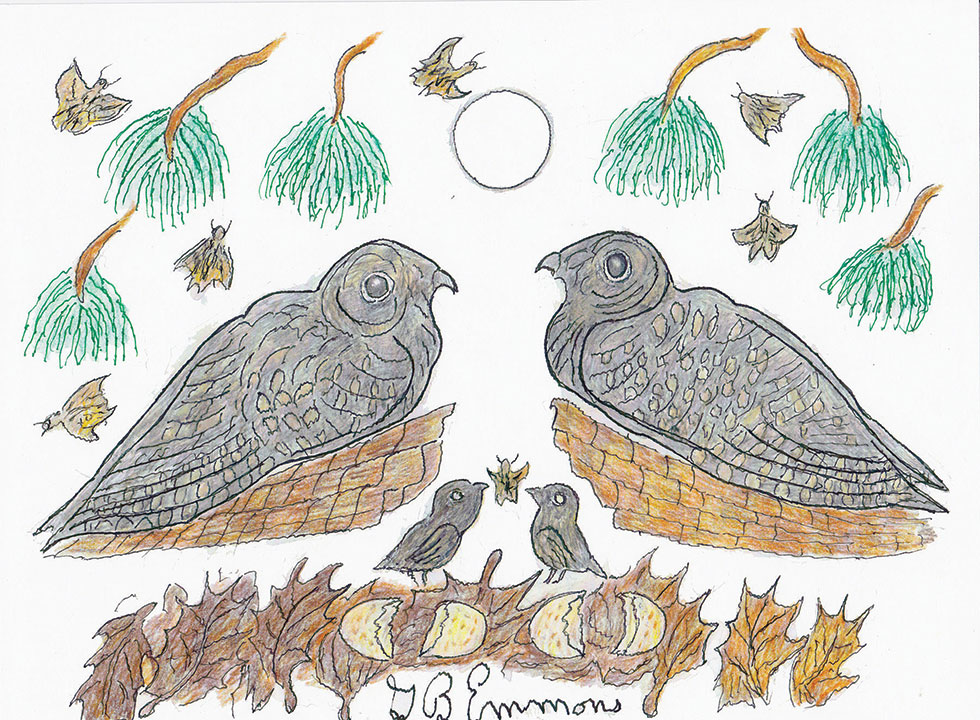
            After an incubation of about 21 days, the time of hatching is closely tied to the lunar cycle. It will amazingly coincide, happening just a few days before a full moon, as illustrated. This reflects a celestial orchestration with mortal survival on Earth, so parents will be able to catch enough bugs for their new offspring. Bugs are magnetically attracted and activated by the moon’s light, just like a bright streetlight on a dark night.

            Unfortunately, reproduction population is dwindling everywhere. Like all its species cousins including the night hawk, night jar, and chuck-will-widow, the whip-poor-will population has decreased annually by at least six percent for the past 50 years This decline is attributed to a vital loss of insects, moths, or beetles, caused by human’s consumption of the pitch pine and scrub oak habitat.

            Research to reverse the recent Audubon classification of “species of national concern” is underway at three nearby locations of Massachusetts Wildlife Management areas: Cape Cod, Bolton Flats, and Montague Plains. After netting and banding, a tiny microchip is attached to GPS track migratory routes and final destinations. This eventually showed a deviation from other bird migration along the traditional Atlantic Flyway. The whip-poor-will was somehow able to reach Central America by a strictly overland route. This is critical for survival during stopovers to rest; however, crucial questions and solutions are still pending and unanswered.

            The whip-poor-will’s ritualistic and mystical country echo every evening has left a lasting impression in the human mind, especially young children just before bedtime. It has inspired paintings by James Audubon, poetry by Robert Frost, and homespun country humor by Mark Twain.

            The Native American symbolic interpretations of birdcalls are meaningful. The reverberating wail of a loon across a lake forecasted rain. To the elderly, the hoot of an owl could seem to call out a person’s name when it was time for them to go. And across a peaceful summer setting at twilight, they heard the whip-poor-will as a soul snatcher, rising up from the Earth to rescue a dying human spirit before nightfall.

By George B. Emmons