Scott Peter Hall

Scott Peter Hall, 44, of New Bedford, MA passed away unexpectedly on Sunday April 19, 2020, at St. Luke’s Hospital. He was born in New Bedford to Jerry G. and Ellen H. (Harris) Hall on May 7, 1975.

            Scott attended Old Colony High School in Rochester, MA in the Electronics department, and enjoyed being with his family. He especially loved spending time with his daughter, listening to music, and playing video games.

            He is survived by his loving mother Ellen, and sister Brandy Hall both of New Bedford, MA. Daughter Scarlite Leighton of New Bedford, MA, His Aunt Liz Harris of New Bedford, MA, and Uncle Bill Harris of New Bedford, MA. He is preceded in passing by his father Jerry G. Hall.

            A Celebration of Scott’s life will be announced at a later date.

Four-Town Partnership Back in Business

            The Mattapoisett River Valley Water Supply Protection Advisory Committee and the Mattapoisett River Valley Water District Commission barely had to switch out personnel to hold back-to-back meetings in the same Zoom video-conferencing window on April 14.

            The committee and commission, which are both related to a four-town partnership of Fairhaven, Marion, Mattapoisett, and Rochester, met for the first time via remote access and had plenty of catching up to do.

            Jon Gregory reported to the committee on a potential water-quality-management grant opportunity, an annual 604B grant through the Department of Environmental Protection. The grant spreads $200,000 in amounts ranging from $30,000 to $50,000 to fund anywhere from four to six districts’ water-quality assessments.

            “It seems to fall into what we’re looking to do with Snow’s Pond and other areas,” said Gregory, noting a competitive process and a stipulation of disadvantaged-minority (4.2 percent) women-owned business (4.5 percent) that has to be taken into account for any work the committee proposes with the grant money should it be awarded.

            The committee agreed to evaluate what could be a pricey application process that will reveal itself on April 24, and decide from there what to pursue at the committee’s meeting to be held on May 10 or May 11.

            “I know that would be very robust to do a Mattapoisett River management plan,” said Laurell Farinon. “It’s a good idea to keep the door open and explore every opportunity.”

            In his treasurer’s report to the committee, David Pierce reported $75,188.01 in income for the current fiscal year (beginning July 1, 2019), including $443.21 in bank interest.

            Gregory reported to the committee plans to finalize the purchase of a Hach-brand water testing meter by April 15, and the committee also approved $500 in funding to pay back the Town of Mattapoisett for committee member Henry Renauld to replace his sonic device for measuring the wells.

            Citing the social value of the event, the committee postponed a regional meeting of water officials to the fall. This meeting had originally been scheduled for April 30 at Marion Town House.

            In his treatment plant operations update to the commission, Renauld reported that power outages burned out a lower compressor that has since been repaired. The cause was wiring that heated up on a three-phase motor.

            The plant was filled up on chemicals including oxygen in the latter part of March, allowing the plant to run 50 days before needing another delivery. Marion’s Wolf Island facility is down, and the commission is working with an electrician.

            In his treasurer’s report to the commission, Paul Silva reported invoices totaling $106,828.40.

            The commission’s auditors requested documents estimated to be 12 years old containing a report from engineering group Tata and Howard for services they provided. There is no deadline, but Silva said he would like to see the matter addressed before leaving his post. Member and Fairhaven Town Administrator Mark Rees said he will try to find the records in the plant.

            There was discussion on how to best utilize the role of treasurer where it concerns both the committee and the commission. Rochester Town Counsel Blair Bailey suggested linking the committee and the commission for the services of a professional. Pierce had also indicated that he is leaving his treasurer’s role with the committee in June. 

            According to Silva, bills are reviewed and signed, which is a service that the commission pays Fairhaven to do. Silva said he has no problem staying on a month or two beyond his term while a solution is found.

            The next meeting of the Water District Commission is scheduled for May 12. Members expect it will take place via remote access.

Mattapoisett River Valley Water Committees

By Mick Colageo

Sippican Woman’s Club Cancels Annual Meeting

As other clubs and organizations have done, Sippican Woman’s club has responded to COVID 19 quarantine and canceled their Annual Meeting at the Kittansett Club on April 24. The “Oar Project” has been postponed until the summer of 2021. Members are determined that this is just a “pause” and the Sippican Woman’s Club will resume stronger than ever.

ORR’s Meaghan Dufresne Staying Ready to Play Ball

            For high school spring athletes looking to continue their playing careers in college, junior year is crucial. As much as senior season is important because it’s the final year playing with high school friends, junior season is when spring athletes draw the attention of college coaches. Then, over the summer, those athletes can further the recruiting process by speaking with coaches at showcases and travel-ball tournaments.

            Like other juniors, that process is in jeopardy for Old Rochester shortstop and catcher Meaghan Dufresne, as sports remain on hold while students continue to learn from home during the novel coronavirus outbreak.

            “It’s definitely different (learning from home),” Dufresne said. “And it’s a little hard to get motivated when you’re in your own house. So, every subject, I move to a different spot in my house (to study) and it helps.”

            Unlike academics, training from home has offered no distractions whatsoever for Dufresne. She’d rather be playing games, but she’s spending two to three hours a day training — any combination of running, hitting and throwing — to ensure she is improving her skills. Plus, she wants to be ready for the high school softball season, should there be one.

            “I’m just trying to think positive that we will have a season and that I will have a summer season to prove myself to (college) coaches,” she said. “(I’m) just hitting in the cages every day and I have this playlist of songs that puts me in a good mood and (helps me) think of all the time.”

            But if the 2020 spring season is canceled, it may not impact Dufresne in the same way it will other members of the recruiting class of 2021. Prior to the 2020 spring season, she had been in contact with Assumption College and American International College, both of which have Division II athletic programs, as well as a pair of Division III universities, Fitchburg State and Westfield State.

            “She’s a fabulous player,” Old Rochester softball head coach Don DiBiasio said. “Meaghan would make a Division III starter anywhere she went because she’s a fabulous hitter. If she went to a (Division) II or I, depends what they need her for — whether she would start or not start. But, she’s also a very smart student. She’s a straight-A student so she’ll do well wherever she goes.”

            As much as Dufresne already has options, she wanted to get in touch with more schools to cast as wide of a net as possible. She’s still making contact, but a junior spring season would make the process easier for her.

            DiBiasio thinks Dufresne will be all set, but he does think it’s important she gets the chance to play travel ball over the summer and possibly into the fall.

            “The college coaches look more at the travel leagues than they do with the high school ball,” he said. “Very few college coaches come out to watch any high school games. Number one, they’re still in their seasons for most of our season. And they might look at what the standings are how they’re doing, but they know that the good games and the good talent is playing summer ball. And that’s what they want to look at.

            “She’ll be fine. She’ll get enough looks during the summer and the fall with her travel team to be able to make a decision on where she wants to go.”

            Despite the way things are trending, Dufresne has not lost hope for the spring season, and she has a little advice for others who are trying to do the same.

            “Be positive and keep working on your skill,” she said. “Because when the season hopefully does come they’ll be the best and ready to go on unlike everyone else.”

Sports Roundup

By Nick Friar

Sippican Historical Society

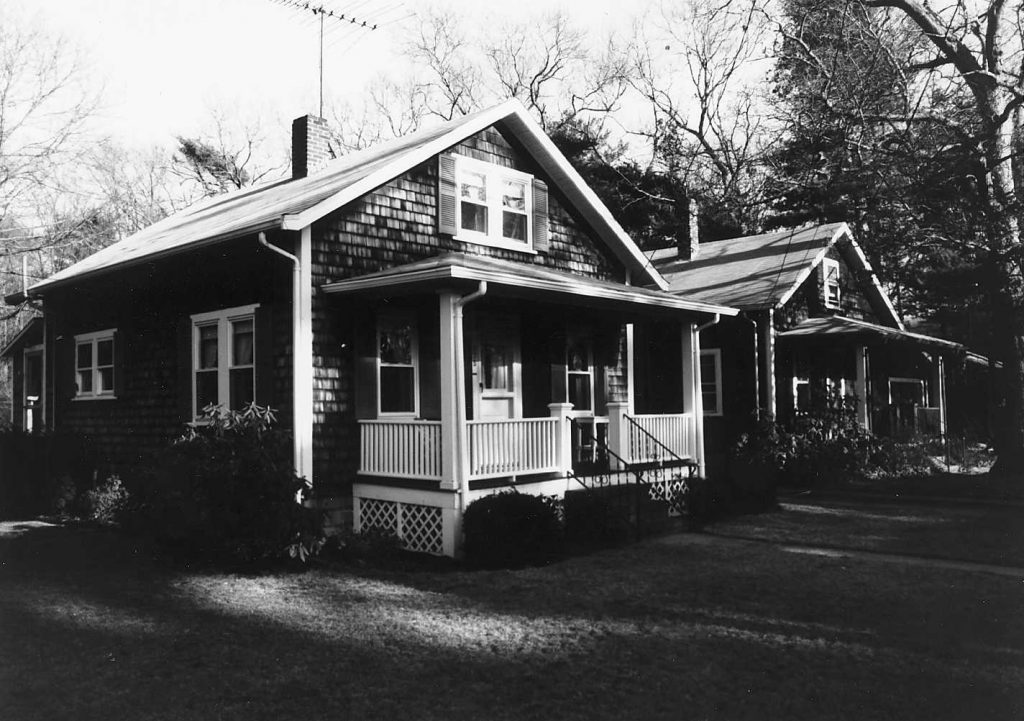
Marion (Old Rochester) is one of the oldest towns in the United States, and the Sippican Historical Society maintains an extensive collection of documentation on its historic buildings. In 1998, the Sippican Historical Society commissioned an architectural survey of Marion’s historic homes and buildings. Over 100 were cataloged and photographed. SHS will feature one building a week so that the residents of Marion can understand more about its unique historical architecture.

            This installment features 373 and 375 Front Street. After his retirement from the sea, Capt. George Allen began to expand the economic base of the Old Depot area. He demolished the neighboring one-room schoolhouse and, between 1900 and 1920, built two Craftsman-style cottages at 373 and 375 Front Street as a real estate development project. He also established a cigar and confectionery store opposite the depot. The diminutive cottages at 373 and 375 Front Street feature full-length front porches resting on lattice-covered platforms and support slat-work railings and square posts. Captain Allen augmented his retirement nest egg with the proceeds from the sale of the cottages.

Joan Marie (Gendron) Harding

Joan Marie (Gendron) Harding of Mashpee died April 14 at a Sandwich long-term care facility after a long illness. She was 82 years old.

            Born to Florence and Charles Gendron of New Bedford, she was raised with her 11 siblings on a farm in Acushnet. She was a 1955 graduate of New Bedford High School.

            She went to work in the family business, Ma’s Doughnut Shop in New Bedford and Buzzards Bay; the shop was featured in the 1990s sitcom “Wings.” While working in the Buzzards Bay store, she met Bourne Police Officer Wilson “Bud” Harding, who became a regular at the shop. They were married in 1957.

            The couple lived initially in Bourne and Acushnet and then moved to Mattapoisett, where they raised their four children. Ms. Harding continued work for the family doughnut shop and then became a bookkeeper at Bud’s Auto Body, a business she owned with her husband for 40 years in Fairhaven.

            After their retirement, they moved to Mashpee.

            A person who was never idle, Ms. Harding kept herself occupied by making jigsaw puzzles and ceramics and was an avid reader, often reading several books at once. She loved playing cards and parlor games and watching movies. She had an extensive collection of children’s titles to share with her grandchildren, with a special fondness for the character Pepé Le Pew.

            She also loved to travel and, in addition to annual holiday visits to her family in Ohio, she and her husband traveled to Hawaii, California, Florida and the Caribbean. She had a special fascination for English history and had hoped to make a trip to England.

            Until she became ill a year ago, Ms. Harding was a regular attendee of the Tuesday and Thursday senior lunch gatherings at the Mashpee Wampanoag Community & Government Center, where her husband is a tribal member.

            In addition to her husband of 63 years, she leaves her daughter Melissa A. Harding of Welborn, Florida; two sons, Matthew S. Harding and his wife, Gretchen Liesl Eiselt, of Bexley, Ohio, and Mark D. Harding and his wife, Paula Peters, of Mashpee; granddaughters Bryn Aquinnah Harding of Westchester, Pennsylvania, Lili Katherine Harding and Margaux Lynn Harding of Columbus, Ohio, and Chrystal Coppering of Sumterville, Florida; and a great-granddaughter, Novah Coppering, also of Sumterville.

            She was preceded in death by her daughter Melanie Marie, who died in 1980 at the age of 18.

            A celebration of her life will be held at a later date.

Solar-Array Progress No Promise of Online Public Hearings

            Speaking before the Rochester Planning Board on Tuesday night, Eric Las itemized his way through a substantial list of show-and-tell tweaks to the Braley Hill North Solar project, all of this via video conferencing.

            Whereas Las had presented before in-person and thoroughly engaged the Planning Board’s requests, his presentation will not guarantee an opening for the closing of large-scale projects in Rochester.

            Planning Board Chairman Arnie Johnson is not in favor of public hearings via video conference “I’m very concerned about abutters voicing their opinion and this (platform) is not it,” he said.

            Board clerk Ben Bailey asked if, considering that every applicant has a need, is the town setting itself up for a discriminatory claim.

            Town Counsel Blair Bailey told Johnson he does not see an issue with opening a new hearing, but added, “I wouldn’t close one until we had a chance for everyone to be involved.”

            Johnson didn’t consider any current applicant to be pressing for time.

            Blair Bailey cautioned the board that the main issue is a potential backlog of cases and meetings with very busy dockets.

            “The clock doesn’t start ticking on the governor’s calendar until 30 days after he declares an end to the state of emergency,” said Bailey.

            The Braley Hill Road solar array was neither presenting nor concluding on April 14, merely updating to satisfy the board’s requests.

            The plans, dated March 30, contained input from Town Planner Steven Starrett and included the discussion of work proposed for two parcels off of Braley Road, including the removal of stone walls, a description of bordering areas, a wetland system along the eastern side of the project and an added, 40-foot paved apron at the entry point off of Braley Road to the west.

            A proposed tree line set 675 feet from the paved road would provide a sense of the distance to the project. The grade would rise from the road to the site with the array located mainly on the downslope side of the hill, so it will not be seen.

            The site is 619 feet from the fence, over 600 feet from the installation, and panels are 500 feet from the north-bordering house and over 600 feet away from the south-bordering house.

            Addressing concerns over temporary stump-grinding berms, Las told the Planning Board, “Our intent here is to have a grass surface below the panels. The wood-chip berms will be removed before seeding occurs.”

            There are two basins at the east end of the set.

            A 100-foot setback fence will be placed toward the north edge. “No portion of the facility is within 100 feet of the shared lot line,” said Las. “We know that there were power outages (Monday) just from the wind… If this project is approved, there are three-phase (electrical) upgrades… that would provide extra reliability to the residents in town.”

            Johnson expressed hope that the engineering report will be ready for the April 28 meeting of the Planning Board.

            In other news, the town’s flood-plain amendment has become tricky. As Johnson said, “Right now we can’t really put it on the docket yet because we have to make sure 65 days don’t elapse between the amendment and the town meeting.”

            No one knows right now when town meeting will occur, but Blair Bailey said that the Federal Emergency Management Agency (FEMA), regardless of the current state of affairs, will not alter its deadline after which everyone in town covered by flood insurance would lose coverage. Bailey said he would get the actual bylaw to the Planning Board in time for its next meeting.

            In other business, the Planning Board approved a decision for repurposed properties at The Village on Rounseville Road across from town hall, and also discussed logistics around a partial town meeting and elections and the signing of documents.

            The next meeting of the Rochester Planning Board is set for April 28 via remote access.

roplanRochester Planning Board

By Mick Colageo

Stay-at-Home Exercise for the Creative

            I can remember when I was a kid, running up the down escalator in a department store at the local mall. It seemed like a good idea at the time but, judging by all the yelling, my mother and the store manager were not on board. Years later, some entrepreneur gets a patent, calls it exercise, and it’s a million-dollar idea. If only my mom and store manager had known.

            There are exercise opportunities all around us every day. The pandemic, and stay-at-home orders that followed, have seemingly made exercise less accessible, but that’s not exactly true.

            There was a time when strength training and fitness, as leisure time activities, were very counterculture. They were often misunderstood and frowned upon by the general public. Back then, exercise facilities were few and largely underground; department stores didn’t have much of a fitness section, and Amazon was just a rainforest.

            The early exercise folk, who were referred to as physical culturists and pejoratively branded as freaks, had to be very resourceful about finding and procuring exercise equipment. Between the lack of availability and typical financial constraints, they often fabricated their own homespun designs with MacGyver-like ingenuity.

            Nowadays you can grab a workout at a hotel, on a cruise ship, and at the office. There are exercise facilities in every direction. Even pharmacies have fitness aisles, and e-commerce has made dumbbells just a click away.

            For the time being, commercial gyms are off-limits, and most of us don’t have access to pneumatic exercise equipment or the other fancy stuff. To me, this is simply a matter of the exercise zeitgeist coming full circle.

            There was a time when exercise furnishings were less widespread and less accessible, and that time has temporarily come again. Exercise may seem less convenient in certain ways, but it’s, in essence, as available as ever. Like the physical culturists who came before us, we need to take advantage of those resources that are available, improvise, be creative, and think both inside and outside the box.

            Although our love affair with technology is undeniable, there is in fact a trend in fitness toward some of the old-timey tools and methods. Despite all of today’s whistles and bells, stone-lifting and sandbags are enjoying a nice resurgence in weight rooms and elsewhere.

            Exercise has a very primal element to it, whether looking at people running barefoot or competitors throwing bundles of straw at the Highland games. We like our amenities, but even a modern-day softy appreciates getting in touch with their primitive side and channeling their ancient predecessors.

            Pheidippides ran a marathon back in 490 B.C., and they’re all the rage these days.

            Running and walking are still on the table for confined exercise enthusiasts; they’re old but not passé. Calisthenic exercise is literally ancient, but it’s no mistake that we still see it being used today. Our own body weight can be used in so many different ways as its own piece of exercise equipment: pushups, sit-ups, squats, and pull-ups just to name a few.

            It’s never a bad time to work on our cores, but it’s a particularly good time because so many of the core-specific exercises don’t require any extra equipment. You may not have a leg-press machine, but you don’t need one to do leg squats, lunges or glute bridges.

            Strength training comes in so many forms it’s almost limitless. The resistance can be a dumbbell, bodyweight, stretch bands, medicine balls or any other external load or force that your muscles have to work against. Chopping wood is strength training; carrying a laundry basket is strength training; playing tug of war with your dog is strength training.

            Old-time strongmen were known to use sledgehammers for exercises and feats of strength. There are a million ways to overload your muscles, and your muscles probably don’t care all that much about the instrument of torture. There are plenty of unwitting pieces of workout equipment hiding in plain sight or at least in our basements and sheds. Do some unpleasant chores and repurpose some less-obvious things that are heavy enough to serve as exercise-resistance equipment.

            To bookend a young boy’s joie de vivre and excitement over an escalator, we have a jaded 40-year old’s despair over an escalator. More than a few years back, I was at a crowded mall the day before Christmas and noticed a huge logjam of shoppers atop an escalator entry.

            Upon closer inspection, I could see that the escalator was not moving, and the huddled masses were paralyzed with bewilderment. I usually don’t break rank but decided to take the lead and descend to the lower level. As if it never dawned on the congested mob that a broken escalator could be used as a staircase, my rare act of initiative restored order once the stranded shoppers followed suit.

            Sometimes we don’t see things for what they are or could be. A tree branch can double as a pull-up bar. Gravity and inertia are the critical elements for most strength exercises, not bumper plates, and those are still available.

            Movement is the most important ingredient for fitness, not where we move. We should not focus on our limitations but rather on our bounty of provisions and potential exercise means. It may feel a bit confining these days, but we have plenty of options.

            Today’s exercise fanatics have nothing on yesterday’s lumberjacks and pioneer women. Use your imagination and the sky’s the limit.

            — Certified strength and conditioning coach Norman Meltzer, the owner/operator of MW Strength and Conditioning in New Bedford, was known during his competitive weight-lifting career as “the Muscless Wonder” for his lean, mean physique lacking in the traditional bulk associated with strength training. Meltzer’s experience and knowledge has helped pro, college and high school athletes and teams and even regular people improve their strength and performance.

Schvitz’n with Norm

By Norm Meltzer

Elks Student of the Month

The Elks of Wareham / New Bedford Lodge No. 1548 sponsors the Elks Student of the Month and Student of the Year Awards for students enrolled in local area high schools. The criteria used in nominating a student includes a student who excels in scholarship, citizenship, performing arts, fine arts, hobbies, athletics, church, school and community service, industry and farming.

            We congratulate Senior Jacob DeBastos of New Bedford for being selected as Student of the Month for February by the Old Rochester Regional High School Faculty and Staff.

MBTA Case Continued Pending Improvements

            Before he presented on behalf of Edgewood Development Company, LLC, environmental engineer Brisco Lang of Pare Corporation told the Rochester Conservation Commission, “You guys have a lot of guts for pulling this off. It’s gone a lot more smoothly than I would have expected.”

            Lang was referring to the holding of a remote access public meeting with the complications of outside participation and, by extension, the public hearings that were to come later in the evening of Concom’s April 9 meeting via Zoom video conferencing.

            Mattapoisett has also taken the step of holding remote public hearings; Marion has held several remote public meetings but, on the advice of its town counsel, has not held public hearings in hopes that any such cases can be continued, extended or otherwise put off until people can once again meet safely inside public buildings.

            “The smoothness of the meeting is a testament to the good work of the chair, Michael Conway, and a testament of the preparation by commission members. We have an outstanding commission,” Laurell Farinon, Rochester’s environmental planner and conservation agent, told The Wanderer on Monday.

            Farinon pointed to Vice Chairman Dan Gagne (professional engineer), Maggie Payne (soil scientist) and Kevin Thompson (former IT professional at Hewlett Packard) as examples of the talent on the Rochester Concom.

            She considered it “fair” that ConCom concluded the lengthy Thursday night meeting with a decision to refrain from closing on large projects while, at the same time, hearing those cases and allowing the smaller, primarily residential ones to achieve expedient conclusions.

            Given the length of the April 9 meeting, the discussion at its conclusion was substantial as ConCom assessed the format. Thompson was viewing from home on a large monitor and said presentations necessitate full color with large graphics. Bailey suggested a direct mailing of hard-copy presentations to ConCom members’ homes for their review before meetings. The members accepted the idea.

            Gagne suggested that larger projects not put on a full presentation online but send a brief update that will allow Concom to become acquainted with a project before a full-blown presentation is made online. Conway suggested peer review before ConCom discussion, and Farinon suggested site visits in advance of meetings.

            Over the course of three hours on April 9, two public hearings were heard and continued to ConCom’s next scheduled meeting on April 21.

            The Massachusetts Bay Transportation Authority filed a Notice of Intent seeking to install security fencing around its facility at 45 Kings Highway and restore the 100-foot buffer zone to bordering wetlands per ConCom’s February 4 enforcement order. Prior violations had led to an involuntary shutdown of the construction.

            Holly Palmgren, representing the MBTA, opened with an apology. “This is not typically how the MBTA does business,” she told the commission before describing the requested work to include hydro-mulch and the addition of erosion controls.

            Jessica Rebholz, an environmental scientist representing Jacobs Engineering Group, proposed a row of arborvitaes among a mix of three kinds of shrubs, an inclusion that was advised against by ConCom member Lena Bourque because of their attraction to deer. ConCom wants to see more sustainable shrubs and more than the 36 trees proposed.

            Palmgren cited issues with vandalism and security in the placement of fencing differently than originally proposed. Gagne cited that the proposed fencing was only a few feet off the wetland line. The MBTA says it complies with the state Wetlands Act.

            Town Counsel Blair Bailey confirmed that the MBTA is not subject to local wetlands restrictions in general and acknowledged its need to secure the chosen position for security reasons. He said ConCom would have to go to litigation to take the matter further.

            A motion to continue the case to April 21 passed.

            Continued from February 18, Pedro Rodriguez of Connecticut-based Solar MA Project Management LLC was represented by Austin Turner, who visually presented Rodriguez’s efforts to comply with requested improvements on his solar array along Walnut Plain Road and Old Middleboro Road. Those improvements mainly demonstrated the refinement and addition of runoff basins, along with other infrastructural projects.

            “We’ve come a long way on this project. Everyone’s been working hard,” said Farinon in the meeting.

            There was still tweaking to be done in the final presentation. Having “learned the hard way,” ConCom said it could not ask for an amended plan in its final conditions but voted to continue the hearing to April 21.

            When requested to provide an additional $1,000 in fees, the balance of which would be returned with interest, Rodriguez said, “Happy to do that.”

            At the conclusion, Conway said, “Thank you, Mr. Turner. Nice presentation.”

            Before the MBTA case was heard, the Conservation Commission issued negative determinations of applicability per Farinon’s recommendation on three requests, allowing those projects to move forward.

            The first of these was from the town itself for the dense gravel it intends to use to regrade and resurface the eroding boat-access path to Leonard’s Pond. When finished, a regrading, crowning and resurfacing of the pathway will allow damp areas to maintain cohesion and its high-ground portion of loose stone-dust stability.

            Other work at the site includes the addition of a proposed water bar, the replacement of a large boulder with two smaller ones and a removable bollard for emergency access.

            The second negative determination of applicability was issued to an RDA filed by Jill Taylor for an emergency upgrade to a failed Title 5 sewage-disposal system at 200 Mattapoisett Road.

            Brian Grady of GAF Engineering called it a “simple septic-system upgrade” and said the job should take about a week to complete. The existing 1,500-gallon tank will continue being used and will be pumped as needed.

            Farinon noted that the leaching area is in the same location as the existing one, reviewed the wetland line and said this project is “making a bad situation much better with Title 5,” recommending the board’s negative determination that allowed the project to go forward.

            The third RDA, filed by property owners Richard and Lynn Amicucci for installation of a 28×45-foot, private, ground-mounted solar array in the backyard at 79 Haskell Ridge Road, resulted in more questions from the commission but was approved nonetheless.

            Gagne asked how many trees were inside the 25-foot buffer zone. Brian Butler, who presented the project, said that none were and further explained to Gagne’s satisfaction.

            Noting that the project encroached 35 feet into the 100-foot buffer zone, Conway asked why not move the array to the front yard. Butler cited practicality and aesthetics, and engineer Matthew Sly said alternative locations would have caused greater complication with tree removal and a front-yard septic system.

            “We chose the back yard for minimal environmental invasion. It just made more sense,” he said.

            Farinon asked Butler about tree stumps, and Butler said trees would be cut flush to the ground with the biomass remaining off to the side where it would naturally deteriorate.

            Farinon was pleased upon her site visit to see the trees were all marked. She also stated that an adjacent stream was not flowing and is thereby confirmed the commission’s determination from years ago that the stream should be categorized as intermittent.

            The commission’s negative determination was issued with the stipulation of a pre-construction meeting before work begins.

            Edgewood Development Company, LLC was issued a Partial Certificate of Compliance for work the company has completed off of Forbes Road and Douglas Corner Road, along with related public improvements in its Connet Woods Development. 

            The development has 93 lots that have been sold or are under agreement, and another 13 that are for sale.

            Edgewood sought a partial certificate of compliance for its turtle fencing, and company representative Steve Meltzer explained how changes in stormwater basins were made in conformance with changes in the field and with the Planning Board and are not in ConCom’s jurisdiction. Edgewood did not ask for a certificate of compliance on wetlands at this time.

            Meltzer explained that Edgewood retains open parcels until they are transferred to the town.

            Farinon told ConCom she walked the area a couple of times at least, walked the basins, the southern and northern extremities and found everything to be satisfactory and well stabilized.

Rochester Conservation Commission

By Mick Colageo