Author Margot Livesey Book Discussion

Everyone is welcome to join the Mattapoisett Library Book Discussion Group in welcoming author Margot Livesey on Wednesday, August 19 at 6:00 pm to discuss her novel Eva Moves the Furniture. The novel is a captivating story of a young girl who is visited by two ghost “companions” throughout her life, a woman and a girl, and isn’t always sure if they are there to comfort her or otherwise. Set in Scotland, this heartfelt tale captivates and challenges readers’ sense of reality. 

            The discussion will be via Zoom, and those wishing to participate should email spizzolato@sailsinc.org to receive the meeting invitation link. 

            The library is welcoming Margot Livesey again, as she was very well received in 2009 when she read from her novel Banishing Versona as the speaker at the Friends Annual Meeting.

            Her new novel The Boy in the Field has just been published and she will be giving the group a preview.

            Livesey is the author of eight novels, one collection of stories, and a work of nonfiction. She has taught at numerous writing programs and universities, and resides in Cambridge, Massachusetts. According to the author Alice Sebold, “Every novel of Margot Livesey’s is, for her readers, a joyous discovery. Her work radiates with compassion and intelligence and always, deliciously, mystery.” 

            This virtual program is part of the Purrington Lecture Series sponsored by the Mattapoisett Library Trust.

Marion Early Voting Information

Marion will be offering three ways to vote in the September 1 State Primary. There will be voting by mail, early voting in person at the Town Clerk’s office, and regular voting at the polls. The deadline to register to vote in the State Primary is Saturday, August 22.

            The deadline to request a vote-by-mail ballot is Wednesday, August 26; however, remember we must mail you the ballot and receive it back by Tuesday, September 1. Vote-by-mail ballots may be returned by mail, in person to the Town Clerk’s Office, or in the locked drop boxes in front of the Town House on Spring Street.

            In-person early voting will be held at the Town Clerk’s office at 2 Spring Street at the following times: Saturday, August 22, from 2:00 pm to 4:00 pm, and from 7:00 to 8:00 pm; Sunday, August 23, from 10:00 am to 12:00 pm, and then Monday, August 24 through Thursday, August 27, from 8:15 am to 4:15 pm and Friday, August 28 from 8:15 am to 3:15 pm.

            The polls at the Benjamin D. Cushing Center will be open from 7:00 am until 8:00 pm on Tuesday, September 1. There will be COVID-19 safety precautions in place such as hand sanitizing stations, socially distanced check-in/check-out lines and voting booths, and separate entrances and exits. Please wear a mask and bring your own blue/black ink pen.

            For any questions or concerns, please call 508-748-3502 or email (lmagauran@marionma.gov) the Town Clerk’s office.

Water Agreement Amended to Delete Destination of Funds

            The Rochester Board of Selectmen met on Zoom for a specially called session on August 7 to execute the amendment of the town’s water agreement with the Town of Wareham.

            Two weeks prior, the Rochester selectmen had signed the water agreement that included a sentence saying where the funds from a 15 percent user fee would go. The latest amendment unanimously approved in Friday’s remote access meeting deleted that sentence and restored the agreement to its original wording.

            The agenda had listed an executive session, but there was none, nor were there minutes or people on the agenda or a Town Administrator’s Report. There was no old or new business, and the meeting adjourned approximately three minutes after it started.

            The next meeting of the Rochester Board of Selectmen is scheduled for Monday, August 17, at 6:00 pm.

Rochester Board of Selectmen

hallBy Mick Colageo

Stamp Collecting with the Mattapoisett Library

A patron recently generously donated their collection of stamps to the library. These stamps are perfect for new stamp collectors to try their hand at the hobby. Stamp collecting, or philately, is a wonderful opportunity to learn about people, places, and history and is a great affordable hobby for all ages. We will set up the new collector with a batch of stamps and information on philately. If you are interested, please contact Michelle Skaar by email, mskaar@sailsinc.org, or by calling the library.

            Our Teen and Adult Summer programming, the MFPL Scavenger Hunt and Bingo, are still going on till August 28, so don’t forget to join in the fun! Each task you complete will earn you a raffle ticket. Each raffle ticket will be put towards our awesome prizes which include gift certificates from local restaurants.  

            An important reminder, to participate you must contact Michelle Skaar, by email or by calling the library, notifying her of what you have done to earn raffle tickets; otherwise, you will not be eligible for the prizes.

            Please contact Michelle Skaar at mskaar@sailsinc.org or call the library for more information. All programs are free and open to the public.

Little Library at Matt Congo Church

The new Little Library at Matt Congo Church has been a huge success. We now find we are running low on children’s books. Please search your bookshelves and see if you have any age appropriate books you would be willing to donate. We need books for children of all ages but particularly books for young teens. Please contact the church office at mattcongchurch@gmail.com to schedule a drop-off time and location since the building is currently closed.

Building Upon A Strong Foundation

After the loss of her three young children and her husband, feeling lonely, rich and restless, Elizabeth Taber returned to Marion for her final years to enrich the community and “put some snap into her village.” In 1891, under architect Williams Gibbons Preston, Elizabeth’s dream was realized in the Marion Music Hall. A historic and beautiful building for meetings, concerts, and special festive occasions in the center of the village where she grew up, the Marion Music Hall stands proudly today as a lasting legacy and Elizabeth Taber’s final gift to the town.  

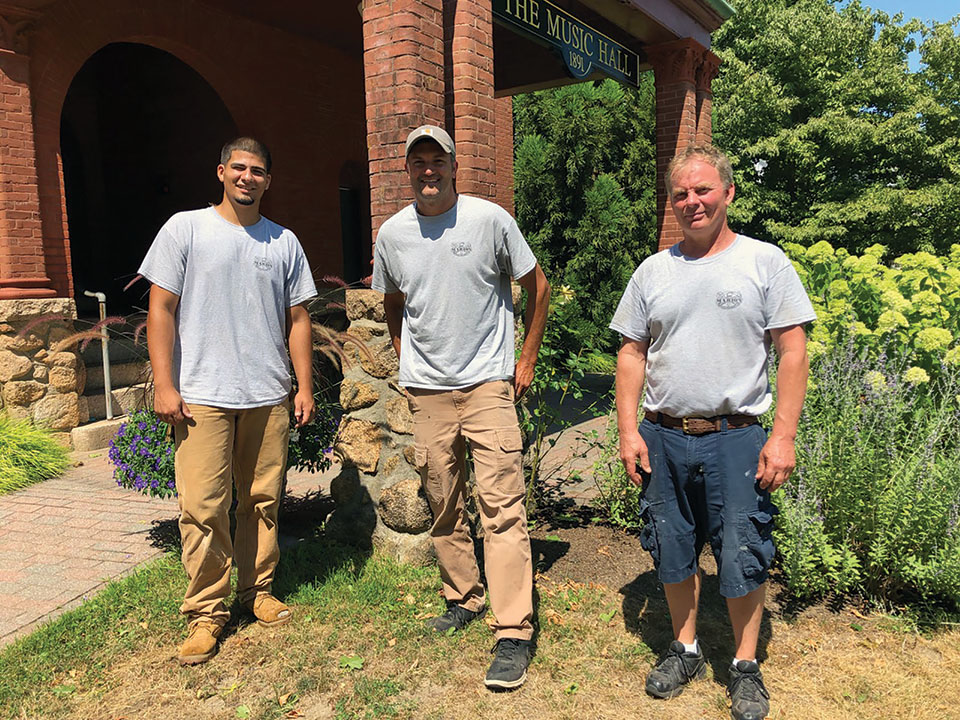
            Over the past months, the Music Hall has focused on shoring up the building’s foundation. Shaun Cormier, Marion’s Facilities Director, and a team of skilled craftsmen broke up the old concrete floors and carted the debris to the Benson Brook Dump. They removed all of the dirt from trenches and installed new perforated drainpipe – adding and leveling 60 yards of crushed stone. Soon they will be pouring concrete throughout to create an entirely new dry basement floor. In so doing, the result will lower the water table, preventing further deterioration of the brickwork.  They have also totally rebuilt ten basement windows as well as the stairwell to the basement. 

            Shaun gives enthusiastic credit to his team which included his foreman, Peter Wood, his laborer, Eric Cormier, and three members of the DPW, Adam Carvalho, Toby Gonsalves, and Nathan Fincher. The Music Hall Advisory Committee is appreciative of all this recent foundation work which will clearly extend the life and use of this historic building.

            Elizabeth Taber would be proud to know that we continue to build upon this strong foundation. Thanks to the public/private partnership between the town and the Sippican Historical Society, other recent upgrades include acoustical additions to the concert hall and the stage, a new Bose sound system, the hanging of numerous Cecil Clark Davis portraits, a new generator, and the recent addition of a rebuilt Steinway piano, a generous gift from the Charles Paulsen family.

            Future projects on the Music Hall to-do list include repairs to the brick walkway, additional stage improvements, new gutters, and the refinishing of all the hardwood floors.

            While the Covid-19 currently limits the town’s use of its public facilities, there shall soon come a time when the Music Hall will reopen to the public for all its intended uses: chamber concerts, exercise classes, book sales, lectures, weddings, and more.

            If you or your organization is interested in booking the Marion Music Hall, please contact Tami Daniel, Coordinator at 508-748-9556. This exceptional facility is ready and waiting to host your favorite future event – sooner or later!

Donn Thomas Stangohr

Donn Thomas Stangohr, of Rochester, MA, bright blue-eyed, gregarious, and wildly loved, passed away on August 11, 2020 at the age of 69. He is survived by his best friend (passionate spouse, business partner, and partner in all things) Sandra Lee Stangohr (Sandi), along with a whole troop of family – his son Blake Stangohr and his step/half children Alex Schinas, Jon Lagreze, Keith Lagreze, Kit Lagreze, and Emma Lagreze; his siblings James Stangohr and Chrissy Stangohr; his six nieces and nephews; his nine grandchildren; and an incredible circle of friends. He was preceded in death by his parents James and Helen Bernice Stangohr.

            Donn resided with Sandi in Rochester for 28 years, boating in Mattapoisett on their boat Cruzan, a Cape Dory Typoon, and cruising around town in their big yellow Chevy Capri Classic 1973. Donn and Sandi founded Norumbega Associates, a high-end, decorative, hardware business that they own and built from the ground up together since 1991.

            Donn, a man of endless talents, was the person to call for every obscure handy-man question or history lesson. His knowledge was boundless and incredible. He was born in Evanston, IL, and went to the School of the Museum of Fine Arts at Tufts University (SMFA) to study sculpture and went on to express himself in many ways beyond sculpture. He was creative, laughed with his whole body, and made everyone feel welcome.

            The family will hold a celebration of Donn’s life in October. In lieu of flowers, donations, or food, please shower your loved ones with hugs, kisses, and “hello, beautiful’s in remembrance of Donn and his daily expressions of care and affection. We raise our glass and share in a big belly laugh for Donn. Bear hugs to all.

            Arrangements are with the Saunders-Dwyer Mattapoisett Home for Funerals, 50 County Rd., Route 6, Mattapoisett. For online guestbook, please visit www.saundersdwyer.com.

Confessions of a Wanna-Be Hairdresser

            One of the many grooming skills I learned from my Mother was how to keep my hair neat and tidy. She valued all things clean. Clean floors, polished furniture, crisp freshly laundered sheets, but more than these, clean bodies including fingernails – and hair topped her list.

            Growing up at a time when showering daily was still in the future, the Saturday night bath was mandatory. That deep claw-foot tub was like a massive indoor pool compared to my tiny stature. Ma would let me play for a bit but then she’d march in and scrub me from head to toe. A vigorous head washing was quietly endured.

            Before handheld hair driers, one’s head of hair dried as ambient temperatures dictated. As a very young child, my hair was cropped short at my chin, thus the drying process didn’t take that long. Later as my hair grew longer, wet hair had to be braided. Ma was a stickler for tight, eye-popping braids. The pain was real.

            But I was always fascinated by ladies’ hairstyles and products. Anyone remember Adorn Hairspray, White Rain Shampoo or Halo? How about bobby pins? Ma used loads of bobby-pin curls to create her WWII hairstyle that she wore well into the 1970s. As women moved onto more updated hairstyles, curlers instead of bobby pins came into popularity for the smooth, full curl you could achieve by installing them in your hair, especially overnight. Ouch! Raise your hand if you remember sleeping with curlers in your hair.

            By the time I reached high school, decisions had to be made. While I learned how to type and keep ledgers in balance in high school business classes, all I really wanted to learn was how to cut and style hair. It had been made clear there wasn’t any next tier of education coming my way, so I learned shorthand and typing well enough to support myself after graduation. Let’s hear it for office skills. I took my frustration out on my own hair and the hair on the heads of my Mother, Father and willing neighbors.

            Vera, who lived across the street from us, was glad to employ me for her once-a-week wash-and-set. This woman had places to go and people to see so looking her best was critical. After getting her hair permed professionally, a chemical permanent wave for those unfamiliar with hair-industry technical vocabulary, the weekly maintenance was entrusted to me.

            Vera liked her tight little curls. The curlers had to be equal to the task. By the time I was done carefully placing row after row of springy tiny curlers all over her rather large head, skewered in place by pink plastic pins, she was ready for her bonnet hair drier.

            This, as some of you will well recall, looked like a small canister vacuum with a large hose that had an equally large bouffant bonnet attached at the end. The bonnet would inflate with hot air once switched on. You couldn’t hear a thing once that puppy was fired up. Sometimes small burnt patches of hair and skin ringed the perimeter of the face from under the thick elastic of the bonnet. What women won’t do to achieve their look.

            Vera paid me two dollars plus tip, big money in those days. She has gone to her reward now, but while she lived, we remained on good terms. In her later years when I was kind of forced to visit her at the nursing home – Vera and Ma were roomies – she was fun to talk to. I’d comb her hair, much to the chagrin of my mother who, whispering under her breath, would say, “I thought you came here to visit me?”

            Doing my mother’s hair, especially in her later years, was a joy. She willingly submitted to my snipping and clipping with faith only a mother could muster. First, there was the hair washing in the kitchen sink, then the cutting and blow drying. There was always a little extra neck massaging thrown in for good measure. Much later in her journey those massages became a way to communicate what her deaf ears would no longer hear: “I love you.”

            Oftentimes Dad would be my customer, but mostly that was for a light trim and a major bushwhacking of his eyebrows. He trusted my steady hand not to poke his eyes out. He wouldn’t say a word that might distract me from the task of taming those wiry protrusions.

            My son was not spared my experiments with hair. I cut his thick, dark hair on many occasions. There was the near mullet I gave him before he was to embark on a trip with other teens from throughout the country who had been selected to sing in a chorus traveling to many countries. He sat bravely in our miniscule kitchen as I sawed through that mane of natural curls until I was satisfied it didn’t look so bad. I have photographs to prove no lasting damage was done. Scary to think that now his hair is fully salt and pepper.

            I never became a hairdresser, I just played one from time to time as needed. Yet it’s never too late to begin something new or, in my case, pick-up where I left off some 25 years ago. Due to the quarantine, I’m back in the hair-cutting business. My latest Guinea pigs are my husband and Harry the Dog.

            I suggested to my husband that I could, in fact, cut his hair during the quarantine. He was willing; the rest is now history. I’ve been doing a darn good job since March. I remind him how much money he is saving by letting me practice on his head, although I know he misses talking sports and politics with his barber, two topics of which we’ll never be simpatico. Absent the smack talk, my man is getting a good haircut even if I do say so myself.

            As for Harry, well he is far less willing. In our basement, I’ve set up a dog grooming station. Harry’s haircuts have progressed nicely from a patchwork quilt affect to a smooth, overall trimming. He is patient with me every now and then, giving a great sigh as if to say, “Are you done yet?” He’s even received compliments from the moms of his doggy pals, Oliver and Breton. Harry graciously accepts all compliments. Practice does make perfect.

This Mattapoisett Life

By Marilou Newell

Community Center Improvements, Cemetery Maintenance Discussed

            While a heatwave outside was tempered only by a sea breeze, the Marion Board of Selectmen met on Tuesday afternoon inside the air-conditioned Music Hall with a busy agenda, including a pair of appointments to discuss a landscaping project at the Community Center and the need to improve maintenance of the town’s cemeteries.

            In the 4:15 pm appointment, Harry Norweb of the Marion Council on Aging brought to the board a Community Center landscape project. “We’re looking for Board of Selectmen approval to start fundraising for our landscaping plan.” 

            For two years according to Norweb, the Cushing Community Center Park Project has been a concept that, if pursued and funded, could become a reality in 3-5 years. It would include a playground. The driveway and parking lot are outside the project’s scope, and Norweb hopes it will work its way up the priorities list for the Capital Improvement Planning Committee.

            According to Norweb, no work on any phase will commence without Board of Selectmen review, and no work on any segment of any phase will begin without funding secured. Norweb says that the project advances the AARP-friendly initiative signed earlier in 2020 by the selectmen.

            “We need this support to justify the time and effort. We are seeking no funding, just support of the selectmen,” said Norweb. “We’re not prepared to start fundraising yet… Donors like some assurance that the plan has been blessed by the authorities.”

            Selectman John Waterman said, “I don’t think that building has curb appeal, and we should be thinking about that.” Waterman indicated the belief that the Community Center’s outside appearance can be significantly improved without major work. A paint job is likely to occur in the near future.

            The renovations would include a 35 by 46-foot, open-air pavilion.

            Board of Selectmen Chairperson Randy Parker introduced infrastructural unknowns to the conversation and suggested that more should be learned before making decisions with limited information. “I think we have to look at the bigger picture on our end, replot the roads. Now is our opportunity,” he said.

            Having been instructed by Town Administrator Jay McGrail that the matter required no vote at this meeting, Parker told Norweb, “Take your time and see that it’s done right.” Norweb said his group will come back to the selectmen when it is ready.

            In the delayed 4:30 pm appointment, Margie Baldwin and Becky Tilden appeared to inform the selectmen about the challenges the town is facing with its maintenance of cemeteries. Baldwin reported that $30,000 was raised for headstone repair.

            Waterman reported seeing bush stumps strewn about on Marion cemeteries, paling in comparison to Boston-area cemeteries he described as “impeccable.” Selectman Norm Hills reported having cleaned out a cemetery section himself three years ago, only to see the brush all grown back.

            “We currently spend a lot of our workforce and our fees on cemetery maintenance; our fees don’t pay that bill,” said McGrail, who explained that a cemetery lot can be sold to a resident for $300, the money going into an account currently at $140,000 and needing Town Meeting approval to spend. On top of that, said McGrail, $200 is charged as a one-time fee for perpetual care (that money goes into an account currently at $36,000 that the Board of Selectmen can access — some of it was used it for mowing last year). Hypothetically, a surviving spouse would pay the town $500 for digging a hole for burial, that money going to the general fund. It costs $800 to be buried on a holiday and $175-$250 for cremation.

            Tilden was asked what other towns are charging their residents. “It’s hard to compare apples to apples because everyone does everything a little bit differently,” she said, explaining that in Marion, a maximum of six cremation remains are allowed atop a full burial.

            Waterman suggested that Marion need not be concerned with what surrounding towns do but rather figure out how much of the cost to subsidize the cemeteries comes through fees. He believes that the town should try to reconcile the fees closer to the costs.

            “I don’t know that you could charge a proper fee that would cover our costs,” said Baldwin. “Nothing against the DPW, but they’re just used to mowing and weed-whacking… Maybe we can charge more, but you can’t charge the full amount.”

            Tilden reported that, for the season, $51,681.28 is the estimated cost.

            “We’re not close; we bring in about ($10,000) a year,” said McGrail of the revenue gained through fees. He indicated that more research might yield some advice as to what Marion can do to better offset the costs of cemetery maintenance.

            McGrail opened his Town Administrator’s Report with a plan of bringing the Marion Open Space Acquisition Committee (MOSAC) in for a joint meeting on September 8.

            “It’s my view that if we are going to acquire more land for the town, it should have some strategic value,” said Waterman. “I want that to have public discussion.”

            The selectmen will also hold a public meeting with the Marine Resource Commission on September 22.

            Over the next month, the Department of Public Works facility project will issue an RFQ to achieve a preliminary design and needs assessment from an architect with a civil engineering component so that the final project can be lined up for spring Town Meeting. DPW Director David Willett said the Harbormaster headquarters project is not scheduled to be ready for proposal until spring. McGrail said, “We’ll have to move that up.”

            Parker is happy with the work be done on the Mill Street Water Main project, where a 12-inch main has been completed and chlorinated. 

            McGrail reported that the Town House renovation, a CPC project, saw its second run of windows installed on Tuesday. He said a majority if not 99.99 percent will be done. Sippican Historical Society’s donation helped complete the roof, and next up is the front entrance. McGrail said it will be on the board’s September 8 meeting agenda to approve the agreement and accept the donation.

            The sale of town property at Atlantis Drive was completed on August 5; the town no longer owns the property. Waterman said, “The public needs to understand that we sold it to move forward… will need another (DPW) building within a couple of years.”

            Parker suggested a walk-through of the existing DPW facility. He also thanked the Marion Garden Club. “Everything looks so nice,” he said. McGrail noted that the Garden Club “almost got the entire village done.”

            Among the 28 action items on the agenda, the selectmen approved the COA’s request for the appointment of Margaret Gee to full membership. That gives the COA a voting body of 13 members, four above the minimum. The council typically sees two members leave per year.

            The selectmen approved the donation of two surplus vehicles to the Town of Rochester. According to McGrail, Marion had been successful selling other used vehicles on an auction website but had no takers for the two in question.

            The approval of the additions of Tom Friedman, Alanna Nelson, and Alex Roy to the Energy Management Committee was tabled with an agreement that McGrail would discuss the matter on Wednesday with Chairperson Cristian Ingersoll. The committee, originally having five members, would now have eight. Waterman said it is better to have five regular members and three alternates.

            In keeping with the recommendation of Harbormaster Isaac Perry, the Bird Island Restoration Committee, which has not met in five years, was dissolved.

            The selectmen appointed Connor Flynn as a Student Police Officer. Chief of Police John Garcia, who is retiring in January, opening a position on the force, anticipates a graduation date of December 19 for Flynn.

            The selectmen approved McGrail’s proposed policy that all access to Town Counsel go through his office with the exception of the selectmen. “The most important part of this is this policy has been playing out for the last year and playing out well,” said McGrail. “I’ve never said, ‘No,’ but it keeps me in the loop and keeps you guys informed.” 

            The selectmen approved the closing of the A&J Boats land swap, ending a process that lasted a year and a half, according to McGrail. On Wednesday, the Conservation Commission was to vote to give the selectmen the authority to close on the land.

            Joe Zora and Turnbull Lynch were publicly thanked for their donation of $100 to Marion Fire/EMS. 

            The minutes for the board’s July 14 public meeting were approved. Before the meeting, McGrail clarified that those are not the minutes of the 2:00 pm executive session that preceded the 3:00 pm public meeting that day. The executive session on July 14 was held pursuant to Purpose 1 of General Law c. 30A, s. 21(a)(1) to discuss a personnel matter unrelated to performance.

            The next meeting of the Marion Board of Selectmen is scheduled for Tuesday, September 8, at 4:00 pm.

Marion Board of Selectmen

By Mick Colageo

Votes for Women

            On August 18, it will have been 100 years since the ratification of the 19th amendment, giving women the right to vote. However, women were not “given” the right to vote; they campaigned over 50 years for equality and the right to vote. The 19th Amendment declared, “the right of citizens of the United States to vote shall not be denied or abridged by the United States or by any State on account of sex.” Suffrage, the right to vote, is the fundamental right of citizenship.  

            On June 24 and 25, 1915, the Sippican Woman’s Club hosted the State Federation of Women’s Clubs for their annual meeting and to vote on women’s suffrage. Over 400 women from around the state gathered in Marion for two days. It was their annual meeting and an opportunity to add their voice to the suffrage movement.

            The General Federation of Women’s Clubs was founded in 1890. It was an important vehicle for women to gather consensus among themselves, on political issues, such as suffrage. The Federation had a notable record of activity on issues of historical importance. In a time when women’s rights were limited, the State Federation chapters held grassroots efforts to make sure the woman’s voice was heard.

            By the turn of the century, women had abandoned the hope of a Federal decree, and they had begun a state-by-state ratification campaign. By 1910, 11 states, all in the West, had given women the right to vote. Still, since southern and eastern states resisted, the Suffragettes decided that a “blitz campaign” to mobilize state and local organizations was needed. As of 1914, only 17 of the state federations had voted to support suffrage, even though it had been affirmed that suffrage had become a mainstream cause for middle-class women from every part of the country.  

            The question has always been, “why would members of the Federation of Women’s Club vote NOT to give women the right to vote?” In 1915, the woman’s suffrage movement was not universally popular. There were almost as many women against the suffrage movement as there were suffragettes. They opined that a woman should be first and foremost the homemaker, caring for children, husband, and home. They also believed that women would be best in a bipartisan role, impartial, no opinion, protecting themselves from the sordid world of politics. These women were called “anti-suffragettes”, or “antis” for short. The New York Times editorialized that “giving the vote to women is repugnant”.  Mrs. Grover Cleveland, a famous Marion summer visitor, wrote: “men’s and women’s roles had been assigned long ago by a higher intelligence.”

            So, women from around the state took trains, (had to transfer from Tremont in Wareham to Marion Depot), stayed at the Sippican Hotel for $4 a night, and convened at the First Congregational Church in Marion to participate in a two-day conference. Both sides of the suffrage movement were ready to fight for their cause. Newspaper articles of the event state that the “antis” were upset when they saw a suffrage ribbon tied to a decorative palm in the church. With 400 or more women, it was “standing room only”. 

            The first day was amicable, being that they only dealt with usual annual club issues. That evening there was a reception at the Sippican Hotel and a production of “Midsummer Night’s Dream”.

            On the second day, it was written in a newspaper account an undercurrent of excitement over the pending question of woman suffrage prevailed. Anti-suffrage and suffrage leaders were marshaling their forces for the test of strength which is expected to come when the suffrage question is brought before the convention for the adoption of resolutions.

            In the face of such division, the President of the State Federation began the session by stating, “Let us maintain unity in diversity. Let us not be broken by factions. Let us keep the peace in the organization we have always enjoyed.”

            Vote was taken, 203 to 99 in favor of ratification of Massachusetts’ referendum to grant suffrage to women in the November ballot. It is recorded: “Whereas the question of political equality of men and women is a very vital problem under discussion throughout the Commonwealth of Massachusetts, therefore, be it resolved, that the Massachusetts state federation of Women’s Clubs give the cause of political equality the moral support by recording its beliefs in the principle of political equality regardless of sex.”

            In November, the referendum failed. The strong political machine did not want an electorate they didn’t know. New York had the same referendum, and that lost also.

            It took five more years of continued pressure, with rallies, political polling, jailing, and hunger strikes. However, it was World War 1, when women picked up the gauntlet to drive ambulances, die at the frontlines while nursing the wounded, worked assembly lines to keep production of the country’s needs, that women finally were finally given citizenship, namely the vote.  

Sippican Woman’s Club