Eunice A. (Kimball) Eaton

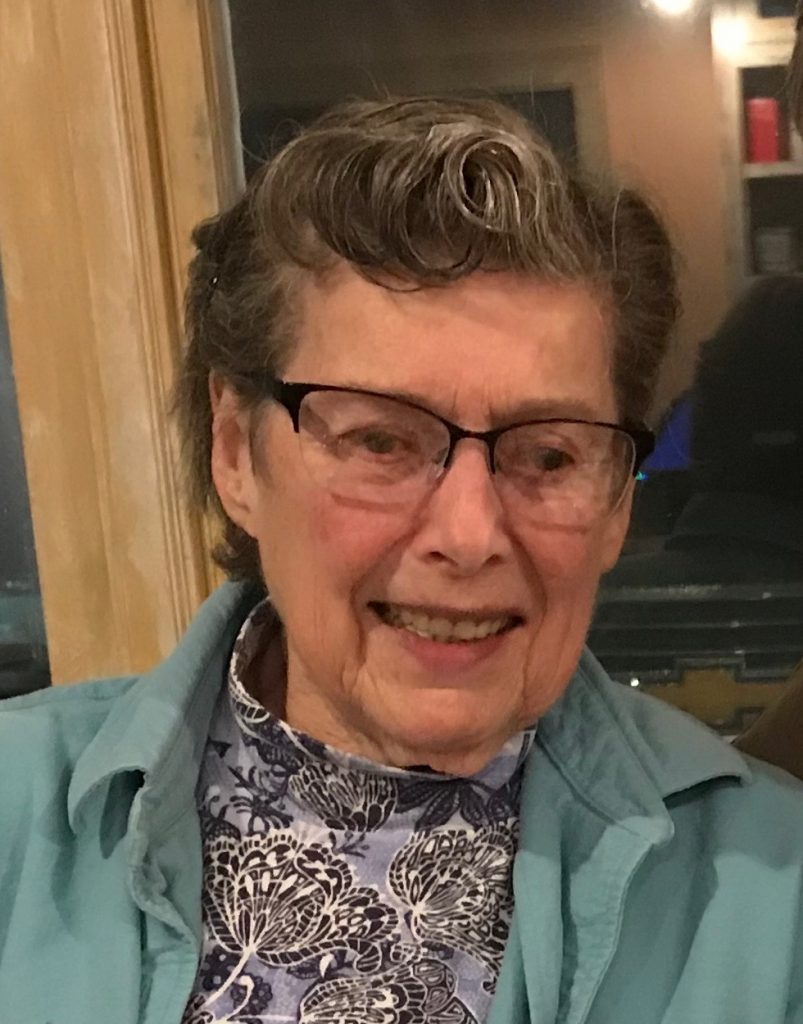
Eunice A. (Kimball) Eaton, 85 of Marion died February 24, 2020 peacefully at Tobey Hospital after a brief illness. 

            She was the wife of Everett F. Eaton with whom she shared 64 years of marriage. 

            Born and raised in Haverhill on the Kimball family farm, she lived in Topsfield before moving to Marion in 1959. 

            She was formerly employed by Cliftex and Calvin Clothing. 

            Mrs. Eaton was an active member of St. Gabriel’s Episcopal Church. 

            She enjoyed sewing, and working at her daughter-in-law’s drapery workroom. 

            Survivors include her husband; a son, Kevin Eaton and his wife Melinda of Mattapoisett; a daughter, Kim-Ann Eaton-Martin and her husband David of Jupiter, FL; a sister-in-law, Judith Kimball of Milford, NH; a granddaughter, Brandis Eaton; 3 step-grandsons, Christopher, Collin and Graham Smith; and several nieces and nephews. 

            She was the sister of the late Gladys Cande and Leonard Kimball. 

            Her Memorial Service will be held on Saturday, February 29th at 4 PM in St. Gabriel’s Episcopal Chapel.. Visiting hours are omitted. Arrangements are with the Saunders-Dwyer Mattapoisett Home for Funerals, 50 County Rd., Mattapoisett. In lieu of flowers, remembrances may be made St. Gabriel’s Episcopal Church, 124 Front St. Marion, MA 02738. For online guestbook, visit www.saundersdwyer.com.

Walter J. Wordell

Walter J. Wordell, 88 of Mattapoisett passed away at home on Saturday, February 22, 2020. He was the husband of the late Mary (McKay) Wordell, with whom he shared 48 years of marriage.

            He was born and raised in Westport, MA, the son of the late Harold O. and Dorris E. (Macomber) Wordell.

            Walter was a graduate of Westport High School and New Bedford Institute of Textiles and Technology.

            He enjoyed a long career in the textile industry in New York City, working for Celanese Fibers Marketing Company, J.P Stevens and Co., and the Forstmann Co.

            Walter and Mary raised their family in Ossining, NY. Walter was very active in his church, St. Augustine, serving as a commentator and on the parish council.

            After retiring, Mary and Walter moved to Mattapoisett, where the two had met at the Mattapoisett Town Wharf square dancing in the early 1950’s, and where the family had a summer home.

            Walter was a communicant of St. Anthony’s Church, a member of the Machacam Club, and a weather watcher for WQRC in Hyannis.

            He is survived by his four daughters, Paula M. Spengeman and husband Peter of Verplack, NY, Susan M. Rodriguez of Peekskill, NY, Mary Elizabeth Rock and husband Michael of Raleigh, NC, Julie A. Ford and husband Philip of Carmel, NY; his son, David and wife Sarah of Fairhaven, MA; 12 grandchildren, Peter, Stephanie, Alfonso, Alyssa, Nicholas, Jesse, Matthew, Katherine, Nathaniel, Angelica, Amanda, and Drew; two great-granddaughters, Bailey and Isabella; and his companion, Barbara J. Brownell.

            Walter was predeceased by his brother Richard Wordell and sister Arline Tripp.

            His funeral will be held on Saturday, February 29, 2020 at 9 am from the Saunders-Dwyer Mattapoisett Home for Funerals, 50 County Rd., Rt. 6, Mattapoisett, followed by his Funeral Mass at St. Joseph’s Church in Fairhaven at 10 am. Visiting hours will be on Friday, February 28th from 4-7 pm. Burial will follow in the St. Anthony’s Cemetery. In lieu of flowers, remembrances may be made to the Carolina’s Raleigh Chapter of the Cystic Fibrosis Foundation Angelica’s Angels at 7101 Creedmoor Rd. Suite 130, Raleigh, N.C 27613, the Pancreatic Cancer Action Network at pancan.org, or to the National Multiple Sclerosis Society at nationalmssociety.org. For directions and guestbook, please visit www.saundersdwyer.com.

Assessors Impose Abutters-List Fee on ZBA

            Technicalities regarding the application of a special permit in addition to a variance highlighted one of two continued cases before the Marion Zoning Board of Appeals at its February 13 meeting, but the stickiest subject was the letter that the ZBA received from the Assessor’s office regarding a new $50 fee being charged the ZBA for every request a citizen makes for an abutters list.

            The letter dated February 11, 2020, stated that the Board of Assessors had recently voted to implement a $50 fee for all abutters lists distributed.

            The ZBA is Marion’s only board in which the office procures the abutters list. On the other boards, applicants notify abutters.

            Administrative Assistant Anne Marie Tobia explained to the ZBA that applicants currently request the list from her and she procures it from the Assessor’s office. The ZBA’s application fee is currently $300. 

            “And I do all my notifications,” said Tobia. “So, the applicant will go to the Board of Assessors and pay their $50 fee, and their application would consist of the abutters list and the application and the fee. If we decide to knock it down to $250 or not, that’s up to the (ZBA).”

            “I don’t feel comfortable lowering our fee. I don’t think our board should take a hit. But I also don’t feel that we should have to pay for it,” said ZBA Chairman Mark LeBlanc.

            ZBA member Margherita Baldwin indicated concern that the process should remain user-friendly for citizens, but member Tad Wollenhaupt said it was normal for applicants to notify abutters.

            “All the other boards require (a fee); we’re the only board that doesn’t,” he said.

            LeBlanc sought to confirm, given the internal nature of the assessment, whether or not the ZBA will now be charged by the Assessors Office for each application requesting an abutters list. Tobia answered that the ZBA will be charged and suggested applicants submit two checks, one for $250 to satisfy the ZBA and one for $50 to apply for the abutters list. That way, the ZBA would not need to change any procedures. LeBlanc concurred, hoping to avoid having applicants make their own abutters lists and notifications, a scenario he considered “disastrous.”

            “So, let’s put it on the agenda for the next board meeting to discuss lowering our fee,” said LeBlanc. “I just want to make sure it’s publicly noticed because we’re making a vote on it.”

            Board member Christina Frangos suggested amendments for clarity to the January 16 meeting’s minutes, and those amendments were included in the accepted version of the minutes. 

            Town Counsel Jon Witten drafted a decision granting a special permit to Tabor Academy for the usage of field lights. After studying the document, Frangos, an attorney, offered several suggestions. 

Focusing on Footnote No. 1 that states Tabor is permitted to maintain field illumination until 9:45 pm to ensure safe exiting from the premises, providing the lights are lowered at 9:30 pm, Frangos clarified the intent of the permit to define the process as beginning the lowering sequence at 9:30 pm.

            LeBlanc asked, “Do we need to identify a level? Is it that necessary?”

            “I don’t know what a proper level is; that’s not a skillset I have,” said Witten. “The board could certainly limit that – a lumen (maximum). I just don’t know what that number would be.”

            It was agreed that trial and error would be a necessary part of the process of arriving at a fair implementation of the permit.

            Two continued cases were brought before the Zoning Board. The first time hearing the case, two board members were not present so the ZBA applied the Mullin rule to allow the full board to rule and ask any questions. Frangos, who was not present at January 16, abstained from voting on both cases.

            There was extensive discussion over a question in Case 773, in which property owners Raymond Whitley and Natalia Vartapetova, 534 Point Road, sought a variance from Section 230-5.1 for setback relief and a special permit under Sections 230-6.1a, 230-6.1c, 230-7.1, 230-7.2 and 230-7.3 of the zoning bylaws to allow the construction of a detached garage. It is customary that a variance or special permit be required but not both.

            “The existing building is a bit of a disaster so we want to clean that up,” said Whitley, addressing the board. “I spoke to each neighbor, (and) they said they were fine with it. I didn’t see why they wouldn’t be because the garage is an eyesore.”

            Whitley indicated that the house, a 1950s design built on a slab and later expanded, needed the garage for storage.

            Scott Shippey, building commissioner and zoning officer, said, “The whole thing could be considered non-conforming because it’s detached,” and further instructed the ZBA that while a special permit provides more leeway, it does not carry over to a new owner and would be terminated upon transfer. A variance stays with the property forever.

            Originally measuring 13 feet, 6 inches by 10 feet, 3 inches, Whitley plans to rebuild the structure at 26 feet deep so it can garage a vehicle. Since the work will not make the structure any worse and is approved by the neighbors, it was granted a variance as a new, non-conforming structure rather than an expansion of an existing structure.

            In Case 772, Stephanie and Richard Harding were also granted a variance from Section 230-6D and 230-6E of the zoning bylaws for their non-conforming garage at 52 Ichabod Lane.

            After the public hearing was closed and the location of the Harding’s garage was approved by the board, discussion around the operations of the board ensued before the next public hearing. 

            Alternate member Cynthia Callow, who was new to the board, sought clarification on law and process. 

            “The thing with the Zoning Board is we have a very narrow window that we look through, very narrow. And we’re reminded of that quite often by town counsel,” said Board Chairman Mark LeBlanc. “It’s a small town, we know people but we tend to – we have to keep a really small focus as to what we’re discussing as far as the cases go.”

            The next meeting of the Marion ZBA is scheduled for February 27 at Marion Town House.

Marion Zoning Board of Appeals

By Mick Colageo

Tabor Academy to Host Blood Drive

Please participate in Tabor Academy’s winter blood drive on February 27 from 8:30 am to 3:30 pm for the Kraft Family Blood Donor Center benefitting Dana Farber and Brigham and Women’s Hospital! You will find the Blood Mobile in the parking lot at 256 Front Street in Marion. Drop in or by appointment by emailing cmoore@taboracademy.org. 

            Just 45 minutes of your time can help save lives. People undergoing treatment for cancer, as well as accident victims, transplant recipients, and many other patients depend on transfusions. Volunteer donors are the only source of blood products for these patients.

            A photo ID is required and donors must be at least 17 years of age. Appointments take about 45 minutes.

Mattapoisett Cultural Council

Are you interested in supporting community-based projects in the arts, humanities, and sciences in Mattapoisett that enhance our quality of life? Each year, Mattapoisett Cultural Council awards funds for public cultural events such as plays and concerts, arts in the schools, community organizations, field trips for students to museums and performances, and more. These programs promote the availability of rich cultural experiences for Mattapoisett residents.

            Council members are municipally-appointed volunteers who help determine how to disburse available funds to individuals, schools, and community organizations that apply for project support. Mattapoisett Cultural Council is seeking several new volunteers interested in serving as voting members to work together to allocate funding. 

            Council members are appointed for a term of three years. While we welcome prospective members who appreciate the cultural life of our community, individuals with skills and experience in accounting, publicity, web design, public advocacy, and event planning are particularly needed.

            Information about the local cultural council program is available at www.massculturalcouncil.org/programs/lccgrants.asp.

            If you are interested or have questions about becoming a member, please contact kcdamaskos@gmail.com. Deadline March 10.

Mattapoisett Woman’s Club Scholarship

Mattapoisett Woman’s Club is pleased to offer three $2,500 scholarship awards to Mattapoisett residents who are high school seniors, graduating June 2020. 

            In addition, there will be a $1,000 scholarship granted to a Mattapoisett resident

who is reentering the academic world after graduation and is in pursuit of a post secondary degree. Please go to the website (listed below) for further information and/or to obtain the application for this scholarship.

            The Mattapoisett Woman’s Club is a philanthropic organization that plans and executes fundraising events to help generate the revenue for these scholarships and other charitable donations. In offering these scholarships, the club supports educational leadership and helps to support the community whom has partnered with the club in its fundraising efforts. 

            For high school seniors, the scholarship application will be available in the Guidance offices of Old Rochester Regional High School, Bishop Stang High School, Old Colony Vocational Technical High School, Tabor Academy, Bristol County Agricultural and online at www.mattapoisettwomansclub.org for those not attending the above schools.

            Final deadline for returning completed applications is March 31,2020. No one will be considered after this date.

            If you have any further questions you may contact the Mattapoisett Woman’s Club at P.O. Box 1444, Mattapoisett, MA 02739.

Madison J. Snow

Madison J. Snow, 32, of Buzzards Bay was welcomed into Angels arms unexpectedly on Friday, February 14, 2020 at Tobey Hospital.

She was the daughter of Dale and Susan M. (Santos) Snow.

Madison was born in New Bedford and grew up in Marion, graduating from Old Rochester Regional High School before moving to New Bedford then Buzzards Bay.

Madison loved gardening, animals (especially cats), swimming, beachcombing, walking and sitting by the canal, reading and writing.  She wrote beautiful poetry.  Most of all, Madison cherished spending time with her sons, the loves of her life, Myles (9), and Brian (8), whom she adored.  Any activity with them was special.  Playing at the playground and beach, cuddling while watching movies, being silly with imaginary play or funny Snapchatting.

Survivors includes her parents, Dale and Susan M. (Santos) Snow of Marion; her two sons, Brian Snow of Marion and Myles Snow of New Bedford; her sisters, Chelsea Snow of New Bedford, McKenzie, Bellamy and Ainsley Snow all of Marion; her brothers, Randy Snow of New Bedford, Douglas Snow of Dedham, Chad Snow of Boston, and Gideon Snow of Marion; her niece, Kayla A. Briggs; her nephew, Dyllen C. Briggs, and many aunts, uncles and cousins.

Madison’s friendship touched many people.  She will be remembered and missed by many.

“Our lives are streams, flowing into the same river, towards whatever heaven lies in the mist beyond the falls.  Close your eyes and let the waters take you home.”

Services will be held at a later time.

Arrangements by Chapman, Cole & Gleason Funeral Home, Wareham.  To leave a message of condolence, visit: www.ccgfuneralhome.com

Vincente (DeSimone) Garofalo

Vincente (DeSimone) Garofalo, 86, of Marion, MA and Bayonne, NJ passed peacefully at home on Tuesday February 18, 2020 in the loving embrace of her devoted family. 

Vincente held a deep and abiding faith in God. She will forever remain a graceful presence in the hearts of all those who loved her. 

She is survived by her beloved daughters, Chantal Garofalo and Joanne Hannan and her husband Joseph. 

Her Funeral Mass will be celebrated on Monday February 24, 2020 at 10 AM at St. Rita’s Church, Marion. Burial will follow in Riverside Cemetery, Fairhaven. Visiting hours will be on Sunday February 23, 2020 from 2-4 PM. For directions and guestbook, please visit www.saundersdwyer.com.

Surety Discussed for Age-Related Development

            For over a year, an age-related residential subdivision has been wending its way through the permitting process in Rochester. Long hearings with both the Conservation Commission and the Planning Board, site visits, engineering modifications, peer reviews, and continuances have been required by town officials to satisfy their questions and concerns in what will be a very high-profile construction project when shovels start moving dirt near Plumb Corner.

            Thus, it was no surprise when Repurpose Properties, represented by both Brian Wallace and John Churchill of JC Engineering, Inc., when coming before the Rochester Planning Board on February 12, found the hearing once again continued, this time over the matter of surety – the type of surety Rochester was willing to accept.

            The site is located in the heart of Rochester at the intersection of New Bedford Road and Route 105. The 44-unit, over-55 community on property owned by Gibbs V. and Patricia Bray Trustees, has gone through many iterations in terms of drainage designs and protection of contiguous wetlands, but on this night the theme was surety.

            Wallace said that he had responded to all final site-related questions posed by peer-review consultant Ken Motta of Field Engineering. He also noted that he was in receipt of a letter from the Historical Commission indicating there were not issues with the placement of the project at the proposed location. 

            Wallace also discussed how fresh water will be supplied to the residential units, saying that project planners were in discussion with the Town of Marion, which supplies water to that location and that the Mattapoisett River Valley Water District had confirmed acceptance of the plans.

            Then surety was discussed. Churchill suggested holding units would be sufficient for ensuring that the project will be completed as planned. But members of the Planning Board said that was not what Rochester was looking for. They stated that the town had moved away from solely holding units until such elements as roadways and infrastructures were completed to their satisfaction, to cash or bonded sureties up to 50 percent of the value of Phase 1, in this case over $1 million.

            “A fifty-percent contingency is standard,” stated Chairman Arnie Johnson. 

            Discussion continued for nearly 30 minutes, during which Johnson explained that a bond was needed up front, then once the roadway binder was in place along with utilities and drainage infrastructure, a switch to units could be considered. “We can amend the surety agreement afterwards,” he stated.

            Churchill expressed concern that a bond would be a financial burden to the developer, saying “…I don’t want to bond the entire Phase 1; usually the developer starts with infrastructure, then goes as far as you can with financing.” 

            In the end, it was decided that Churchill would return with a surety plan that included bonding for Phase 1. Once that surety is in place and Phase 1 roadway(s) and infrastructure completed, Johnson said the developer could apply for building permits, build model units, and have surety agreements reviewed. The hearing was continued until February 25.

            Also coming before the board was Pedro Rodriguez, Solar MA, regarding a 35-acre solar array planned for 0 Old Middleboro Road. Requested plan modifications were discussed including the protection of historic features such as stone walls and homestead foundations. Construction waivers were also discussed. The project hearing was continued until the next meeting.

            The next meeting of the Rochester Planning Board is scheduled for February 25 at 7:00 pm in the Town Hall conference room.

Rochester Planning Board

By Marilou Newell

Centennial Celebration – The Road To The Vote

            In softly spoken tones, Katherine Dibble, former director of Public Service at the Boston Public Library, gave a presentation at the Mattapoisett Public Library on February 15 on the struggles of the suffragettes who fought the battle for women’s right to vote and won. 

            While the world may know Susan B. Anthony as the most famous suffragette, her work was not a solo effort. This year is the 100th anniversary of the 19th Amendment, and to celebrate that monumental achievement the Boston Women’s Suffrage Trail is taking its show on the road to educate the public about the activism of local women. The lecture series highlights the work of many Massachusetts women in the pursuit to secure voting rights for women. 

            Few in attendance were familiar with many of the names Dibble shared, names that should not be lost to history. Thus, through the establishment of the BWST, suffragettes from the Commonwealth are finally getting recognition they deserve, she said.

            Dibble began by sharing that as far back the 1700s Abigail Adams was lobbying her husband, “…do not forget the ladies” when drafting legislation. The notion of women being fully capable of participating in government and in electing officials was still in the distant future. While the letter exchanged between the Adams showed a rather modern concept of the relationship between men and women and their roles in life, Abigail simply wanted women to be thought of as more than property. It would more than 100 years more before the 19th Amendment solidified that women did, in fact, have the mental capacity and human qualities needed in order to vote. 

            It is a short amendment, a mere 39 words that reads, “The right of citizens of the United States to vote shall not be denied or abridged by the United States or any State on account of sex. Congress shall have the power to enforce this article by appropriate legislation.” By August 19, 1920, the required 36 states had ratified the agreement. Massachusetts was the eighth state to accept ratification. The long years of campaigning, lecturing, publishing, traveling near and far, spreading the doctrine of equal voting right for women had at last succeeded. 

            But who were those women of Massachusetts who put their private lives on hold, who tested the male-dominated legal system, who were arrested, sent to prison, and in some cases persecuted for their belief that voting rights should be granted to women? 

            Lucy Stone (1818-1893), in Dibble’s estimation, is deserving of far more recognition than Anthony. But Anthony ”and Elizabeth Cady Stanton wrote the early history of the movement,” she said, possibly solidifying their position as singular engines of change. 

            Stone had had a falling out with Anthony over the inclusion of voting rights for African Americans. Dibble described Stone as being very modest and preferring to work behind the scenes. More than a century later her work is being publicly hailed. 

            In the Boston State House, along with Josephine Ruffin (1842-1924), Mary O’Sullivan (1864-1943), Sarah Remond (1814-1894), and Florence Luscomb (1887-1985), is a bust of Stone, who is also celebrated with a bust in the Boston Public Library along with her daughter Alice Stone Blackwell (1857-1950), who was an activist for suffrage, human rights, and peace. 

            Stone’s image can also be found at Faneuil Hall and as one of the three women depicted in the Boston Women’s Memorial located on Commonwealth Avenue at Fairfield Street. This later monument also includes Abigail Adams (1744-1818) and Phillis Wheatly (1753-1784). Wheatly is remembered for being the first African American female poet published in book form. Today she is known as the mother of African American literature. 

            Remond was a free-born African American and a well-known speaker against slavery as well as an advocate for women’s right to vote. O’Sullivan moved to Boston from Missouri, becoming a labor organizer and suffragette. Ruffin published the first newspaper by and for African American women. Luscomb was the first woman to graduate from Massachusetts Institute of Technology, a leading suffragette who also fought for prison reform and factory safety, and many years later became an activist against the Vietnam War.

            The Morey women, mother Agnes (1868-1924) and daughter Katharine were prominent leaders of the movement. They were arrested for picketing against President Wilson when he came to Boston. Agnes had also been arrested and imprisoned in Washington, D.C. for picketing the White House.

            Sisters Sarah (1792-1873) and Angelina (1805-1879) Grimke made some of the first attempts at securing voting rights for women. They were also abolitionists.

            Dibble’s presentation carefully mentioned more than 30 Massachusetts female movers and shakers for women’s right to vote. Of special note there was Clara Barton (1821-1912), also known as the “Angel of the Battlefield” for her nursing of the wounded during the Civil War, Mary Rice Livermore (1820-1905), also an abolitionist and advocate for the vote traveling hundreds of miles for years for those causes, Mary Eliza Mahoney (1845-1926), the first African American woman to become a registered nurse and also the first woman in Boston to register to vote, and Jennie Loitman Barron (1891-1969), the first full-time female judge in Massachusetts was also an outspoken advocate for women’s right to vote as she stood on street corners declaring her position to passersby.

            Dibble’s presentation was sponsored by the Friends of the Mattapoisett Library and the Southcoast League of Women Voters. To learn more about Road to the Vote: The Boston Women’s Suffrage Trail, visit www.bwht.org.

By Marilou Newell