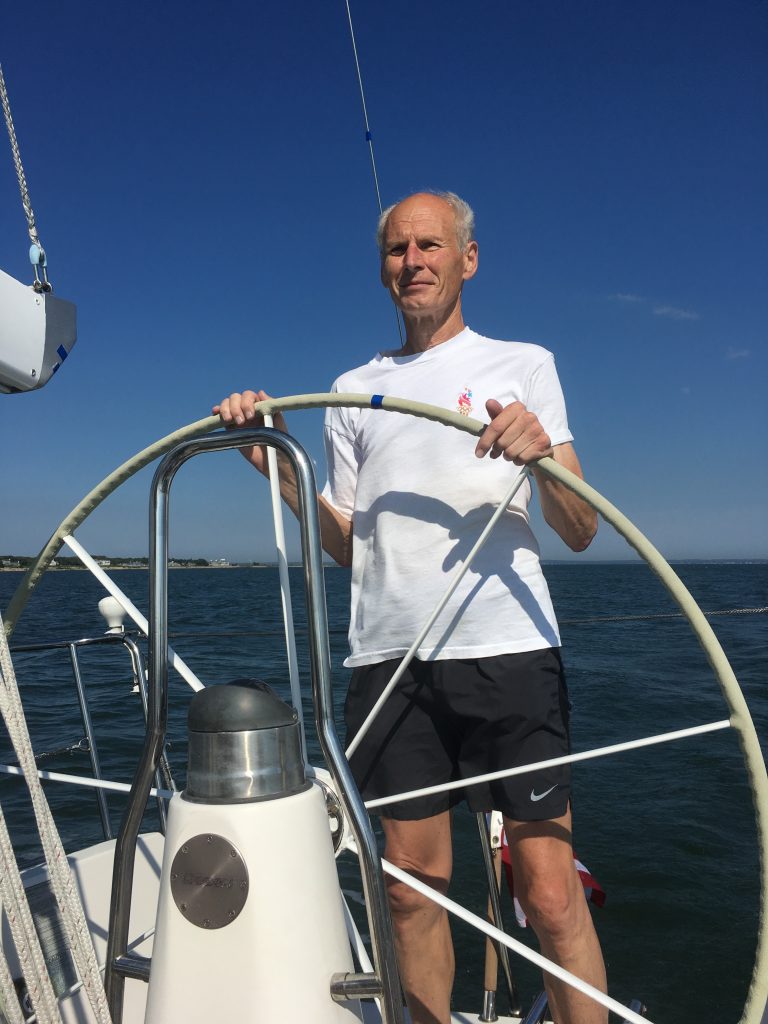
Hathaway’s Trek Has Come Almost Full Circle

            The number 24,901 is symbolic to most minds, but it is especially fascinating in Brad Hathaway’s because he sees it as a finish line coming into view.

            “I’m kind of a numbers freak, I could tell you exactly how much money I have found on my walk,” he said while resting at the Town Beach at Aucoot Cove. “You want to know how much money I’ve found? Just shy of $400. But that’s 32 years.”

            Likewise, the Mattapoisett resident has been steadfastly accurate in measuring his progress while walking the equivalent of the earth’s circumference.

            “I absolutely knew… from the minute I started walking,” he said. “First of all, I took my car and I measured every place to a quarter of a mile that I could possibly walk, down into Marion, down as far as Angelica Point – I did that once, 10 miles so I knew… I knew exactly.”

            What began in 1988 as a 3-mile-per-day prescription to the wake-up call of heart disease and the threat of diabetes has, in its stretch run, been refocused as a “Walk around the World” for the benefit of the Mattapoisett Land Trust.

            Brad Hathaway’s lifelong passion for land conservation emanates from four centuries of American history that goes back toMayflower passenger John Cooke, one of the five colonists to purchase the land surrounding Aucoot Cove from Native Americans in 1668, and Arthur Hathaway, a witness recorded in the Plymouth County Registry of Deeds.

            Brad Hathaway is a direct descendent of both colonists, and his commitment to his land led to the 1974 co-founding of theMattapoisett Land Trust with David and Norma Hewitt, George Mock, and others.

            Today, the Mattapoisett Land Trust protects over 850 acres of land. The proceeds from Brad Hathaway’s walk around the world will be used to purchase land in the Aucoot area in an effort to increase the 480 acres presently held there by the MLT.

            At age 88 and dealing with a December 2019 diagnosis of Parkinson’s Disease, Brad Hathaway now needs a walker to get around. He has fallen on the backroads and once on Route 6. Rain, ice, and snow used to be a nuisance. Now bad weather is a dealbreaker.

            “I used to pick up trash, but now it’s very hard for me to get down,” he said, noting 11 discarded scratch tickets yielding $49 in lottery winnings. “If I get down, there are times I can’t get up even if I have (my walker). But if this rolls away from me, even 4 or 5 feet, I can’t get to it.”

            His pal Carl Sharpe reminded him that he has no cell phone, to which Brad Hathaway said he does not have a computer. “I won’t,” he said.

            Brad Hathaway is old school in more ways than one.

            On September 1, he had approximately 90 miles remaining. He is acutely aware of the 20-mile difference measuring from pole to pole, and will keep that in his back pocket should the wheels come off on the home stretch. All tongue in cheek, of course. He fully intends on reaching his goal.

            In the early 2000s, Brad Hathaway wrote a story for The Standard-Times in which he stated he thought he could complete the earth trek sometime in 2008. The memory now triggers laughter. “It’s 2020 and I’m still walking,” he said. “My wife used to walk with me. There’s something driving me inside now that says, ‘You’re going to make it.’”

            The day he will make it is anticipated to be on Saturday, October 3, and the Mattapoisett Land Trust has organized a celebration.

            Starting at 10:00 am, supporters will join him where Aucoot Road meets Bowman Road and join him for the home stretch back to his house. Attendees are asked by the Mattapoisett Land Trust to wear facemasks, and family groups are asked to maintain 10 feet between their clusters. Parking is available along Aucoot Road and at the Town Beach at Hiller’s Cove.

            For more information or to donate, visit mattlandtrust.org/bradswalk or mail a contribution to Mattapoisett Land Trust, P.O. Box 31, Mattapoisett, MA. Online contributions can also be made by searching “Brad Hathaway” at gofundme.com.

By Mick Colageo
Sippican Historical Society Speaker Series

Our Speaker Series continues this month with a presentation via Zoom by Dr. Nina E. Harkrader of NYU. The lecture, which will take place on Thursday, September 10 at 7:00 pm, is entitled “All the Single Ladies: Women-Only Buildings in Early 20th-Century New York”.

            SHS members will receive the Zoom link by email on the day of the presentation (September 10). Non-members may request the link by contacting us at info@sippicanhistoricalsociety.org

            Dr. Harkrader holds a Ph.D. in art and architectural history (NYU) and an MA with distinction in the Archaeology of Buildings from the University of York, England, as well as an MA in Architectural History from the University of VA. In addition to teaching seminars for Historic District Commissions and working as an independent consultant with local historic preservation, she has worked as a field officer for the Council for British Archaeology, for the Connecticut Trust for Historic Preservation, and the National Trust for Historic Preservation. She has also served as a member of the Guilford, CT Historic District Commission for six years.

            Dr. Harkrader’s work and teaching focus on the relationships between buildings, history, and people during the 19th century. Her lecture will discuss the ways in which buildings, interior plans, and furnishings work together with documentary evidence to shed light on significant moments and periods in social history, specifically on housing for women in NYC at the turn of the century.

            We hope to see you there.

A Kid’s Historical Bike Tour of Marion

Summering in Marion with her grandparents, seven-year-old Greta Agnew of Pennsylvania spent much time riding bikes around the village. Curious about the history of this little town, she read through her grandmother’s books and found old photos online. She learned all about historic buildings, local architecture, and Marion’s “fairy godmother,” Elizabeth Taber.  Knowing kids (and their parents!) are looking for activities that allow for social distancing, she thought a bike tour focused on her findings would be fun to create. The tour begins at Main and Front and loops around town. Print out a guide or use the website for a guided tour. See more at: kidsbikemarion.wixsite.com/mysite

David Lawrence Bramley

David Lawrence Bramley, 72, of Marion formerly of Woburn, passed away on Wednesday, September 2nd, 2020 at Rhode Island Hospital. He was the husband of Margaret-Mary (Dailey) Bramley. They were married and deeply in love for 39 years.

            Born in Boston, he was the son of the late Mary Angela (Bailey) and David L. Bramley.  Mr. Bramley graduated from Tufts University School of Engineering with a B.S. in 1969 and received his MBA from Babson College in 1981. He worked as a Civil and Environmental Engineer for various corporations and as an independent consultant with LEP, LSP, and PE certifications.

            Mr. Bramley was an active member of the Marion community and was a member of the Marion Zoning Board of Appeals. He was an avid runner and participated in many road races and multiple Boston Marathons. He also enjoyed sailing, renovating his homes, playing with his dogs, Teddy and Phoenix, and spending precious time with his wife, daughters, and grandsons.  He will be deeply missed and loved.

            Survivors include his wife, Margaret-Mary; his daughters, Kathryn Dailey Bramley and Elizabeth Dailey Bramley Williams; son in-law, Thomas Jacob Williams; his grandchildren, Jacob Cruz Edward Williams and Caleb Hawk Ellis Williams; his sister, Pamela A. Bramley; his brother, Peter Bramley; his sister in-law, Linda Bramley; his brother and sister in-laws, Ed and Mary Dailey, Rick and Maureen Dailey, and Stephen and Debbie Dailey. Also surviving are his nine nieces and nephews.

            Services will be private and for immediate family only. A celebration of life will be planned for a future date.

            In lieu of flowers, please consider making a donation, in Dave’s name, to giving.tuftsmedicalcenter.org/give, designation “Hypertrophic Cardiomyopathy” or by check  to Tufts Medical Center Development Office, 800 Washington St., Box 231, Erin Gilbert, Executive Director of Development, Boston, MA 02111, or phone at (617)636-5219, in order to support further research on Atrial Fibrillation.

            Arrangements by Chapman, Cole & Gleason Funeral Home, Wareham. To leave a message of condolence visit: www.ccgfuneralhome.com

Maureen A. (Jackson) Hedges

Maureen A. (Jackson) Hedges, 71, of Fairhaven passed away peacefully, surrounded by her loving family at home, Saturday, September 5, 2020.

            Born in New Bedford, daughter of the late Frederick and Evelyn (Tyson) Jackson. She grew up in Fairhaven and Mattapoisett, lived in North Carolina and raised her family in Rochester, MA prior to returning to Fairhaven in 1996. Maureen was a graduate of Old Rochester Regional High School and St. Anne’s Nursing School in Fall River. She practiced as a Registered Nurse working at several nursing facilities retiring as Director of Nursing from Copley of Stoughton. In her 50 years as a Registered Nurse, she established many friendships often referred to as the ‘gang’ or ‘misfits’ but always revered as friends.

            Strong in her faith as a child of God, Maureen was an active member of St. Joseph’s Church in Fairhaven, acting as a Bereavement Minister, a member of ACTS, the choir and as a Faith Community Nurse. She cherished her family, friends and her companion goldendoodle, Cassie. She was honored to help and make a difference to all she encountered with words of comfort, guidance, faith and humor. Her place of elated comfort on earth was with her family, friends and especially at the beach with her best friend.

            She leaves Clifford J. Hedges III and their children; Clifford J. “CJ” Hedges, IV and his wife Heather of Marion, Ronald F. Hedges of Fairhaven, Joshua J. Hedges and his wife Erin of Acushnet, Christina E. Beam and her husband Stephen of New York and Kathleen A. Hedges of Massachusetts. Also survived by six grandchildren, Clifford J. Hedges, V, Kendall C. Hedges, Xavier R. Hedges, Kylie H. Beam, Briggs A. Beam and Braeden J. Beam; a brother, Frederick W. Jackson and his wife Jeannette of Dartmouth; a sister, Susan E. Jackson of Scituate and several nieces and nephews. Maureen also leaves behind her very dear and beloved best friend Jeanne Zaborski, her husband Paul and their children of Rockland.

            In the words of Maureen, “Live with love, grace and laughter!!!”

            Calling hours are on Tuesday September 8, 2020 from 4-7:00 pm at the Fairhaven Funeral Home, 117 Main St., Fairhaven, also Wednesday, September 9, 2020 at 9:00 am at St. Joseph’s Church, Fairhaven with a funeral mass at 10:00 am. Immediately followed by a burial ceremony at Riverside Cemetery, Fairhaven.

            For memorial register or facility directions please visit, www.hathawayfunerals.com.

            In lieu of flowers, gifts may be made to Dana-Farber Cancer Institute in memory of Maureen A. Hedges to support cancer research and patient care at http://danafarber.jimmyfund.org/site/TR?team_id=7646&pg=team&fr_id=1200

Sippican Historical Society Presentation

The Sippican Historical Society is pleased to announce the Thursday, September 10 lecture in its Speaker Series, which will be delivered via Zoom at 7:00 pm. The lecture/PowerPoint is entitled All the Single Ladies: Women-Only Buildings in Early 20th Century NYC, presented by Dr. Nina E. Harkrader of Brooklyn, NY.

            Dr. Harkrader holds the Ph.D. and MA with distinction in the Archaeology of Buildings from the University of York, England, as well as an MA in Architectural History from the University of VA. In addition to teaching seminars for Historic District Commissions and working as an independent consultant with local historic preservation, she has worked as a field officer for the Council for British Archaeology, for the Connecticut Trust for Historic Preservation, and the National Trust for Historic Preservation. She also served as a member of the Guilford, CT Historic District Commission for six years.

            Her lecture will discuss the ways in which buildings, interior plans, and furnishings work together with documentary evidence to shed light on significant moments and periods in social history, specifically on housing for women in NYC at the turn of the century.

            To receive the Zoom link for this presentation, please email the Sippican Historical Society at info@sippicanhistoricalsociety.org. The presentation is free, but donations to offset speaker fees may be made on our website under the About – Presentations tab (www.sippicanhistoricalsociety.org). We hope to see you there.

Academic Achievements

MCPHS University is pleased to announce the students who have been named to the Dean’s List for the Spring 2020 semester:

            Krishna Patel is a native of Mattapoisett, and is pursuing a Bachelor of Science in Global Healthcare Management. Krishna will graduate in 2020 from the Boston, Massachusetts campus.

            Sarah Sirois is a native of Mattapoisett, and is pursuing a Bachelor of Science in Health Psychology. Sarah will graduate in 2023 from the Boston, Massachusetts campus.

            The Dean’s List recognizes those students with a full-time course load who have achieved outstanding scholarship with a 3.5 GPA or higher for the academic term.

            The Maggie Farrell of Rochester and Grace Jackson of Marion have been selected for inclusion on the Dean’s List for academic achievement during the Spring 2020 semester at St. Lawrence University. To be eligible for the Dean’s List, a student must have completed at least four courses and have an academic average of 3.6 based on a 4.0 scale for the semester.

Weeds? Nay, Edible Plants!

            If you walked a mile in Russ Cohen’s shoes, you’d be bent over plucking at all manner of flora, finding there something to eat. Whether scouring the landscapes of urban or suburban sprawl to hiking along woodland trails or seashores, Cohen is going to find a plant that early settlers would have recognized instantly for its edible or medicinal qualities.

            In its ever-expanding role as a source for information on the natural world that surrounds us, Sippican Lands Trust hosted a remote-access presentation on August 28, authored by Cohen and titled Edible Plants and Mushrooms.

            Cohen has spent his professional life learning and educating people on the types of plants that humans can consume directly from nature. Educated at The Ohio State University and Vassar College where he studied law, natural resources, and land planning, today this master of all things growing in Mother Nature’s garden spends his time writing books, at speaking engagements, and establishing native plants back where they belong in the ground that surrounds us.

            On Friday, Cohen brought his vast knowledge on the subject of edible plants via remote roadshow, that is, Zoom. The Sippican Lands Trust has been successfully utilizing the virtual platform to continue its community engagement, offering unique presentations and informative themes that refresh and enliven our human experience. Hence, Cohen’s plateful of plants was delectable.

            “Mushroom season begins now through mid-October,” Cohen began, remarking that foraging is best from summer through late fall. He said that the SLT holdings, some 1,350 acres of protected properties, gives local folks ample area to begin to identify local edibles. He believes, “If you like being outdoors anyway, foraging adds to that experience… it’s like meeting old friends.”

            Before going through a very long list of plants to potentially find by yourself and, yes, taste as well, Cohen cautioned that poisonous plants “taste awful” and not to “override” your body’s alarm system – if it tastes bad it’s most likely bad for you. Having said that, he also warned that mushrooms do not offer an exit strategy; they won’t taste bad, but eat the wrong ones and, “they are deadly without warning.”

            And so onto some of the plants one can find in the local area. The complete list may be found on any number of websites; the following are highlights to engage the imagination.

            Yellow wood sorrel or Sour Grass may be found 80-percent of the time from May through October. It is oftentimes mistaken for clover, but Cohen said its heart-shaped leaves, three to a slender stem, are the clue. He said that these are tasty in moderation when added to a salad, but consuming a giant bowl can make you quite sick due to its high oxalic-acid content.

            Pepper Grass or Poor Man’s Pepper is part of the mustard family, tasty in sandwiches and salads, while Jewel Weed has a two-fold use – you can eat it or apply it to poison-ivy rashes. Cohen said that applying the plant to affected skin may bring relief from the itch of poison ivy, but that the ripe seeds, which by the way are a glorious shade of Robin’s egg blue, are edible, tasting much like walnuts. Expanding on the plant’s unique qualities, he said that most of the time “color in nature serves a purpose.” However, in the case of pepper grass, “We don’t know why it’s that amazing color, but it’s dramatic when added to a salad.”

            By the way, most of the green-type plants Cohen discussed were used in the raw state, while berries, which can be rather sour, were suggested in a number of cooked creations.

            Raw-food lovers should also try purslane, sweet fern also known as goldenrod, orache also called lamb’s quarters, wild rose (all roses are edible, Cohen said), swamp rose mallow, riverside grapes, common hazelnuts, black walnuts, and, yes, even acorns!

            Mushrooms were also touched on as Cohen pointed to a slide where a massive layered Sulphar Shelf or chicken mushroom was shown growing directly on the side of trees. Another variety, ominously called Trumpets of Death, were not at all poisonous. “They are a chanterelle… if you find it, stop in your tracks because you may find hundreds of them surrounding you.” They are diminutive at only a couple of inches in height.

            Cohen talked about Puff Ball mushrooms that appear as they are named like giant white balls, and King Bolete with its baked-bread color and lacey-appearing stock.

            Likely the most surprising fungi Cohen discussed was a rather nasty sounding and looking one called Corn Smut, which grows as you would imagine on corn husks. He said that it was once considered a delicacy fit only for kings. “If people found corn smut on their crops, they were required to call in the royal guards.”

            Moving from the meadows and fields, woodlands, and swamps, Cohen briefly touched on seaweeds. Dulse, with its strong flavor, was suggested for use once dried; Irish Moss when cooked turns green, and Codium, known as Oyster Thief or Deadman’s Fingers, is an invasive variety. “So take as much as you want.”

            Complete information on edible plants, berries, seaweeds, and more can be found in Cohen’s YouTube videos and writings, where not only will you learn plant identification but also recipes for turning your foraged foods into something quite delicious. Or you may visit identifyingthatplant.com.

Sippican Lands Trust

By Marilou Newell

Not All Solar Arrays Are Created Equal

            The Rochester Conservation Commission began its meeting held on September 1 by addressing a request for determination of applicability on a new solar array project. Their review primarily centered around whether or not the proposed project fell under the commission’s jurisdiction. 

            Eric Las of Beals and Thomas Inc., representing the applicant, shared his screen over Zoom to show the commission his plans for the site located off Braley Hill Road. The site would encompass roughly 40 acres and produce 9.5 megawatts of solar energy.

            Las explained that the project has made significant progress. The plans have already been brought before the Rochester Planning Board and received their approval. The request for determination of applicability submitted by Las seemed to be more of a formality to ensure that there would be no conflicts with the commission in the future of the project’s development.

            After his discussions with Conservation Agent Laurell Farinon, Las revealed that his final version of the proposal included a redesign to keep a completed project outside the 100-foot buffer zone for vegetated wetland areas. His plans showed that the nearest point to any buffer zone in the area is 100 feet.

            Commission member Kevin Thompson expressed concerns relating to the surrounding tree foliage and how the overall site plan demonstrated that the clearing would be conducted only in areas near the perimeter fence. Thompson recommended that Las ensure that the surrounding trees farther out would not have any potential fall hazard that could destroy the proposed site. Las provided the commission with a comprehensive vegetation analysis asserting that the surrounding vegetation and the trees will not grow tall enough to pose a significant risk to the array.

            Ultimately, the commission found that none of the work proposed by Las fell under their jurisdiction, meaning that they could easily issue a negative determination of applicability. This would allow Las to go forward with his work without a Notice of Intent for the project.

            Though she agreed that the project did not fall under commission jurisdiction, Farinon expressed the hope that Las would clearly denote the surrounding buffer zone areas on the site in order to guarantee that there is no accidental negative impact. “This does not fall under jurisdiction, but if we review the site and there is work in the buffer zone, it will come back before the commission,” Farinon explained to Las.

            The commission voted to issue a negative determination of applicability, allowing Las to move forward with his project, but Las wasn’t finished with his business with the commission.

            In the second and final public hearing of the commission, Las presented another outline for a project he ultimately hopes will gain commission approval. This time his proposal included numerous potential developments falling under commission authority.

            The proposal features a solar array that is set back roughly 350 feet to the East of Snipatuit Road in a heavily wooded area. The array would produce nearly 5 megawatts of solar power and faces significant challenges due to its location.

            The proposed area for the site is bordered by protected wetlands areas on both sides. In addition, much of the work will have to be conducted inside of the 100-foot buffer zone with some of the work falling within the border of the 25-foot no-disturb zone of a wetlands resource area.

            Las told commission members that much of the difficulty surrounding the site came from the fact that the solar array had to be split into two separate sites due to one of the town’s bylaws. The particular bylaw requires that there must be a 100-foot separation of construction on two abutting properties. For this reason, Las’s plans show a large, seemingly inexplicable gap in the solar array.

            Farinon suggested that Las seek a waiver for the bylaw from the town’s Zoning Board of Appeals, and she argued that doing so would allow much of the site to be narrowed and moved away from sensitive areas. Las explained that he was told in a public meeting that the chances of being granted such a waiver are highly unlikely so he decided not to pursue that option further.

            Commission members also voiced concerns surrounding the access road to the site. Las tried to convince the board that heavy equipment had traversed the existing road that cuts into the forest before for other projects. Still, the commission doubted that no improvements or work would be need to be done for the road to facilitate the heavy machinery required to construct the array.

            After the allotted time for Las’s presentation had expired, he still had much to discuss with the board and requested a continuance of the public hearing. Las needed more time to update his plans to address the board’s concerns and ultimately await the comments provided by the commission’s review engineer. The board voted to continue the public hearing until October 20 to allow sufficient time for Las to update his plans and to allow the town to work with a consulting engineer on the proposal.

            The next Rochester Conservation Commission meeting is scheduled to take place remotely over Zoom on Tuesday, September 15.

Rochester Conservation Commission

By Matthew Donato

Marion Art Center

Fall Classes at the MAC – Registration is now open at the Marion Art Center for fall courses for both children and adults. Instructor Jay Ryan will teach a four-week Intersession course, All-Levels Watercolor Painting for adults. This course for beginning through advanced watercolor painters will run from 10:00 am to 12:00 pm on Thursday mornings in September (September 3, 10, 17, and 24). Students will paint outside on the MAC lawn, weather permitting, or class will be held in the MAC studio with adequate spacing for social distancing. Cost: $95 for MAC members, $110 for non-members. Masks are required while inside the Marion Art Center. A two hour eight-week beginner course will start on Thursday, October 1, and a new three-hour intermediate-advanced course will start Friday, October 2. Please visit marionartcenter.org/adult-classes for rates and details, or to register.

            Instructor Catherine Carter will lead a five-week course, Botanical Drawing for Adults, on Tuesday evenings from 6:00 to 8:00 pm, from September 8 through October 6. In this class for beginners or intermediates, students will use colored pencils to explore the complex shapes and intricate surfaces of botanical subject matter, with a focus on value, color, and composition. The cost is $145 for MAC members and $165 for non-members, including the $10 materials fee (to cover the cost of fresh arrangements weekly). Students must wear a mask while inside the building. Number of students will be limited to allow adequate physical space in compliance with Massachusetts safety guidelines. For more information or to register online, visit marionartcenter.org/adult-classes

            Children’s Art Lab owner Benares Angeley will teach Art in the Afternoon on Fridays from 3:00 to 4:00 pm. Session 1 (four classes) will run September 11, 18, 25, and October 2. Cost: $80 for MAC members, $95 for non-members. Description: Ocean Art Lab: students will explore the ocean world through an artistic lens! We’ll work with clay, paper, paint, and more to create an enchanted coral reef, a “small world” ocean, and lots more hands-on art experiences! 

            Class will be held outdoors on the MAC lawn if at all possible. Otherwise, students will be indoors in the MAC studio. Students must wear masks and will be asked to wash and sanitize hands before beginning class. Class size will be limited to maintain adequate social distancing in compliance with state regulations. Sippican School students can come directly to the MAC for Art Lab. Parents must provide release forms to Sippican School for children to be walked over by a MAC volunteer or staff member. All other students may be dropped off at 3:00 pm at the MAC. Parent pick-up is at 4:00 pm. For more information, or to register, please visit marionartcenter.org/art-lab.