A Grateful Community Welcomes Home Its ‘Fairy Godmother’

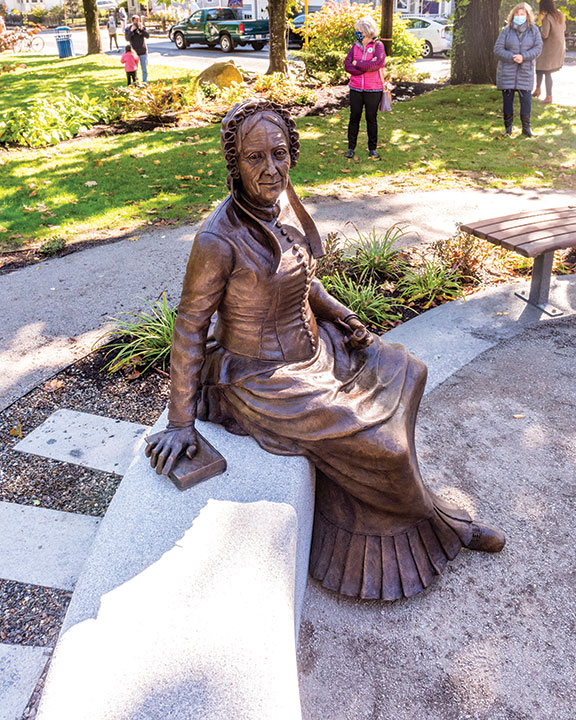
            There was sunlight after a storm, rousing band music in the background, cupcakes, and a large warm and welcoming crowd when the Elizabeth Taber statue was officially “unveiled” and given to the Town of Marion. Sitting in casual posture yet with an elegance and grace one can only imagine Taber possessed in life, the statue is art on a grand, lifelike scale. The Bicentennial Park location at the corner of Spring and Pleasant streets means that, at last, Taber is back in the center of community life.

            For more than two years, a dedicated group of benefactors along with a supportive and hardworking committee of nearly 30 people combined efforts to make the creation and placement of the Taber statue a reality.

            On October 17 it all came together beautifully, not unlike the many buildings given to the community by Taber, whom many called the town’s “Fairy Godmother.” Waiting in the wings seated on a bench in the recently created garden in the park was the statue. Before short speeches were uttered, a small tent shielding the statue from earlier rains was carried away, fully exposing the bronze figure to her adoring public.

            Taking to the patriotically decorated podium first was Celebrate Elizabeth Taber Statue Committee Chairperson Judith Rosbe, who recalled a conversation that fellow committee member Tinker Saltonstall had had with former selectman Al Winters, in which Winters lamented the lack of recognition for all that Taber had done for the community.

            Sometime thereafter the committee was formed and began the process of finding the right sculptor for their project. Rosbe said they had wanted to secure a local artisan. “We didn’t want to fly someone in from California,” she said. The committee eventually received three responses to its invitation for concepts and costs. When the voting was done, Erik Durant of New Bedford was unanimously selected.

            The Sippican Historical Society started off the fundraising by pledging $50,000 to what would ultimately grow to more than $175,000, Rosbe said. The Fundraising Committee was chaired by Betsy Fallon along with committee members Priscilla Ditchfield, Susan Grosart, Louise Nadler, Shelly Richins, Carolyn Rubenstein, Maryellen Shachoy, and Lisa Whitney.

            Other committees Rosbe said were critical to the success of the project were the Site Committee chaired by Bob Raymond with members Nancy Braitmayer, Debbie Bush, Priscilla Ditchfield, Norm Hills, and Nan Johnson. And last but not least was the Publicity and Outreach Committee chaired by Tinker Saltonstall with members Dana Anderson, Debbie Bush, Laurie Knight, Robin Shields, Amanda Stone, and Margot Stone.

            Of Durant’s work, Rosbe said, “I love the intimacy of her sitting on a bench.” She said the committee had a lot of ideas, but in the end, it was Durant’s artistic vision that they agreed was the best.   Rosbe explained that the statue’s posture is what is called contrapposto, an Italian term which means the arms and shoulders while pointed in a specific direction are somewhat turned but balanced when compared to the torso and legs. Taber’s statue shows her gazing slightly northwest towards the library bearing her name.

            Board of Selectmen Chairperson Randy Parker spoke next, giving a verbal sketch of all that Taber had done for the community and her history that is now published in the New Bedford Whaling Museum’s Lighting the Way program.

            Taber lived in New Bedford after marrying Stephen. She would suffer greatly with the loss of all three of her children and later her husband. As a widow, she retired into her County Street home only to emerge nearly a decade later and return to Marion where she had been born in 1791 at the confluence of Marin and South streets.

            Once back in Marion, she made it her business to bring “snap back” to the town she loved so dearly. The “snap” would be, as she is quoted as saying, “for the improvement and embellishment of my native place, lovely Marion by the sea.” To that end, there are six buildings in all for which her legendary wealth was given for the betterment of the townspeople. Those buildings remain standing today – the library which also houses the Natural History Museum, the Music Hall, the stone chapel across the road from the First Congregational Church, the founding of Tabor Academy, and the building of a home for its headmaster.

            At the end of Parker’s comments, the Board of Selectmen moved to accept the statue as a gift to the town when it was time to make the official transfer of ownership.

            Durant was asked to say a few words about the masterpiece he crafted. He thanked the committee for their trust first and foremost. While there had been a bit of controversy about the pipe the statue is holding and the positioning of her legs in the seated position, for Durant it was all about giving the final piece humanity. “It’s designed to be interactive,” he joked, saying it was ripe for taking selfies. “I designed it so you’d move around it and so that the back would be just as interesting as the front.

            “It’s not a monument to what she has done, but it’s bringing her to us … just sitting here … a real person.”

            Rosbe said there was a fund for the continued maintenance of the site and to keep the statue clean and “not turning green.”

            The event was made more festive with music from the Sanborn’s Academy Brass Quartet headed by former Tabor Academy music chairman Phil Sanborn, “Celebrate Elizabeth Taber” stickers, and mini-cupcakes.

By Marilou Newell

Photo by Ryan Feeney
Dear Post Office, I Love You!

            There has never been a time in my life when the US Postal Service did not matter. Some of my earliest memories of growing up in Onset include going to the post office for my mother. Our dependence on the services provided by the USPS was high with nearly daily interaction with the postal clerks who seemed always to be beavering away.

            We did not have home delivery service in Onset. Everyone walked to the post office. It was a hub of community activity and a place where people would stop and chat each other up for a bit. It was the heartbeat of that tiny village.

            Carrying the mail home each day was one of my chores. Ma would sort through the mass of advertising circulars and utility bills, handing me anything she thought could be relegated to my play-office in the corner of my bedroom.

            The post office kept us connected to the bigger world outside the confines of our little house and our little village. Magazine subscriptions and the arrival of the seasonal mail-order catalogs were events. Whether it was delivery of my summer Weekly Reader or the Christmas edition of the Sears and Roebuck catalog, the post office provided the conductivity, albeit manual, that we needed.

            Through the years, staying in touch with people via the written word was a high priority for yours truly. When I say written word, I don’t mean keystrokes. I’m talking about good old fashion pen in hand. I was thinking the other day about all the people I once wrote letters to, maybe as many as seven at one point in time. A book of postage stamps was like an internet connection.

            When my high school friends began migrating west to California in the ‘70s, writing and receiving letters became the conduit by which our relationships were maintained. Coming home from the post office with a thick envelope knowing it contained the latest Gold Coast adventures, detailed in longhand, of friends living a bohemian life-style thousands of miles away. It was exciting. Writing a response was expected, otherwise, I’d receive, “Why haven’t you written!” Writing and receiving letters was simply part of living and made possible by the USPS.

            Later on when I began a decades-long quest to “find myself” my journeys took me to Italy. The postal service kept me connected to family and friends. I attempted to explain myself, be understood, be accepted, and included all by way of letters entrusted to an operation we really couldn’t see or understand.

            As I sat in that small apartment in Vicenza looking out from my fourth-floor perch across the fields that surrounded the country farm villa far below at the end of the lane, I’d describe what I was seeing in living color and in long rambling sentences to my cousins and my mother so far away. The act of writing a letter and posting it made me feel like I was talking to my family. I just had to wait two weeks to hear their voices in return. I relied on the postal service; in this case, the A.P.O. afforded the US military service that kept the mail moving across the Atlantic. Those letters swept away the loneliness.

            By the late ’80s, I’d returned east after a stint on the west coast near my hometown friends. They stayed there, not wanting anything or anyone back east. My return spoke volumes about missing home. Once again it was letters that tied me to Onset, primarily my mother but also several cousins who seemed to enjoy reading my missives.

            But I wonder today, usually when the internet goes bye-bye, as it has just now while I write this, what would we have done without the US Postal Service? Consider all the services it’s offered over the years far beyond mail distribution. People without a bank account can buy money orders. Applications for a variety of things such as passports can be obtained from the post office. I don’t know if this applies any longer, but the post office used to offer notary services.

            When I think about the mail it is not so much the actual stuff that now arrives daily, but instead, a sentimental journey through relationships, most of which have come and gone, that I once enjoyed, secrets shared, love expressed, gifts sent, and received.

            The USPS was so reliable I once baked cranberry-nut breads during Christmas time and mailed them from Onset to Santa Monica so my girlfriend could have a taste of home during the holidays. And those cards in the mail received into my homesick hands so often when I lived thousands of miles from family, Christmas, Easter, birthday, or simply “thinking of you.” Small emotional life rafts that buoyed my spirit for days knowing that someone somewhere was thinking of me.

            Today receiving hard copies of my Medicare statements ranks high on the list of must-haves. After all it is my responsibility to make sure the program is only paying for services rendered, and maintaining those documents for two years is necessary. But, let’s face it, people of a certain age depend on hard copy versus scrolling through electronic lists. Yes, I still prefer real books, too.

            Sure, I use the usual suspects of delivery services available at a keystroke in our digital satellite-controlled world. But much like the library, the brick and mortar types, the post office stands out as a bastion of what good government can accomplish. I know, I know the USPS if fraught with money troubles, mismanagement, etc., etc. That is troubling. But the principle of a government helping its citizens, connecting people, providing business opportunities, and keeping the love light burning between sweethearts is precious to me.

            While most of the family I wrote to has passed away, as grandchildren have grown into women of purpose using quick texts to convey messages complete with emojis (give me strength), and my penmanship now rarely pressed into service deteriorates, I hold steadfast to the importance of the USPS. For surely if it were dismantled, a private letter-carrying service would fill the void, and costs would be what the market would bear, not what the market should bear.

            I “heart” the USPS. May it last at least as long as I do, for to lose it now would be like losing another loved one.

This Mattapoisett Life

By Marilou Newell

SRPEDD Outlines Housing Production Plan Process

            Eric Arbeene, principal comprehensive planner with the Southeastern Regional Planning and Economic Development District (SRPEDD), was on conference call with members of the Marion Affordable Housing Trust, who met on Tuesday night at the Music Hall to discuss the process that will culminate with a five-year update of the town’s Housing Production Plan.

            During its September 15 meeting, the Affordable Housing Trust requested $45,000 from the Community Preservation Committee (as it had in 2015) to fund a feasibility study approved at the June 22 Town Meeting for the purposes of identifying opportunities to expand on Marion’s amount of affordable and subsidized housing. The Affordable Housing Trust also requested $8,000 for SRPEDD’s assistance in updating its Housing Production Plan.

            In its October 13 meeting at the Music Hall, Arbeene discussed a number of aspects regarding the path SRPEDD will take in order to compile a Housing Needs Assessment and ultimately a Housing Production Plan. Arbeene worked with Marion as it developed its Master Plan in 2017 and has ongoing work with the Bylaw Codification Subcommittee.

            In referencing economic changes, Arbeene asked the question, “How have our goals changed in light of this data? Strategies, have they held up, should we replace them, have we accomplished them? A lot has changed in seven years, a lot has changed in the last seven months so we anticipate many changes.”

            In distinguishing between Affordable Housing and affordable housing, “two different things,” said he said, Arbeene suggested members of the Affordable Housing Trust focus open-mindedly on subsidized housing. At the same time, he will provide an update on needs assessments, demographics, households, and data. Even though the 2020 census information will not be part of his report, he is confident using the most-recent available data (2010).

            Alluding to developments holding an overall potential to get Marion close to the magic 10 percent in subsidized housing that categorically improves a town’s standing for potential state and federal subsidies, Arbeene asked for updates on those projects. Arbeene told the Affordable Housing Trust that one town in the SRPEDD region has established 17 percent in affordable housing.

            Having been a zoning board of appeals chairman in his own town, Arbeene acknowledged the many “ins and outs” of 40B housing and asked the question if Marion wants to focus on other areas as to how to diversify its housing.

            Administrative Assistant Terri Santos said she would update Arbeene with the latest on Marion’s Capital Improvement Planning Committee funds and the budget.

            The next meeting of the Marion Affordable Housing Trust is scheduled for November 10.

Marion Affordable Housing Trust

By Mick Colageo

Elizabeth R. Field

Elizabeth R. Field of Mattapoisett passed away peacefully on October 15, 2020 surrounded by her family after a brief illness. She is survived by her husband of 59 years, William D. Field.

            Born on February 16, 1942, she was raised in Fairhaven, the daughter of Helen (Hiller) Radcliffe and Elmer M. Radcliffe. She was a graduate of Fairhaven High School and Colby Sawyer College in New Hampshire. Liz began her married life in Lexington, where she started her family and established many life-long friendships. In 1972, Liz and Bill quite literally bought the family farm and moved to Mattapoisett.

            Liz was the secretary of the Mattapoisett Congregational Church for 20 years, and prior to that, spent ten enjoyable years employed at Brownell Boat Yard. She was an active member of the Mattapoisett Council on Aging, the Wilbur Point Association, and her beloved Mattapoisett Congregational Church, where she especially loved singing in the choir.

            Her most cherished role was that of mother, grandmother, and wife. Liz was the embodiment of the phrase “love above all else”. She exemplified care as a wife, mother, grandmother, and woman. She was the soul of the Family and made all those she knew feel a part of that. Her love, kindness and devotion to her family, friends and others cannot be expressed in words.

            In addition to her husband, survivors include son Robert and his wife Kimberly, daughter Susan and her husband William Wilbur, and daughter Polly. Four Grandchildren- Jonathan Wilbur and his fiancée Kathleen Holmes, Katherine Wilbur and Abigail and Megan Field, as well as two great-grandchildren- Charlotte and William Wilbur, all of Mattapoisett. Her brother, John Radcliffe of Maryland and her two sisters Penny Hiller and her husband Charlie, and Polly Duff Phipps and her husband Donald. She leaves behind many special nieces, nephews, and cousins.

            In lieu of flowers, donations can be made to the Mattapoisett Congregational Church, P.O. Box 284, Mattapoisett, MA 02739 or the Mattapoisett Fire Department, P.O. Box 362, Mattapoisett, MA 02739. Due to current public health concerns, services have yet to be determined.

From the Files of the Rochester Historical Society

From its inception and through the 18th century, pasturage was a source of wealth in Rochester. Indeed, when the lands that would become Rochester belonged to Plymouth, the profits earned from the uplands and meadows were used for the support of Plymouth’s school. In the early days of Rochester, the town fathers spent much of their meeting times dealing with roaming animals and the damage they often inflicted on private pastures and gardens.

            Laws or acts were created to keep ” Sheep-rams” within limits and “swine properly yoaked and ringed” as these animals ran free over common lands and beyond. In 1726, it was determined that notices of “RAM or Rames” running wild should be posted in five specific areas around the town.

            The discussion of these laws and regulations was so common that Timothy Ruggles, Jr. was able, as a practical joke, to get a law passed that would require all men who owned swine should have their noses ringed. The vote had to be recast to make it applicable to the animals and not the owners.

            Because of all these mischievous, roaming animals, it was necessary early on to create a town pound. Almost every town in Massachusetts had a pound in their early years. However, Rochester’s Town Pound on Snipatuit Road is one of the few left in the state. According to L.C. Humphrey, this pound was constructed in 1711. Its purpose was to hold stray animals and livestock until their owners who had to pay damages and/or fees before their animals could claim them would be released.

            Since one sheep or pig looks much like another, farmers clipped animals’ ears in distinctive ways. These were called the Ancient Marks of the Beast. Starting around 1732, many pages of records were kept of these distinguishing marks. It listed marks such as a crop or half crop on the “nere ear” or “two pennies ” under the ear as well as many others. In 1778, it was recorded that David Dexter marked his cattle with “two slits in the end of the left ear” which was the same mark that Caleb Dexter, his grandfather, had used in the past.

            Animal pounds, particularly ones that might hold horses or cattle, were generally made from heavy stones with six-foot high walls. In the 1960s, the Rochester Pound, under the auspices of the Conservation Commission, was restored by Maxwell Lawrence an expert stonewall restorer.

            Of course, a pound needs a pound-keeper. From the Laws of the Colony of New Plymouth: ” It is enacted by the Court that whatsoever meat cattle horse kind sheep or swine henceforth impounded for Trespass or damage done that the person that owneth the said cattle sheep swine or horse kind doe give to the poundkeeper Cecurities, to satisfy the damages done by them for which they were impounded: VIZ Ingage before two witnesses or give under his hand to the keeper of the pound to satisfy such just and legall damages as abovesaid: and the pound Keeper that releaseth such beasts alsoe satisfied for his impounding of them.”

            The first listed Pound Keeper was Elisha Barrows in 1739. He turned the job over to Nathan Nye in 1776. In the next 10 years, there were 10 different men who acted as keepers, along with those whose names appear more than once. As time passes, the list goes from having four pound-keepers at a time to two in 1888 and this continued until 1918 when George C. Bennett became keeper. He served in this capacity until his death in 1953, at which time the list ends. The pound has been out of service for many years, but it remains a fascinating reminder of history past.

            Note: as you can see, spelling has changed a lot since the 1700s.

By Connie Eshbach

Cushing Cemetery

Cushing Cemetery has not had a meeting for a while due to Covid-19, but we now feel safe to hold a meeting in an outdoor setting. We are holding a meeting at Cushing Cemetery on October 25 at 11:00 am; the rain date is November 1 at 11:00 am. We are inviting the public to attend so they can see what the Cemetery has been doing and to see if they would be interested in joining the board of trustees. Everyone is welcome.

Wild Turkeys Find Home in Suburbia

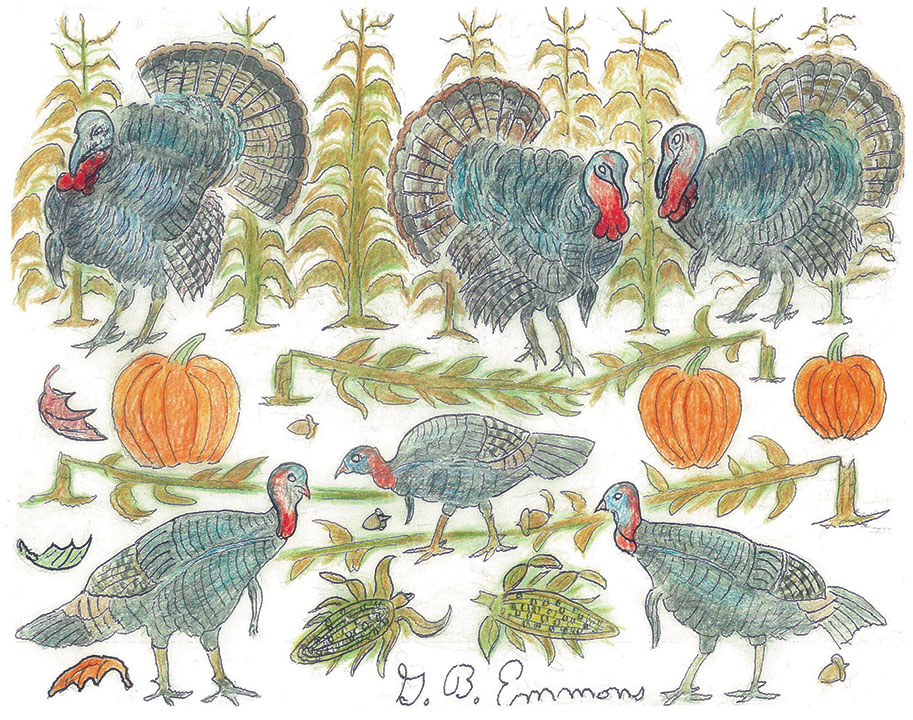
            The wild turkey has made a remarkable revival in numbers from near extinction in Massachusetts when the last one was killed in the year 1840 until today; the state population is approximately 25,000.

            Frequent attempts at stocking over the years failed because pen-raised hens did not have wildlife survival skills to teach their poult, who died off wherever they transplanted. The effort turned a corner in 1980 when flocks were moved from Pennsylvania to Berkshire County, and they expanded so rapidly that a limited fall and spring hunting season was allowed and, 40 years later, is still in effect to this very day.

            Over the next quarter-century since 1980, state trap and releases of wild stock moved the population across the state with the final stocking on Cape Cod. According to many officials, they are now almost everywhere except the island of Nantucket. The Indian name for Nantucket means far-off place, which is obviously why they are still not there.

            Today in many of our suburban wooded areas they have become a problem with some residents, thus biologists wonder if they were too successful for the turkeys’ own good. Turkeys are social creatures with a pecking order in each flock. The trouble usually begins with younger males coming of age by contending and pushing for position around them. In suburbia, they lose their fear of people, and are known to chase away children waiting on a street corner for a school bus. Sometimes they become obnoxious and ornery around wooded back yards, and managing them by involving animal control officers has become a sticky situation. It is still legal to feed wild turkeys, but authorities do not recommend it because it attracts competition near your house.

            Strangely enough, it is the suburbs that have attracted large numbers of turkeys instead of moving into vast remote forests, as might be expected. Agricultural habitat clearings developed by human beings are more to their liking, which seems to be a contradiction of wildlife adaptation in modern times.

            Turkeys were very abundant here when the pilgrims were shown in paintings bringing them home from the hunt for their first Thanksgiving, but their numbers declined every year that forests were cleared for agriculture. Extensive hunting also took a toll for almost the following century. When the continental congress of a new nation voted to name the turkey its national bird as recommended by Benjamin Franklin, it was not approved because the turkey loses its head at the first sign of danger and flies scatter-brain in all directions. Instead, the bald eagle was adopted, even though it had a flawed character of regularly stealing prey from ospreys.

            The turkey’s final recovery is unique in a country that endangered and decimated the passenger pigeon to extinction, nearly wiping out endless herds of buffalo, as well as two species of whales, the western sockeye salmon, and the eastern Atlantic salmon.

            The wild turkey may have risen out of the ashes of stocking failures like a phoenix, but its saving grace may well have been the similarity to its domestic cousin; both have an American image as leading role in Thanksgiving’s historical tradition. It now appears to be right at home at the edge of harvested cornfields, or nearby pumpkin patches, and often close to barnyard habitat.

            They would fit in today with other of Mother Nature’s cornucopia of natural blessings for the feast that was celebrated to express thanks for a bountiful harvest. The present wild turkey may still rank with the Indian three sisters of squash, corn, and beans, almost 400 years later.

By George B. Emmons

Marion Voter Information

The new secure ballot dropbox has arrived! This dropbox is located at the bottom of the stairs on the Library side of the Town House. It will be checked multiple times a day for ballot applications and ballots. 

            The absentee/early voting ballots have been received from the state and the Town Clerk’s office completed mailing them out on Friday. If you haven’t received yours by Friday, October 16, please call the Registrars’ Office at 508-748-3526. Remember to sign the brown envelope that you put your ballot into. Ballots may be mailed, placed into the dropbox, or brought directly to the Town Clerk’s Office. Once received, they are date/time stamped, entered into the State Computer System, and stored in the vault until Election Day.

            Early Voting will begin Saturday, October 17 from 10:00 am until noon outside of the Town Clerk’s office at the Town House (Library side of the building). In addition to the hours listed below, there will be a special Early Voting session at the Benjamin D. Cushing Community Center (465 Mill Street) on Tuesday, October 20, from 12:00 pm until 3:00 pm.

            Early Voting hours are as follows: 

October 17 and 18 from 10:00 am to 12:00 pm

October 19 to 23, Monday through Thursday from 8:00 am to 4:30 pm;  Friday from 8:00 am to 3:30 pm

October 24 from 2:00 to 4:00 pm and from 7:00 to 8:00 pm

October 25 from 10:00 am to 12:00 pm

October 26 to 30, Monday through Thursday, from 8:00 am to 4:30 pm; Friday from 8:00 am to 3:30 pm.

Sippican Historical Society

Marion (Old Rochester) is one of the oldest towns in the United States, and the Sippican Historical Society maintains an extensive collection of documentation on its historic buildings. In 1998, the Sippican Historical Society commissioned an architectural survey of Marion’s historic homes and buildings. Over 100 were cataloged and photographed. SHS will feature one building a week so that the residents of Marion can understand more about its unique historical architecture.

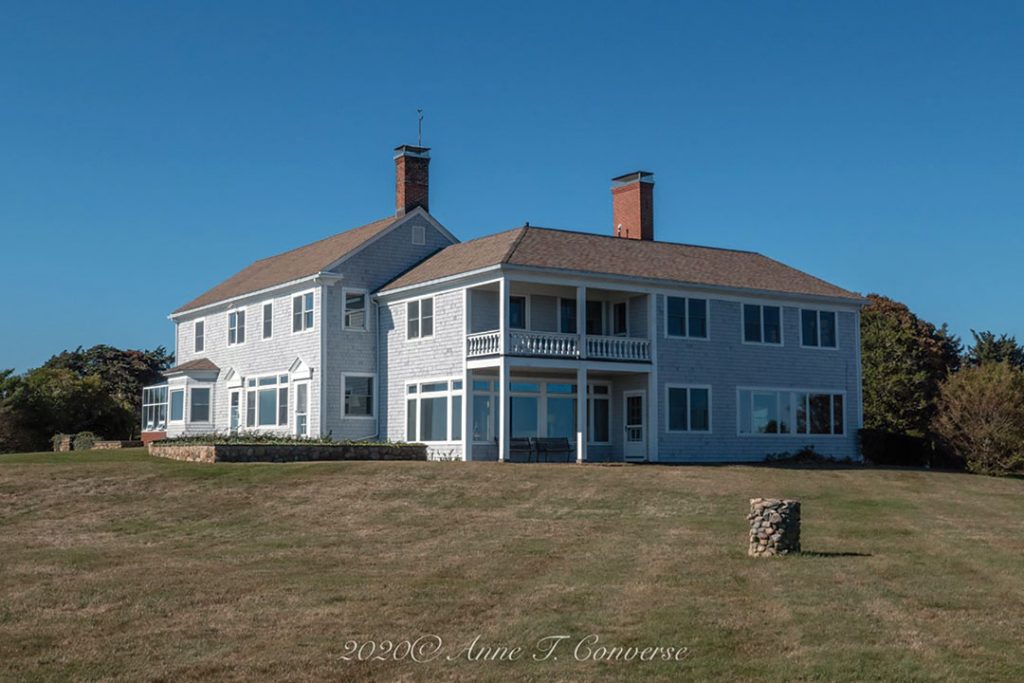
            This week we feature The Moorings, which is situated at the tip of Converse Point, the southernmost of the two necks that shelter Marion’s Sippican Harbor. Converse Point was formerly called Charles Neck and was a Native American campground for centuries before the English settlement of Marion in 1679. This Colonial Revival-style home was built in the mid-1920s to replace the much larger late-19th-century Shingle-style Moorings estate that had 40 rooms.

            The first Moorings was built in 1890 for Harry E. Converse, who was an heir of Elisha Converse. The founder of a rubber products industry in Malden during the 1850s, Elisha Converse manufactured rubber shoes that were in great demand worldwide. Harry E. Converse was an important local philanthropist who funded many causes, including Marion’s fire department. 

Drought Poses Challenges to Regional Water Watchdogs

            In his operations update for the regional water-treatment plant, Henri Renauld said, “It’s been really nice to get through these windstorms and not get all our primaries (high-voltage electrical wires) blown down.”

            Renauld noted that age is a factor with such equipment in his October 13 update to members of the Mattapoisett River Valley Water District Commission during their back-to-back Zoom meetings with the far-overlapping membership of the Mattapoisett River Valley Water Supply Protection Advisory Committee.

            There are challenges to maintaining equipment that engages water, and Renauld indicated that the MRV’s meter that reads oxygen level is failing. It is by far not the most expensive problem, but its value has been well established. Renauld told the commission that, in Mattapoisett, lead and copper sampling passed with great numbers and so the town put on a lower monitoring schedule at this time.

            Those small victories all count for a group of concerned citizens improving, managing, and saving the region’s freshwater supply.

            It was on the MRV Water Protection Supply Advisory Committee’s agenda to discuss surface-water levels on the Mattapoisett River.

            “A lot happened since the last meeting,” said Laurell Farinon, Rochester’s conservation agent, alluding to the 2020 drought, the beaver situation, and issues along Route 6.

            “Drought status is Level 3, but (Tuesday) it rained hard,” said Renauld. “We’re in a critical level at this time, but we’re basically starting to get past the point of outdoor watering. … My personal opinion is we stay with the voluntary (water ban) at this time.”

            The committee and commission that serve the Tri-Town and Fairhaven welcomed the first Treasurer’s Report from Marion DPW engineer Meghan Davis, who noted an irregularity in the amount invoiced by Eversource. The utility company billed the MRV $13,498.72. Farinon suggested that there were reasons to believe that some months were missing from prior invoices.

            The fiscal year invoice from Mattapoisett for the quarterly cost of running the regional water-treatment plant is $45,984.82. The final requisition for payment has come in from Fall River Electrical for the execution of the certificate of completion at $9,600.

            Davis also told the commission that UniBank wants to make a change in the commission’s type of bank account from vendor account to checking account. The change, in title only, will help the commission improve its ability to track information.

            The MRV made a $16,840.90 payment, its fifth and final payment, to Fall River Electric, and Eversource now takes over management of the primary (high-voltage) electrical equipment.

            The committee voted to approve Renauld and Committee/Commission Chairman Vinny Furtado to sign all invoices until the commission can meet again in person.

            The status of a payment of approximately $1,600 to Fairhaven for accounting services was discussed because the town never submitted an invoice to the MRV Water District. That item was put on the agenda for the next meeting, which will be held on November 10.

            Renauld suggested in advance of next month’s meeting that budget work should begin.

            In the MRV Water Supply Protection Committee meeting beforehand, Treasurer Jeff Furtado reported an October 1 ending balance of $180,109.56.

            The annual assessment has been invoiced to each of the member towns, but none have been paid. Fairhaven’s town meeting is coming up on Tuesday, October 20, so funds are not expected to be released until November. Marion and Mattapoisett were said to be ready to go.

            Engineering firm Tata & Howard invoiced the committee for $3,537.61 to catch up on 2015 and 2016 annual reports and river monitoring.

            The committee received a reimbursement of $5,000 and also deposits in lesser amounts from Rockland Trust.

            The committee approved solar-array projects for both Randall Lane in Mattapoisett and Cushman Road in Rochester.

            The Rochester project is a 3.9-megawatt, ground-mounted solar array in what is considered an undeveloped and forested area. The committee expressed no objections pending the Conservation Commission’s evaluation regarding wetlands restrictions and stormwater runoff. The Mattapoisett project is a larger solar array at 7.7 megawatts. Although one of the eastern-most panels falls within a zonal area in question, members took up no issues.

            The committee approved the $850 purchase of a specific conductance probe for its Hach Meter. Jon Gregory of Tata & Howard engineers said that the added gear emanates from a request to monitor Snow’s Pond. Farinon said that University of Rhode Island “water watchers” group training used the item and that Snow’s Pond Association checks at least weekly on water conditions at two locations. Farinon sees potential usefulness of the probe beyond into the MRV’s areas in possibly into Snipatuit and Leonard’s ponds. “I think it’s something that would be really helpful,” she said.

            Former chairman David Pierce participated in the call and helped solve questions about an annual payment made by the committee. Despite living in central Vermont now, Pierce will continue to assist the MRV.

            The next meetings of the MRV Committee and Commission is scheduled for November 10.

MRV Water Supply Protection Advisory Committee/District Commission

By Mick Colageo