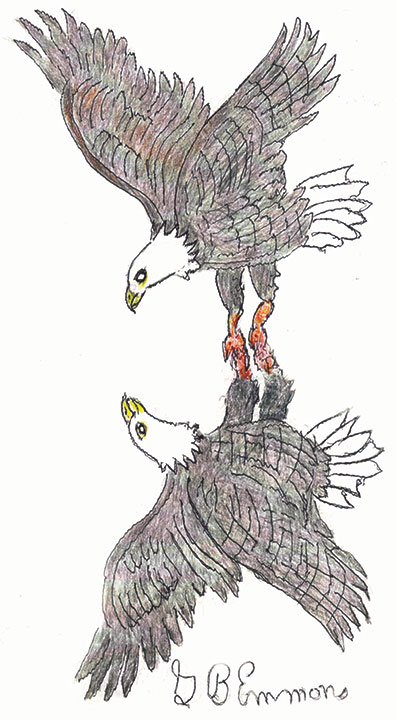
Cartwheeling Bald Eagle in Dangerous, Glorious Descent

            The bald eagle that is our national bird has become well known to avid bird watchers for performing a spectacular aerial acrobatic called a cartwheeling, as illustrated.

            It is the most daring and breathtaking maneuver when two eagles in competition for a mate or nesting site, along the coastline of Buzzards Bay, joust around each other in circles and then lock on to the other’s talons to twirl downward, plummeting out of control for thousands of feet. Many adult eagles fly so high during the mating season that they are barely visible from the ground, then make a lasting impression as they come tumbling down toward the ground.

            The bald eagle’s sight is seven times as powerful as that of a human’s. Each eye is protected by a face bone over the eye socket to shield its vision from the glint of the sun from high in the clouds where the air is thin and the light is very bright.

            As a high-performance predator for fish, the bald eagle comes down to the earth in spring when the anadromous herring come in from the ocean to spawn in fresh water at Halfway Pond, source of the Agawam River, to become easy prey for a gathering of eagles classified as a convocation in birdwatching terminology. Soon after the herring arrive, aggressive incidents of eagles fighting over territories and mates bring on a cartwheeling exhibition for all to see.

            Last year a local landowner reported witnessing two males locked in deadly combat, having rolled over each other by lifting their talons in defense and then grabbing each other and beginning to plummet below the horizon out of sight. They were soon located where they landed in shock on the deck of a beach cottage, still holding on until covered with a blanket to rapidly take off on their own.

            We are indeed very fortunate along our coastline, which attracts the fish-eating bald eagle, all too often stealing prey of our local ospreys. However, all of this provides an afternoon’s entertainment for Jan and me on the back porch of our Fairhaven seaside residence on Little Bay, a wonderful place to experience and share nature in my article and illustration in The Wanderer.

By George B. Emmons
From the Files of the Rochester Historical Society

Charles Jarvis Holmes was the son of Abraham Holmes, whose memoirs tell us much about Rochester’s history. Charles followed in his father’s footsteps, becoming a lawyer (having studied under his father). He was very involved in the business of running the town. He was on the Board of Selectmen and in 1832 was chosen as one of three to be on the newly created School Committee. Before 1857, he was a Rochester representative to the State Legislature, following his father into the House of Representatives. His law office in Rochester was often visited by leading lawyers from other towns, one of whom was Daniel Webster.

            In 1839, he participated in the decisions that resulted in Mattapoisett separating from Rochester. It was Charles Holmes who moved that the following motion be passed “In order that the difficulties respecting the place of holding town meetings in the town of Rochester, and other difficulties growing out of agitation of that subject may be amicably adjusted, we agree that if the town meetings for the year next ensuing, after the close of the present March meeting, including the next annual meeting for the Choice of town officers, be holden at Mattapoisett and that the town meetings for the two following years shall be holden at the town house, and that at the end of three years the town shall be divided upon fair and equitable terms in all respects.” The vote was 65 in favor and 62 opposed, so the motion passed, and the separation of Mattapoisett from Rochester was begun.

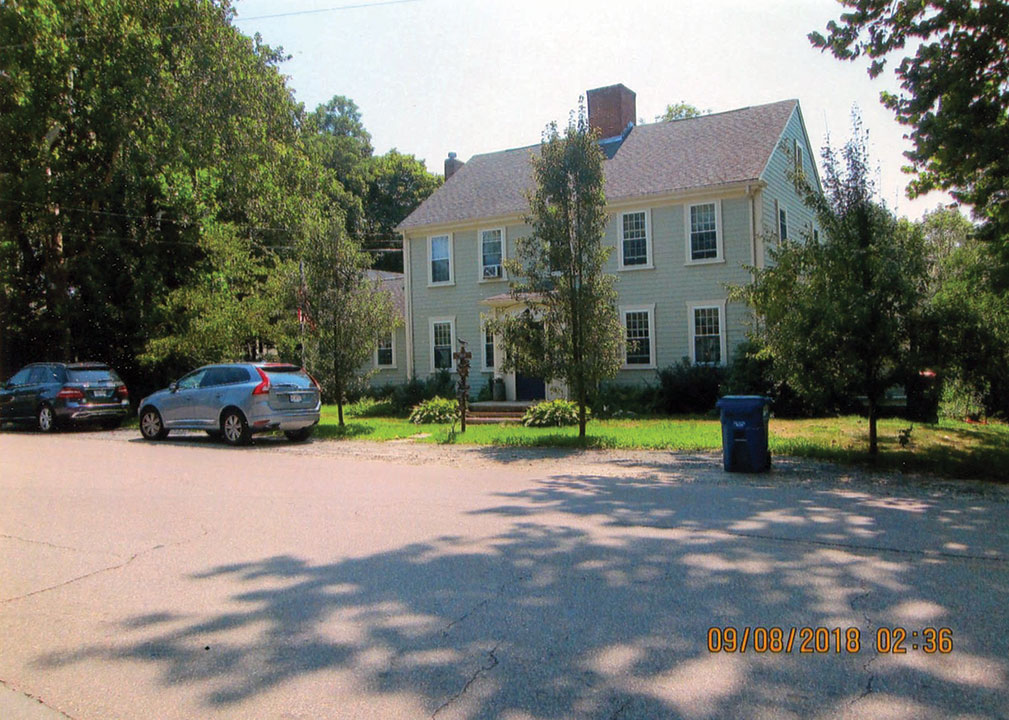
            In addition to his law and political work, Charles ran a tavern in the house he built at 10 Marion Road, which today houses the Secret Garden. The house is a good example of the Federalist style of architecture. In his later years, his father Abraham lived with him. The tavern became a gathering place for lawyers, debaters, educators, and politicians to meet to discuss and argue over the day’s issues. Many of the acquaintances of both father and son met there. The list includes John Adams, John Hancock, Thomas Jefferson, and General Wadsworth.

            In 1815, the Post Office was located in #10. Holmes’s descendants occupied the house until the early 20th century.

By Connie Eshbach

Joseph D. Travis

Joseph D. Travis, 69 of Cranston, passed away peacefully, December 10, 2020 at the Philip Hulitar Inpatient Center, Providence. He was the beloved husband of Roberta (Palazzo) Travis. Born in Fall River, MA. a son of the late Joseph D. and Rosalind (Sequeira) Travis. His family moved to Mattapoisett in the 1960’s. Mr. Travis graduated from ORR in 1969, and attended SMU (U-Mass Dartmouth). Mr Travis always saw Mattapoisett as his home town, and spent many fond hours visiting friends in the area. Mr. Travis was a retired sales manager for an electronics companies. Besides his wife he is survived by his two step-daughters, Laura Gendron of New York City and Bethany Gendron of PA. His funeral and burial will be private. In lieu of flowers donation in his memory may be made to Philip Hulitar Inpatient Center or any Animal Rescue Center. Please share memories www.WoodlawnGattone.com. Donations may be made to: Hope Hospice and Palliative Care, 1085 North Main Street, Providence RI 02904 or Animal Rescue Rhode Island, P.O. Box 458, Wakefield RI 02880 Web: http://animalrescueri.org (http://animalrescueri.org).

Merilyn “Merry” Eustis

Merilyn “Merry” Eustis, 84, voyaged onward into the hands of our Lord on December 7, 2020. Her husband Ralph and family were at her side as she departed peacefully with a smile on her beautiful face. She was an inspiring, lovely and loving lady with an infectious personality that loved everyone.

            Beloved daughter of the late Norman and Dorothy Hodgson, Merry grew up in Portland, ME. It was there that she met her soul mate Ralph W. Eustis. Their 64-year voyage together as husband and wife, took them to live in places like Tokyo, Manhattan, California, and Washington DC. After Ralph retired from the Coast Guard, they settled in Mattapoisett in 1975 but embarked on many personal and professional adventures both on land and on sea.

            Merry was a lovely lady who brought happiness to everyone who touched her life; a lifelong wife, supporter, and companion to Ralph, a devoted mother to Ralph and Bill who had predeceased her. Merry especially enjoyed her role as grandmother to Heather and Stephen. She was happiest when she was with family and friends and sharing the joys of being alive whether it was with activities like sailing, skiing, adventuring around the world or just throwing a party so she could gather everyone together to celebrate. Aimhi Lodge in ME, where she spent her childhood summers, is one of her dearest spots. Her home and garden were her place to dream and relax from everyday stresses. She was an artist and an entrepreneur who founded Merrel Crafts in Washington DC and Eustis Design in Marion, MA, an interior design and architectural design firm. The New Bedford Chamber of Commerce named her the small business person of the year in 1989. Also, the Mass Senate honored her as the Small Business woman of the Year in 1991.

            Merry’s boundless energy extended throughout the Community. She was a founding member of the New Bedford Art Museum; the first to receive the New Bedford Symphony’s Friend of the Year award; a recipient of the Art Museum’s New Bedford Patrons of the Arts award; and the director of the Mattapoisett Yacht Club youth program.

            Survivors include her husband Ralph; her son Ralph III and his wife Karen of Mattapoisett, MA; granddaughter, Heather Eustis and fiancé Jacques Ray of NC; grandson, Stephen Eustis of NV; sister, Joelle Bentley of Stamford, CT; sister, Julie Broom and her husband Tony of Stony Creek, CT; brother-in-law, Gordon Eustis and his wife Joan of Lopez Island, WA; sister-in-law, Bette Ascheffenberg of Silver Spring, MD; and many beloved nieces, nephews, cousins, and many other extended family and friends.

            Due to COVID, a service will be held at a later date when it is safe to gather. It will take place at Mattapoisett Congregational Church and the interment will be after that at the Coast Guard Academy Memorial Chapel, the place where Merry and Ralph first met.

            One of Merry’s final wishes is that everyone takes time to reach out to anyone who is struggling with Alzheimer’s as well as their caregivers. Please offer whatever support you can.

            The family requests that any remembrances be sent to the New Bedford Art Museum Children’s Art Fund.

            Arrangements are by the Saunders-Dwyer Mattapoisett Home for Funerals, 50 County Rd., Mattapoisett. For online condolence book, please visit www.saundersdwyer.com.

MRV Anticipates Q&A with Koch Reps on Water-Treatment Plant

Given the last couple of years’ turnover in the memberships of the Mattapoisett River Valley Water Supply Protection Advisory Committee and District Commission, the commission thought it best to ask Koch representatives to reboot its presentation on the water treatment plant project when they visit the committee/commission on Tuesday, January 12.

            Addressing the commission at its December 8 meeting, Tata & Howard Associate Jon Gregory spoke about Koch Membrane Systems’ Puron technology.

            “It’s a new technology in Massachusetts, but a similar installation where they replaced two old Targus stages in a facility in Texas in 2018,” said Gregory, noting that things at the Texas facility are going well as it works in a series with two Puron stages.

            With more questions on the new Puron system, Gregory wants to send questions to Koch by January 7 at the latest.

            “They’re available and in favor of providing any additional information that we would like,” said Gregory, who will try to set up what will amount to a subcommittee call with Koch before Christmas.

            Paul Howard, co-founder and senior vice president at Tata & Howard, told the commission that there are no reserve pumps with the Puron system, calling it a “totally different technology,” offering annual savings in the $70,000 to $80,000 range.

            The commission is still discussing materials with an eye on tweaking some of the costs and, at the same time, trying to be sure that pipes are durable as well. Howard said stainless steel is no longer the industry standard but a requested upgrade.

            Member Paul Silva asked Gregory if he has asked Koch if another community is at the same stage that Koch is with the MRV District. “I’m very hesitant to get involved with something we don’t have enough background on. I’d just like to have a lot more comfort than I do right now,” said Silva.

            Gregory said he had not had that specific discussion.

            Howard said Koch, based in Wilmington, has applied a membrane technology from treating juices. “I believe this technology is superior to what we have now. I don’t think you should be that concerned,” he said, noting that Littleton is home to the first membrane-ozone plant in the country.

            Megan Davis of Marion gave the commission’s Treasurer’s Report with $77,212.86 in invoice totals. That included total chemicals at $7,257.74. Eversource, she explained, had its last billing period in September that the commission paid in full, so the current period covers October and November with two bills totaling $51,592.54. The commission only paid $30,311.04 of that. “We’re not behind by any means; we’re up to what we’ve used,” said Davis.

            Other figures reported included a $17,945.39 ECA credit, $7,657 in maintenance and repairs to Station No. 6 and Koch tech services, and $10,494.70 for Tata & Howard’s combination of FY21 operations and RO8 project.

            The commission voted to accept the Treasurer’s Report and pay the invoices; the commission also voted to accept the FY22 Budget.

            The committee’s Treasurer’s Report included an ending balance on December 1 at $190,990.32. Deposits totaled $19,279.37, including Mattapoisett’s assessment of $19,267.50. Invoices totaled $4,380.05, the lion’s share an invoice from the Tata & Howard engineering firm.

            Water-level monitoring in the Mattapoisett River has proven to be costly. Alluding to questions Silva had asked on the matter of the monthly $5,000 expense for the collection of data, member Laurell Farinon noted in the committee portion of Tuesday’s meeting that the MRV Water Supply Protection Advisory Committee is all about collecting data on the Mattapoisett River, whereas the MRV Water District’s Commission’s concerns are the water treatment plant and the water-quality side. Meantime on the reporting side, Tata & Howard is working to reduce all of the data.

            “It’s really most necessary for the district,” said Farinon, defending the $5,000 figure for data collection and presentation. “I think that the monthly monitoring and the graphing is something this committee would do anyway, but it really comes down to the annual reporting, not just for this committee but for the district. If it’s five or six grand … I’m just defending what the annual charge is.”

            “We could argue that it is being split evenly, they’re paying ($5,000), and we’re paying ($10,000),” said Chairman Vinnie Furtado, in this instance speaking on behalf of the committee as opposed to the commission that he also chairs.

            Farinon said it is something the committee wants to continue with, especially the monthly monitoring.

            The next meeting of the MRV Water Supply Protection Advisory Committee and MRV Water District Commission is scheduled for January 12.

MRV Water Supply Protection Advisory Committee/District Commission

By Mick Colageo

Giving Season and Holiday Happenings

The Marion Art Center continues its annual giving campaign through the holiday season. As a nonprofit organization, the MAC relies on funding from individuals and businesses in the community. The MAC has received generous support from members and donors during this difficult year, and we’re on our way to reaching our 2020 goal. Help the MAC hit the mark by sending in your donation of any size through our easy-to-use online form at marionartcenter.org/support. Your donation of $5, $50, or $5,000 will help sustain the MAC during the months ahead while we prepare to be fully operational again. We also accept gifts of securities. In the meantime, we will continue to offer reimagined programs and events while we await the safe reopening of our beloved theater, music, and children’s programs.

            As our way of saying thank you, the MAC will roll out several virtual holiday offerings within the coming weeks to celebrate the season and the generosity of our donors. In December, we’ll feature a homemade snow globe project video tutorial with Benares Angeley of Childrens’ Art Lab at the MAC; a Winter Wonders family-friendly performance by Jackson Gillman – participatory songs and stories about shoveling, snowmen, snow angels, and nature in winter; a portion of the Tri-County Symphonic Band’s holiday concert, The Grinch, performed by Phil Sanborn and company; and John Heavey’s (Tabor Academy) recorded annual reading of The Grinch in a storytelling format. Programs will be released in mid-December. Stay tuned at marionartcenter.org.

Great Decisions Program

            The Mattapoisett Woman’s Club “Great Decisions Program” will continue through a collaborative partnership with the Mattapoisett Library and Director Jennifer Jones. Great Decisions is produced by the Foreign Policy Association, and each year a current briefing book is available to support discussion. The goal is to reach informed decisions and opinions about world issues and policy. The Mattapoisett Woman’s Club has sponsored the Great Decisions Program consecutively for over 48 years; this is one of our Civic and Community Service outreach activities. We will offer the 8-week sessions on Wednesdays from 1:00 pm – 3:00 pm starting January 20 until March 10 by way of the Library’s Public Zoom system.

            The deadline for registration is December 28, and we have a maximum of 25 participants.

The Topics are:

1.         The role of international organizations in a Global Pandemic

2.         Global supply chains and national security

3.         China and Africa

4.         Korean Peninsula

5.         Persian Gulf Security

6.         Brexit and the European Union

7.         The fight over the melting Arctic

8.         The End of Globalization?

            The book price is $30 each. The program includes watching the DVD, weekly topic discussions, and outside research.

            To register, please send a check, your name, email address, and phone number to Mattapoisett Woman’s Club, P.O. Box 1444, Mattapoisett, MA, 02739, and please write “Great Decisions” on the check.

            You are welcome to offer to facilitate a topic as we are always grateful for your knowledge, generosity, and your command of the subject. After January 6, the books will be distributed through the library. If you have any questions, please send inquiries to Ellen P. Flynn, Chair, elflynn@vassar.edu.

‘Comfort and Joy’ Remembered

            Here we are, folks; it’s the Christmas holiday season, a time to remember past celebrations and renew old traditions.

            In thinking about the joy this time of year can represent, I thought it might be fun to ask around and find out what other folks remember from their childhoods or what traditions they continue to preserve with their families today. I’d venture to say that during those brief moments of reflection, joy was experienced once again. I weave those submissions here with my own, like a giant patchwork quilt sewn together by a common thread of thought, “Peace on Earth.” Thus, I give you “comfort and joy” by way of memory.

            ML: Plum pudding with hard sauce, spices wafting from the kitchen stove where Ma stood warming the special holiday treat. That tickle in my throat as the warm syrup slid slowly from my mouth. Later, snuggling up to Ma’s arm as I stared at the empty Christmas stocking and wondered if that exotic orange and delicious apple would once again miraculously appear in the dead of winter, making the stocking, once in rotation in Dad’s bureau drawer, like a giant swollen pea pod…

            “When I was little, we had to go to my aunt’s house every Christmas,” J said, “but we didn’t have a car. We lived in the city. We walked everywhere, even in the freezing cold! It was awful.” She said that years later, when her own children were able to travel, Christmases were always spent somewhere warm, never in New England, and she confirmed her children had great memories of Christmases spent in tropical climates.

            ML: Christmas gifts were often an opportunity for Ma to give us things we actually needed, practical things like new underwear, socks, pajamas, or boots. We always got a few toys, depending on how the year had gone for Dad’s TV repair business. I recall years with a Shirley Temple doll, a Barbie, a toy kitchen, paper dolls…

            “We were always sent to bed after a light dinner, then the grown-ups would wake us up as they came into my parent’s house after midnight mass,” P said. “My mother always put out a big meal. I remember two tables pulled together to make one long banquet-sized table the length of the double parlor. We’d open all our gifts together; there must have been 30 people squeezed into our two-family home. My aunt, my mother’s sister, lived on the first floor, and we lived on the second. My sister would play the piano, and everyone would sing. One year all I wanted was a new bike. But when I got up, I didn’t see one, so I sulked until I finally saw it hiding behind a piece of furniture. I was spoiled rotten, but they never bought me a pony.”

            ML: The scent of talcum powder called “Heavenly” that came in a pink Bakelite container with a big pink powder puff was an annual gift fit for a young girl aged 5 to 15, and I was always the happy recipient. Taking a bath and putting on new pajamas after dusting myself with powder made me feel safe and so comfortable…

            G was surely smiling when she wrote, “There are so many memories! Hard to choose just one. I remember, as a kid, leaving the Tinkham Chapel service on Christmas Eve and going to my aunt and uncle’s place in New Bedford, scanning the skies to see if we could see Santa’s sleigh and Rudolph’s red nose. Later, my dad learned about the NORAD Santa tracking, so he’d tune in to the radio so we could hear where Santa was in his travels. I’m still a NORAD Santa-tracker nerd.”

            ML: In school, in the ’50s, Christmas was a high point of winter. School windows would be decorated with our artwork of snowflakes and Santa heads. The day before school closed for the holiday, we’d bring our teacher small gifts that she lined up on her desk like trophies she had won from being patient beyond what is humanly possible…

            “I grew up moving often and spent most of my childhood in Southeast Asia,” began JM. “Every Christmas Eve, at my mother’s insistence, we listened to Dylan Thomas’s ‘A Child’s Christmas in Wales.’ She owned an old recording of the book read by Thomas himself. The sound was muffled, the record was scratched, Thomas had a Welsh accent. Moreover, we were in Hong Kong, Malaysia, and the Philippines – no snow, no cozy fires, no candy cigarettes. For many years I do not think I even listened – just sat with my own thoughts. When my children were born, my mother began giving us new, illustrated editions of ‘A Child’s Christmas in Wales.’ At the beginning of this tradition, I read aloud to my children. I essentially forced this on them. Christmas Eve is my birthday, and I can be bossy. Now every Christmas Eve, we gather all our copies and the five of us take turns reading. I believe we all enjoy it, but I never ask.

            ML: Decades later, there was that Christmas when I gave my son new summer clothes. I planned a February school vacation trip to Disney World, our first. But the look on his face as he opened boxes containing summer clothes, well, his fake smile would have broken any mother’s heart. As he stood up surrounded by new summer clothing he tried to be grateful for, I told him why the clothes would be needed…

            “My childhood, we had more than one Christmas. We had Christmas at home, Christmas at my grandparent’s house, which included aunts and uncles and cousins, and we had Christmas in Maine with my great-grandmother and other relatives. It seemed to last for weeks. It was wonderful,” wrote E.

            ML: This last entry seemed to sum up not just the good times but the longing not to forget, to hold onto joyful memories, for in the end, those are the real gifts we give one another…

            C wrote, “I grew up on North Street on the second floor with my family. My Aunt was on the third and my Grandparents on the first. On Christmas Eve, the family, all ten of them with spouses and children, would gather in my grandparent’s home.

            “One of the first Christmases that I remember, the children were all on the floor in the two front rooms waiting for Santa. Suddenly there was a rattling noise, bells, and sounds of footsteps coming from the attic. Santa was arriving. Anticipation and excitement took my breath away!

            “Down the front stairs came Santa, all in red and ‘Ho-Ho-ing.’ There was a sack filled with gifts and a moment of pure joy. This was a miracle to see. Then a voice from an older cousin said, “That’s Grandpa.” It couldn’t be; I refused to believe it wasn’t the real Santa, although his eyeglasses did look vaguely familiar.”

            “Presents were passed out, and Santa climbed back up the stairs. Later, of course, the realization that Santa was Grandpa sunk in. Grandpa had dragged chains across the attic floor, rang bells, and stomped his feet like reindeer. It didn’t matter; I still love the wonder of that moment. Santa always visits my home, fills my stockings, eats my cookies, and leaves a gift unwrapped at the foot of the tree. If only Grandpa could come back and once more sing ‘Christians Awake’ at the bottom of the stairs on Christmas morning, then all would be truly perfect.”

This Mattapoisett Life

By Marilou Newell

Hartley Pushes to Accelerate Full Return for Youngest Learners

Old Rochester Regional Superintendent of Schools Mike Nelson and Craig Davidson, the district’s director of Student Services, reported to the Rochester School Committee during its December 3 Zoom meeting on preliminary findings of a survey of questions to parents and guardians geared toward helping Central Office take what Nelson called “an important first step in moving forward with the (learning) model.”

            Nelson said with COVID, “every day is a new day,” and considered the survey responses a good first step.

            Upon all the information shared and at the end of a question-and-comment session, Chairperson Sharon Hartley stated her anticipation of a planned or unplanned meeting of a subcommittee as necessary to take the next step in mobilizing toward getting the town’s youngest learners back in the classroom on a full-time basis.

            “I know you have to be cautious about the continuing COVID-19 (pandemic), and I appreciate that very much, but I also know that our children, in order to become the learners that we want them to be and the readers that we want them to be, will benefit from our teachers face to face. And we want them back in school as fast as we can,” said Hartley, asking Nelson what the school committee can do as a next step.

            Nelson acknowledged the survey result in which 78 percent of respondents confirmed their ability to transport their children to school on what are now Hybrid-Out days. Still, he said, “The guidance is the guidance,” and stopped short of considering a full return imminent.

            “We’re going to put down a plan that we can articulate to the School Committee and, if we have it done prior to when our next meeting is scheduled, as I mentioned, I will not hesitate to reach out to … call a meeting and move it up because we agree with you that the sooner we can create more opportunities, that’s our plan,” said Nelson, stressing that this scenario was always in the works since August and aligns with the guidance from the state Department of Elementary and Secondary Education (DESE).

            Several questions were asked with graphs and charts illustrating percentage and hard-number breakdowns among Rochester’s 292 survey respondents (there are 1,200 district-wide). Parent/guardians were generally agreeable to the level of communication coming from the Central Office regarding the reopening plan.

            On a five-point grading system, Synchronous and Live (Hybrid-Out) sessions were considered by 76 parents/guardians as “adequate” with “helpful,” “very helpful,” and “somewhat helpful,” divvying up most of the rest of the responses. “Not helpful” drew 22 responses.

            “My child enjoys Hybrid-In days” drew a 198-voice confirmation. The Hybrid-Out workload was confirmed with the agreement of 75 percent of responses, the other 62 nearly evenly (32-30) divided between “too much” and “too little.”

            With a small percentage of dissent, most parents/guardians confirmed that their children have “enough connection throughout the day” with teachers.

            Only two out of 34 respondents said they disagree with the survey statement that their children are enjoying the remote learning model, and 28 of 34 considered their child’s remote-learning day workload to be adequate. Furthermore, parents/guardians confirmed in the vast majority that they agree that child has an appropriate amount of instruction and an appropriate amount of interaction with their teachers.

            Based on the current metrics of COVID-19, 53.2 percent of Rochester Memorial School parents/guardians responded negatively to skipping February vacation week in favor of four remote-learning days. A change in the current school calendar would subtract those days at the end of the school year.

            Almost 63 percent of Rochester Memorial School parents/guardians are in favor of increased in-person learning opportunities, provided the school building maintain at least 3 feet of social distance. The district is currently using a 6-foot minimum. Although the most positive response was also returned to the question of increased in-person opportunities, albeit without the same homeroom/classroom teacher, that number was 48 percent, while 33.6 percent were against it and 18.4 percent were undecided.

            Rochester responded favorably to the transportation question, with 78.1 percent of respondents confirming the ability to transport their children to school on what are now Hybrid-Out days for the sake of more in-person learning opportunities. Nelson said ORR schools could safely fit 24 to 25 students on each of its 77-passenger buses, but state updates are anticipated.

            As of December 3, Rochester Memorial School had 442 students enrolled in the hybrid learning model, 60 on full remote, and 26 others who are being home-schooled.

            ORR has had 29 COVID-19 situations relating to its school buildings, but Rochester Memorial has not had a confirmed case in its building since the September 16 opening. There are four people in quarantine and some others awaiting tests after displaying COVID-like symptoms.

            Nelson reported that there had been no in-school transmission in the district and noted his weekly COVID-19 dashboard is continuously updated. Despite rising rates, finding substitute teachers remains difficult, said Nelson.

            Rochester Memorial School Principal Derek Medeiros credited custodial workers and other staff with getting Rochester Memorial School off to a strong start. He said parents have been cooperative in dropoff and pickup, making things run smoothly in and out of school.

            In other business, the Rochester School Committee voted to approve a Tech Replacement Fee as presented by Assistant Superintendent of Finance and Operations Howie Barber. A distribution of iPads will be accompanied by a return of a signed waiver.

            Barber and Facilities Director Gene Jones were at the meeting, also to discuss the revival of a solar project for Rochester Memorial School. The concept has shifted from a roof solar array to a carport solar array. The committee was asked for and agreed to submit a letter of intent authorizing Barber to seek the interconnection from Eversource.

            There would be no monetary obligation on the part of the town or the school. “It’s a win-win all around,” said Jones, pointing out that the carport would be lighted and include charging stations for vehicles, aligning the project with the Green Communities initiative while at the same time lessening snow removal. Barber estimated that, while year-one savings would approximate $2,300, the project could reach up to $400,000 in savings.

            The next meeting of the Rochester School Committee is scheduled for January 7.

Rochester School Committee

By Mick Colageo

Families Accept Hybrid, Aim at Full Return

            In his Reopening Update to the Marion School Committee’s December 2 Zoom meeting, Old Rochester Regional Superintendent of Schools Mike Nelson said, “I cannot believe we’re in the first week of December already.”

            Nelson reported that, as of the December 2 meeting, Sippican Elementary School had 326 students in the hybrid learning model and 65 in full remote, with 21 others who are being home-schooled.

            Nelson was happy to report that the ORR School District has yet to see the transmission of the coronavirus from someone inside the school to another. All 29 confirmed cases among six district schools are isolated and coming from the outside, he said.

            The case breakdown is as follows: Sippican School has had eight cases, one of which was in isolation and three others in quarantine at the time of the meeting. Some are awaiting test results.

            Preliminary findings of a November 20 survey from feedback received in 228 responses from Sippican School parents indicate that most families agree or strongly agree that communication from the ORR district has been adequate.

            The questions were answered on a five-point scale. In the case of the hybrid learning model (i.e., is it helpful?), the majority of respondents categorized the model as “somewhat helpful” or “helpful,” with lesser numbers categorizing it as “adequate,” “not helpful,” or “very helpful.”

            Hybrid-In was considered by far to be the “most favorable” learning time. Student workload on Hybrid-Out days was deemed adequate by 68 percent of respondents, while 21 percent said hybrid-out days require too little of the students.

            Most agree that their children are enjoying the hybrid model and that it contains an appropriate amount of instruction, but there was a significant amount of disagreement on the amount of instruction.

            Asked if they favor maintaining the school calendar, including February vacation, 54 percent of respondents said they favor maintaining the current school calendar. The alternative is to cancel the February vacation and subtract those days off at the end of the school year.

            Respondents were closely divided on the matter of social distance inside school buildings, 50.5 percent in favor of maintaining 6 feet of distance and 49.5 percent in favor of a 3-foot limit. The breakdown was 55-45 in the percentage of parents in favor of full, in-person learning even if a student’s home-room teacher changes as a result.

            Transportation has lingered as a logistical hurdle to a full reopening, but 82 percent of respondents indicated they have the ability to transport their children to school on what are currently their Hybrid-Out days; 18 percent say they do not.

            Nelson stressed that, while there are no immediate changes planned, it is a good time to weigh in.

            “That survey was fantastic,” said Marion School Committee Chair Michelle Smith, who said she wants to start looking at a full-reopening plan and asking, “when it is possible to do so?”

            Nelson said the district continues to rely on updates from the state and that safety remains the number one priority. “From the start in August, we knew the plan would be fluid,” he said. “But we don’t want to be complacent; we’re constantly talking about what can we do to improve our model.” Nelson referenced his end-October “Back to School Addendum” and its commitment to continuing to look at options.

            “It would be great to have everybody in (school),” said Smith. “Hopefully, the trend continues at school where there is (no transference of the coronavirus).”

            The Marion School Committee, including Smith and members April Rios, Jody Dickerson, Nichole Daniel, and Mary Beauregard, voted to approve a Tech Replacement Fee as presented by Assistant Superintendent of Finance and Operations Howie Barber.

            While the district has received supplemental funding via the CARES Act, the investment in additional Chromebooks and iPads was met with a delay in receiving that has since ended in the delivery of that equipment. Now the emphasis is on how to maintain the equipment.

            “The problem is sustaining them,” said Barber.

            Inside policy, Barber indicated, ORR can charge for certain costs. “There is a matter of trying to ensure we have fees beyond the normal operating budget,” he said, referencing the minimal cost of Chromebooks, screens, cords, iPads, adapters, and repair work. “We can’t forecast what’s going to break. There are some fees relating to these costs.” Barber hopes that fees will motivate students and families to “be a little bit more accountable.”

            He recommended a rates and fees schedule.

            Smith asked if an insurance plan would be cheaper.

            Barber said ORR could tackle the problem one of three ways: do nothing and rely on general funds; charge an annual fee such as $40, $60, or $80, thereby sustaining a hypothetical revolving fee that can act as insurance and cover costs; or as items need fixing, charge a replacement cost. Not all Old Rochester Regional High School students have the same Chromebook, and Barber felt that it was more reasonable to look at a replacement plan that falls in line with what it already referenced in the Student Handbook.

            Smith discussed her concern about families that cannot afford the costs should something happens to their student’s Chromebook, be it a single mother, for example. “If it broke,” said Smith hypothetically, “where am I going to get that money? Screens break and computers break. My A doesn’t work on my computer, and I don’t know why.”

            Committee member April Rios said that, as families and parents, Marion residents were thrust into the present situation. “I agree with Michelle that we’re putting a lot back on families and expecting a lot of families at this time. I wish there was another way we could do it.”

            Smith said she did not want her child to take a Chromebook “because I didn’t want him to be responsible for it.”

            “I get both sides of it,” said Rios. “What do we do when a family looks at us and says, ‘I can’t pay that?'”

            Committee member Mary Beauregard suggested a contingency plan. Nelson said that Barber had referenced working with families from a hardship standpoint.

            “The one hard part about this,” said Barber,” is that if we did have that minimum fee every year, some of those fees, even though it is a warranty, we’re already collecting more from everybody. So far from the amount of damages, we haven’t had to replace a whole Chromebook. We can reduce the $40 minimum fee from 2,600 students. That’s why we’re trying to go this method. I understand everyone’s perspectives.”

            The Tech Replacement Fee proposal circulated last week to all three towns’ school committees and became effective with those school committee’s approvals.

            Daniel asked if children will be going home with cases and screen protectors or if parents need to buy them. Barber said the iPads have cases and shields that cover the entire device, “a little bit more (protection) than we would have had on the Chromebook.”

            Nelson reported to the local committee that the ORR Joint School Committee had voted to authorize him to use his discretion to shift snow dates to remote-learning days. Nelson qualified that news with the caveat of significant power outages that would make such a day off altogether.

            Assistant Superintendent of Teaching and Learning Dr. Janell Pearson-Campbell reported on a district-wide professional development event held November 3 during which faculty were reminded to engage the student, what lies under the tip of their “iceberg” and to look beyond the surface and toward the future.

            In her update, Sippican Elementary School Principal Marla Sirois reported on a fun Halloween with teachers and Hybrid-In students dressed for the occasion and 1970s-style class pictures.

            Sirois reported on a 2021 plan to better connect parents, staff, and students, a Marion School Committee donation that brought an interactive system to kindergarten children, a local clothing drive, the teachers’ completion of a “pivot to remote” plan, and a Crayon Project that Tri-Town Against Racism organized with a local company providing free crayons. Led by Tangi Thomas and Jess Barrett, Tri-Town Against Racism also donated books to Sippican Library. The School Council, said Sirois, is focused on social-emotional learning, global citizenship, and 21st-century learning.

            “We’re definitely in a groove,” Sirois said. “The children have sort of embraced where we are.” Sirois explained how the children have learned to play no-touch tag by chasing and catching each other’s shadows. Noting Sippican is a quieter building under the hybrid learning plan, Sirois reminded parents to dress their children for cold weather “because we will be going outside if possible. We’re trying to get the kids out.”

            Director of Student Services Craig Davidson reported on individual service plans tailored for the hybrid learning model, crediting Pearson-Campbell and Sirois with building the plans.

            Barber reported a slight increase in meals being served from the first month into the second month.

            Smith credited Jill Henesey, ORR’s Food Service director. “Jill and her staff, they are still doing an incredible job,” said Smith, noting the adjusted times from 4:30 pm to 5:30 pm. “They’re out there in the rain and waiting, happy to greet every family and guardian that comes through. And they’re doing it on their own time. I can’t thank them enough for what they’re doing.”

            Smith reminded the community that ages 0-21, with no questions asked, are welcome to fill out a form and pick up food.

            The ORR Policy Subcommittee is scheduled to meet on December 14.

            ORR’s Anti-Racism Subcommittee met on December 2, and grant funding is being sought for professional-development training sessions focused on hate and social-emotional education. The subcommittees are considering a split into two groups to better mobilize and get more done. A potential name change was also discussed, as some, according to Nelson, think Anti-Racism strikes a sour chord.

            The next meeting of the Marion School Committee is scheduled for January 13, and the next meeting of the ORR Joint School Committee is scheduled for March 11 via Zoom.

            The meeting broke into an executive session for Collective Bargaining purposes and only returned to adjourn.

Marion School Committee

By Mick Colageo