Marion Scholarship and Education Committee

Through the generosity of Marion residents, the Marion Scholarship and Education Committee is offering a scholarship to high school seniors who will graduate in 2021.

            Applicants must live in Marion, be in good academic standing, and accepted at a recognized college for the fall of 2021.

            Application requirements can be obtained through the counseling office at your high school. Applications must be received in full no later than April 15.

            Anyone who would like to contribute to these and to future scholarships can send a donation to The Marion Scholarship and Education Committee, Marion Town House, 2 Spring Street, Marion, MA 02738.

From the Files of the Rochester Historical Society

In the woods of Rochester, far from the eyes of the curious, sits a small family burial ground surrounded by a stone wall and overgrown trees and brush. Only one stone can be found there, though; however, in a letter written in 1989, the writer remembered more.  As a child, in 1904-1911, she and her brother would visit the site to lay flowers at five graves there. The one stone visible has an interesting story. It reads: “In memory of Mrs. Sarah Howfe (Howse) Relict (widow) of Lieut. Jeremiah Howfe, who died May 5th, 1791, in her 88th year. N.B (note well), Mr. Jeremiah Howfe was killed by Indians in May 1747 aged 45.”

            Little is known about this family other than a church record noting the marriage of a daughter, Sarah, to Earl Clap in 1761. Clap had been a prominent family in Rochester from very early on. There was also a baptism listed for Sarah, age 30, in April 1770, and another in June 1770 for five Clap children and Sarah’s mother, Sarah Howse, a widow near 70 years old.

            As for Jeremiah, only his death date is known for sure. By this time in history, only a few Native Americans remained in the area, so it is unprovable that Jeremiah was killed here, or there would have been a notation somewhere in Rochester’s history. This is where the Forgotten War comes in.

            As a Lieutenant, he must have been in a militia at some point in time. Between 1689 and 1763, four wars were fought between the British and the French, with Indians fighting on both sides. The first three were King William’s War, Queen Anne’s War, and King George’s War. The fourth, the French & Indian War, is the one we today know and remember.

            The British ordered towns in Massachusetts to supply men to fight in the wars as subjects of the crown. Around 1744-45, Massachusetts raised a force of some 3,300 men, many from this area. These recruits, mostly farmers and fishermen, sailed from Boston with the very inexperienced but rich Boston merchant William Pepperell in charge. The intent was for these troops to take the garrison of Louisburg on Cape Breton Island. Having no idea of how to carry out a siege, ammunition and provisions were gone in three weeks.

            Disease was everywhere. Thankfully, the French garrison was poorly manned. King George did send help, and finally, the town and fort were demolished. It took 9,000 cannonballs, 600 bombs, and a great deal of courage to accomplish this deed. When departing, Pepperell left 2,500 men to hold the fort for the British. Sickness that winter took the lives of 900 men. By spring, those left were hospitalized. Three regiments of British troops were sent to help. Fighting continued for two more years. By October 1748, when it was finally over, the British signed over the fort, which was so hard fought for, back to the French.

            Was Jeremiah on Cape Breton and at Louisburg or elsewhere fighting during this time? Was he one of those left behind to fight for two more years? We only know that his death in 1747 fits the timeline. What we know for sure is that he had a wife and children in Rochester who were left alone when he was “killed by Indians.”

Lonely Graveyard, Forgotten War

By Susan LaFleur, Secretary/Librarian

Schools Looking for Level-Services Budget

            Old Rochester Regional Superintendent of Schools Mike Nelson told the March 15 joint meeting of the Marion Finance Committee and Board of Selectmen that the Fiscal Year 2022 budget for Sippican School will see a 2.43-percent increase, and the FY22 budget for the ORR School District will see a 2.47-percent increase.

            These percentages do not count the assessment made by Bristol County Agricultural High School, one that Town Administrator Jay McGrail has repeatedly told elected officials he has no intention of paying. Marion is among several towns disputing the assessment based on debt, of which non-member towns have no control.

            McGrail commended Nelson, ORR Assistant Superintendent of Finance and Operations Howie Barber, and the Marion School Committee for achieving “a level-services budget, or as close as we could (get).”

            The first draft left Marion with a $170,000 shortfall, but after huddling with Marion Finance Director Judy Mooney, McGrail said a subsequent meeting with ORR administration resulted in a workable solution for both sides.

            The general operating funds for FY22 are $6,456,815 for Sippican School and $19,895,966 for ORR, factoring in the Bristol Aggie assessment of $126,744.

            “We really appreciate the work that they did,” McGrail told Marion’s elected officials. “The budget they are presenting has Judy’s and my support.”

            “I don’t want to be looking at a fix…. I want to be looking at a two, a three, a five-year plan,” said Barber, alluding to his recent illness that postponed the joint meeting originally scheduled for March 2.

            Barber told the meeting that he started from scratch building the FY22 budget on department-based goals and establishing what he called an “all-funds budget,” factoring in grants and other funding sources that allowed him to operate on that approach.

            Finance Committee member Karen Kevelson questioned a $56,000 line item for substitute teachers at Sippican, a number that projects to 2.78 substitutes per day at the elementary school.

            Barber explained that the year-to-year item covers maternity leave and other long-term absences. Without such coverage, Barber said the school would have to invest in a long-term substitute at a greater expense. He said, based on the current union contract, the minimum is $254 per day. The Masters 1 category, he said, costs $280 per day and, at 45 days or more (long-term), is a minimal expense of $13,000.

            In discussing the ORR budget for FY22, Barber said the district has been approved to add a Chapter 74 vocational program and therefore added a paraprofessional in that area. To compensate, he said, the position of director of guidance was reduced and eliminated from the budget, and in its place, a $7,000 consultant was added.

            Technological upgrades via grant and other funding sources led to the need to install a computer science laboratory in the Junior High School. To compensate, ORR is not filling a position being vacated by a retirement.

            According to Barber, ORR’s $21,175,000 total operating budget for FY22 constitutes a $500,000 increase over $20,673,628 for FY21. With offsets, the FY22 number is still at $21,174, 638.

            FinCom member Shay Assad suggested a deeper dive into the long-term impact of ORR’s school-choice policy.

            While members of the Finance Committee shared growing concern over a lack of control in spending and implied the need to establish subcommittees in order to better evaluate enrollment trends and the necessity of services, Marion School Committee member Heather Burke argued that a decrease in services could results in greater expense for the town paying out assessments to out-of-district schools educating Marion’s children.

            Assad, FinCom Chairman Peter Winters, and other members thanked Barber and Nelson for the significant improvement in transparency through the budget process.

            Like his message to the town a year ago, Winters reiterated his interest in more information, saying he would like to also see hard figures in line item costs that he said become obscured by the budgeting process and presentation.

            The public hearing for the school budget will be held on March 24. FinCom will also entertain a vote that night on McGrail’s presentation of the draft warrant for the Annual Town Meeting. McGrail said, if there are problems, they can meet again on March 31.

            The budget schedule will culminate with the April 6 closing of the warrant of articles for the May 10 Town Meeting and its April 13 submission to the printer.

            The next meeting of the Marion Finance Committee is scheduled for Wednesday, March 24, at 7:00 pm.

Marion Finance Committee

By Mick Colageo

Tri-Town Early Childhood Program

Tri-Town Early Childhood Program Registration for 2021-2022 is open online. Children who have attended high-quality preschools are well prepared for their future learning. In an effort to provide this opportunity to more children, the Tri-Town Early Childhood Program enrolls children ages 2.9 to 5 years. Class size is limited to 15 children per day. The enrollment policy, as adopted by the ORR School Committee, is as follows: Enrollment is based on a balance of 3, 4, and 5-year-olds, a balance of boys and girls, and a balance among residents of Marion, Mattapoisett, and Rochester. If openings remain after resident applications are processed, nonresidents may apply.

            Preschool choices and options are as follows: Two days per week (Tuesday & Thursday) 72 days total; three days per week (Monday, Wednesday, Friday) 100 days total; five days per week (Monday-Friday) 172 days.

            There is a half-day option, 7:00 am-12:00 pm, $35/day; and full-day option, 7:00 am-3:30 pm, $45/day.

            Parents are responsible for providing transportation to and from school each day.

            The Tri-Town Early Childhood Program serves as a model setting for high school students interested in early childhood education. Under the direction of both the high school early childhood teacher and the preschool classroom teacher, high school students learn, practice, and master the skills necessary to support young learners in a preschool classroom.

Donald R. LaBrode

Donald R. LaBrode, 66, of Acushnet passed away at home on March 14, 2021 surrounded by his loving family.

            He is survived by his wife Donna (Mayer) LaBrode. Last year they celebrated their 47th year of tireless and dedicated love. Donald was born on January 7, 1955 in New Bedford to the late Myles Louis LaBrode and the late Deolinda (Amaral) LaBrode. He was a resident of Acushnet for his entire life residing in the family home originally built by his grandparents. Donald’s source of ceaseless joy was his family, which consists of three children, Julie Bosworth along with her husband Thomas of Dartmouth, Eric LaBrode along with his wife Rebecca of Westport, and Elizabeth Leifheit along with her husband Gareth of Avon, MA. As “Puppa”, he adored his six grandchildren: Logan and Hadley Bosworth, Taylor and Eleanor LaBrode, and Emin and Alder Leifheit. Donald was the youngest of four siblings and is survived by his sister Margaret (LaBrode) Rapoza along with her husband John of Sarasota, FL, his brother Myles LaBrode along with his wife Elizabeth of Taunton, MA, and his brother Paul LaBrode along with his wife Claire of Leland, NC as well as his brother-in-law Donald Mayer and with his wife Janet of Mattapoisett.

            Donald was an avid sailor, captaining his beloved Dove and later Honeybee, out of Padanaram harbor on the waters of Buzzard’s Bay and beyond. The friendships he made through boating were true and enduring. Donald was a long-standing member of the New Bedford Yacht Club. Brodie, as he was affectionately known, worked as a Pepperidge Farm distributor for forty-one years until his retirement in 2017. He traded driving the bread truck for long rides in his 1967 Mercedes coupe. Donald had a knack for making people feel welcome and comfortable; that was never more true than on Sundays by the pool when family and friends would gather for fantastic food, conversation, and music. He always enjoyed relaxing with a book and looked forward to a new selection arriving from his cousin Michael.

            His life will be celebrated this summer by family and friends in true Donald fashion under a tent in the field he so proudly tended at 188.

            In lieu of flowers, remembrances may be made to Southcoast Visiting Nurses Association, 200 Mill Road, Fairhaven, MA 02719. For guestbook, please visit www.saundersdwyer.com.

MOSAC Spies a Turtle

            Marion Open Space Acquisition Commission Vice Chairman Alan Harris reported on a meeting with a Natural Resources Conservation Service representative and learned that the parking situation at Grassi Bog “was not so cool” in the eyes of federal officials.

            “It’s getting a little bit muddy with deep muddy ruts,” Harris told the March 4 meeting of the commission. “He said we should work on creating parking control.” Harris said MOSAC had installed some posts on the site to anchor the gates so the cars don’t go down the dikes. The NRCS representative told Harris he would follow up with more direction.

            In going through photos taken a year ago, Harris discovered that there was a yellow-spotted turtle at Grassi Bog on March 12, 2020. He suggested some raking in the area to improve the turtle’s habitat. “March 12 is incredibly early for a turtle to be out wandering, but apparently it happens,” he said.

            MOSAC members planned a raking expedition for March 6. “We don’t want the raccoons and possums to be watching this because they’ll eat those eggs right out,” said MOSAC Chairman John Rockwell.

            Rockwell looked over a Small Communities competitive grant application that Harris brought to his attention and decided it’s worth pursuing. The idea of pursuing a grant application unearthed the need to update the commission’s criteria list established in 1994.

            MOSAC would use its next meeting to figure out a strategy, then meet on May 6 with the end game of submission of the application on May 7 ahead of the application deadline that month.

            “We need a project and a budget,” said Rockwell. “I think if we talk about it it’s a good chance of getting a grant because that process we went through was the basis of the Buzzards Bay National Estuary Program getting a federal grant to initially hire Sarah Williams as an open space person…. We want to go through that process again.”

            Open space plans were originally recreation plans, according to Rockwell.

            Rockwell told MOSAC members that the commission had received the signed Hoff Property Conservation Restriction and sent it to the Buzzards Bay Coalition, which added a signature page and sent it to Katie Klein at KP Law, who was holding it in escrow at the time of the meeting. Rockwell said the proper paperwork to facilitate the deal is with the town accountant.

            MOSAC still needs a settlement statement, the only hang-up being arrival at a closing date. “Very close, maybe (this) week,” said Rockwell.

            Rockwell might be seen during this week’s warmer weather steaking out the next half-mile section of the Point Road (bike) Path planned between Joanna Drive and Jenna Drive. Rockwell said grubbing that area out will not require a wetlands permit.

            The next meeting of the Marion Open Space Acquisition Commission was not scheduled during the March 4 meeting.

Marion Open Space Acquisition Commission

By Mick Colageo

South Coast Families Make Music Together

For over 50 years, the Tri-County Symphonic Band has drawn large and enthusiastic crowds of those who love good music. With a repertoire that includes traditional and contemporary classical music as well as jazz, Broadway, and popular selections, the band has developed great audience excitement throughout the South Coast area. In addition to many concerts in Tabor Academy’s Performing Arts Center in Marion, the band gives concerts in Dartmouth and has recently appeared on the concert stage at Falmouth Academy. Fueling much of this music making are a number of South Coast families. Fathers and sons, brothers, fathers and daughters, and husbands and wives have all appeared with the band.

            With regard to family contributions, the family of Toby Monte, trumpet first chair, stands out. Toby’s great-grandfather, Antonio Pacheco Silva, arrived in America in 1912 and a year later launched a legacy by starting the Acoreana Band (now called the Banda Filarmónica Santa Cecilia). Six of Antonio’s sons played in the band while granddaughter Irene Silva Monte, Toby Monte’s mother, has been the driving force behind the legacy. A gifted pianist and soprano, Irene was the inspiration for her son’s musical achievements. Irene provided the music for services at Santo Christo Church in Fall River for 60 years. In addition to her piano playing and singing, Irene made sure that the church had an organist by urging Toby to learn to play the organ along with his interests in the trumpet.

            Toby Monte began playing with the Tri-County Symphonic Band in the 1970s. At various times, Toby’s children have also played with the Tri-County Symphonic Band. Toby Monte, Jr. is a superb euphonium player and his twin brother, Daniel, is an excellent percussionist. David Monte is an accomplished French horn player. Toby’s brother, Michael, has played with the band as a bass clarinetist as well as an E-flat clarinetist. David Monte’s fiancé, Angela Reed, has played with the band on tuba.

            The musical heritage started by Toby Monte’s great-grandfather continues in other ways. Both of Michael Monte’s children share their musical talents. Michael, Jr. is a percussionist and daughter, Meghan, is a violinist. Toby Monte conducts the Marion Concert Band, is a music professor at University of Massachusetts, Dartmouth and finds the time to play organ and direct the choir at St. John of God Church in Somerset. He has also shared his talents for conducting and teaching with the Southeastern Massachusetts Youth Orchestras. Both Toby and Michael have been members of the Cape Cod Symphony Orchestra. Toby Monte continues to be proud of the musical legacy that began with his great-grandfather back in 1912 and he vows to continue it in many ways through playing, teaching, conducting, and directing musical organizations of various kinds. He also encourages his offspring to carry on the legacy into the future with even more musical Montes. While another legacy as large as the Montes’ is unlikely, the families of the Tri-County Symphonic Band will always be a significant part of the band’s success.

            Toby Monte will be performing all of the parts of a seven-trumpet arrangement of “The Star-Spangled Banner” in a virtual format, on the upcoming Tri-County Symphonic Band concert “March Musical Mosaic – A Virtual Offering.” The concert will be aired at 3:00 pm on Sunday, March 21. Please visit https://tricountysymphonicband.org for more information.

Lorna E. (Lizotte) Boulanger

Lorna E. (Lizotte) Boulanger, 72, of Rochester, passed away on Friday, March 5, 2021 at Vibra Hospital of Southeastern MA following a long illness. She was the wife of Donald R. Boulanger.

            Mrs. Boulanger was born in Wareham, daughter of the late Leo N. and Edith I. (Reynolds) Lizotte and had been a lifelong resident of Rochester. Prior to her retirement, she worked for many years at Old Colony Regional Vocational Technical High School. She lived for spending time with her family and friends especially around the holidays. She cherished her weekly coffee dates with Helen and her late friend Carol.

            Survivors along with her husband include her 2 sons: Mark Boulanger and Gary W. Boulanger, both of Rochester; 2 brothers: Ronald Lizotte of FL and David Lizotte of Wareham; 4 grandchildren: Krystle Kennedy, Mark Pinhancos, Sydney Boulanger and Blaine Boulanger; her 2 dear friends Carol Taylor & Helen Medeiros; along with many nieces and nephews.

            Graveside service to which relatives and friends are invited will be Wednesday, March 17, 2021 at Sherman Cemetery, Rochester at 11:00 am.

Winter’s End Sparks Eval of Recreation Facilities

            On March 3, Mattapoisett’s Master Plan Committee met to continue exploring concepts and ideas on what living in Mattapoisett might be like for all of its residents in the coming years. Building on the previously explored chapters, which included Land Use, Housing, Economic Development, and Climate Resiliency, on this night, the committee opened discussions for chapters covering Open Space, Recreation, and Natural and Cultural Resources and Services.

            Before plunging too deeply into the topic of Open Space, committee member Carlos DeSousa wanted to drive home what he believed was an important point – existing regulations. “We should look at other regulations such as the waterfront management plan,” he said, explaining that those regulations already covered a variety of recreating topics, primarily on the waterfront, and that those standards should be added to the updated plan.

            Robin Lepore brought the group up to date on the efforts of the Friends of the Mattapoisett Bike Path to have amenities added to the bike path plan, such as benches and signage. She also said that the selectmen would be working with the Massachusetts Department of Transportation about the possible bifurcating of the construction contract, given that the opening of the Shining Tides (Phase 1a) section would not be opening this spring.

            In attendance as administrative assistant to the Planning Board, Mike Gagne said that improvement to the crossings at Mattapoisett Neck and Brandt Island Road is in the bidding stages, as well as a parking study for Railroad Avenue.

            Committee member Yasmin Flefleh wanted to make sure that recreational opportunities in the greater village area are not overlooked, adding that the return of the skateboard area near the police station is necessary. She also commented that the consolidation of schools might have a negative impact on children. Gagne said a study was about to get underway that would include school consolidation options.   

            Turning to available open spaces, Lepore and Nathan Ketchel thought the former Holy Ghost grounds now owned by the town might be an ideal location for a playground and rest area for bicyclists. Member Mary Dermody suggested that any amenities added along the bike path should include other areas such as the wharf area and said that the sailing program is an important recreational activity.

            Turning their attention to Natural and Cultural Resources, Ketchel thought that perhaps the tree bylaw governing scenic byways and canopy cover might be expanded to include more streets. He also suggested that a local wetlands bylaw would be beneficial, especially for such features as isolated bodies of water.

            Last year, the Town of Marion began requiring denitrification in new septic systems, and Ketchel said he thinks that Mattapoisett’s Board of Health might consider developing regulations that govern nitrogen removal in septic systems, especially along the Mattapoisett River Valley. He said that sump pumps discharging directly into the municipal stormwater runoff need to be addressed.

            On the topic of residential subdivisions, Ketchel voiced the need to have natural landscaping left in place versus clear-cutting entire construction sites.

            Member Donna Shea said she would like to see more cultural events such as open-air musical performances, theater, and art shows.

            Circling back to the harbor and stormwater runoff, DeSousa said, “We need to do something somehow so that we don’t have raw stormwater discharging into the harbor.” He said that after a big storm event, plumes of murky water flood the harbor, sometimes not dissipating for several days. Gagne noted that new state environmental regulations, Municipal Storm Separate Storm Sewer System, aka, MS4, “will address this based on discharges.”

            The lack of public access to the waterfront was broached in a wide-ranging manner that covered everything from what is currently truly public and beachfront that cannot be accessed due to private property and/or private associations. Gagne thinks securing an accurate map of the waterfront is a first step towards looking into any lots that might be used for public access.

            Onward, the committee marched into the chapter covering Services, to which they included Facilities.

            Member Bob Bergman said that flood mapping would demonstrate the vulnerability of such buildings as Town Hall and Center School. DeSousa said that the police station has not been renovated since the mid-1980s and needs to be taken into account, including energy studies for all municipal buildings, maintenance costs, and the hiring of a consultant to facilitate the process.

            Walsh called litter throughout the community an “eye-sore” and said that “maybe some town effort could be made to clear sidewalks of snow.”

            The issue of improvements to Route 6, though more apropos to the Transportation chapter planned for future meetings, was also discussed.

            Member Janice Robbins said, when an earlier Route 6 study covering Fairhaven through Wareham had been completed by the Southeastern Regional Planning & Economic Development District, it was left up to the communities to decide what they wanted to do with the results. Robbins is the Planning Board’s designated member to SRPEDD. Gagne suggested that the Master Plan committee could take up the report in question in a meeting dedicated solely to that topic. Gagne also thinks nothing is impossible and that if the committee could establish a list of priorities associated with Route 6, it could be added to the Master Plan. “It’s an opportunity to send a message to the town fathers and legislature,” he said.

            Returning to playgrounds, Robbins thinks it would be advantageous to know what the current usage is to establish the need for more facilities. Gagne thinks that the majority of children in the town reside north of Route 6, where homes were more affordable, and that there had been some consideration of providing those households with playground areas closer to home. He thinks polling the residents might help to better understand the need.

            The next meeting of the Mattapoisett Master Plan Committee is scheduled for April 7 at 7:00 pm.

Mattapoisett Master Plan Committee

By Marilou Newell

Great Blue Heron a Sign of Equinox

            In late winter, the great blue herons are the first to be seen with lumbering wing beats from over the horizon of Little Bay in Fairhaven. They are very noticeable in coastal flight with long S-shaped necks of their Florentine-shaped figurine profile, pointing the way toward open waters liberated from winter bondage.

            Their welcome arrival is often well ahead of other waterfowl migrations still making up in flocks several hundred miles behind them. As they pass Ashley Island, clearly identified and classified from our picture window, the bird-watching seasonal panorama has officially and vividly come alive with an awareness to be appreciated.

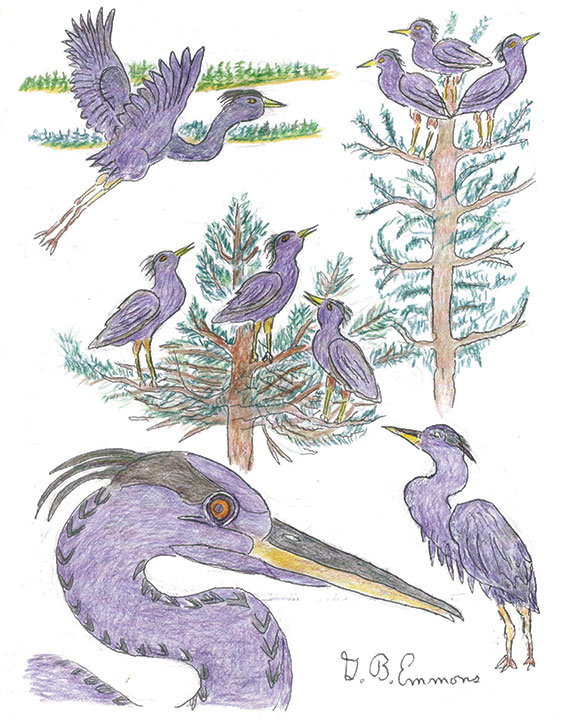
            As illustrated, males are the first to arrive to stake their claim on a preferred nesting site, sometimes the same as last year or even in the same tree, simply by building a new one directly above last year’s.

            When females finally show up, males attract them to the new abode by performing an elaborate courtship dance. To motion her attention, he will erect and wave his regal head plume until she responds. After the two join one another as partners, they both clack their bills together in an avian consent ceremony to procreate a family of three fledglings, as in my illustration. This will soon keep them both busy for long periods of time at the water’s edge.

            When looking to find prey, they stand motionless with head and beak drawn back until a sudden sighting releases a hair-trigger that springs the point of the bill with lethal force and deadly accuracy. The heron can close up the air-intake valve on its bill that underwater can scoop up and retrieve a variety of fish, frogs, salamanders, or small turtles. They also easily take insects, rodents, and birds at the edge of a marsh.

            Both parents feed their young by regurgitation, making a diversity of edible creatures appetizing for small chicks at an early age. To be so well fed, the offspring can take flight in less than two months and be able to launch their own migration before the end of summer. Or if they are well situated, they can handle severe winter weather longer and farther north than most other species.

            Because of this successful reproduction in raising their young, the latest American breeding-bird survey estimates a continental population of 83,000 reproducing pairs that, with this mobility, can be found almost all across North America. Their timeless broad survival at the water’s edge since the ancient formation of the evolution of living species originally crawled out of the primordial soup of the ocean millions of years ago hints at supernatural powers of survival.

            The narrative of the great blue heron might well be written in the stars of the night sky, shining down on the eve of the vernal equinox, when the hours of light and shadow are the same all over the world. With the planetary cycle of tidal pull over the universe, the arrival of spring again proves to be a spiritual, environmental awareness that includes the great blue heron for our appreciation as birdwatchers.

By George B. Emmons