ConCom Approves Commissioner’s Plan

The Rochester Conservation Commission on Tuesday night approved a commission member’s project to construct a driveway on Gerrish Road near cranberry bogs.

            Commissioner Ben Bailey recused himself for the hearing that endorsed the Order of Conditions for the plan to place the driveway within the 100-foot buffer zone to a bordering, vegetative wetlands to access a single-family building lot at Snipatuit Pond Estates. But Bailey defended the proposal by noting he is deed-restricting it so that the lot can only be for one home, and the driveway must remain exactly where it is being placed now.

            Brian Grady of GAF Engineering explained to the Conservation Commission that he and Bailey have spent a considerable amount of time with the Planning Board revising the original proposal, which was to build a road to access the lot. He noted the town’s Zoning Board of Appeals has approved, allowing the insufficient frontage that the plan requires. He acknowledged that the neighbors’ concerns over and disapproval of the first plan contributed to the new configuration, which will now “preserve much of the wooded area.”

            “The revised plan is a much simpler project,” Grady said.

            The strongest objection to the current proposal came from commissioner Dave Gagne, who was attending via Zoom. Gagne said he was concerned the driveway could evolve into a roadway to a solar project in the area of the cranberry bogs.

            Bailey quickly countered that suggestion. “The ZBA is restricting it to a single-family lot,” Bailey said. “I want to deed-restrict the lot for the next owner so the driveway stays where it is and has an impervious surface. I want to protect the neighbors. A solar project? That’s a very abstract question.”

            Grady noted any changes to the plan by a new owner of the property would have to come before town boards for additional permitting.

            The commission’s approval vote was unanimous, and it included two previous orders of conditions previously placed on the property.

            In other action, the commission endorsed a plan proposed by the Rochester Land Trust and the Library Trustees to place Trail Tale poles at the Doggett Brooks conservation restriction off of Dexter Lane. This project will post storybook pages on the poles so young readers may read and hike a nature trail at the same time. The program will take place between June and July and possibly August.

            The commission also approved a change to post its meetings as in-person only with an option to attend by Zoom. Chairman Chris Gerrior explained the commission will now be able to hold a meeting with or without a secure Zoom connection. The commission set its next meeting for Tuesday, April 19, at 7:00 pm.

Rochester Conservation Commission

By Michael J. DeCicco
Marion Dept. of Public Works Open House

On Saturday, April 9 at 10 am, the Town of Marion will hold an Open House at the Dept. of Public Works Facility on Route 6. We will offer a tour of the buildings at the site and showcase the proposed plans for a new Dept. of Public Works Facility to be located on Benson Brook Road.

            We look forward to welcoming residents on Saturday at the Open House.

Fire Damages Bike-Path Bridge

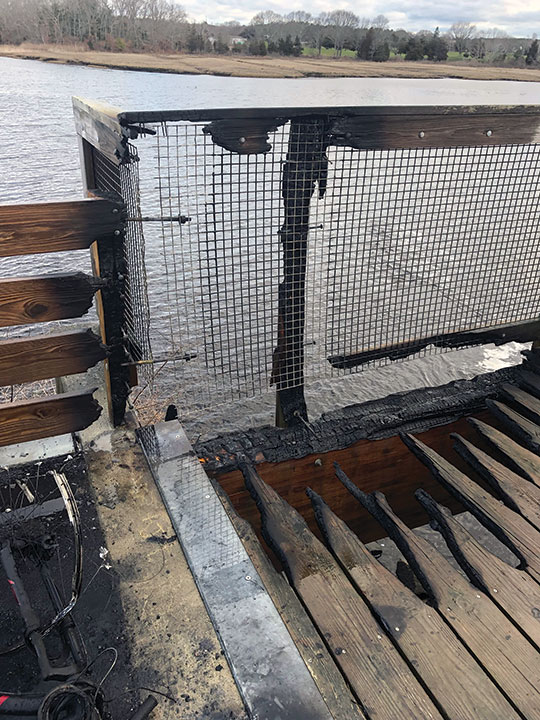
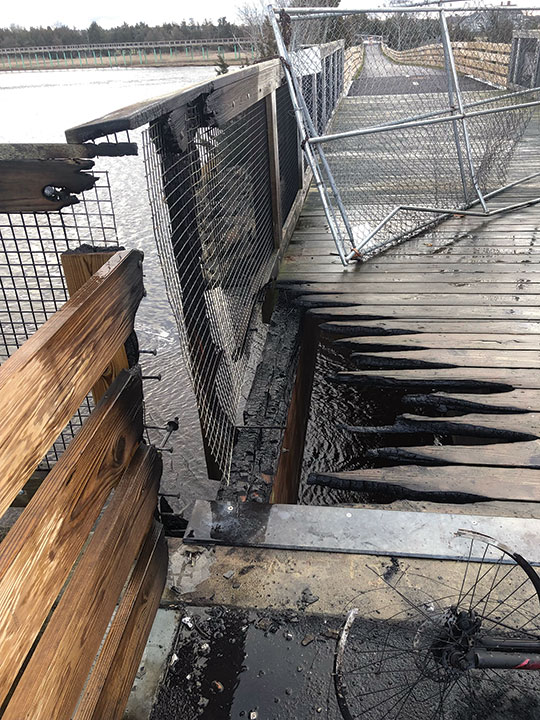
On April 2 at 6:22 am, the Mattapoisett Fire Department responded to a fire at the bike-path bridge originally built over the Eel Pond River near the entrance at Mattapoisett Neck Road, which is currently closed to the public.

            According to Fire Chief Andrew Murray, the fire was reported by a neighbor living on Mattapoisett Neck Road, and the department arrived in time to confront an active fire on the bridge that only took a few minutes to extinguish. Firefighters had to cut through three chain-link fences to reach the bridge and stayed on the scene 40 minutes to make sure the fire did not reignite.

            The fire was intentionally started according to the Mattapoisett Police, which took a person of interest into custody, Town Administrator Mike Lorenco stated. The incident remains under investigation by both the Mattapoisett Police and Fire departments.

            “It obviously is unfortunate and certainly not what you want to see with a project that has had several setbacks. However, we must move forward and find solutions,” stated Lorenco. “The town will be doing what is necessary to repair the damage in a timely fashion. The public can also help. Please refrain from using the closed section of the bike path. I cannot express that more, especially now, where repairs are needed to ensure it is safe. I would like to thank the town’s public-safety personnel for their efforts. The situation could’ve been much worse without their quick and professional response.”

            The new bridge under construction and part of Phase 1b of the bike path was not involved in the fire incident.

By Marilou Newell

Drivers Need Incentives to Go Electric

            Energy Management Committee member Tom Friedman could have been Ray Kinsella looking out at his financially endangered Iowa cornfield, calling Marion “a Field of Dreams situation. If we build it, they will come,” he said, provoking laughter during Monday’s meeting of the members who are otherwise dead serious in their pursuit of green energy.

            Friedman’s remark was in response to the town’s lack of adequate charging stations for electric vehicles. While there are opportunities for people to choose battery-powered cars, a scarcity and sometimes efficiency of charging stations has created an incentive problem.

            EMC member Eileen Marum said charging stations belong at locations such as Silvershell Beach, Harbormaster headquarters, along with an increase of stations at the Cushing Community Center and the Town House, where its one operational station runs slowly according to the members. Council on Aging and town vehicles typically occupy those two locations, according to Marum, who also recommended charging stations for Little Neck, Marconi Village and the proposed residential developments along Route 6 near the Wareham town line.

            EMC Chairman Christian Ingerslev said, once the Town House gets its new power grid up and running, the charging station on site will be upgraded. EMC member Alanna Nelson cautioned that the charging station can do the whole 40 kilowatts required, “but the electric panel can’t handle it.”

            Member Bill Saltonstall suggested that businesses may be able to access incentive programs, and the committee would do well to educate them on such financial opportunities. Nelson said she would write a note to introduce businesses to the prospect of electric cars.

            Reporting on the Mass Energy Insight program, Saltonstall told the committee that he has received a note from Lisa Sullivan, Southeast Regional coordinator for the state’s Green Communities Program.

            Having looked at Marion’s annual report, Sullivan had questioned a home construction project that had not fallen “a little shy of meeting the requirement” of the air test. But that problem was alleviated after Saltonstall’s visit to the Building Department confirmed a new report indicating compliance “by a couple of points.” Green Communities accepted the updated information.

            “I think our report from last year is in good shape,” said Saltonstall, who has figures from the first half of FY22 and only needs Friedman’s help to upload the information.

            As Saltonstall has scoured Marion for unbothered rocks to turn over in hopes of finding new opportunities for upgrades to cleaner energy, he has been flummoxed by the wall restricting pursuits of solar projects. “It isn’t clear to me with why there is a problem with the town leasing panels,” he said.

            Friedman, who discussed the matter with colleagues at Trinity Solar, said any town structure would have to go out to public bid, and few installers are interested in building municipal projects. Saltonstall said he would look into if CVEC has any contractors that work with towns.

            Nelson said that while a number of contractors work with CVEC, the matter of who gets the credit has become a sticking point in some cases. She noted that the parking lot at the Captains Golf Course in Brewster is covered with solar panels, and the income from the lease arrangement is financing a staff person. Saltonstall said he believes My Generation Energy built the array at the Captains Golf Course in Brewster and would follow up. Friedman suggested that the Sippican Elementary School parking lot would offer 100 percent sun exposure.

            Nelson said that solar installers are hitting their market, using as an example one that works exclusively with nonprofit organizations and that CVEC has been building relationships with providers. “If we can just clasp-bond to one of those, that would be great,” she said.

            Completion of the Taber Library project is important to the EMC, which cannot apply for another grant in the fall until that project is completed and paid for.

            In reporting on Marion’s Multi-Hazard Mitigation Plan status, Marum discussed a potential educational session with Laura Gardner, the Dartmouth Public Schools librarian who has spoken before on issues and impacts brought about by climate change. Marum suggested transitioning into phases or a series of programs that would lead into the Hazard Mitigation Plan.

            In her report on reducing Marion’s carbon footprint, Nelson said the increase in efficiency of the Green Communities base code has rendered the stretch code in need of an update and hold implications for Marion’s building projects.

            After Marum reported on a regional decarbonization meeting, Ingerslev agreed with the findings and said, “The lifetime cost of a building is what people should be looking at.”

            “If you plan for it ahead of time, it’s actually not that much more expensive,” asserted Nelson, citing the improvement in technology.

            Ingerslev told the members that he has sent three letters to Marion officials, including the committee’s push for a moratorium on the usage of fossil fuels in any new municipal construction projects, the EMC’s interest in changing the committee’s scope and name and its request to the Select Board to approve full voting membership for alternate member Jennifer Francis.

            The next meeting of the Marion Energy Management Committee is scheduled for Monday, April 25, at 5:00 pm.

Marion Energy Management Committee

By Mick Colageo

Friends of the Rochester COA Pop-Up Sale

Friends of the Rochester COA are having a Pop-Up Sale April 9, 9 to noon at 67 Dexter Lane. There will be an abundance of fabric, sewing notions, iron-on transfers, thread, buttons, patterns, yarn, knitting needles, crochet hooks and embroidery supplies. All priced to sell.

SEMAYO Summer Camp Announced

The Southeastern Massachusetts Youth Orchestras (SEMAYO) is pleased to announce that registration is now open for SEMAYO Summer Camp 2022. The camp is offering multiple performing groups of various skill levels to string, wind, and percussion students that have completed the 5th grade up to age 17. The camp will also offer special guests, masterclasses, field games, music theory, music history and more. Cost is $250 for single campers and $125 for each additional sibling. Interested students will need to submit an audition video by Wednesday, June 29, for ensemble placement purposes only. Any students that are actively enrolled and participating in SEMAYO are not required to audition.

            Location: University of Massachusetts Dartmouth, 285 Old Westport Road, College of Visual and Performing Arts (CVPA) building (parking lot 9)

Dates: Monday, July 25 – Friday, July 29

Times: 9:00am – 3:00 pm (drop off 8:30 – 9:00 am)

Performance: July 29, 3:00 pm

            All details, including the camper application and instructions on submitting the video, may be found at: nbsymphony.org/our-educational-programs/semayo-summer-camp/.

Committee Affirms School Choice

            There is a combined total of 99 School Choice students attending the Old Rochester Regional High School and Junior High, and that’s the way it will stay after the ORR School Committee voted at its March 23 public meeting to retain the current parameters, policies and practices.

            The committee held a Public Hearing on the matter, and with 25 School Choice students scheduled to graduate this year and 37 applications in hand, the vote of approval results in a plan to allow no more than 25 students to fill the vacated spots in the 2022-23 academic year. School Choice students populate Grades 7-12, and the district prioritizes their inclusion in Grades 7, 8 and 9.

            “We are very blessed to have some great students who came to our community and added to the quality just by their presence … the reality is they serve the overall benefit of tri-town students … create more offerings and broader educational opportunity for everybody involved. It has worked for the last several years,” said committee member Jim Muse, who was quickly supported in his comments by committee members Margaret McSweeny and Frances Kearns.

            McSweeny recognized the decline in tri-town student enrollment and recommended maintaining the School Choice program as is “to keep numbers up and keep education broad.” She read the motion prepared by ORR Administration, including a Grade 7 maximum of 18 School Choice students. Currently populated by 99 students, the School Choice program is capped at 125.

            Public Comment was invited during the public hearing, but none was received. The public hearing was closed and later in the meeting the committee voted unanimously in favor.

            In her Chairperson’s Report, Heather Burke revisited the matter of School Choice with a focus on state support or the relative lack thereof. Burke said that, while ORR is enriched by the students it receives via School Choice, the point of the program was not just to use it as a carrot but also to motivate the districts losing students to improve. The funding should go with School Choice students, said Burke, otherwise the program’s goals cannot be fully met.

            Burke also said that, while she is happy the high school track will finally be repaired, it still falls short of Massachusetts Interscholastic Athletic Association (MIAA) standards and therefore does not qualify ORR to host any large track meet. The context of the statement was that the junior and senior high school buildings need updates, and that need extends far beyond athletics to science and technology.

            “If we don’t tackle these topics, it’s only going to become more expensive,” said Burke, urging the committee members to attend and vote at their respective town meetings this spring.

            It was with Principal Mike Devoll’s recommendation that the School Committee held off on a vote regarding the request of the Old Rochester Youth Football Association to use ORR’s multi-purpose field this year. Devoll advised the committee to wait until after the high school lacrosse season to evaluation the field’s condition.

            “I appreciate the early notice from youth football; I feel like last year we were all hurried,” said Devoll. “Graduation’s on my mind in June, I want to see what that field looks like in June.”

            Having secured two dates on the field in 2021, Christine Medeiros appeared on behalf of the youth football organization seeking approval to hold three or four home dates. Youth football plays five age-group games on each game day.

            The committee will meet after graduation, at which time a vote will be taken, but member Jason Chisholm didn’t want to let it go at that.

            A former player at Boston University in the 1990s before that program was cut from the school’s roster of fall sports, Chisholm now coaches his sons in another football program. The Rochester resident told the committee that the hardship ORRYF parents incur in extra travel time lacking a home field has factored in his hesitation to transfer into the local program.

            “I would love for us to figure out a way to support this organization,” said Chisholm. “I can’t say that I would change things now … but it pains me to see that the kids in the tri-towns can’t play on the field where they will probably go (to high school). I respectfully understand the process and effort to the decision, but I would love – even if it wasn’t the multi-purpose field. … I’m biased, but I’ll own that.”

            Chisholm made sure the committee understands that ORRYF has not been able to find a home on any other field in the tri-towns. They therefore play most of their games either in Rhode Island or Dighton-Rehoboth and Seekonk. Participation is slightly down as a result.

            Echoing Chisholm’s sentiments, committee member Joe Pires asked about the current field conditions at ORR. Devoll said the field is in “good shape” and that it was “managed very carefully in the fall.” Referencing conversation with Facilities Director Gene Jones earlier on the day of the meeting, Devoll said more extensive maintenance has improved the field’s resiliency.

            Kearns thanked Medeiros for ORRYF’s diligence in cleaning up after football days and asked ORR Administration if any grants or funding can be pursued for the sake of the field. Assistant Superintendent of Finance and Operations Howie Barber said that, as of now, there are no such opportunities. The committee tabled the matter until June, when spring sports will have ended. The lacrosse season is coming up this spring.

            The ORR Youth Lacrosse Association was also scheduled to make a request, but that was withdrawn.

            ORR Superintendent of Schools Mike Nelson said that the matter of naming the press box will be revived and he will bring an update to the committee at a future meeting.

            After hearing from Junior High Principal Silas Coellner’s discussion on how technology has changed music, the committee voted to approve his proposal to shift the focus from a “Music and Technology” course to “Music for Life” with an emphasis on social-emotional learning.

            The committee also voted to approve ORR’s School Health Unit Application submitted by school nurses Nicole Sadeck and Linda Deveau and endorsed and signed by Nelson and Dr. Jason Reynolds, the school physician.

            In the Administration Report, Assistant Superintendent of Teaching and Learning Jannell Pearson-Campbell said she is working on creating a professional-development plan for 2022-23. The last P.D. day of the current school year addressed cultural proficiency.

            Director of Student Services Craig Davidson talked about events meant to smooth the transition from elementary schools to the junior high. On Tuesday, April 12, at 6:00 pm, parents will have the opportunity to gain advice on how to speak to their children about racial incidents at school. Registration forms were emailed to families on March 23.

            In his Principals Report, Silas Coellner reported that 100 parents attended the March 22 transition event, which was to be repeated this week with another parent tour scheduled for April 17. “It makes a big difference when they’ve had prior exposure,” he said.

            Earlier in the meeting, Devoll recognized winter season successes, starting with sports including South Coast Conference championships in boys and girls basketball, boys and girls indoor track, and boys swimming. “We don’t have a winter pep rally, but maybe we should,” he said. Colby Gross made nationals in the 300-meter run, and Jen Williams finished seventh in New England in the 55 hurdles. In music, Corinne Hibbert qualified for the Southeast District Festival in flute.

            ORR’s DECA chapter produced state champions including Eddie Gonet, Colin Carroll and Brendan Burke, who will all compete in April in Atlanta. Gonet and fellow senior McKenzie Wilson exceled in Speech & Debate.

            Among committee reports, Muse said the Mattapoisett School Committee’s negotiations with teachers were “going well,” that Kevin Tavares will be promoted at Old Hammondtown School and that the town is looking for a principal for Center School.

            After thanking the Central Office for its hard work, attention to detail and including the school committee in its communications, McSweeny used the floor in the Open Comment segment of the meeting to say she would like to hear from junior and senior high schools about the implementation of discipline. She also asked why the ORR District does not employ a Curriculum coordinator, calling it “a huge job.”

            Gonet reported on ORR’s Student Council, including a spring dance with the freshman and sophomore classes, a junior class semi-formal and the senior prom at the Belmar in Newport, Rhode Island. Spirit Week, he said, will be held before the April vacation with an outdoor pep rally scheduled. Senior Week will be held the week before graduation with a series of events including a parade, a walk-through the elementary schools, an awards night and a breakfast. Gonet said that Senior Superlative Night raised $1,400 for the class to offset prom-related costs. Gonet regretfully reported that nothing came from the regional Student Advisory Council meeting.

            Alison Noyce of Tri Town Against Racism recognized ORR students Grace Long and Angus McLellan after their entries placed in the TTAR Art Contest during Black History Month, calling the work, “very moving pieces that we are extremely proud of.”

            The ORR Senior Class Fundraiser request was withdrawn.

            The committee entered Executive Session at 6:48 pm to discuss collective bargaining strategy and to comply with the provisions of any general or special law or federal grant-in-aid requirements and exited at 7:15 pm.

            Early in the meeting, Nelson held a moment of silence for ORR student Emma Whittaker, who passed away on February 16.

            The next meeting of the ORR School Committee will be held on Wednesday, April 27, and the next meeting of the Joint School Committee will be held on Thursday, April 28, both at 6:30 pm.

ORR School Committee

By Mick Colageo

Secrets: True Crime Writing

            It is a fair statement that no one gets closer to the drama of a real crime than those charged with reporting it as news. The real time investigatory work done by law enforcement is followed in minute detail as the reporters strive to tell the full story with clarity and, yes, compassion for victims and their families regardless of where the guilt may eventually fall.

            Or consider what happens when a crime becomes a cold case spanning years, hanging like torn laundry from multiple lines of inquiry, only to remain flapping in the wind of time.

            Maureen Boyle knows the challenges and has accepted the responsibility of keeping victims alive in the minds of a public, who have long lost interest in their unfinished stories. Such is the case with her true crime story “Shallow Graves,” which brings us back to the nine unsolved murders of women whose lives were savagely taken in 1988. The victims’ bodies were tossed in the tangled brambles along tree lines off Routes 195, 140 and 88. Not a single case has been solved.

            “Someone knows something,” Boyle stated during her March 26 presentation at the Mattapoisett Public Library. But even her exhaustive efforts during and since the first victim was uncovered have failed to produce new evidence, thus Boyle’s goal is to keep the files open and relevant despite the passage of time. She wonders aloud, “How can anyone keep a secret of this many decades?”

            In 1988 Boyle was assigned by the Standard-Times to cover the New Bedford Police Department. She had been a working reporter for some time and found covering the police a good beat for her. As the body count increased, Boyle interviewed police officers, detectives, victim’s families and neighbors, combed through documents and kept asking, “Is this a serial killer?

            “I didn’t know it was a serial killer until he stopped.”

            Altogether, a total of 11 women went missing and were reported as such; nine were eventually located, while two have never been found. But in some cases the missing person report wasn’t filed right away. They lived on the fringes of society in a world filled with drugs and physical abuse, Boyle clarified. But as she explained, weather and time exercised additional abuse on the discarded murdered women, sometimes leaving little useable evidence even in the form of an intact body.

            Boyle’s book tells the story of the victims with what she said was absolutely necessary “dignity and respect.” But it is also a validation of the hard work and dedication she witnessed from law enforcement, the endless searching in the wooded byways, knocking on doors, shagging down leads, and thousands of pages of documents.

            “People were saying the police didn’t care, they didn’t want to solve the case,” Boyle said. But as she firmly attested was not the truth, “They worked around the clock.”

            Boyle’s talent to probe and search, asking the tough or mundane questions is well honed from her many years as a journalist. But she is also a truly interesting speaker. From the moment she began her talk about not only Shallow Graves but her newer publication “The Ghost,” another true crime story that was eventually solved but only after decades, Boyle captivated her audience. That she knows her material is an understatement, but that she can deliver it in an interesting and thought-provoking manner is a gift.

            “Writing true crime is not easy. There are mountains of documents from birth certificates to death notices,” Boyle shared. She singled out libraries as important repositories for all manner of public documentation and the aid provided by library staff. She spoke of the hours spent reading microfiche, saying it was torturous but necessary and that newspapers – hardcopy – are critical to society, giving us a sense of place and time.

            In closing, Boyle said, “Crime writing is like solving a secret, but getting the answer does not ease the pain. It doesn’t bring anyone back. Lives are lost, these were real people.

            “You have to be careful how you treat the people – not hurt them further, but to write about it truthfully and tastefully.”

            Boyle will continue to shine a light on these victims, women she has lived with for decades. To learn more about Boyle and her crime stories, visit maureenboylewriter.com.

By Marilou Newell

Academic Achievements

Julia Pardo, a member of the class of 2022 from Marion, has been named to the Fall 2021 Dean’s List at Loyola University Maryland. In order to qualify for the Dean’s List at Loyola, a student must achieve a minimum QPA of at least 3.500 for the term, provided that in the term they have successfully completed courses totaling a minimum of 15 credits.

            Allison Paim of Marion, Daniela Gil Veras of Marion, Lilah Gendreau of Mattapoisett, Maya Dube of Mattapoisett, and Felicia Aguiar of Mattapoisett were named to the 2021 Fall Semester Dean’s List at Simmons University in Boston. To qualify for Dean’s List status, undergraduate students must obtain a grade point average of 3.5 or higher, based on 12 or more credit hours of work in classes using the letter grade system.

The MAC Announces New Exhibit

The Marion Art Center is pleased to announce its newest exhibit, Emergence, featuring works by textile artist Paula Stebbins Becker and painter Tracey J. Maroni. The show runs April 1 through May 6, with an artists’ reception scheduled on Saturday, April 9 from 3:00-5:00 pm.

            Paula Stebbins Becker is an artist and textile designer residing in Rhode Island. She received her MFA in Fibers from Cranbrook Academy of Art and her BFA in TD/Fibers from UMass Dartmouth. Paula is “inspired by people, nature and our relationship with the environment and human experiences.”Paula explores themes of memory, time and the delicate structure of human existence through the medium of fiber – by weaving, knotting, stitching, unraveling and reconstructing threads and fabrics.

            Tracey J. Maroni is a visual artist from Massachusetts who works in paint and mixed media. She holds a Bachelor of Fine Arts with a painting major and art history minor from University of Massachusetts, Amherst. Maroni, whose most preferred medium is painting, “draws her inspiration from nature” and her artwork is “an investigation and exploration of the natural world and the planet as a living, giving entity.”

            The MAC will host a closing event during the show, kicking off ten days of SouthCoast Spring Arts events on Thursday, May 5 from 6-7 pm with a conversation with artist Paula Stebbins Becker (free to attend.) Paula will share her inspiration and discuss her various processes of unraveling and weaving threads, natural dyeing, and using thread in her printed works on paper. During the event, guests can also view an image slideshow in the MAC Theater featuring more works and images by artist Tracey J. Maroni. Find out more at marionartcenter.org/events.