From the Files of the Rochester Historical Society

Rochester’s early settlers led lives that we would find difficult. No running up to Friend’s Market at Plumb Corner to get a forgotten supper item or to Wareham Crossing for a new shirt. Pretty much anything you ate or wore had to be grown by you or a neighbor willing to barter.

            One crop grown in Rochester in those early days was flax. The cultivated flax plant, scientifically named “Linum usitatissiman” by Carl Linneaus in his book “Species Plantarum” (no doubt a big seller) in 1753, has been grown and used since the 5th millennium B.C. The word, flax, is used to denote both the plant and its spun fiber. The cultivation of it was introduced to North America by the colonists settling there. Flax likes certain growing areas, one of which is in the soil just above the water line of a cranberry bog.

            This plant is quite interesting as well as being essential in the 1800’s. It has a fairly short growing season and is harvested soon after flowering and forming seed capsules. This is usually in early summer. The plant which reaches 3 ft. is pulled completely out of the soil.

            The flax plant is full of edible seeds but was grown primarily for its long fibers which after much preparation could be spun into thread (yarn) and then woven into linen cloth, an important colonial commodity. Linen was absorbent, washable and durable, so it was perfect for everything from underclothes to men’s shirts.

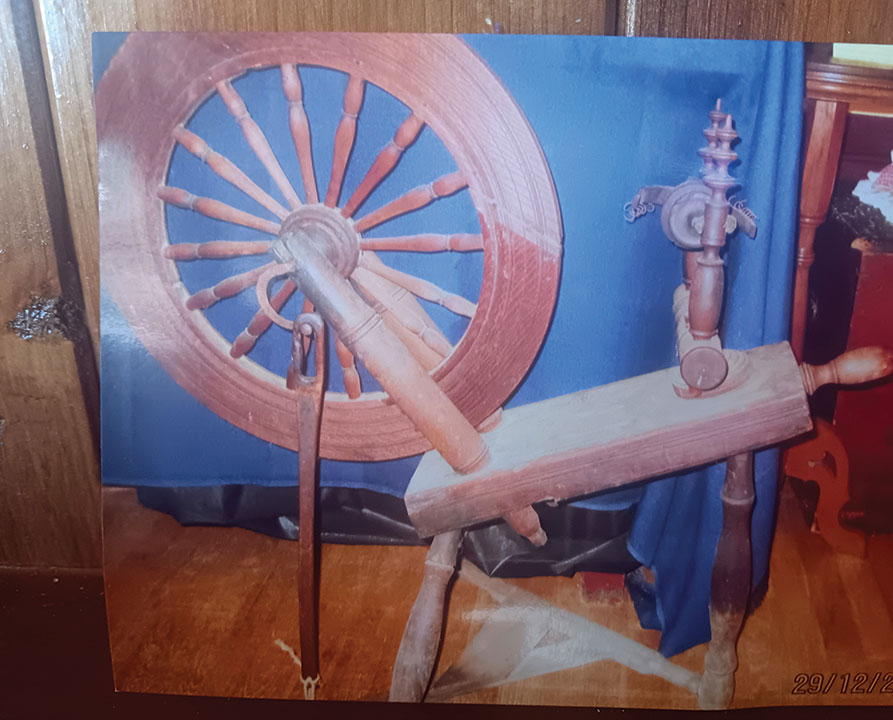
            The harvesting is the easiest part of getting flax thread. Once the plant is pulled from the garden there are several steps to get the flax to the flax wheel pictured here with its distaff and recently donated to the museum by Pam and Orrin Robinson.

            After drying the plants by laying them out in the sun, they need to be “retted”. Retting is the process of breaking down the pectins that bind the fibers. The most common way to do this was “pond retting”. Placed in a shallow part of a pond the water would basically rot the plant, loosen the unwanted fibers and as a by-product release a “prodigious odor.”

            L.C. Humphrey, in his papers, says that in Rochester, the flax would be taken to Mary’s Pond for this process to take place. Its clear bottom made it an ideal location and there are/were old stones on the south side that shows where the flax was placed.

            Once softened, it had to be again dried in the sun until it was “bone dry.” The flax was then beaten against a board with a blunt wooden knife. A contraption called a “flax break” was used. Next a “scutching knife” was used to “scutch” or break out the woody stems.

            The next tool was a “hetchel”. This tool came in sizes from large to small and looked somewhat like the wool comb in our exhibit. These were used to remove the remaining woody stems and short fibers, gradually refining the fibers. As the combing process continued, discarded fibers were saved to be fire starters or to be made into rope and even socks.

            When the fibers were smooth and start to look like hair (source of term, flaxen haired), they were finally ready to be spun into the thread used to weave linen cloth. The distaff on the wheel held the flax and spinners would wet their hand to ensure smooth not fuzzy yarn.

            Obviously, it was linen’s durability that made it worth all the work entailed in making it. Colonials had few pieces of clothing and wore them for many years.

By Connie Eshbach
Hanna R. Milhench

Hanna R. Milhench, 86, died peacefully at her home in Marion on Friday, January 23rd, 2026. A devoted wife, mother, proud grandmother and community member, Hanna lived a life of faith and serving others.

Born and raised in Lemgo, Germany, Hanna was the daughter of Hermann Rossmann and Else Klages Rossmann. After completing high school and vocational school, Hanna came to the United States in 1961 to au pair for the See family of Marion.

It was here in Marion where Hanna met Arthur Milhench, and a courtship ensued. In October of 1964 they were married in Germany, a marriage that would last forty years.

This marked the beginning of an indelible period: a family was started and a home was built on Butler Point.

Hanna was one of several German au pairs to enter the genteel Marion scene during this time. As one longtime friend put it, “These women were beautiful inside and out. They brought to Marion a European flair, they cherished their husbands, families and their new lives in America. And they wore bikinis!”

A devoted wife and mother of four, Hanna immersed herself in Marion. She led numerous projects at Saint Gabriel’s Church, including Fair Noel, Gardens by the Sea and Friendship Table. She was also a project leader at Damien’s Pantry and CRN. Hanna spoke with actions. A friend remembers, “Hanna was always doing for others, with folks not knowing half of what she did”.

Hanna took up golf under the care of Kittansett’s Ray Dennehy and grew to love the game. She competed successfully in numerous Club events and led Ladies Golf for three years. A creative problem solver, she was a talented seamstress, even sewing wedding dresses for four family members. But it may be her famous rum cakes that will live on indefinitely; this Christmas tradition she started for friends, has since become a Milhench Supply institution.

Hanna was happiest at home on the Point. Her love of gardening, the outdoors and the weather were the perfect match for living five miles out into the Bay. This setting, often filled with many of her eleven grandchildren, brought her true serenity. Fiercely independent and with an indomitable spirit, she lived at home to the very end.

Hanna was predeceased by her brother, Jürgen Rossmann, and her husband, Arthur Milhench.  She is survived by her sister, Christel Dudey; her children Heike Milhench (Barratt) of Marion, Loren le Gassick (Stuart) of Mattapoisett, Elke Pierre of Marion, and Mark Milhench (Kerry) of Marion; eleven grandchildren – Alexander, Anne Louise, Bessie Marie, Philip, Markus, Peter, Ella, Luke, Annalise, Henrik and Else; four nieces and nephews, and eight great nieces and nephews.

A memorial service will be held for Hanna on Saturday, March 21st, at Saint Gabriel’s Episcopal Church in Marion at 10:30am. In lieu of flowers, donations can be made to the Harwood Society at Saint Gabriel’s, P.O. Box 545, Marion, MA 02738.

Arrangements by Chapman Funerals & Cremations – Wareham.  For directions or to leave a message of condolence visit: www.chapmanfuneral.com

Marion Natural History Museum

The Great Backyard Bird Count (GBBC) is a free, fun, and easy event that engages bird watchers of all ages in counting birds to create a real-time snapshot of bird populations on February 4 from 3:30 pm to  4:30 pm. This year’s bird count runs from February 13 to 16. Participants are asked to count birds for as little as 15 minutes (or as long as they wish) on one or more days of the four-day event and report their sightings online at birdcount.org. Anyone can take part in the Great Backyard Bird Count, from beginning bird watchers to experts, and you can participate from your backyard, or anywhere in the world.

            With the help of Nasketucket and Brookline Bird Club member Carol Molander we will be learning how to identify some of our more common bird species, taking a walk into the woods to see what we can find and then learning a little more about this important event. Warm hats, gloves and boots are highly recommended for our excursion.

            Let’s learn the basics before these important dates are upon us. Please register at www.marionmuseum.org.

Academic Achievements

The University of Hartford is pleased to announce that Jay Carrillo of Marion has been named to the University of Hartford’s Dean’s List for the fall 2025 semester. The Dean’s List recognizes students achieving superior academic standing. The requirement, with some exceptions, is a grade point average of at least 3.0 and no grade below C.

            Regis College today recognizes Jenna Lynch, of Mattapoisett, whose academic excellence and commitment to learning have earned them a place on the fall 2025 Dean’s List. To qualify for the Dean’s List, students must earn a GPA of 3.5 or higher. First-year students qualify with a GPA of 3.25 or higher.

            Henry Bailey of Rochester was named to the Champlain College Dean’s List for the Fall 2025 semester. Students on the Dean’s List have achieved a grade point average of 3.5 or higher during the semester. Bailey is currently majoring in Game Design.

            Stonehill College is pleased to recognize Matthew Curry of Mattapoisett, Hannah Squires of Mattapoisett, Nathan Yurof of Marion, Andrew Poulin of Rochester, Martha Savage of Mattapoisett, and Allison Winters of Rochester to the Fall 2025 Dean’s List. To qualify for this honor, undergraduate students must have achieved a semester grade point average of 3.50 or higher with a minimum of 12 credits from courses graded with standard letter grades.

            Palmer Clingman of Mattapoisett, Will Hurlbut of Marion, Bree Killion of Rochester, Brady Lee of Mattapoisett, Drew Mastovsky of Marion, Owen Osterday of Marion, George Psichopaidas of Mattapoisett, Holyn Turner of Mattapoisett, and Zachary Zutaut of Rochester have been named to the Fall 2025 Dean’s List at Roger Williams University in Bristol, RI. Full-time students who complete 12 or more credits per semester and earn a GPA of 3.4 or higher are placed on the Dean’s List that semester.

Stephen E. Perry

Stephen E. Perry, 81, of Mattapoisett passed away Monday, January 26, 2026 at home surrounded by love after a brief illness. He was the husband of the late Drusilla L. (DePina) Perry, with whom he shared 47 years of marriage.

            Raised in Cataumet, son of the late William and Florence (Perry) Barrows, he lived in Mattapoisett for most of his life.

            Stephen attended New Bedford High School until he left at age 17 to enlist in the United States Marine Corps. He loved being a Marine and served honorably for many years, both active duty and as a reservist, retiring as a Master Gunnery Sergeant.

            He was formerly employed as a building and grounds supervisor for the Town of Marion for many years until his retirement.

            Stephen enjoyed time spent with family, friends, and his beloved dog, Cash. He was an avid golfer and loved traveling, listening to music, and watching sports, especially the Boston Celtics.

            Survivors include four sons, Anthony Perry and his wife Melanie, Brandon Perry, Shawn Perry, and Stephen Perry; his daughter, Charnelle Perry; two brothers, Donald and Jack Barrows; five grandchildren, Mikenzie Perry, Jason Perry, Ella Perry, Charlotte Perry, and Shawna Rose Pires.

            He was predeceased by his brother, Ronald Barrows.

            His Funeral Mass will be held Friday, February 6, 2026 at 12 Noon at St. Anthony’s Church, 26 Hammond St., Mattapoisett, with everyone invited to meet directly at Church. Visiting hours are omitted and burial at the Massachusetts National Cemetery will be private. For directions and guestbook, visit www.saundersdwyer.com.

Audrey Howard (Smith) MacDonald

Audrey Howard (Smith) MacDonald, 84, of Marion, MA, died peacefully on January 19, 2026 after a long courageous battle with Alzheimer’s. She was the daughter of the late Frank and Mary (MacKenzie) Smith of Cambridge, MA. Audrey was predeceased by her loving husband of 61 years, Ronald F. MacDonald; and her late sister Joan Smith.

            Audrey was a graduate of Cambridge, Rindge and Latin High School and Burdette College School of Secretarial Science. She worked at New England Gas and Electric Company in Cambridge where she met her dear husband. Ron and Audrey were fortunate to relocate to their beloved Marion where they raised their family. Audrey was an active member of the First Congregational Church and loved working at local employers Eames Insurance Company and American Research & Management Company.

            She is lovingly survived by her two children Ronald F MacDonald, Jr. of Arlington and Chatham, and Janice (MacDonald) Koss and L.Brian Koss of Woburn (formerly Winchester) and Chatham, two granddaughters, MacKenzie Koss of Dorchester and Abigail (Koss) Gravallese of Marshfield; sister Gwen Washburn of Kennebunk, ME; nephew Andrew Washburn of Kennebunk, ME; nieces, Lauren Walier of Keene, NH; Paige Wilner of Old Greenwich, CT; Lindsay Brancaleone of Eliot, ME; and Elizabeth Smith of Sarasota, FL. She was affectionately known by her family as Gammy, and will always be remembered for her loving and comforting demeanor, generous spirit, wise words, and unwavering strength and determination.

            Thank you to the wonderful caregivers at Sunrise of Arlington.

            A Celebration of Life will be held at the First Congregational Church in Marion in May.

            Arrangements are with the Saunders-Dwyer Mattapoisett Home for Funerals, 50 County Rd. (Rt. 6), Mattapoisett. For online guestbook, visit www.saundersdwyer.com.

Swimmers Put up Personal Bests

            Old Rochester’s boys and girls swimming teams split at Seekonk on January 22, as the boys team won, 102-74, while the girls team lost, 85-65. Chase Karo was named the swimmer of the meet for the boys, winning the 500-yard freestyle with a personal-best time of 5:43.52. Bree LeFavor was the swimmer of the meet for the girls. LeFavor won the 100 backstroke with a personal best-time of 1:08.06 and qualified for Sectionals.

Sports Roundup

By Aiden Comorosky

Hoo-ah! Snow Days!

            Snow, as any New Englander knows, is a great facilitator to sports and play. It’s the stuff that gives us snow angels, snowmen, sledding, skiing, and snowshoeing. Or, if you prefer, snow is the inducer of deep hibernation and resting for the season to come.

            Whatever way you look at it, snow falling is a beautiful sight and one that we northerners adore (all the more if timed right). I am not tethered to weather reports though. I prefer to be open to surprises, and I detest being disappointed when the predictions fall short. As a result, I’m often the last to know about an impending storm; so be it if it’s against my Girl Scout code. It seems silly when people panic over snow predictions. Case in point – the supermarket frenzy. I went to get a balloon for my granddaughter after school the other day to find absolutely mayhem … I went to a different store, which had lines galore, and was relieved that the florist shop allowed me to pay for my few items in one go. Though it shouldn’t surprise me that a week in advance people were reacting to the news of a snowstorm.

            Actually, I’m rebelling against an upbringing where the weather report determined everything. Suffice it to say that snow is part of the New England experience that must be endured and hopefully enjoyed.

            Beyond the pleasures and visual appeal the snow brings, there are real benefits for our plants. By insulating the ground, snow inhibits vast changes in the soil temperature and also maintains soil moisture. Great fluctuations – freezing and thawing – can hurt roots and even fall-planted bulbs, causing them to expand and contract or to essentially press the start switch in their growth cycle. Too many ups and downs in temperature can be calamitous. So, the snow serves to balance the temperature like natural mulch blanketing the bare ground, preventing frost heaves. Mind you, lots of plants need cold to happen in order to go forward and bloom, so maintaining cold beneath the ground is essential and snow helps.

            Another common Yankee belief is that snow provides nutritional benefits for plants. Often called the “poor man’s fertilizer,” snow deposits nitrogen into the soil. When the ground thaws, this nitrogen becomes available for plant uptake. Research suggests that between 2 and 12 pounds of nitrogen per acre are deposited each year through precipitation, including both snow and rain. Much of this nitrogen comes from the atmosphere, while the remainder is produced through nitrogen fixation caused by lightning – an essential natural process that supports agriculture. While not a replacement for traditional fertilizer, this natural process provides a “free” boost that supports early spring growth.

            Hopefully these benefits will prove themselves as we turn our eyes to spring and our flowers. My procrastination seems to have worked in my favor regarding bulbs. Each year I seem to take longer to plant them (partly intentional to outsmart the thieving squirrels)… well in past years this has gone swimmingly (sorry for the mixed metaphor), but I did wait until the ground was freezing over – a tad risky and, though the results were good, my numb fingers paid the price. In past years, I waited even longer in hopes that snow would gently seal the bulbs in. Snow has that aura – it’s protective, comforting and peaceful, whether you’re a bulb, a human, or Punxsutawney Phil.

            Pretty soon (February 2) we will know the dictate of the famous groundhog. I’m betting (hoping) on six more weeks of winter and more hibernation time. It doesn’t seem like we’ve really had a proper winter yet, so I’m inclined to stay bundled up a bit longer. Meanwhile I’ll check my Farmer’s Almanac.

            “He seemed a part of the mute melancholy landscape, an incarnation of its frozen woe, with all that was warm and sentient in him fast bound below the surface…” – from Etham Frome by Edith Wharton

The Seaside Gardener

By Laura McLean

Many Monumental Approvals

            The Old Rochester Regional High School Track Department’s road race and an initiative for more solar on town properties received endorsements at the January 21 Select Board meeting in the Police Station conference center.

            Jessica Pilla, a teacher at the high school and a track coach, said the cross-country team has fewer needs but the track team is playing with older hurdle equipment and mats. She speculates that some of the mats in use date back to the 1980s. Modern replacement mats are priced at $13,000 per pack, Pilla said.

            Pilla said the department works on fundraising frequently, but she said a road race would further help the program. She said successful fundraising could also open more opportunities, such as scholarships for students and other training equipment such as treadmills and ellipticals. 

            The board endorsed the road race, which will take place later this year on a currently unspecified Saturday. 

            The Select Board also approved placing solar panels on the new Department of Public Works building, which is expected to open next month.

            The Energy Management Committee met with the Select Board late last year. At that time, the board was hesitant because start-up costs will range in the $90,000 range. However, EMC members said there are state and other funding sources that will help pay back that appropriation.

            Town Administrator Geoffrey Gorman said a solar company has also approached the town about placing solar arrays at the landfill, which could also generate energy and savings for the town.

            The Select Board appointed several members to the 175th Anniversary Committee. Board members noted that some people have applied but were not appointed. Officials at the January 21 meeting still encouraged non-appointees to volunteer. They mentioned that with many facets of this town birthday celebration, subcommittees might form and some interested parties, not appointed to the main committee, might get a second opportunity for an official appointment.

            The Select Board also approved some town-land for the long-awaited shared-use regional bike/walking path route through Marion to Mattapoisett.

            That South Coast Bikeway starts in the Fall River area and is in the process of ending close to the Cape.

            Gorman said that the state Department of Transportation has three engineers working on the design, which is still in flux. He said the town also received a $97,000 feasibility study project as the path continues to be revised.

            The Select Board also approved a donation from the Friends of the Council on Aging for an industrial grade hand mixer, which will save kitchen staff time as they prepare calzones, pizza and other treats for COA events.

            The mixer’s market price was over $3,500 but a grant has allowed the friends group to secure a deal to purchase it for just under $2,000.

            The next meeting of the Marion Select Board is scheduled for Tuesday, February 3 at 6:00 pm in the Marion Police Station.

Marion Select Board

By Jeffrey D. Wagner

Summer Programs at the MAC

Registration for all summer camps at the Marion Art Center will open to MAC Members on Friday, January 30, and to nonmembers on Friday, February 13.

            ArtStart returns to the MAC for four weeks this summer. ArtStart is the MAC’s summer art program for children ages 4 1/2 to 9 years, offered in June and July each year. ArtStart teachers are specialists in music, dance, theater, and art, most of whom teach throughout the year and are professionals in their fields. Activities include arts and crafts, theater, music, games, and storytelling.

            The schedule for 2026 is:

            Session 1 Monday, June 29 – Friday, July 3

            Session 2 Monday, July 6 – Friday, July 10

            Session 3 Monday, July 13 – Friday, July 17

            Session 4 Monday, July 20 – Friday, July 24

            The cost is: MAC Members: $275 Nonmembers: $315. More information is available at: marionartcenter.org/artstart.

            Dungeons & Dragons: Our participants are immersed in a week-long journey of creative storytelling and thrilling improvisation with the Guild of Imagination’s five-day Dungeons & Dragons program. Players will craft their own unique hero and embark on a fantastical adventure. With a focus on encouraging creativity, teamwork, and problem solving, Dungeons & Dragons ignites imaginations and nurtures storytelling skills. This unforgettable experience will forge friendships in a safe and supportive environment and create memories that will last a lifetime. Sessions run in late July and early August for ages 10-15. Learn more at marionartcenter.org/d-and-d.

            All Things Art is an immersive weeklong program which takes place in late summer and is geared toward young artists ages 10-15. During their time in the Art Studio, young artists will experiment with a number of practices, techniques and media such as drawing, sculpting, printmaking, fiber arts, working with clay, and more. Learn how to talk about art making and what inspires one’s creative choices.

            The All Things Art Schedule for 2026:

            Session 1 – Monday, August 3 – Friday, August 7;

            Session 2 – Monday, August 10 – Friday, August 14.

            Cost: MAC Members: $275 Non-members: $315, plus a $45 materials fee per student each week. Classes meet in the MAC Studio 9:00 am to 12:30 pm each day. For more information and to register: marionartcenter.org/all-things-art.

            All Things Theater is a weeklong theater intensive for preteens and teens ages 10-15. Young actors will learn from several instructors, many of whom are professional artists working in their fields. This interactive afternoon theater camp will showcase multiple facets of theater craft both on stage and behind the scenes. Activities may include acting, improvisation, costume creation, stage management, tech, and movement. Monday-Friday in the MAC Theater 1:00 pm to 4:00 pm each day. The 2026 Schedule is:

            Session 1 – Monday, July 27 through Friday, July 31

            Session 2 – Monday, August 10 – Friday, August 14

            The cost for MAC Members is $265 and for nonmembers it is $305. For registration and more information go to marionartcenter.org/all-things-theater.