From the Files of the Rochester Historical Society

When CNN advertises a town hall event, we all know that the Presidential election cycle is gearing up. However, the moderated question-and-answer sessions are a far cry from what has actually gone on in New England town halls for over two centuries. While many Massachusetts towns have gone through the stages of transitioning first to a representative town meeting and then to government with a mayor, Rochester still has a Town Meeting that mirrors those of the past.

            As we have seen this week, residents attended Town Meeting to listen to and vote on 32 articles. Two days later, they headed to the polls to vote for a variety of positions, including a seat on the Select Board.

            Rochester’s first Town Meetings began after incorporation as “Rochester-town in New England” in 1686. Laws for the town were made and voted on by “freemen” at these meetings. By 1690, selectmen were elected. The earliest recorded names were those of Aaron Barlow, Samuel White and Samuel Hammond. The records of earlier selectmen have been lost to time.

            In her history of Rochester, Mary Hall Leonard credits Town Meetings for stabilizing state and national affairs after the colonies had severed ties with England. When no longer ruled by England, a new government needed to be formed and new constitutions written, but that took time. Town governments accustomed to making decisions at Town Meetings filled that breach and proceeded with the business of day-to-day governance. As Leonard writes, “Each little town by its decisions made known through its representative will help to direct the trend of State and national affairs,” and so the ” town government holds on its way but all else is in a transitional and chaotic state.”

            Those who chose this week to participate in Town Meeting walked in the footsteps of our community’s ancestors.

By Connie Eshbach
Boat Race Ham & Bean Supper

            The Rochester Memorial Day Boat Race (RMDBR) Ham and Bean Supper will be held Saturday, May 27 at the Rochester Senior Center, 67 Dexter Lane. The supper will be served from 5:00 pm to 7:00 pm, and tickets can be purchased at the door. There is the option to eat in or eat on the patio if weather permits. Adults, $10.00 and children under twelve are only $5.00. Beans baked by the best bean bakers in town, coleslaw, potato salad, rolls and brown bread. And to top it all off, apple crisp or other fruit crisp. Proceeds from the supper help offset the expenses of the race.

            Started in 1934, this is the 89h anniversary of the race. Enjoy a great meal at one of the important social events of the year in our area. The more the merrier. For additional information, please contact Arthur Benner, Chairman, RMDBR, 508-763-2024 or email, artbenner@comcast.net.

Murphy Wins Select Board Seat

Adam Murphy has unseated Woody Hartley on the Rochester Select Board, winning the May 24 election 845-673. After a recount of last year’s Select Board race, Murphy lost by one vote against incumbent Brad Morse. Murphy also ran against Hartley in 2020 and lost.

Below are the Rochester Town Election unofficial results, as read shortly after the polls closed by Town Clerk Paul Dawson.

* incumbent

1,557 ballots were cast.

SELECT BOARD (vote for 1)

* Greenwood Hartley III 673

Adam Murphy 845

Write-in’s: 0

Blanks: 39

PLANNING BOARD (vote for 2)

* Ben Bailey 809

* John Demaggio 935

Dennis McCarthy 632

Write-in’s: 5

Blanks: 733

LIBRARY TRUSTEES (vote for 2)

Heather Alford 644

Jane Taylor 983

Sarah Verbyla 441

Write-in’s: 8

Blanks: 1,038

ORR SCHOOL COMMITTEE (vote for 1)

* Joe Pires 791

James O’Brien 728

Write-in’s: 0

Blanks: 38

ROCHESTER SCHOOL COMMITTEE (vote for 2)

* Kate Duggan 805

* Anne Fernandes 733

Greg Hardy 693

Sydney Teixeira 691

Write-in’s: none announced

Blanks: none announced

TAX COLLECTOR (vote for 1)

* Beatrice Renauld 1,237

Write-in’s: 13

Blanks: 307

TOWN CLERK (vote for 1)

Marjorie Barrows 990

Write-in’s: 299

Blanks: 268

BOARD OF HEALTH (vote for 1)

* Dale Barrows 1,182

Write-in’s: 6

Blanks: 369

CEMETERY COMMISSION (vote for 1)

Write-in’s: 217

Blanks: 1,340

BOARD OF ASSESSORS (vote for 1)

* Suzanne Szyndlar 1,163

Write-in’s: 9

Blanks: 385

PARK COMMISSION (vote for 1)

* David Sylvia 1,203

Write-in’s: 3

Blanks: 351

HERRING INSPECTOR (vote for 1)

* William David Watling 1,251

Write-in’s: 5

Blanks: 301

WATER COMMISSION (vote for 1)

* Fred Underhill 1,236

Write-in’s: 4

Blanks: 317

Shall the town vote to have its elected town clerk become an appointed town clerk for the town?

YES: 401

NO: 895

Blanks: 261

Sprinkler Malfunction Closes Sippican

A sprinkler malfunction resulted in water damage throughout the Sippican Elementary School on Tuesday night, prompting Old Rochester Regional Superintendent of Schools Mike Nelson and Sippican Principal Marla Sirois to cancel classes on Wednesday, May 24, according to a press release issued at 10:33 pm.

            Initial reports of the broken sprinkler came in at approximately 8:12 pm, to which the Marion Fire Department responded and shut down the second-floor sprinkler. There was no fire in the school building nor were there injuries, but extensive water damage was found in first and second-floor classrooms.

            “We are grateful to first responders and town officials for all of their assistance,” said Nelson. “The quick actions of the Marion Fire Department prevented even more damage from taking place.”

            The ORR School District stated it would provide updates and guidance with a plan to email any further schedule changes.

Nasketucket Bird Club

Author Will McLean Greeley will present “A Connecticut Yankee Goes to Washington: Senator George P. McLean, Birdman of the Senate” at the next meeting of the Nasketucket Bird Club.

            This is the story of how Connecticut’s George P. McLean helped establish lasting legal protections for birds, overseeing passage of the 1918 Migratory Bird Treaty Act, landmark environmental protection legislation that is still in effect today. Greeley, McLean’s great-great nephew, puts McLean’s victory for birds in the context of his distinguished 45-year career marked by many acts of reform during a time of widespread corruption and political instability. David Allen Sibley, author and illustrator of The Sibley Guide to Birds, writes of the book: “On one level this is a fascinating, and thoroughly researched, glimpse into the workings of U.S. politics in the early 20th century. On another level, it’s an inspiring story of one man’s determination and steadfast commitment to securing legal protections for birds. I am glad to know more about George McLean.” “A Connecticut Yankee Goes to Washington” was published by the Rochester Institute of Technology Press in March 2023.

            The event will be on Thursday, May 25 at 7:00 pm at the Mattapoisett Free Public Library (7 Barstow Street) and online. Free, all are welcome. For the Zoom link, see our website at www.nbcbirdclub.com.

ORRHS Senior Class Events

            The Old Rochester Regional High School Senior Class Events Schedule is as follows:

            May 30: Senior Prom 6:30 pm – 10:00 pm

            June 1: Senior Awards Night 6:30 pm

            June 2: Senior Assembly 9:00 am

            June 2: Senior parade 6:15 pm

            June 3: Graduation 12:00 pm

Eleanor’s Splendor Brought to Life

            Taking on the story of a person as wrapped in 20th century history on a global and local level as Eleanor Roosevelt takes an equally brave and insightful person. But to take it on as an actress inhabiting such a large personality is something else – it is epic.

            Equal to the character she portrayed for an hour on May 13 in a one-woman performance, Linda Monchik of Marion took us on Eleanor’s journey from shy lonely child to world-renowned, human-rights advocate. The title is “An Hour with Eleanor.”

            This performance is the first in in a series of Marion Art Center Theater Playwriters Incubator productions.

            “It’s a program for first-time play-writes. The goal is to aid the writer through the creative process with mentors …,” MAC Director Jodi Stevens explained. The press release noted, “Finding theaters to produce new or unpublished plays can be an obstacle … the MTPI is a structured program that aims to discover and support, through workshop and production, new stage plays from the region.”  “An Hour with Eleanor” was written by Cynthia Krause, who states, “My interest in theater is a central theme.” A graduate of the University of Wisconsin with a Bachelor of Arts in history and Masters of Science in Education, Krause has acted, worked on Broadway plays and performed in “Scrooge,” “Social Security” and “A Little Night Music” to name a few.

            Under the direction of Maura Barry Van Voris and Richard Van Voris (daughter and father), Monchik’s flawless telling of Eleanor’s life in the first person was tender, humorous, sorrowful and profound.

            The play covered the vast range of experiences and events that placed Eleanor in the center of world events, sometimes to the chagrin of her husband, you know, the President. President Roosevelt.

            His presence in the play is there, of course, but the “hour” hardly long enough to cover one political event Eleanor participated in, never mind a quarter century of the country’s history, is a telling of life lived through her experiences, not his. In the hands of Krause and Monchik, it is masterfully crafted.

            If you are not of an age to remember Eleanor when she walked amongst us, you’ll get an enjoyable history lesson.

            This lady, who was born into privilege, never felt wanted or loved. With the passing of her father (Teddy Roosevelt’s brother), she went to live with her grandmother. Her father was an alcoholic far removed from caring about the small child he had fathered as told in this anecdote: “Father took me to the Knickerbocker and told me to wait on the step, he’d be right back.” Four hours later, the doorman arranged for the four-year-old Eleanor to be sent home.

            One can only imagine what early, inner fortitude she possessed. Krause’s words spoken by Monchik left us deeply moved.

            And while there were many moments when we were left wondering where Eleanor found the strength to persevere, there was humor as well. But methinks the humor came when Eleanor was able to best naysayers.

            One singular event, the development of the United Nations, speaks volumes to Eleanor’s brilliant, possibly superior ability to bring disparate parties together, find the common ground and work together for the good of all.

            “My job was to be useful,” she is quoted as saying.

            Indeed. She was the first (and only for a long time) woman who helped create the U.N. Universal Declaration of Human Rights and later became the first chair of the United Nations Commission on Human Rights. Eleanor spent many years both before President Roosevelt’s death and after working on projects intended to improve the lives of those whose voice was not often heard. Such groups as the League of Women Voters, Women’s Trade Union and the Red Cross she would put her shoulder to the wheel for progress of human rights.

            Today, the following would be just a small footnote to Eleanor’s history, but in 1940 she was successful in securing freedom for 83 Jewish refugees. She knew it wasn’t enough, but for those who were spared a death sentence, it was.

            Krause didn’t shy away from the personal and painful moments when Eleanor questioned President Roosevelt’s faithfulness and then the ultimate betrayal. It is all there in emotions worn by Monchik to perfection. You want to cry at the reality of her passionless marriage and daughter Anne’s part of organizing trysts for President Roosevelt with his longtime paramour, but in the next moment experience the joy and freedom the grand lady knew through her work and her relationships.

            Whether you know the story of Eleanor Roosevelt or only recently heard her name, do yourself a favor and see this play. The writer, directors and the actress have prepared a feast for you.

            The next and final performance is scheduled for Sunday, May 28, at 2:00 pm. For tickets, visit MarionArtCenter.org.

Marion Art Center

By Marilou Newell

Marion Trees and Parks Committee

Many streets in Marion have recently experienced heavy tree removal, particularly Converse Road, Front Street and Spring St. Every 10 years or so, Eversource comes through to inspect power lines and remove trees where they think they are in danger of coming down over the wires. Large orange trucks have been doing the work- hard to miss.

            The Marion Tree Committee is working to replace some of these lost trees where possible. In some instances, we will need to speak with individual homeowners to see if they are willing to have a tree planted in their yard near the road and away from the power lines. We hope to plant in the fall and Eversource will help with this effort with smaller trees under the wires.

            Last year in honor of our 25 years as a Tree City, we raised funds to plant 25 trees within the village area. This year so far, we have planted 13 new trees in Evergreen Cemetery, 7 trees in the newly replanted Childrens Garden between the school and library and donated 4 more trees to the COA for their walking path.

            If you have any questions, please contact Margie Baldwin, chair of The Marion Trees and Parks Committee- 508 748-2080

Restoration Plan Anticipated

            Rochester’s Conservation Commission Tuesday gave the owner of property at 89 Box Turtle Drive a new ultimatum in the year-long dispute over the clearing of land too close to wetlands without a permit.

            The commission approved giving owner Doug Rose until June 6 to provide an acceptable restoration plan without being fined for his noncompliance. But no plan by then will mean the fines will start up again.

            Town Counsel attorney Elizabeth Lydon told the panel that the judge in a Magistrate Hearing on the fining issue has continued the case until September, and she and Rose’s attorney have agreed his client might have a restoration plan ready before then, in time for the commission’s next (June 6) meeting or shortly thereafter.

            “My recommendation is to stop the fines until then,” Lydon said.

            The commissioners agreed to suspend the fines, but they also decided that June 6 should be the hard and fast deadline to receive a restoration plan. Or the fines will begin again.

            Commission member Mike Gifford emphasized how important it is that the board see the right plan by then. “Everyone in this room just wants to get past this,” he said. “I think it’s a good compromise. He needs to come here and work with us.”

            Lydon said Rose’s attorney’s availability on June 6 is in question. Commission member Ben Bailey debunked that sticking point, saying if the attorney is part of a law firm he can send someone else. This dispute has dragged on long enough, he said.

            “And when we have the plan, they have to lift the no-trespassing notice,” Bailey demanded. “We have to have that lifted for site visits.”

            A year ago, the board voted to begin delivering “noncriminal enforcement tickets,” fining the property owner on a climbing scale of $50, then $100, then $300 per day for having done clearing work closer than 25 feet from wetlands without a permit. This vote came after the board asked the property owner to file a restoration plan with erosion and sedimentation controls in late July 2022.

            In April of this year, the board reviewed a plan Rose had submitted that Bailey said lacked sufficient detail. The resulting vote at that meeting to continue fining Rose for his noncompliance was unanimous.

            In other action, the commission voted a “negative determination” for a plan to install a set of exterior stairs to an existing garage within 70 feet of wetlands at 24 Mayflower Lane. The board decided the proposal would not result in any wetlands impact after Conservation Agent Merilee Kelly reported the garage is ‘a good distance’ from wetlands area.

            The commission responded to a Notice of Intent to sell an acre of Chapter 61A agricultural and horticultural land for residential use off Mary’s Pond Road by recommending the Select Board not exercise its right to purchase the property under 61A regulations.

            The Conservation Commission announced its next meeting will be held on Tuesday, June 6, starting at 7:00 pm at Town Hall, 1 Constitution Way.

Rochester Conservation Commission

By Michael J. DeCicco

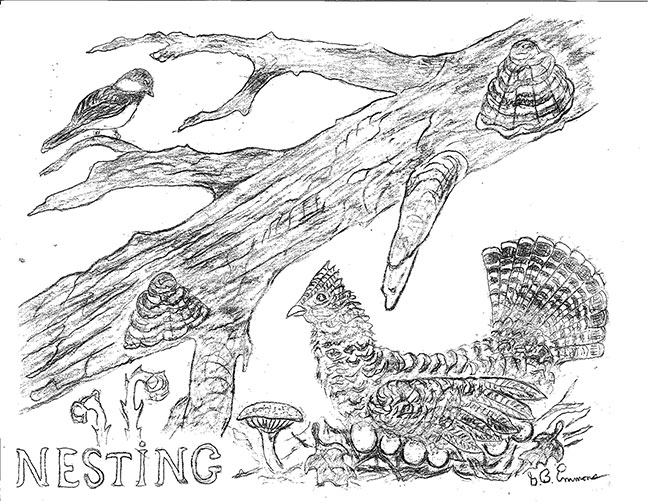
Partridge Plumage Matches Earth Below

The Ground Nesting Partridge in spring is hard to locate and identify because the color of its plumage is camouflaged with one of two earthly color phases.

            Here in New England, the Partridge feathers match the dark gray shadows of the surrounding conifer forest. Further south, the Partridge plumage has a rusty cast to match the brick-colored, red-earth shade of more colorful soil below the Mason Dixon line. Either one of the two Partridge camouflaged shades can readily be recognized in the feathers of a Ground Nesting Partridge.

            As in my illustration, the mother Partridge is sitting on a clutch of six eggs that she started incubating after they were all laid so that all would hatch out at about the same time. Then all would match the others and coincide with one of the two earthly colors. Both can be easily identified to match the nesting Partridge coloring that came about from the geographic origin of the Partridge ground nesting location at the time the eggs were laid and incubated.

            The mother Partridge, out of habit, builds a bowl-shaped nest of sticks so she can pluck loose vegetation into it because it probably contains high-level protein and rich vitamins to grow on and develop into bigger fledglings.

            They quickly learn to move about into groves of aspen, pine and birch, and later to develop an appetite for fruit buds, ferns and shrub berries and then later in the season nuts and acorns that have a high content of cellulose, which after digesting makes it later possible to survive harsh, winter-weather conditions.

            Even after forced to move about more than a half-mile for a plentiful, unexpected, different food supply that pops up, their location is observed by a nearby Partridge drumming male that has no secrecy by loudly making his observation known. When he may mount a hollow log as a convenient drum, he can thunder some 40 wingbeats against his chest that sounds like some person trying to start up a two-cycle engine with a sputtering burst of a loud static tattoo.

            The plump Partridge has a cocky crest on its head and a tail marked with a broad, dark band near the tip, which when displayed gives the displaying male a rich, black ruff around the neck, giving it the well-known other name of “Ruffed Grouse.“

            The thumping, rousing beating like a drum carries up to a quarter of a mile and announces its message like a barnyard rooster beating its chest like Chaucer’s Chanticleer literary bugle announcement of the coming dawn of a new day.

By George B. Emmons