Radon Presentation

Radon: Just because you cannot see it, smell it, does not mean that it is not there.

            Do you know that federal and state guidelines recommend testing your home for the presence of radon? Radon is an odorless, tasteless gas and it may be in your home, whether it is an old or new build, with or without a basement. Radon is found in houses built on ledge and houses built on the sands of Cape Cod. This radioactive gas seeps undetected into homes from the ground, and such indoor exposure over time at elevated levels poses significant health risks, including lung cancer.

            Please join us at the Mattapoisett Library on Wednesday, September 25, at 1 pm to learn more. A representative from Massachusetts Department of Public Health’s Radon Unit will share a PowerPoint presentation followed by a question-and-answer session, including discussion on how to detect, monitor, and if necessary, mitigate the presence of this radioactive gas in your home. All are welcome to attend.

Samuel Thomas Ogle

Samuel Thomas Ogle of Cambridge, and Mattapoisett died on September 9, 2024, at the age of 76 after a long illness. Born in Philadelphia, he graduated from Franklin College and Northeastern University School of Business. Sam’s long career in information technology spanned society’s shift to the digital age. He adapted to these changes with his easygoing and clever approach to problem solving and to life in general. His quiet demeanor and self-effacing humor masked an inner confidence and sense of adventure that endeared him to everyone he met. Sam loved sailing his Nonsuch sailboat on Buzzard’s Bay. He was a car guy and had recently restored the Alfa Romeo Spider Duetto he purchased right out of college. He volunteered clearing and maintaining trails for the Mattapoisett Land Trust.  Sam had a keen eye for real estate and a creative vision for the potential of living spaces. An inveterate collector, he loved antiquing and finding new uses for found objects. His deep concern for the environment and enjoyment of it came together while walking the woodland paths on his property on Mattapoisett Neck with his beloved standard poodles by his side.

            He is survived by his wife, Deborah Smiley; a brother Peter Ogle and his wife Susan; a niece Hope Turenne, her husband Robert and their daughters Caroline and Lauren. A celebration of his life will be held at a later date.

            Please consider a donation in Sam’s memory to the Mattapoisett Land Trust.

Variance Could Be Replaced by Permit

Rochester’s Planning Board meeting on Tuesday night approved the request by Snipatuit Solar LLC to extend for one year the special permits for its proposed solar-energy installation on 128 acres at 529, 523 and 0 Snipatuit Road and Featherbed Lane within the Mattapoisett River Valley Watershed and groundwater protection district.

            The vote came after project engineer Greg Sampson agreed to new terms that include the town being indemnified on the project owner’s liability insurance policy and increases in the bond amounts that the company must post.

            The five-year performance bond the company must pay has been increased to $21,000 and the decommissioning bond to $350,000. Sampson said a simple yes when Planning Board Chairman Arnold Johnson asked him if he was amendable to both increases.

            In other action, the board signed the draft letter to the Zoning Board of Appeals regarding a Use Variance petition for a plan to construct a multifamily unit on a lot barely more than one acre in size at 48 Pierce Street. At its previous meeting, the board had agreed to send notice to the ZBA that it opposes such a plan.

            The Planning Board also signed the Site Plan Review draft decision for the four-building, self-storage facility proposed for County Road that will include one multistory building.

            The board’s lengthiest discussion came when it reviewed the Zoning Bylaw Review Committee’s proposed bylaw changes for the January 6, 2025, Special Town Meeting warrant. One change would enact regulations for short-term rentals. A second would create regulations for accessory-dwelling units. A third would eliminate use variances.

            Review committee member Mark Wellington presented the Planning Board with the way the Cape Cod town of Truro regulates short-term rentals as an example for a possible Rochester bylaw. Truro considers a short-term rental if it is 120 days or fewer and requires an application fee; Truro’s is $450.

            The property’s well must be tested, and the property owner must present a Mass Tax Connect Certificate of Good Standing. In Truro’s case, the application can be completed online.

            As the Planning Board reviewed this example, its members added that well tests might be needed yearly for such properties, and septic-system capacity should be judged on the number of bedrooms.

            Zoning Bylaw Review Committee Chairman Richard Cutler said his committee’s plans for accessory-unit regulations are being complicated by new state regulations allowing such units in many cases by right.

            Regarding elimination of the “use variance” in favor relying on special permits for special requests instead, Cutler said most communities in the state have done away with them. “A use variance stays with the property,” Cutler said. “It confuses people applying for something. They go for use variance when a special permit will do.”

            Board members concluded that further review of the three changes should await discussion with Town Counsel. Johnson said that meeting is scheduled for September 24 and that boards are required to submit only placeholder articles, with language lacking specifics if necessary, for Town Meeting by October 31.

            The Rochester Planning Board’s next meeting is scheduled for Tuesday, September 24, at 7:00 pm at Town Hall, 1 Constitution Way.

Rochester Planning Board

By Michael J. DeCicco

Should You Be Tested for Alzheimer’s Disease?

 Several recent studies have promised a reliable test to detect Alzheimer’s disease in people with mild memory loss. What are these and should you request one?

            One test is a very expensive imaging test, a specialized PET scan that will almost certainly not be covered by your insurance and is probably still best used in the research phase.

            The other is a blood test – “phosphorylated tau” should you wish to Google it – that was reported to have over 90% accuracy in predicting Alzheimer’s in a group of elderly people (average age 74) who had either subjective memory loss, doctor-diagnosed mild cognitive impairment, or dementia.

            The blood test was better than both primary-care physicians and dementia specialists in diagnosing Alzheimer’s disease and will probably soon be clinically available.

            The real question, should the test be positive is: what next?

            The medicines available to treat Alzheimer’s are not miracles. Both the older oral medicines and the newer IV medicines slow down the progression of the disease but do not cure it.

            Considerable media attention and soaring stock prices have greeted the newer IV agents, but their results are only mildly better clinically than the old ones, and their potential side effects are worrisome, including bleeding in the brain.

            The British agency responsible for approving new drugs in the National Health Service just turned down Biogen’s drug, Leqembi, and its U.S. FDA approval has been controversial.

            There is hope, but it is yet unproven, that starting these drugs much earlier in the process might make them more effective. Hopefully clinical trials will be conducted to see if this is true.

            My strong feeling is that, for most people, the side effects of the newer drugs outweigh their proven benefits.

            Any medical test should only be done when knowing the results of the test is expected to have a beneficial effect on your health.

            So, putting the horse in front of the cart, if you are worried about memory loss, have a full discussion with a doctor you trust. Ask what would happen after a positive test before you are tested. Then you can make an informed decision.

            Edward Hoffer MD is Associate Professor of Medicine, part-time, at Harvard.

What Does The Doctor Say?

By Dr. Edward Hoffer

Mattapoisett Quakers Donation Drop-Off

The Mattapoisett Friends Meeting will soon be holding donation drop-off times in preparation for an October 5 yard sale. This year, earnings will go toward renovations of their community hall, including replacement of rotted fascia boards and the addition of gutters. All donations are much appreciated. Please drop off donations at 103 Marion Rd. (Route 6) on Saturday, September 21 or Wednesday, September 25 between 10:00 and 12:00. Another option is Sunday, September 29 from 11 to noon. Someone will be in the community hall (the building in the back) to receive you.

            If none of the above times works for you, please email mattquakers@gmail.com in case something can be arranged. The Friends are looking for clean items including small furniture, and clean, ready-to-wear clothing. They are not taking large furniture, large appliances, electronics, or books at this time.

Sea Turtles in Massachusetts Waters

The Marion Natural History Museum is hosting “Sea Turtles in Massachusetts Waters” on October 18 from 6:30 to 7:30 pm at the Marion Natural History Museum, 8 Spring Street, Marion.

            Join us when we welcome Massachusetts Audubon Sea Turtle Stranding Coordinator Karen Dourdeville. Let’s hear about the efforts Mass Audubon is working on to protect these incredible animals in our waters.

            Karen Dourdeville is actively involved in sea turtle research and conservation. She works as the sea turtle research coordinator at Mass Audubon’s Wellfleet Bay Wildlife Sanctuary, and her work includes rescuing stranded sea turtles, studying their behavior and addressing threats like boat strikes and habitat loss.

            Recently, she has been involved in documenting sea turtle nesting activities in Massachusetts, which is quite rare for the region. Her efforts are crucial in understanding and protecting these endangered species as they navigate the challenges posed by climate change and human activities. Program donations are $10.00 nonmembers, $8.00 for nonmembers.

Accessory Units Subject to State Law

Marion’s Affordable Housing Trust held its monthly meeting on Tuesday night.

            Chairperson Eileen Marum called the meeting to order and asked for comments on the minutes of the previous meeting. These were unanimously approved as written, and the group proceeded with the scheduled agenda items.

            The first of these was an update and in-depth discussion on the recently passed state law, the Affordable Homes Act, and how the town will integrate its requirements, particularly on Accessory Dwelling Units (ADU’s).

            Member Toby Ast reported that the new law supersedes town bylaws and regulations and highlighted some of the specific changes to expect, based on an assessment by outside counsel KP Law.

These included: Towns may not restrict the number of occupants, require that occupants of an ADU be relatives, or require more than one parking spot for an ADU; towns may put restrictions on short-term rentals or require site-plan reviews; and towns must require a cash bond from residents seeking to appeal a decision on an approval of their proposed plans.

            ADU’s will be considered “as of right” to build and not require special permits.

            The Marion Codification Committee has reviewed the report and made recommendations.

            There was a discussion on what the maximum size of an ADU should be. The state law does not specify, while the existing town limit is the lower of 1,200 square feet or 50% of the area of the existing home. The Codification Committee’s recommendation is 900 square feet, which AHT members consider to be too small.

            Next steps include meeting with the Codification Committee on Thursday, October 3, at 12:00 pm to review changes proposed by the Affordable Housing Trust. Once reviewed and approved, the town’s modifications will go to the Planning Board, then to Town Meeting for approval by residents and ultimately to the Attorney General for finalization.

            The meeting adjourned at 6:40 pm. Topics at the next meeting of the Affordable Housing Trust will include brainstorming on targeting CPC funds, updates on the 78 Wareham Street and Heren Cove projects and agenda items.       

The next meeting of the Marion Affordable Housing Trust is scheduled for Tuesday, October 8, at 6:00 pm at the Police Station, 550 Mill Street.

Marion Affordable Housing Trust

By Mary McCann-Fiske

Baseball, Bananas and Clean Energy

Have you heard about the Savanna Bananas? Of course, you have. They are the comedy baseball team that barnstorm from stadium to stadium, dressed in yellow uniforms, entertaining people who are willing to pay good money for a cheap laugh. Heck, you can stay home and watch the current Red Sox do that.

            Truth be told, these aficionados of “Banana Ball” (who follow the footsteps of the great Max Patkin – look him up) whose crazy antics occur while professing to play the national pastime, are funny. But this column is not about them.

            I just thought mentioning them would catch your attention. In writing parlance, that is called the “hook.” No, this essay is not about dancing infielders and gymnastic outfielders. It is about real bananas, the eating kind.

            I have a pretty good relationship with the yellow berry. (Yes, they are berries, like grapes, oranges and eggplants, but don’t ask me to explain, the science is way over my head.) Thirteen years ago, I had a serious operation after which a specialty nurse advised me to eat two bananas and two marshmallows every day. I should mention that I have always hated bananas, but I am inclined to do what I am told when lying prone in Intensive Care.

            The nurse was very smart. The banana diet helped to put my ailment into remission. The marshmallows not so much. Many pounds of body weight later, I found out she meant marshmallow root, an anti-inflammatory, not the sugary confection. I still eat bananas every day, but not marshmallows.

            You will be glad to know that a bunch of bananas is called a “hand,” and one banana is a “finger” (don’t go there), or that they are slightly radioactive? Bananas can float, which may be why you never hear of a banana boat sinking. Just sayin’.

            Over 100,000,000,000 bananas are eaten across the globe every year. You can use a banana peel to polish your leather shoes or rub one on your forehead to cure a headache. Gross! I’d recommend rubbing a marshmallow instead. I am proud to say my Portuguese ancestors introduced bananas from Africa to America in the 16th century. I don’t recall Grandma cooking up a batch of banana-and-kale soup.

            Sadly, bananas are on the verge of an “apocalypse,” so says Li-Jun Ma, a University of Massachusetts Amherst biology professor. The Cavendish bananas we eat today suffer from the same devastating fungus that wiped out the variety my mother forced me to eat in the 1950s. Overplanting has caused the wilt to re-emerge. Luckily, there are 1,000 different varieties of bananas.

            Thank goodness because someday soon you may be wearing banana clothing just like the Savanna Bananas. It’s true. Scientists in Pakistan predict that soon they will be able to turn banana waste into textiles and provide clean energy as a bonus. Why Pakistan? Because banana farms there produce over 80,000,000 tons of waste! And the peels can produce enough electricity to supply half of the country. That’s pretty a-peeling.

            Imagine if I had saved all of my 9,490 banana peels over those 13 years … never mind.

Thoughts on…

By Dick Morgado

From the Files of the Rochester Historical Society

I know that I have occasionally mentioned that the East Rochester Congregational Church and the Woodside cemetery are on the National Register of Historic Places. I’m not sure that I get much of a response to that statement. I know that both the woodpeckers and the flying squirrels who put holes in the siding are not impressed. To many it may seem like no big deal, so I decided to delve into what it took to get that designation from the United States Department of the Interior, National Park Service. See, I told you it was a big deal.

            The work that goes into receiving this honor is massive. Betty Beaulieu, a stalwart of the Historical Society for many years, along with Timothy Orwig, National Register Editor, submitted the application in 2007 and it was subsequently approved. Going through the paperwork and research in the application made me even more impressed with Betty’s dedication to this project.

            Among the items needed were photographs and detailed descriptions, including measurements and dimensions of both the inside and outside of the church building. This included notations on changes made to the original structure. The descriptions were of the attic, bells, basement, the main floor and even the privy (outhouse).

            Both topographical and assessor’s maps were required, as well as a sketch map. Included in this were measurements and boundary descriptions of the church, privy and cemetery. These physical aspects may have been the easier tasks compared to the in- depth historical research required.

            The first pages are a summary of the church and cemetery district with the cemetery preceding the church. The next 7 pages are devoted to the first criterion, Religion. This entailed research into the origin of the cemetery, its place in the community, early religious groups and how some of Rochester’s early religious institutions came to be.

            The next criterion was Community Planning and Development in which the cemetery played a large part. The last criterion was Architecture which covered information on its Greek Revival style. Then there was research into the builders of the church, the bells in the steeple and the foundry that cast them.

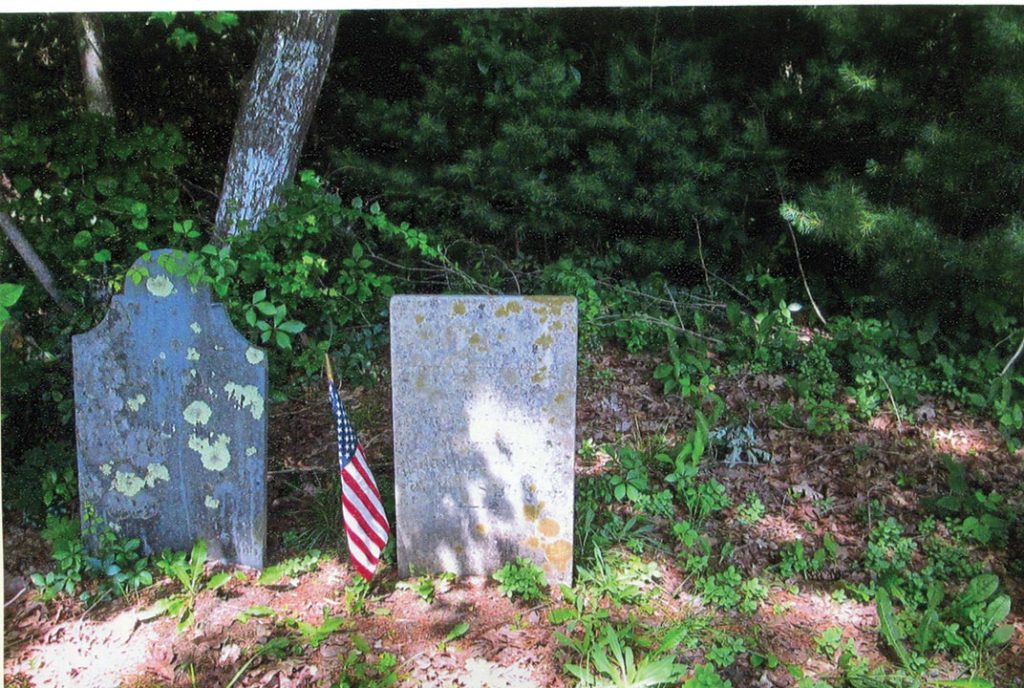
            The history of the church and its many congregations is a compelling story from the early Methodist Circuit preachers to the Congregational Church of the eighteen and nineteen hundreds and its importance to the neighboring community. The picture with this article is of the first grave in the cemetery. Betty’s research determined that this is the grave of a soldier who participated in the Revolutionary War. A fact that was not on  any list of veterans’ graves.

            There is a quotation near the end of these documents relating to the last days of the East Rochester church that sums up its importance to the community over the years. The remark concerns the church’s bells and was made by Elizabeth Bessey. She remembered that the bells, “never pealed truer then when they signaled the end of WW II and everyone went running up to the church”.

            As the account says, “that was the nature of it: a church people ran or walked to”. In 2003, the Rochester Historical Society was proud to preserve the building as a museum that saves and shares the history of Rochester.

            It’s too bad that no monetary assistance comes with being put on the National Register, but the Society perseveres with the help of its members and the generosity of businesses. Now we just need a sympathetic church painter and a lot of money.

By Connie Eshbach

MYC Racing Results

Wednesday night MYC held its classic interclub race with 13 boats from all classes participating. No Quarter Given led the fleet at the start and never looked back, taking first place line honors and first place by handicap time. Second place was a battle. Restless, which placed second overall lost to Odyssey by 4/10s of a second in the handicap finish. (The math was checked more than twice for sure).

            The night was capped off with a fabulous pizza party under the MYC tent.

            MYC Overall Series Winners. The tally is done for this summers racing with PHRF Class B providing most of the excitement. There was a three-way tie for overall champion with Fir Na Tine, skippered by Commodore Rich Gleason, winning the tie breaker.

            Steve Capone’s Kinsail came in second in the tie breaker with Charlie Smith’s Chickadee third. Fourth place Beck skippered by Fred Baker was only 3 points behind the group.

            No Quarter Given skippered by Mark Thornhill took first place overall honors in Class A with Rob Ryan’s Restless second, Don Ross’s Coconuts third and Jeff Lee’s Billy Bud finishing fourth.

            Overall winner in the Ensign Class this season was Odyssey, skipper by Rick Warren. Second place was Black Ice, skippered by Phil Warren, third was Steve Clark’s Brou Ha Ha, fourth place went to Brass Monkey, skippered by Andy Wehner fifth place was Dennis McLaughlin inHamburgler and sixth place was Tim Moll in Uncle Fester.

            Last race of the season is the MYC Fall Round the Bay Race on September 14. PHRF boats from all over Buzzards Bay come to race in this classic. This is one of the last races in the Buzzards Bay Trophy Series and highly attended.

            Entry details are on the MYC website under Racing/ FRTB.