Town to Seek County Road Reclassification

The Rochester Board of Selectmen on January 11 voted to authorize Town Administrator Michael McCue to further work with town officials of Marion and Wareham towards a reclassification of County Road to a federal “urban connector” to be eligible for federal funding for repairs and upgrades.

McCue said he met with representatives of the Southeastern Regional Planning and Economic Development District (SRPEDD) as well as Marion and Wareham selectmen on January 6. The results of SRPEDD’s traffic study of County Road, he said, showed a traffic flow high enough to warrant a possible reclassification of the road.

Although the idea is to have the road classified as an urban connector, McCue said the federal government is not seeking to add further roads under its oversight without potentially taking out other roads.

SRPEDD suggested several roads in the three towns, McCue said, to downgrade from urban connectors to urban local roads. Only one in Rochester would fall under that possibility – a less than 1-mile stretch of road on Walnut Plain Road between Mary’s Pond Road and Marion Road (Route 105) that is currently classified as an urban connector. Selectmen found this classification peculiar, if not plain weird.

“Urban connector … for deer,” Board of Selectmen Chairman Richard Nunes commented.

Furthermore, the town had never seen any reimbursement for it, as far as McCue was concerned.

Too bad we already paved it, was Selectman Brad Morse’s comment.

Selectman Naida Parker made the motion to allow McCue to continue to investigate the matter, and the selectmen voted unanimously.

In other matters, McCue said the town is actively exploring avenues for a possible acquisition of the old ‘airport’ property on Marion Road.

McCue said he is in contact with Conservation Agent Laurell Farinon seeking viable ways to acquire the land, although no concrete action has yet been taken.

Also during the meeting, the board nominated and appointed Parker as the Board of Selectmen representative to personnel matters, including personnel reviews and position adjustments relative to the Personnel Board.

McCue also asked selectmen for permission to look into the grant opportunity of several surrounding towns, including Marion, to study the feasibility of a regional wastewater treatment system. McCue said adding sewer service to parts of Cranberry Highway where development is encouraged would further benefit business, and thus the town.

“I just think it makes sense to just look at it,” said McCue.

Selectmen also commented on Marion Selectman Jonathan Henry’s recent decision to not seek reelection in 2016.

“I found him to really be really well grounded,” said McCue. “I was actually very surprised when I heard that.”

“He’s always been a good, sane voice,” said Parker.

The next meeting of the Rochester Board of Selectmen is scheduled for January 25 at 6:30 pm at the Rochester Town Hall.

By Jean Perry

ROsel_011416

Nasketucket Bird Club

The Nasketucket Bird Club will be hosting a program about “Shorebird Migration and Conservation.” Brad Winn will talk about how the rapidly evolving tracking technology is helping us understand the habitat needs of individual long-distance migrant shorebirds. The conservation community is gaining new insight into hemispheric sites of importance and uncovering regional threats for shorebirds, leading to the geographic prioritization of conservation activity. Brad, a life-long naturalist, is currently Director of Shorebird Habitat Management at the Manomet Center for Conservation Sciences.

The event will be held at 7:00 pm on Thursday, January 28 at the Mattapoisett Public Library, 7 Barstow Street. The meeting is free and open to the public. For more information, contact Carolyn Longworth at bvm1290@comcast.net or visit the club website at http://massbird.org/Nasketucket/.

Musical Behind the Scenes

Each winter, Tabor Academy puts on its largest annual production: a musical.

Dancers, singers, actors, and students who are looking to try something new all gather to put together an amazing production. Currently, the cast is in rehearsals working all winter long to learn and perfect the songs, dances, and lines.

This year’s musical is entitled Thoroughly Modern Millie and is set in the 1920s. Millie Dillmount, played by Aurelia Reynolds, comes to New York City from Kansas to escape small town life and find a rich businessman to marry.

The effects of the 1920s on women – for example, allowing them to break social norms through their dress (the famous flapper style is a prime example) and lifestyle (engaging in previously forbidden behaviors such as smoking and drinking in public and demanding more freedom in careers and choices) – are also heavily explored in this play, through Millie as well as other women.

Another interesting aspect of the musical is its focus on ethnic stereotypes.

Mrs. Meers, under the guise of a Chinese Madame, runs a boarding house for girls who are new to the city. She has an underlying motive, however, to sell these women into slavery. She acts as a villain in Thoroughly Modern Millie, and nearly succeeds in selling Dorothy, another main character who befriends Millie, into slavery.

John Heavey is the director of Thoroughly Modern Millie.

“Rehearsals are going great!” said Heavey.

One big challenge with this show is that there are two huge tap dance numbers, a feat previously not attempted by any Tabor musical.

“The cast has been working really hard,” said Heavey. “Danielle LaTullippe, our choreographer, has tackled the challenge of tap nicely, and the cast has already memorized the big company numbers.”

The main characters, too, are “perfect for their roles,” Heavey said. “They’re doing a great job bringing their respective characters life.”

While this musical differs greatly from Hairspray, last year’s show, the core returning cast has been able to adjust and tackle all of the new challenges.

A lot of work goes into creating a musical production, beyond just memorizing lines and songs. The technical crew is working to build the sets, utilizing many pieces and techniques to put it together. The lighting designers, too, must constantly work to adjust spotlights and decide and implement lighting for each scene. The costume crew must create authentic-looking 1920s costumes, and the stage managers work with Heavey to help direct the actors and keep the show running smoothly.

“They’re all awesome,” said Heavey. “Millie would be impossible without them.”

The production of Thoroughly Modern Millie will undoubtedly be impressive and entertaining, but it’s easy to overlook the astounding amount of work that goes into every rehearsal and all the different people involved in bringing it to fruition. From directors to lighting and set designers to the actors, costumers, and choreographers, many different talented people have to come together to make this production work.

The show opens on February 18 at 7:30 pm at the Fireman Performing Arts Center on Front Street and runs again on February 19 and 20.

By Madeleine Gregory


Tiny Athletes Participate at Tabor Program

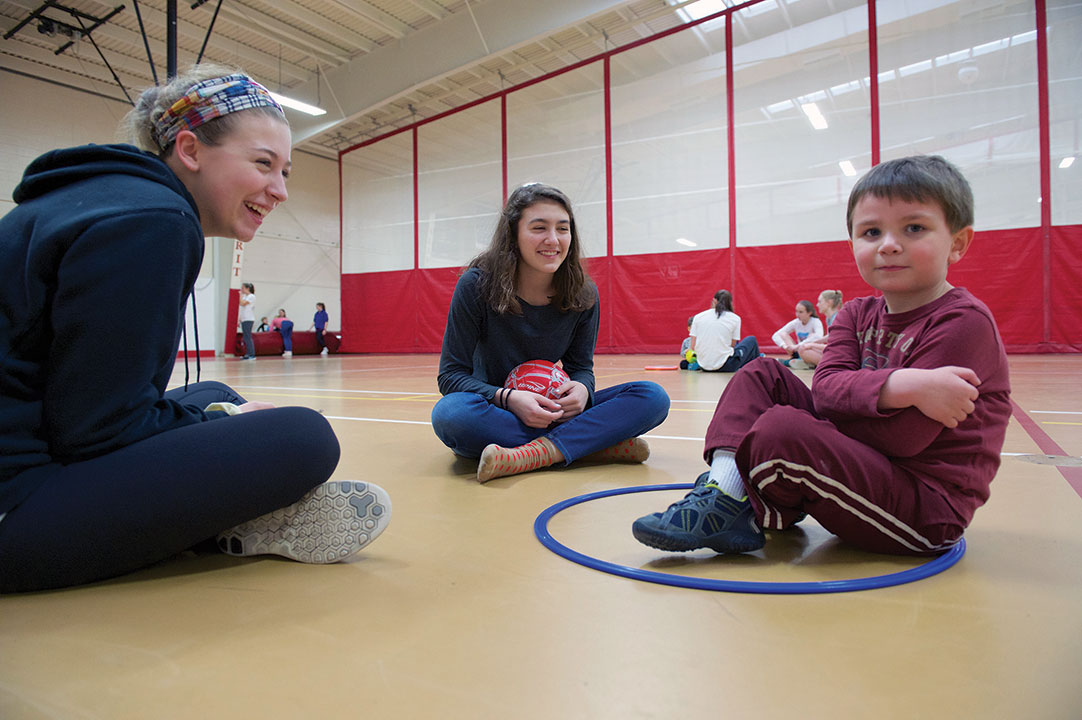
About a dozen tiny athletes joined Tabor Academy student volunteers on January 10 for the opening day of the Young Athletes program, part of the Special Olympics.

Tabor educator, Tim Cleary, along with Tabor senior, Molly Bent, believed they could bring this rewarding and important program to the community through Tabor. Cleary contacted Meg Hoffman, area director of community development for the Special Olympics. She agreed that the program would benefit the area.

“At another school where I worked, I had a program like this and Molly has lots of experience with Special Olympics,” said Cleary. Bent’s sister is a Special Olympian. The two veterans joined forces and pulled the program together.

Leading up to the opening day, Cleary said that four small-scale ‘soft’ events were held. These events were geared to give the tiny participants a chance to try things out and for the Tabor group to work out the kinks.

On opening day, the pre-school tikes cavorted around the gymnasium tossing balls, spinning in circles, pretending to fly, rolling a hoop, and tossing a giant parachute while the student leaders found ways to help the kids focus on the activities in a safe and fun-filled manner.

Parent Joanne DaSilva of Seekonk brought her 3-year-old daughter Skylar. DaSilva said Skylar had never participated in a program like this before. A small section of bleacher seats were positioned behind a large screen, allowing the parents to observe their toddlers without the child realizing they were being watched. DaSilva said this helped the children stay engaged rather than being fixated on their parents.

Mom Leigh LeFaivre, Taunton, and her 4-year-old Tommy were also first-timers. She said that every day since he participated in the soft opening four weeks prior, Tommy inquired, “Are we going to the gym today?” She said Tommy would likely never be able to participate in organized sports such as T-ball and soccer like his older brother due to autism, but this precious hour was making a big impact on his life.

“It’s nice for the parents too,” LeFaivre said. “I’ve made friends coming here.”

Cleary said that when the school announced the program to the 500 strong student body, an amazing 120 students signed up for duty.

“They are looking to have some fun and give back to the community,” Cleary explained.

And it did seem that the students were having just as much fun as their small charges, even though managing a dozen pre-school children is like trying to carry water in your bare hands – it’s a challenge. In that regard, these children were just typical little ones playing games.

Nadia Glaser, Seekonk, said her 4-year-old Gavin “loves it,” adding with pride, “Here, he doesn’t need me to help.”

As the Tabor students played at tasks that helped the children build gross motor skills, Cleary concluded, “This is a good marriage between the needs of the children and an opportunity for the Tabor students to help.”

For more information, contact YoungAthletes@gmail.com or call 508-369-8026.

By Marilou Newell

TaborSpecOly_7713 TaborSpecOly_7717 TaborSpecOly_7732 TaborSpecOly_7743 TaborSpecOly_7761 TaborSpecOly_7764 TaborSpecOly_7793 TaborSpecOly_7812

Mattapoisett COA Happenings

Everyone is welcome to participate in activities and services at the Mattapoisett Council on Aging, 17 Barstow Street. Most activities are “drop in.” For any questions and/or to register for trips and special events, call 508-758-4110.

Mondays: 8:45 am Tai Chi (free); 10:00 am Qi Gong meditative healing (free); 10:00 am Knitting; 12:00 pm Strength & Balance (free); 1:00 pm Scrabble.

Tuesdays: 8:45 am Sport Yoga ($3); 10:00 am Legal Consulting (2nd Tuesday of month, free 15 min, by appt); 11:00 am Walking Group; 12:00 pm Movie & Pizza (last Tuesday of month); 12:30 pm Art History (once every other month, $3); 1:00 pm Water Color Painting (free).

Wednesdays: 9:30 am Cardio Fit (free); 10:00 am Men’s Group (2nd Wednesday of month at Public Library); 10:45 am Meditation; 11:00 am Book Club (3rd Wednesday of month); 12:00 pm Strength & Balance (free); 1:00 pm Bingo; 1:15 pm Mah Jongg.

Thursdays: Various Trips (call for details); 11:00 am Computer Tutor (free, by appt); 1:00 pm Country Line Dancing.

Fridays: 8:45 am Sport Yoga ($3); 10:00 am Rx Qi Gong ($6.50); 11:15 am Chair Yoga ($3); 1:00 pm Line Dancing (donation); Foot Care (once a month by appt).

Upcoming Specials (registration required): Jan. 12, Art History – Winslow Homer’s America; Trips: Feb. 4 Mile Post Tavern, Duxbury; Feb. 11 RI Antique Mall followed by Fountain Grille Restaurant; Feb. 16 Lunch & Speaker, “Dining the Healthy Way” with Nutritionist, Stephanie Boulay (learn better options when eating out); Feb. 25 RISD Art Museum with lunch at Kartabar Restaurant.

Tabor a Place of Art, Talent

It’s pretty easy to recognize and appreciate the talented athletes and scholars at Tabor Academy. Students often watch games in the athletic center or out on the fields, and having classes together demonstrates academic abilities. What is not always as obvious, however, is the incredible artistic talent that also resides at Tabor.

Not everyone has a regular chance to see the work of some of the talented artists on campus showcased in the art center. There are, at Tabor, countless talented artists with skills ranging from dance, drawing, photography, and ceramics.

Some of these artists even plan to pursue their passions and talents in college, and both seniors Nicole McLaughlin and Jennifer Joung are planning on attending art schools next year.

McLaughlin had never even tried ceramics before she came to Tabor, but now she has received a scholarship to attend the Maine College of Art for ceramics. She attributes her success and accomplishments to Tabor’s program and her instructors, Kevin Arnfield and Bob Mogilnicki.

The best part of the program, she says, is how supportive each student is towards each other.

“We’re always helping each other better our techniques,” said McLaughlin. “We all want to see each other succeed.”

Mr. Mogilnicki and Mr. Arnfield are, as well, invaluable resources.

“They continually spark my interest in art,” McLaughlin said. “Mr. Arnfield has really pushed me as an artist by forcing me to break down my work and find what works.”

Looking forward, McLaughlin plans to do a senior project in ceramics, studying five different cultures and their traditions to find the “correlation between ceramics and society and culture.”

She plans to create pieces in the traditional styles, and then fire and glaze in the traditional ways of each culture, making each piece as authentic as possible. The end result will be a piece or a collection of pieces from each culture.

“The ceramics program has prepared me so well for this project and for college next year,” she said. “It has helped me find who I am as an artist well before I journey into my career as an artist.”

Joung, attending Rhode Island School of Design, has been in Studio Art since freshman year with Trisha Smith.

“I didn’t just limit myself to painting and drawing though,” Joung said. “I would use clay from the ceramics studio, wire, any materials we had.”

Joung’s teachers always challenged her to reconsider her perception of art, she said.

“Before Tabor, I always used acrylics, but Ms. Smith has pushed me to try charcoal, graphite pencil, gouache, etc.,” Joung said. “Thanks to her, I could put together my portfolio of mixed media and fine art for college.”

Another Tabor teacher who had an impact on her art career was Chris Botello, the InDesign and Photoshop professor. Through working with him, she said, “I developed an interest in graphic design and the process of thinking about how to communicate visually.”

Joung expressed how much she loves figuring out “how to incorporate the white space in the background to demonstrate a particular scene.”

For her senior project, she’s combining her skills for Photoshop, drawing, and InDesign to design and create a magazine.

Walking through the Braitmayer Art Center, you can see many of Nicole’s and Jennifer’s pieces. As they head into their college art programs, they will build on their skill sets learned throughout years of classes and hours of time spent in the studio to continue to create and excel in their fields.

By Madeleine Gregory

TABOR_Origami Roses

Farmers Governed by Plumbing Code – Huh?

Somewhere back in the forgotten history of codes and regulations is a decision that placed agricultural operations under the governance of the Uniform State Plumbing Code. As odd as that may sound, that is the case and it was discussed on January 5 at the meeting of the Mattapoisett Agricultural Commission.

Some farmers have felt that those regulations were too inflexible for agricultural activities and needed some updating to embrace current best practices.

The Agricultural Commission discussed sending a letter in support of a house bill that would begin the process of reviewing statues that affect farming businesses and give a bit more weight to the needs of those operations.

House Bill 236 sponsored by Representative Leonard Mirra, Second Essex District, reads in part, “… the board of examiners of plumbers and gas fitters is authorized to amend the Uniform State Plumbing Code, to include a category of agricultural buildings and operations, separate from regulations governing residential and commercial buildings…” This seemingly small modification could have a profound impact on farmers in the future.

Commission member Mike King said, “You can’t use PVC pipes [in some farming functions].” King said, for some functions, only copper piping is allowed, which puts an undue financial burden on the farmer. With this house bill, that type of regulation might be modified, he suggested.

In other business, the commission has produced car decals that they plan to sell for $5 each. The decal is a replica of the new ‘Right to Farm’ signs. The proceeds from the decals will help offset printing costs for an updated brochure the commission has been working on for several months. The brochure describes the town’s commitment to agriculture, support of farmers, and contact information.

And speaking of the new ‘Right to Farm’ signs designed by resident Lori Nunes, the Massachusetts Municipal Association newsletter, The Beacon, has acknowledged the beauty of the signs along with the community’s support for agricultural businesses. Commission member Melody Pacheco said another newspaper featured a piece on the signs and the town’s farming culture for an upcoming issue.

The next meeting of the Mattapoisett Agriculture Commission is scheduled for February 2 at 6:00 pm in the Mattapoisett Town Hall.

By Marilou Newell

MTag_010716

John Edward McCauley, Jr.

John Edward McCauley, Jr. of Marion died unexpectedly on January 10, 2016 following a lengthy illness. He was 69.

He was born on June 9, 1946 in Bronx, New York, son of the late John E. and Helen T. (Fitzgerald) McCauley, where he was a proud graduate of Saint Helena’s High School. John earned his accounting degree from Manhattan College. While working fulltime John attended college in the evenings, earning his MBA from Saint John’s University in Queens and his Juris Doctor from Pace University in White Plains. Prior to his retirement, John was a corporate attorney specializing in taxation.

Devoted father of Kerry A. Reynolds and her husband, Jason E. of Marion, Kathleen Meegan McCauley and her husband, Donald J. Padgett of Middleboro. Adored grandfather of Meredith Welsh and her husband, David, Meghan and Kiernan Reynolds, Shannon, Morgan, Sullivan Padgett and the late John Reynolds. Loving brother of Patricia Curtin, Barbara Schum, Maureen Molloy, Marilyn McCauley-Quinn and the late Thomas McCauley. Also survived by many cherished nieces, nephews and his former wife, Virginia F. (Grasso) McCauley.

Funeral from the O’Neill Funeral Home, 59 Peirce Street (corner of School Street) Middleboro, Saturday (January 16, 2016) at 9 AM. A Mass of Christian Burial will be celebrated in Sacred Heart Church at 10 AM. Visiting hours Thursday evening, 7-9 and Friday, 2-4 & 7-9 PM. A reception following the Funeral Mass will be held at The Marion Music Hall 164 Front St, Marion, MA 02738

Memorial contributions may be made to: The Riverview School, Advancement Office, 551 Route 6A, East Sandwich, MA 02537 or The UMASS Organ Transplant Program (w3.umassmed.edu/onlinedonation/) or The Memorial Sloan Kettering Cancer Center (giving.mskcc.org).

Selectmen Say ‘Hi’ to New Personnel Board

Three new people have been appointed to the Rochester Personnel Board since the resignation of that board’s three members just after the 2015 Annual Town Meeting, when voters rejected an article crafted by the board that would have altered the Town’s Employee Compensation Plan.

On January 4, the Rochester Board of Selectmen met with two of the new members to discuss the Personnel Board’s main task – coming up with a way to save the town money by changing the conditions of the employee step increase policy.

“We just wanted to say ‘hi,’” Board of Selectmen Chairman Richard Nunes told Alan Boling and Christopher Peck. Third member Jean Armstrong was not present.

Town Administrator Michael McCue talked of an upcoming yet-to-be-scheduled first meeting of the newly reconstituted board, which will also include Highway Department employee Harrison Harding as a non-voting employee representative.

“I already have my suggestions, my thoughts, on how things should be rewritten,” said McCue. Other duties of the board, he said, would be hearing grievances and acting as an arbitrator, collecting and reviewing employee evaluations, and deciding on the annual three-percent wage step increase for non-union employees covered under the Employee Compensation Plan.

The plan currently allows certain employees to advance a step each year based on merit, but not beyond step number 10, the maximum, which Nunes said most often takes employees only 10 years to reach.

The comp plan, said Selectman Naida Parker, was established with the intent of making employee pay competitive with other surrounding towns, because, at one time, Rochester’s compensation was significantly lower.

“That has changed, so now, not only are we competitive,” said Parker, but in many cases, she continued, Rochester’s compensation is higher. Now, she said, the suggestion is to eventually eliminate the compensation plan and simply hire all employees at a competitive rate, relying on annual cost of living pay increases instead of the steps.

Nunes recapitulated the board’s consensus that an employee compensation plan step policy should be slowed to an extent so that employees would not max-out in just 10 years. He said, on the federal level, an employee comp plan might be slowed down, for example, to every two years upon reaching step five, and then, upon reaching step seven, the remaining steps would be attainable every three years.

“So instead of maxing-out in ten years … you max-out in eighteen,” Nunes said.

Other towns’ employees of this category, pointed out Selectman Brad Morse, are unionized. “We want to avoid that if we can,” said Morse. Boling concurred.

“That’s a good thing to avoid if you can,” said Boling. “If you can keep it non-unionized, that’s better for everyone.”

The Personnel Board will meet for the first time within the next two weeks.

In other matters, McCue wants residents to know that the 2016 trash and recycling schedule has been posted to the website in several easy-to-find locations, in light of several inquiries as to when the schedule would be mailed to residents.

The board briefly discussed codifying the Town’s bylaws in anticipation of an article in an upcoming special town meeting requesting up to $10,000 to pay for the service. McCue said the Town probably would not need the entire amount, but a little contingency money is a good thing.

McCue asked selectmen to think about some questions they might want to ask residents in a pop-up survey he hopes to add to the website – questions other than the ones pertaining to the town hall annex he plans to ask. Selectmen will discuss the matter at a later date.

The next meeting of the Rochester Board of Selectmen is scheduled for January 11 at 6:30 pm at the Rochester Town Hall.

By Jean Perry

ROsel_010716

Margaret Chubbuck Duff

If you listen carefully you will hear the sounds of celebration from Fiddlers’ Green – the sound of Margaret Chubbuck Duff joining her late husband Peter, who predeceased her in 2008. Maggie left this world for her next great adventure on Boxing Day 2015. Following two strokes in 2008, Maggie (and consequently her family and friends) were afforded a seven year reprise until a third stroke ushered her onward.

Maggie was born in 1934 and grew up in Rockland and South Weymouth, spending her summers in Wellfleet. She was a 1956 graduate of Tufts University where she and Peter met and where she majored in Art History and minored in Fine Art at the Museum School. Following her graduation, Maggie applied her discerning eye and organizational diligence working for author Richard ‘Diggory’ Venn, and for then-gallerist and architect Nat Saltonstall. After Peter’s graduation from Tufts and the arrival of their children, Maggie focused her efforts on managing the Duff household and supporting Peter in the establishment of his boatbuilding business, Edey & Duff in Mattapoisett. When her brood fledged, she continued her earlier education, earning a degree in Graphic Design from the Swain School of Design, and applied the skills she developed there with positions at GHR Engineering and the Zeiterion Theater, both in New Bedford, and Abacus Architects in Wareham.

Maggie’s personal pursuits included fiber arts, teaching weaving for a number of years, and being quite skilled at sewing and knitting; she was a trail-blazer in nutrition, preparing, serving and enjoying what was to become the paleo diet years before it was popular; traveling with Peter and their children, either delivering boats Peter had built or sailing in far-away waters; and the warm company of family and friends.

Underlying all of this, and perhaps Maggie’s crowning achievement is the grace and fortitude with which she helped Peter navigate 40 years of Parkinson’s disease as an interloper in their marriage.

Maggie is survived by sisters Mary Louise ‘Mou’ Garrett and husband Kenneth, and Martha Rosewell; son Ian Duff and wife Kathryn; daughter Jane Gleason and husband Bob; and five grandchildren, Storey, Ansel and Haines Duff, and Gordon and Henry Gleason. There will be a memorial service in the spring or early summer, when the Coreopsis is in bloom. In lieu of flowers or other thoughtful remembrances, please feel free to make a donation in Maggie’s name to the American Stroke Association, 7272 Greenville Avenue, Dallas, TX 75231, www.strokeassociation.org, 1 (888) 478-7653. Arrangements were by the Saunders-Dwyer Mattapoisett Home for Funerals, 50 County Rd., Route 6, Mattapoisett.  For online condolence book, please visit www.saundersdwyer.com.