Marion Awarded $93K Grant

A study proposed by the Town of Marion to assess the vulnerability of its wastewater infrastructure was one of nineteen projects to have been awarded a Coastal Resilience Grant from the Office of Coastal Zone Management (CZM). The Town received $93,660 to assess the risks from coastal flooding and storm surge to its pumping stations, and to identify what improvements are needed to reduce their vulnerability.

The Coastal Resilience Grant Program supports local efforts to increase awareness and understanding of climate impacts, and to plan for changing conditions related to coastal storms, flooding, and erosion. All eight of Marion’s pumping stations are located in a flood zone, and two are in the zone designated as most vulnerable. Analyses funded by this grant will compare the existing flood-level with future flood-level projections at each pump station to identify necessary upgrades to address storm surge and a heightened flood risk. Recommended upgrades may include elevating the pump station, raising its electrical components, waterproofing the structure, and modifying piping networks.

According to the Executive Office of Energy and Environmental Affairs’ Statewide and Major Basin Climate Projections, sea levels will likely rise between two and four feet by the year 2100. Over the same period, experts say there is a higher chance for extreme weather, including heavy precipitation events (which are already occurring 70% more often since the 1950s), and total winter precipitation could increase by as much as 34 percent.

The proposed study is part of the Climate Resiliency element in the 2017 Marion Master Plan. Addressing the vulnerability of the Town’s wastewater infrastructure was also identified as a high priority in the state’s Municipal Vulnerability Preparedness program (MVP) assessment for Marion. Participants at the MVP workshops in May 2018 identified key hazards, vulnerabilities, and actions that the Town of Marion should take to reduce risks and build resilience.

For further information, please contact the Town Planner, Gil Hilario at 508-748-3513 or email, ghilario@marionma.gov.

King Philip: Son of Massasoit

King Philip was the second oldest son of the Wampanoag Sachem Massasoit who welcomed the pilgrims to Plymouth and helped them survive. The earthly relationship bore fruition the following fall by a feast of mutual friendship called Thanksgiving to which Massasoit brought 90 others from his Pokanoket village near today’s Bristol, Rhode Island.

In 1656, Massasoit had the Indian names of both his sons changed by the royal court at Plymouth to more prestigious English titles; the older boy, Wamsutta, became Alexander, and Metacomet became Philip.

When Massasoit died in 1661, Alexander became Sachem (leader), but died soon after from suspicious food poisoning while in English custody waiting to be questioned about rumors of an impending Indian uprising. When Philip became king, colonial population had grown to more than 40,000, creating a crowded conflict over land purchases. Philip said he did not want to start a war, and my illustration shows him with a peace pipe in one hand and his war club in the other, drawn from the actual weapon in a museum in Concord.

In June of 1675, the inevitable war started near the Pokanoket village, a location now known as the Town of Swansea, which was burned to the ground. Hostilities spread like wildfire all along the south shore settlements, destroying homes in today’s townships of Dartmouth, Fairhaven, Mattapoisett, Marion, Wareham, and Middletown.

Settler Hugh Cole had purchased most of the land in Mattapoisett from Philip, and Cole’s two sons were among the first to be captured; however, Philip released them, instructing them to tell their father to leave the area before his house was burned. In Fairhaven, John Cooke, who had come across the pond on the Mayflower, had built a fortified garrison at the head of Sconticut Neck for protection, but that also was burned. In what is now Wareham, blacksmith Uriah Leonard had supplied iron works and repaired guns for Philip, and when Indians came to burn his house, he was allowed to escape with his life.

All these settlements were joined by roads of old Indian trails, and natives were skilled at ambushes of frontier skirmishes that eventually expanded to 1,200 homes in 50 settlements all over New England. Indians intended to drive the English back into the sea. Fortunately for the early settlers – and ultimately us – some friendly Indian tribes like the Mohegans joined the English cause of survival.

Philip eventually fled to the Mohawks in New York for help, but they were already friends of the British. They attacked and killed almost all of Philip’s warriors, leaving him to limp back here, only to be shot by another Indian. Philip’s wife, seven-year-old son, as well as Philip’s sister, Amie, were all sold into West Indies slavery, a fate for many Indian survivors, with the proceeds helping to pay for the war. Soldiers that had fought in the war were granted parcels of Indian land to reward their service.

Although peace then came to residents of the south shore, the conflict continued into Maine and New Hampshire. This classic clash between old world and new world cultures actually began in the seventeenth century against Montezuma in Central America by Spanish conquistadores. And then it was followed by the invasion of New York by the Dutch and then English colonists, and finally the more conducive French missionaries. Casualties of both sides continued in battles more like massacres to darken American history, like Tippecanoe, the Cherokee trail of tears, Custer’s last stand at the Little Big Horn, and the Sioux Wounded Knee massacre.

With this trail of perspective by historians, Philip has come to be reconsidered as a patriot attached to his native soil, and compared to military leaders such as Macedon, Napoleon, and Washington. His redemption today may be our environmental awareness that mirrors his Native American belief of land value. And when we bow our heads for a bountiful Earthly harvest at the next Thanksgiving, let us do so in remembrance of his father, Massasoit, as well.

By George B. Emmons

Sippican Historical Society

In 1998, the Sippican Historical Society commissioned an architectural survey of Marion’s historic homes and buildings. The survey was funded one-half by the Sippican Historical Society and one-half by the Massachusetts Historical Commission. Due to the limits of funding, not all of the historic buildings were surveyed, but over 100 were catalogued and photographed. The results of the survey are in digital form on the Massachusetts Historical Commission’s website and in four binders in the Sippican Historical Society’s office (and at the Marion Town Clerk’s office).

Marion (Old Rochester) is one of the oldest towns in the United States, and the Sippican Historical Society maintains an extensive collection of documentation on its historic buildings. The Sippican Historical Society will preview one building a week so that the residents of Marion can understand more about its unique historical architecture.

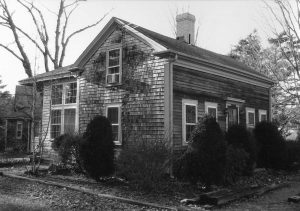
This installment features 368 Front Street. The home at 368 Front Street may represent the only surviving building from the 18th- and early 19th-century cluster of residences called “Parlowtown.” Parlowtown Road was originally a Native American trail that ran northwest to Rochester. It fell into disuse in the mid-19th century, when the rugged, swampy nature of the terrain made its maintenance difficult. This Federal-style cottage was built c. 1800 by the Parlow family.

Japanese Floral Design

On Thursday, August 23at 11:00 am, join Ellen Flynn as she demonstrates the 500 year-old ancient art of Japanese floral design in the Ikenobo Ikebana, Shoka style. Watch as Ms. Flynn’s creativity evolves into unique floral arrangements made in a low vase or bowl.

Ms. Flynn took her first Ikebana class at Vassar College, where she worked in the library’s acquisitions department. Since then, she was invited to become a lifelong member of the Japanese society and has been certified in the first two of Ikebana’s four levels.

Free demonstration at Mattapoisett COA, 17 Barstow Street. RSVP by August 22 to 508-758-4110 or coadirector@mattapoisett.net.

Conservation Office Fears Abutter Fallout

Common, average, ordinary, routine, standard, cut-and-dried – all synonyms for “normal,” which was what Mattapoisett Conservation Commission Chairman Mike King pondered as he considered allowing the 30 Holly Woods project to add another access road post-approval, an access road not noted on the plan of record.

William Frederickson of 30 Holly Woods Road returned to the commission on August 13 asking if he could construct an access road wide enough for forestry equipment to enter a section of forest slated for timbering to convert into an agricultural field for cow farming.

King immediately voiced his opinion that Frederickson would be exempt from the Wetlands Protection Act with an updated forestry plan in hand. Conservation Agent Elizabeth Leidhold, however, wanted to discuss another angle relative to Frederickson’s forestry cutting plan and missing details before moving forward, and waited as King led the discussion.

According to King, the addition of another access road – “cart path”, “cow path”, or “skid path”, said King – would be exempt from the Wetlands Protection Act, as long as the change was minor enough to not require a new plan submission. If deemed a significant change, an additional filing would be required, initiating a new public hearing notice.

As King pointed out, agricultural maintenance or improvements may be exempt from the Wetlands Protection Act, as long as the alteration would be considered “normal” agricultural practice by a “reasonable” person.

“Would it be considered normal?” asked King.

Leidhold listened and continued to wait for a chance to give her recommendation to the commission as King continued. Similarly, Conservation Secretary Teresa Austin kept to herself as she wondered what she would tell abutters.

King maintained that the new access road was within the scope of the original Notice of Intent and an amendment would suffice; however, as Leidhold pointed out, an amendment would still trigger a public hearing notice, which Frederickson said he was hoping to avoid in order to keep the project moving forward.

“I didn’t realize that an amendment would still require a formal hearing, but that makes sense, I guess,” said King. So, instead, King stated, “Based on his [Notice of Intent] filing, with the principal activity being tree cutting, he’s exempted and he’s allowed to do this and we really require no further action,” with the purpose of the original NOI being to create a farm.

“Is it considered normal?” King again asked. “As a farmer myself, in 1800, would it have been normal for a farmer to create a path to get his cows back to pasture if there was a problem?”

“Yes,” King and some commission members agreed.

King said the proposed widened path intended to provide access for equipment to cut timber “could be called a ‘skid trail’, or a ‘landing’, or both.

“But I don’t see anything that precludes him from doing it,” said King. “It’s an allowable activity because it’s considered normal.”

“It’s a normal activity under a forestry cutting plan,” specified Leidhold. “That plan doesn’t show the access road, the new and proposed access road.”

“The majority of activity approved doesn’t change, just the access point,” King said. “I kind of look at is as ‘much ado about nothing.’”

But with this new information, said Leidhold, she called the DEP to confirm if this action was allowed, to which King replied, “I think this is more of a forestry question than a DEP question. But I default back to, is it considered normal? And I think the answer to that is yes,” said King.

The commission’s secretary spoke out: “I get what you’re saying, that it’s a normal process, but if an abutter comes in and wants to see that access road [on the plan], I have nothing to show them.” Austin continued, “When Holly Woods [abutters] see that, they’re going to be at our door.”

In response, King commented, “I am just a lowly Mass licensed timber harvester,” what does he know?

“If you look at the book, it’s not shown on the plan, sir,” said Austin. “I have nothing to show them (abutters). Obviously, it’s your vote,” continued Austin. “The real thing is about what’s on that plan for anyone in this town to look at if they see a bunch of equipment coming down Holly Woods Road, that’s what we’re really talking about. … He’s asking for changes. Period.”

“He doesn’t really have to ask,” said King. Not just on the forestry side, he added, “It goes back to what’s normal.”

“When the abutters come in … I’m gonna give them your phone number,” said Austin.

Then Leidhold pointed out that Frederickson’s forestry plan still needs final state approval, and until it is approved and final, it is not exempt from the Wetlands Protection Act.

“Until it’s accepted, we don’t have a plan that shows access. … Abutters will come in,” said Leidhold.

King took another angle, saying perhaps Frederickson should wait until his forestry plan is accepted, although Frederickson doubted he could get the forestry plan approved so quickly, saying one key person from the pertinent office was on vacation.

King ultimately suggested that Frederickson submit an updated copy of the cutting plan and attach it to the original plan on record and wait for final approval.

“I’m getting the sense from staff and [commission] members that everyone would feel better once that cutting plan is accepted,” King said. “Nothing’s easy anymore, especially if you’re a farmer,” he lamented.

Frederickson’s original filing to convert forestry land to agricultural land was approved last year.

According to the state’s Farming in Wetland Resource Areas: A Guide to Agriculture and the Massachusetts Wetlands Protection Act, a conservation commission cannot require a farmer to submit an RDA for something agriculturally exempt from the Wetlands Protection Act; however, an assertion that an exemption applies when it does not is a violation. The guide recommends farmers file an RDA “as a means of establishing with certainty the permitting requirements (if any) for such activity.” It also recommends that filing an RDA “can be in the farmer’s best interest.”The guide also states that commissions, as well as any member of the public, may also file an RDA for a project, either proposed or underway, “as a means of establishing with certainty the permitting requirements (if any) for such activity.”

Also during the meeting, Ken Motta, on behalf of Donald and Millicent Carlstrom of 6 Ripple Street, presented a plan to raze and rebuild a house and shed, with some of the work slated for land subject to flooding. Motta said the new house would remain inside the existing house’s footprint, a requirement from the Zoning Board of Appeals, and the floor elevation of the house would be built at 15 feet high, as per flood zone requirements. The Notice of Intent received approval in the form of an Order of Conditions.

The commission issued a Negative 3 determination for the Request for Determination of Applicability filed by Sarah and Nigel Hitchings, 28 Holly Lane, for the replacement and expansion by 8 feet of an existing deck. King noted that the work would take place within 40 feet of a bordering vegetated wetlands; however, he added that the building area is over an existing lawn, saying, “It doesn’t appear that there would be any issue,” and no siltation controls would be required.

The Notice of Intent for Ratcliffe and Ann Williams of 31 Shore Drive received approval and an Order of Conditions to construct a garage.

The public hearing for the Request for Determination of Applicability filed by the Mattapoisett Land trust was continued until September 24 as the MLT awaits a response from MassWildlife’s Natural Heritage & Endangered Species Program, and the public hearing for John and Roger Gibbons to pave 658 feet of Foster Street was continued until August 27.

The next meeting of the Mattapoisett Conservation Commission is scheduled for August 27 at 6:30 pm at the Mattapoisett Town Hall.

Mattapoisett Conservation Commission

By Jean Perry


St. Philip’s Episcopal Church

St. Philip’s Episcopal Church, next to the Town Beach in Mattapoisett, continues their 134 year tradition of visiting clergy from Massachusetts and beyond.

Services using the 1928 Book of Common Prayer are conducted at 8:00 am and 10:00 am each Sunday through Labor Day weekend.

The Rev. Philip C. Jacobs III, Rector, Trinity Church, Canton, MA, will officiate services on August 19.

Come visit our historic chapel by the sea in Mattapoisett! All are welcome.

Tree Health Program

Join the Plymouth County Conservation District August 23 for a program about Tree Health at the Carver Public Library, 2 Meadowbrook Way, from 6 pm to 7:30 pm.

The Plymouth County Conservation District is a local environmental agency dedicated to wise land use and conservation of natural resources.

The winter storms of 2018 created major damage for homeowners around the region. Join us to learn about tree health, preventative care, as well as the resources that are available to you. We want to help you keep your landscaping beautiful and safe!

We have entomologist Blake Dinius of Plymouth County Extension, as well as Bill Stendrup, Regional Project Developer for Davey Resource Group, Inc., coming to lead the discussion. This event is free and open to the public. Please contact Kelsey at plymouthccd.office@gmail.com with any questions.

Volunteers are needed now to

Volunteers are needed now to train for the upcoming tax season in 2019. Tax-Aide volunteers make a difference in their communities by assisting many older, lower-income taxpayers who might otherwise miss out on the credits and deductions they’ve earned. Tax-Aide volunteers receive training and support in a welcoming environment. There is need for volunteer tax preparers for the Mattapoisett area. Every level of experience is welcome. Volunteer tax preparers complete tax preparation training and IRS certification. To learn more about the training, hours and other information, please call AARP Foundation area coordinator, Ann Layton, at 508-971-0344.

Selectmen Extend BANs Before Expiration

With a looming expiration date and no timely meeting on the calendar, the Mattapoisett Board of Selectmen met early in the morning on Friday, August 10, to sign a one-month extension to an existing bond anticipation note, or BAN.

A BAN is one manner of short-term municipal financing, and is issued prior to the issuance of a bond as a temporary source of financing for public projects, allowing for a capital project to begin before borrowing the entire amount.

The Town renews outstanding BANs on an annual basis, securing finance interest rates, while also adding new projects and bundling those amounts into existing BANs.

The board approved the extension of a BAN totaling $2.5 million at a 2.4% interest rate that would expire August 15 just hours before the next Board of Selectmen meeting on the same day, extending the BAN one month until September 11.

Another BAN for $1.725 million was approved at a 2.5% interest.

The BANs represent already existing borrowing amounts, with the exception of one new added amount of $150,000 for the water aquifer protection land approved at the last annual town meeting.

The next meeting of the Mattapoisett Board of Selectmen is scheduled for August 15 at 6:30 pm at the Mattapoisett Town Hall.

Mattapoisett Board of Selectmen

By Jean Perry


Annual Rochester Grange Fair

The Rochester Grange Agricultural Fair is this Saturday, August 18from 1:30 pm to 7:00 pm. Our Fair books have been out all over the Tri-Town area and beyond. The Grange looks forward to seeing lots of entries in the many categories listed in the fair book by old friends and new alike. Anyone of any age is eligible to enter. If you are Interested in entering, bring your vegetables, flowers, canning, baking and crafts to the Grange Hall Friday afternoon between 2:00 pm & 4:00 pm or in the evening between 7:00 pm & 8:30 pm. If you have something you’d like to enter, and it is not listed in the book, bring it. New categories are always welcome. Saturday, the fair, which is free to the public, will open at 1:30 in the afternoon. Our annual Ham & Bean Supper will be served at 6 p.m. Cost is $8.00 for adults and $4.00 for children under 10. Following the supper at 7:15, items left from the fair will be auctioned. Bidding “wars” happen often, much to the delight of those in attendance. Join us and maybe you’ll go home with some fresh squash, cucumbers, tomatoes, and who knows what else.

For information, call Sue at 508-295-8908 or email sash48@comcast.net.

Looking forward to seeing you at the Grange Fair.