ORRHS Music Department visits the Music City

Over the first weekend of April, 81 members of the Old Rochester Regional High School Band and Chorus, accompanied by Music Director Mike Barnicle, and eight chaperones, spent four days in Nashville, TN. The ensembles participated in Festivals of Music, where they performed for judges and received verbal and written critiques, as well as clinics with several of the judges. Both ensembles were awarded ratings of “Excellent”, and Chorus accompanist, Mason Tucker, was recognized as “Outstanding Accompanist.” 

            While in Nashville, the students were able to tour the city, see several museums and local historical sites, and tour the famous Ryman Auditorium. They also took in shows on the General Jackson Showboat and at The Grand Ole Opry. But if you ask the students, many will say the highlight of the trip was their hotel, the Gaylord Opryland Resort and Convention Center, with its brand new indoor water park.

            The students in the ORRHS Music Department spent much of the year raising money through fundraisers and a performance at the school by the Southcoast Jazz Orchestra. They were also given some financial assistance from FORM (Friends of Old Rochester Music), and donations from some local organizations, including the Sippican Choral Society. You have one more chance to hear the ensembles this year, at their Spring Concert, May 8, at 7:00 pm in the ORRHS Auditorium.
No Quorum Continues Subdivision Hearing

            The lack of a quorum during the Marion Conservation Commission’s April 24 meeting forced a continuance for the Notice of Intent for the proposed subdivision on Beach Street known as “22 Cove Street, LLC.” In the absence of Chairman Jeff Doubrava and Cynthia Callow and the recusal of commission member Marc Bellanger, engineer David Davignon of N. Douglas Schneider &Associates proceeded anyway with an overview of the project.

            The proposal consists of creating a three-lot subdivision on a bowling alley shaped lot, extending from Converse Road to Shellheap Road. It includes 213 Converse Road which contains a single-family home, called lot 3 on the plan. The other two lots will get their frontage off a cul-de-sac extending in from Beach Street over a vacant lot with a sewer stub, purchased by the owners in order to bring sewer service to the subdivision.

            The stormwater management, Davignon assured the commission, was designed to both MA Department of Environmental Protection and Marion Planning Board standards. The report generated for the stormwater management will be reviewed by the consulting engineer hired by the planning board.

            Davignon included a “conceptual” house on each of the two new lots in order to use the dimensions for roof run-off calculations. Vice Chairman Shaun Walsh clarified that the current NOI covers the subdivision, the roadway drainage structures and grading, but not the two house lots and their attendant details.

            Davignon stated that the site will be serviced by town water and sewer, and a new hydrant will be located as requested by the fire chief. The western lot had passed a perc test last fall, Davignon said, “because of the unofficial moratorium” of new sewer hookups. Walsh asked for written confirmation that the easterly lot was approved for sewer.

            At this time, Davignon asserted that unpermitted cutting of large trees and vegetation along the northern boundary of the parcel near the wetland had occurred, and was not attributable to his clients. Later in the meeting, the commission scheduled a site visit to the location and will attempt to notify the property owners ahead of time.

            Walsh said the flood zone runs through the middle of the cul-de-sac, making anything to the west of the proposed roadway out of the commission’s jurisdiction, including Lot 2 in its entirety. Davignon reminded the commission that the current application is not for any grading on the lots, but strictly for the road.

            Resident Constance Dolan, 9 Beach Street, raised concerns about the runoff from the two houses being constructed and flooding from the roadway. Davignon said a computer model calculates runoff before and after development, and the Cape Cod berms proposed for the site would direct water into the catch basins. He also observed that the water table in the area is quite high, between 30 and 36 inches from the surface, which may contribute to water flooding people’s basements.

            Another resident requested confirmation regarding the wetland line, and Walsh asked Davignon to provide the commission with a findings report regarding soil and vegetation samples. The hearing was continued for two weeks.

            Davignon also represented G. Randall and Cynthia Chamberlain in their NOI to perform improvements to a residential pier and 12-foot by 24-foot float system at 4 West Drive. The applicant proposes adding six pairs of pilings to the existing pilings on a pier built in the 1950s. The piles will be driven by a crane on a barge. New cross members and bracing will also be installed. The float is proposed to be turned 90 degrees, and the chain anchoring system to be removed. The piles will be driven to a minimum of 15 feet deep, or to absolute refusal.

            The site is located near a mapped area for protected species; therefore, Davignon submitted the NOI to the Natural Heritage & Endangered Species Program and is awaiting its response. The Department of Marine Fisheries suggested that the applicant relocate the eelgrass near and under the float. There was some discussion about this issue, with Walsh suggesting that the removal of the chain anchor system would be a vast improvement for the eelgrass. However, the float casting shade the eelgrass, with half the float shading a new area, is an issue to be considered. The hearing was continued for two weeks. 

            In other business, the hearing for Cynthia and John Paliotta’s proposal to remove trees and control phragmites at 119 Converse Road was continued to July 10 at the request of the applicants.

            The commission will be visiting the site of an open enforcement order for O’Leary and Welch at 82 West Avenue, the site of unpermitted clearing and filling. The enforcement order was received by the property owners on April 5, and they were ordered to install erosion control by April 8, which they have not done to date. A notice of intent must be field by May 5.

            “If we go for a site visit and nothing has been done, we contact town counsel,” said Walsh. “I’d like to talk with Jeff [Doubrava] to see if it’s prudent to reach out to [O’Leary and Welch] and see what the status is.”

            The next meeting of the Marion Conservation Commission is scheduled for May 8 at 7:00 pm in the Marion Town House.

Marion Conservation Commission

By Sarah French Storer

A Good Harvest, Indeed

Someone out there will know the answer to this question: When humankind first developed a written language, how long did it take before poetry was created? Since that moment, whenever it was, for centuries the poet has been the one to bring forth all the emotions, sensations, observations, intuitions, and all manners of mindfulness to the written word. By doing so, we’ve learned from one another and, through the language of the poet, that learning has aided in our evolution.

            Poetry is the music of the soul. Poetry is the expression of things we could not otherwise speak. It is the life, the living, the death of all things, expressed in word with or without timing. Poetry, probably more than any other form of communication, is exclusive to humans and therefore must make us even more human.

            April is Poetry Month and the Mattapoisett Public Library closed it out in superlative form.

            On April 28, the library opened its doors to Dzvinia Orlowsky, a Ukrainian American poet born in Cambridge, Ohio to Ukrainian immigrants. She and her siblings spoke only Ukrainian at home, learning English, well the American version, from television. They learned all the swear words, of course, as well as the cultural phrases and nuances.

            As Orlowsky stood before the literary devotees who came to hear her read, a serine veil fell over facial features. She was comfortable in front of a crowd standing figuratively unclothed as her poetry flowed from her mouth – sometimes floating, sometimes bleeding.

            Orlowsky is a master at her craft. She has received the Sheila Motton Book Award, is a Pushcart Poet, and, as a translator, received the 2016 National Endowment for the Arts Translation Grant along with her translation partner. She currently teaches an MFA program at Pine Manor College and Providence College.

            But it was her childhood, which she described as having been raised “in a minor tone” that texturizes her works.

            Her most recent publication, Bad Harvest, has been praised across the country as “entrapping and entrancing … full of seductively quirky humor,” but it was her voice reading her own carefully crafted verses that reached out and touched us.

            Several of her pieces began with the despair of painful experiences, like poorly tuned instruments searching for the right note to play and then emerging lyrically to a joyful conclusion. Others spoke to the harsh realities of a woman aging, the slow deliberate waning of desire that could be rekindled, if only, and of being a woman tied to the body image myth.

            Orlowsky spoke a great deal about the wartime realities her parents faced in the Ukraine, the starvation and genocide that still runs like a river through her mental processing in spite of never having experienced those events firsthand. Children inherit all that their parents were.

            Bad Harvestwas titled after her parents’ experiences of famine and torture and imprisonment. But ultimately she rises out of that darkness from the joys of life to the crazy humor of a father wondering aloud to his Americanized daughters what the word “fack” must mean.

            Orlowsky’s presentation, while hitting on hard topics, was overall filled with light. And as an educator, she clearly is comfortable in that role.

            Orlowsky said reading poetry was not what inspired her to write poetry; it was more so listening to the verses of songs her father would sing while playing the guitar at home. But, she also confessed that, as an American kid, “My urge was towards the British invasion, you know, the Beatles.”

            To learn more about Orlowsky you may visit www.nepoetryclub.org.

By Marilou Newell

Sippican Historical Society

In 1998, the Sippican Historical Society commissioned an architectural survey of Marion’s historic homes and buildings. The survey was funded one-half by the Sippican Historical Society and one-half by the Massachusetts Historical Commission. Due to the limits of funding, not all of the historic buildings were surveyed, but over 100 were catalogued and photographed. The results of the survey are in digital form on the Massachusetts Historical Commission’s website and in four binders in the Sippican Historical Society’s office (and at the Marion Town Clerk’s office).

            Marion (Old Rochester) is one of the oldest towns in the United States, and the Sippican Historical Society maintains an extensive collection of documentation on its historic buildings. The Sippican Historical Society will preview one building a week so that the residents of Marion can understand more about its unique historical architecture.

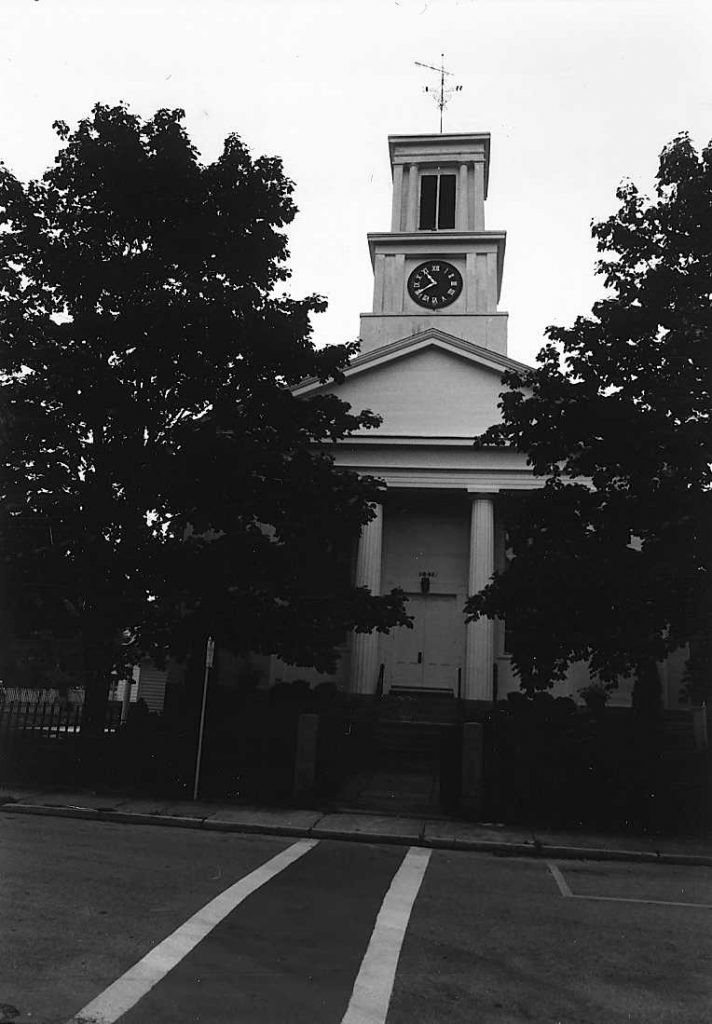
            This installment features 28 Main Street. The Congregational Church at 28 Main Street, built in 1841, is an unusually fine example of a Greek Revival house of worship. Its main entrance opens onto a recessed porch, fronted by monumental Tuscan columns. Architect Seth Eaton of Mattapoisett designed the church and Silas Allen built it. This prominent rectangular building is situated in the heart of picturesque Wharf Village. In the first decade of the 20th century, three stained glass windows designed by Charles Connick were added to the rear wall of the church. When this church was built, it symbolized the maturation of both Marion and the town center.

Mattapoisett Museum Charity Yard Sale

Our 4th annual charity yard sale will take pace on Saturday, May 11from 8:00 am – 11:00 am on Baptist Street. There will be a variety of items for sale: antique tools, ceramics, antique irons, furniture, games, garden furniture, etc. Come buy a treasure and support the Mattapoisett Museum! Questions: 508-758-2844 or info@mattapoisetthistoricalsociety.org. 

Auditions – Death by Design by Rob Urbinati

The Marion Art Center (MAC) has announced open auditions for all roles in the upcoming production of Death by Design by Rob Urbinati, a farcical look at the British Murder Mystery. What happens when you mix the brilliant wit of Noel Coward with the intricate plotting of Agatha Christie? Set during a weekend in an English country manor in 1932, Death by Design is a delightful and mysterious “mash-up” of two of the greatest English writers of all time. Edward Bennett, a playwright, and his wife Sorel Bennett, an actress, flee London and head to Cookham after a disastrous opening night. But various guests arrive unexpectedly – a conservative politician, a fiery socialist, a nearsighted ingenue, a zany modern dancer – each with a long-held secret. When one of the guests is murdered, it’s left to Bridgit, the feisty Irish maid with a macabre interest in homicide, to solve the crime.

            Auditions will be held on Saturday, May 11at 10:00 am, and on Monday, May 13at 7:00 pm, at the Marion Art Center, 80 Pleasant St. (the corner of Main and Pleasant Streets), in Marion. Performances will be Friday, August 23 – Sunday, August 25 and Thursday, August 20 – Sunday, September 1. Thurs, Fri, Sat performances will begin at 7:30 pm, while Sunday matinees will begin at 2:00 pm. Auditions will consist of a cold reading from the script. Both accomplished and aspiring actors are encouraged to audition. Participants can expect 2-3 rehearsals a week during June, July, and August. Rehearsal scheduling will be flexible and take actors’ needs into consideration. 

            Director Kate Fishman will be casting four females and four males. Actors’ ages should appear the ages represented in the following characters: Bridgit- the maid, Irish accent, fifties; Jack- the chauffer, Cockney accent, twenties; Edward Bennett-the playwright, forties; Sorel Bennett-the actress, forties; Walter Pearce-politician, forties/fifties; Eric-the radical, twenties; Victoria Van Roth-the Bohemian, any age; Alice- the shy visitor, twenties 

            For more information, call the MAC at 508-748-1266 or email MACtheater1957@gmail.com. Find more information by visiting marionartcenter.org.

Upcoming Events at the Elizabeth Taber Library

Tuesday, May 7at 6:30 pm. Author Donna Lee Tufts’ “Lola, My Girl”

Author Donna Lee Tufts (My Kayak) returns to the Elizabeth Taber Library with the heartwarming true story of Lola; a rescue dog from St. Thomas and her journey to Marion.

            Wednesday, May 15at 5:00 pm. Jill Sandford from Art for Your Mind presents “The Abstract Expressionists – What Were They Thinking?” Join Sandford for an engaging educational art experience for artists and non-artists alike. Explore the giant canvases, splattered paint, and brilliant colors of the abstract art movement. Sign up at The Elizabeth Taber Library.

            Saturday, May 18, 11:00 am – 1:00 pm. A Visit from the New Bedford Art Museum’s Art Mobile. The Art Mobile is coming to Elizabeth Taber Library. Come for a visit with the van stuffed with art supplies and educators for a morning filled with engaging art activities.

            Sunday, May 19, 2:00 pm at the Mattapoisett Free Public Library. Author Visit and Book Signing with B.A. Shapiro. Join author B.A. Shapiro for a conversation on the art, history, and mystery of The Muralist. Come and hear about her writing and research process, and the inspiration for her novels. Please register for this free program. 

            Thursday, May 22at 6:00 pm. Laughter Yoga with Doug Savage – Breathe, stretch, and laugh with Yoga Leader Doug Savage. Laughter Yoga is easy to learn and lots of fun for anyone. 

            For more information please call the Elizabeth Taber Library at 508-748-1252 or email esherry@sailsinc.org.

Herring Decline Mystery Spawns New Studies

            Throughout the coastal waters of New England, the annual migration of river herring has been a seasonal “must see” event. Watching thousands of small fish swim upstream to natal waters, traveling from saltwater oceans to freshwater streams and ponds, is one of nature’s miracles. Yet these marine animals, like most living things on the plant, have been negatively impacted by human activity. But is that the whole story?

            On April 29, Alewives Anonymous, Inc. held its annual meeting. The group was founded in 1984 to promote and educate the Tri-town communities of Marion, Rochester, and Mattapoisett about all things alewives, more commonly called herring. After enjoying a homemade supper of chowder, stuffed quahogs, and apple cobbler, President Arthur Benner gave his report.

            His report listed herring migration survey counts since 1988, the first year an electronic counter was employed. Over the past 31 years, herring counts have declined to a discouraging low, despite intermittent glimmers of hope. For instance, in 1989, 39,938 fish were counted at the confluence of the Mattapoisett River at Snipatuit Pond, with spikes as high as 130,296 between 1998 and 2000. The 2018 count, however, was a meager 5,241.

            With moratoria in place for the past several years, the group is seeking to better understand natural and manmade stress factors in the hope that, with good data and marine science, these tiny fish can be saved.

            Guest speaker Christopher Rillahan, a doctoral student from the University of Massachusetts at Dartmouth, has been studying herring migration since 2017 in both the Tri-town area and Cape Cod. Rillahan’s observations and studies were aided by the use of sonar imaging equipment that granted visual clarity to what was going on with herring populations during the migration. But, moreover, Rillahan pinpointed when the fish were most actively moving through the river systems.

            Historically, Rillahan said, herring counts were conducted during a 12-hour daylight sampling when it was believed the fish were most active. What the sonar uncovered was herring activity during sunrise and sunset.

            Displayed on the screen, the audience witnessed the herring swimming in large balls through counting areas in the morning and evening, images that heretofore could not have been seen. Over several migration seasons in both Mattapoisett and on Cape Cod, Rillahan confirmed the herring movement in those two times of the day. But he also found other surprising information. Could something else be impacting herring stocks besides the possibility of counts being off a bit? It had long been established that commercial fishing had been a prime suspect. Maybe there were others.

            What Rillahan found was the presence of predator fish, primarily striped bass and bluefish, patrolling the herring well upriver from the ocean. And then there are the cormorants. The sonar images clearly found the fast-moving birds darting at the herrings’ movement. And last but not least, there was also one massive snapping turtle.

            Rillahan said the southeast is a major area for herring study, and counts take place primarily in April. It is now understood that volunteers counting fish may be missing a large percentage of the migrating fish due to nighttime activity.

            Another area not well understood, Rillahan explained, is what becomes of a herring after it has spawned. He said earlier studies noted herring would spawn at four years of age or older. Today, most spawning fish are only two years of age, causing scientists to scratch their heads. Why has it changed, and where are the mature fish? Are there mature fish?

            “The life of the river herring is far more complex then previously believed,” Rillahan stated. He said his studies of data continue, and he hopes to provide further critical information in the coming months.

            To learn more about river herring, you may visit www.riverherringnetwork.com, www.greateratlantic.fisheries.noaa.gov, or www.plumblibrary.com/services/alewives-ananymous.org.

By Marilou Newell

Forum Informs Voters on Town Meeting, Election

            Courtesy of the League of Women Voters, Mattapoisett residents enjoyed the chance to meet some of their 2019 Annual Election candidates on April 27 – all running uncontested now, after Seth Hiller dropped out of the Board of Selectmen race earlier this month, essentially handing the election to incumbent Jordan Collyer for a sixth term in office. But don’t let that deter you from showing up to the polls on May 13 to cast your ballot! Pending all passes at Town Meeting, there will be two ballot questions: one to fund the Old Rochester Regional athletic field and auditorium upgrades, and one to fund a new fire station.

            During the event held Saturday at the library, town officials made one of their few remaining fire station pitches to voters ahead of the May 13 Annual Town Meeting, hoping the townspeople will approve the $9,275,000 project.

            “From a financial standpoint, this an excellent time for the community to look at advancing this project,” said Town Administrator Michael Gagne, who will attend the final town meeting of his career this month before his retirement this year. Within the next five years, 79.3 percent of current debt exclusion capital projects will have been paid off, dropping from $14.3 million to $2.75 million, he said. “I think you need to do this right now – the market is right to borrow.”

            Last year, Town Meeting voted to appropriate $250,000 towards the engineering and design of the new fire station to replace the outdated and safety non-compliant fire station that was built in the 1950s, and the Town formed a committee to explore options.

            According to Gagne, the owner of the average $444,000 home in Mattapoisett would experience a $13.38 annual tax increase to fund the project.

            “As you can see, it’s extremely reasonable,” Gagne said – with a minimal financial impact.

            “We spent a lot of time drilling down on the project,” said Gagne. “[The design engineers] trimmed about $1.1 million out of what they had estimated.”

            Fire Chief Andrew Murray said having a new fire station would attract new and highly-qualified candidates to the department, although he said that for now he is not looking to increase full-time day staff beyond the current two full-time firefighters. In addition to a contamination area and separate bathrooms for the three female employees is a fitness center, Murray said, “to motivate [staff] to stay healthy and stay fit.”

            “People say, ‘Wow, this is really big’,” said Collyer, an advocate for the project. When the Town first looked at a new station in the mid ‘80s, he said, the building was already insufficient in some ways. The last attempt to upgrade the station was in 2009, Collyer said, “It was certainly grossly deficient, and here we are in 2019 … [and] we’re actually building to catch up for the last 35 years and we’re trying to build ahead as well – We’re actually building a building for 65 years now.”

            The project’s scope has expanding more than the Town thought, Collyer added, but this latest look at a new station has “opened our eyes.” The cost to build was half the cost it is today, and not expected to decrease, ever.

            “I’m a strong advocate for the project for many reasons … the least of which is this has been going on for far too long.

            “We think we’re in a sweet spot at this point,” Collyer continued, “but we also don’t want to be overly ostentatious in our request [as if] we’re asking for too much, but allow ourselves the flexibility. … We feel comfortable, as a committee, that we’ll be able to grow into this space over time without having too much quote-unquote dead space.”

            “The price really is very good,” Gagne said.

            Gagne also gave a Town Meeting briefing, touching on some of the important town issues that will appear on the warrant rather than by reading each article line for line.

            Within the budget, Gagne pointed to employee health insurance as one of the leading financial burdens, with costs rising 8 percent this fiscal year, accounting for $2.3 million out of $25 million budget.

            Also driving the budget, Gagne pointed to an increase in tuition for Old Colony Regional Vocational technical High School, although the Town had prepared for such an increase for years via a regional school stabilization fund.

            “We have the money in that … fund so we don’t take a significant spike in the budget,” Gagne said.

            Solid waste collection and disposal is up some, but because the town is only in its sixth year of a ten-year contract, the town is protected form any major increases until then.

            The debt stabilization fund will allow the town to explore some new growth opportunities, he said, and voters will be asked to continue to transfer another $125,000 this year into the fund.

            Other post employment benefits (OPEB) liabilities continue to climb, but the town has been proactive, having set aside $450,000 every year for nine years, Gagne said.

            “That was an extremely prudent move because that situation has not been any better ,” with increasing insurance costs and more retirees,” said Gagne. “You have a situation where the liability has actually increased.” Three years ago Mattapoisett’s liability was $7 million, and now it’s up to $9.5 million.

            There will be two zoning articles on the warrant, Gagne pointed out – one to increase lot coverage within the industrial zone to stimulate growth, and one to allow medical marijuana marijuana cultivation facilities currently allowed in the industrial zone to provide cannabis for off-site adult-use marijuana companies.

            Gagne said some voters might misunderstand the intent of the bylaw, which is solely to allow cultivation of some adult-use marijuana, not the sale of adult-use marijuana in Mattapoisett.

            “That’s not the case,” Gagne emphasized. “It’s strictly for growing purposes. There will not be retail sales there.

            “We’ve looked at some preliminary host agreements based upon certain percentages,” Gagne continued, pointing out why Mattapoisett might want to consider this new bylaw. “You could be looking at annual revenue … anywhere north of $200,000 a year…. Substantial revenues that could be used for other capital projects further down.”

            The Annual Town Meeting is scheduled for Monday, May 13, at 6:30 pm in the Old Rochester Regional School auditorium.

            The Annual Town Election is on Tuesday, May 21, with polls open 8:00 am -8:00 pm at Old Hammondtown School.

By Jean Perry

Tabor Boy Enters Marion Bermuda Race

SSV Tabor Boy, the 92’ sail training schooner owned by Tabor Academy in Marion, will be making history on June 14 when she will be crossing the starting line on her way to Bermuda as one of the classic yacht entries in the 2019 Marion Bermuda Race! https://marionbermuda.com/

            The Race Committee expects around 100 boats on the line for the race. Just two vessels will be in the Classic Yacht Division, with SSV Tabor Boy providing some competition for the Spirit of Bermuda, which has sailed uncontested in the past. Tabor Boy will join 18 current entries to take advantage of the incentives for navigating by the stars. Marketing Chair of the Marion Bermuda Race, Ray Cullum of Marion, shared that this is twice the number of entries for celestial navigators as in the last race in 2017.

            Another exciting opportunity for Tabor Boy is the chance to compete for the Offshore Youth Challenge Trophy given to encourage youth participation. The crew must be comprised of at least four people aged 16-23, representing 66% of the crew. Tabor Boy is planning to meet this criteria, with many of the crew experiencing the thrill of offshore sailing for the first time. 

            Marion Bermuda is the only offshore race that offers a celestial navigation class, which is perfect for Tabor Boy and her student and alumni crew who will be navigating the vessel. Twelve students will be joined by seven alumni crew members, three licensed mates, and Capt. James Geil at the helm. Geil reports that nine out of ten celestial navigators on his crew are under age 24, providing a real test of the knowledge of his students and alumni from the classes of 2017 through 2020 who took the celestial navigation class he teaches at Tabor. 

            “We are looking forward to a memorable trip in June to Bermuda. The student crew is ready to go and put their navigation skills to the test in a real-life situation.” said Geil. “We look forward to greeting many of our Tabor friends on the island on arrival.”

            Tabor Boy will host an Open Ship for Tabor alumni, parents, and friends in the area, and any prospective students and their families are invited. The reception will be held in Hamilton on June 23 starting at 5:30 pm.